


Imagine, for a moment, the golden courts of the Old Kingdom in ancient Egypt. A Pharaoh sits at the apex, supported by a vast network of viziers, scribes, and overseers, all the way down to the laborers tilling the silt of the Nile. Now, fast-forward four millennia to a glass-walled boardroom in Silicon Valley. The titles have changed—CEO, VP, Senior Manager, Junior Associate—ưng the silhouette of the organization remains hauntingly similar. Despite our modern obsession with “flat” organizations and egalitarian ideals, every civilization, every corporation, and even every group of friends eventually settles into a ladder of power.
We often view these structures as inherently oppressive, a relic of a more primitive past that we ought to outgrow. We dream of a world where no one stands above another, where every voice carries equal weight in every decision. Yet, history and science suggest a more complex reality. Why is it that every time humans gather in groups larger than a few dozen, a hierarchy inevitably emerges? Is it a flaw in our character, or is it a fundamental requirement for our survival? To understand why the “ladder” is a universal human phenomenon, we must look beyond politics and into the very fabric of our biology, our history, and our collective psychology.
1. The Biological Blueprint: Evolutionary Roots of Dominance
The tendency to organize into ranks is not a human invention; it is a biological inheritance that predates our species by hundreds of millions of years. Long before the first city-state was founded, the ancestors of modern vertebrates were already navigating social landscapes defined by status. One of the most famous examples in evolutionary biology is the lobster. These creatures have existed for roughly 350 million years, and they operate within strict dominance hierarchies. When two lobsters compete for a prime nesting spot, they engage in a ritualized dance of aggression. The winner gains more than just a home; their brain chemistry actually changes.

In the animal kingdom, neurochemistry acts as a internal barometer for social standing. Serotonin, a neurotransmitter often associated with well-being in humans, plays a critical role here. In a high-ranking lobster, serotonin levels are high, leading to a confident, “upright” posture and a greater willingness to defend territory. In the loser, serotonin levels plummet, and the creature physically shrinks, avoiding further conflict. This isn’t just about “ego”—it’s an evolutionary strategy. If every interaction between two individuals resulted in a fight to the death, the species would quickly go extinct. By establishing a clear rank, animals can decide who gets the best food or the best mate without having to risk their lives in a physical brawl every single day.
We see this same pattern in our closest relatives, the primates. Chimpanzee troops are governed by complex social tiers where the “Alpha” male and female enjoy priority access to resources. However, being at the top isn’t just about being the strongest; it’s about maintaining a coalition. This biological blueprint is hardwired into the human brain. We are constantly, often subconsciously, scanning our social environments to determine where we fit. When we perceive ourselves as rising in status, our neurochemistry rewards us; when we feel we are falling, we experience stress and anxiety. This “status-tracking” mechanism is a survival tool that helped our ancestors navigate the dangers of group living by reducing constant, lethal internal conflict.
2. Efficiency and Coordination: The Logic of Organizational Hierarchy
Beyond biology, there is a cold, mathematical logic to why hierarchies persist: they are incredibly efficient at solving the problem of “too many cooks.” In any group of people trying to achieve a complex goal—whether it’s building a cathedral, launching a startup, or navigating a ship through a storm—the “transaction costs” of decision-making can become paralyzing. If every single person has to agree on every single detail, the group will likely collapse under the weight of its own deliberation before the first stone is laid.

Hierarchy functions as a mechanism to reduce this cognitive load. By delegating authority, a group can streamline its decision-making processes. Instead of 1,000 people debating the best route for a new road, the group appoints a specialist or a leader whose job is to synthesize information and make a final call. This delegation allows the rest of the group to focus on their specific tasks, trusting that the “big picture” is being handled. In economic terms, this is a way of managing limited attention and time. The “chain of command” isn’t just about giving orders; it’s about creating a clear path for information to flow upward and for directives to flow downward.
This becomes most apparent during a crisis. In a burning building, the fire department does not hold a democratic vote on which door to kick down. They follow the captain. The necessity of leadership for collective action is a structural requirement of large-scale projects. Without a hierarchy to coordinate the efforts of thousands of specialized workers, the massive infrastructure of modern civilization—the power grids, the global supply chains, the internet—would be impossible to maintain. Hierarchy provides the “operating system” that allows diverse individuals to function as a single, coherent unit.
3. From Tribes to Empires: The Historical Shift in Social Stratification
For the vast majority of human history, we lived in small hunter-gatherer bands. These groups were remarkably egalitarian. Because they were nomadic and lived hand-to-mouth, there was little opportunity to accumulate wealth or permanent power. If a leader became too bossy, the group could simply walk away or depose them. Status existed, but it was fluid and based on immediate merit—the best hunter or the wisest elder held sway, but they didn’t “own” the others.
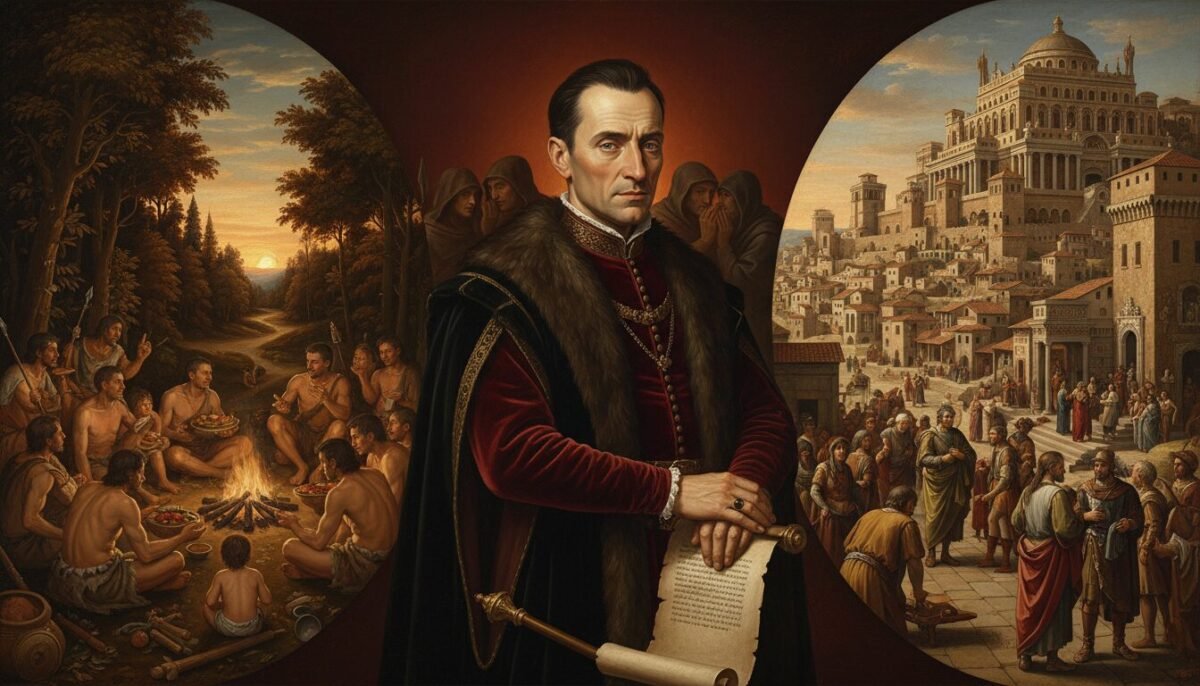
Everything changed with the Agricultural Revolution roughly 10,000 years ago. When humans began to settle and farm, they created something the world had never seen: a food surplus. For the first time, a society could produce more than it needed to survive the day. This surplus required storage, and storage required protection. This led to a massive shift in social stratification. Suddenly, you didn’t need everyone to be a food producer. You could have a class of people who specialized in administration (the priests and scribes) and a class who specialized in defense (the warriors).
As these settlements grew into cities and then empires, the hierarchy became “cemented” through property rights and inheritance. In a hunter-gatherer tribe, you couldn’t pass a “territory” down to your son because the tribe moved. In an agricultural society, the land stayed put. This allowed for the birth of permanent social ranks. The person who controlled the grain stores eventually became the king; the people who defended them became the nobility. Over centuries, these roles became institutionalized. The shift from tribes to empires was essentially the shift from “merit-based influence” to “structural authority,” creating the rigid social ladders that defined civilizations from Mesopotamia to the Qing Dynasty.
4. Resource Allocation and the Economics of Status
At its core, a hierarchy is a system for distributing scarce resources. In a world where there isn’t enough of everything for everyone, society needs a predictable way to decide who gets what. Without a system in place, resource allocation would be a chaotic, violent free-for-all. Hierarchies provide a “sorting algorithm” that, while often unfair, creates a level of social predictability.
Historically, social rank was directly tied to survival. Higher-ranking individuals had better access to nutrition, safer living quarters, and more reproductive opportunities. While this sounds harsh, it provided a framework that allowed the group to survive as a whole. In times of famine, the hierarchy ensured that at least the “essential” members of the social structure (the leaders and defenders) survived to maintain order, rather than the entire society collapsing into total anarchy where no one survived.
In modern economic systems, we have tried to refine this by tying hierarchy to specialized skills and risk-taking. We reward the neurosurgeon with higher status and more resources than a general laborer because the “cost” of producing a neurosurgeon is higher and their skill is rarer. Similarly, we reward the entrepreneur who risks their capital to build a company. While the gap between the top and bottom in modern capitalism is a subject of intense debate, the underlying principle remains: hierarchy is used as an incentive structure to encourage individuals to perform roles that are difficult, dangerous, or highly valuable to the collective.
5. The Psychology of Rank: Human Nature and the Drive for Status
We cannot ignore the fact that humans are psychologically driven to seek status. This isn’t just about greed; it’s about the innate human need for social recognition and prestige. Psychologists have long noted that “relative status”—how we compare to our peers—often matters more to our happiness than our absolute level of wealth. A person earning $100,000 in a neighborhood where everyone else earns $50,000 often feels more successful and satisfied than someone earning $200,000 in a neighborhood where everyone else earns $500,000.
This drive for status is a powerful engine for innovation. The desire to be “at the top,” to be respected, and to leave a legacy pushes individuals to create, discover, and build. Whether it’s a scientist striving for a Nobel Prize or an artist seeking critical acclaim, the pursuit of prestige often results in breakthroughs that benefit all of society. We are “prestige-seeking” animals, and hierarchies provide the arenas in which that seeking takes place.
Even in our digital age, where we claimed the internet would “level the playing field,” new hierarchies have immediately emerged. We see this in the “pecking order” of social media: follower counts, blue checkmarks, and engagement metrics are simply modern versions of the feathers and beads used by ancestral tribes to signal status. We are constantly sorting ourselves into tiers, proving that even when you remove the physical barriers to equality, the human mind will invent new ladders to climb.
6. Stability vs. Inequality: The Double-Edged Sword of Social Order
The primary defense of hierarchy throughout history has been that it provides social stability. The 17th-century philosopher Thomas Hobbes famously argued that without a strong central authority—a “Leviathan”—human life would be “solitary, poor, nasty, brutish, and short.” In his view, hierarchy is the only thing preventing the “war of all against all.” By providing a clear structure of who is in charge, societies avoid the constant, low-level violence of competing factions.
However, hierarchy is a double-edged sword. When a hierarchy becomes too rigid, it stops being a tool for efficiency and starts becoming a tool for extraction. This happens when those at the top use their power not to coordinate or lead, but to insulate themselves from competition and exploit those below them. When social mobility vanishes—when the “ladder” is pulled up—the system becomes brittle. History is littered with the ruins of empires that fell because their hierarchies became too extractive and failed to adapt to changing realities.
The great challenge for any modern civilization is to find the balance. We need the efficiency and stability that hierarchy provides, but we also need the fairness of meritocracy. A healthy society is one where the hierarchy is “fluid”—where those with talent and drive can rise, and those who are no longer providing value to the collective can fall. The goal isn’t to abolish the ladder, but to ensure that the rungs are sturdy and that anyone, regardless of where they start, has a fair chance to climb.
Ultimately, hierarchies are not merely cultural inventions or tools of oppression; they are deeply rooted in our biological heritage and the practical requirements of managing complex groups. They are the scaffolding upon which civilization is built. As we move forward, our task is not to dream of a world without ranks, but to design structures that are transparent, accountable, and just—hierarchies that serve the people within them rather than the other way around.
Frequently Asked Questions
Is it possible to have a completely flat society?
While small groups can operate with high levels of equality, history shows that as groups grow in size and complexity, they naturally develop hierarchical structures to manage decision-making and resource allocation. “Flat” organizations often have “shadow hierarchies” where influence is wielded informally.
Does hierarchy always lead to inequality?
Hierarchy inherently involves an unequal distribution of authority or status, but it does not necessarily have to lead to extreme or unfair economic inequality. Many modern societies use taxes and social safety nets to temper the “winner-take-all” aspects of natural hierarchies.
Why do we feel bad when we are low in a hierarchy?
This is a biological response. Lower social status is linked to higher levels of cortisol (the stress hormone) and lower levels of serotonin. Evolutionarily, being at the bottom meant less access to resources and higher risk, so our brains signal “danger” when we perceive our status is dropping.
If you found this exploration of human structures fascinating, you might also enjoy our deep dives into the mechanics of influence and the philosophy of power:
- Explore how Machiavelli & Political Philosophy shaped the modern understanding of leadership.
- Understand the dark side of ambition in our analysis of Machiavellianism.
- Discover the fundamental tension between Power & Human Nature.
Want to understand the hidden forces that shape our world? Subscribe to the DeepPsyche newsletter for weekly insights into psychology, philosophy, and the strategic thinking that defines our civilization.