
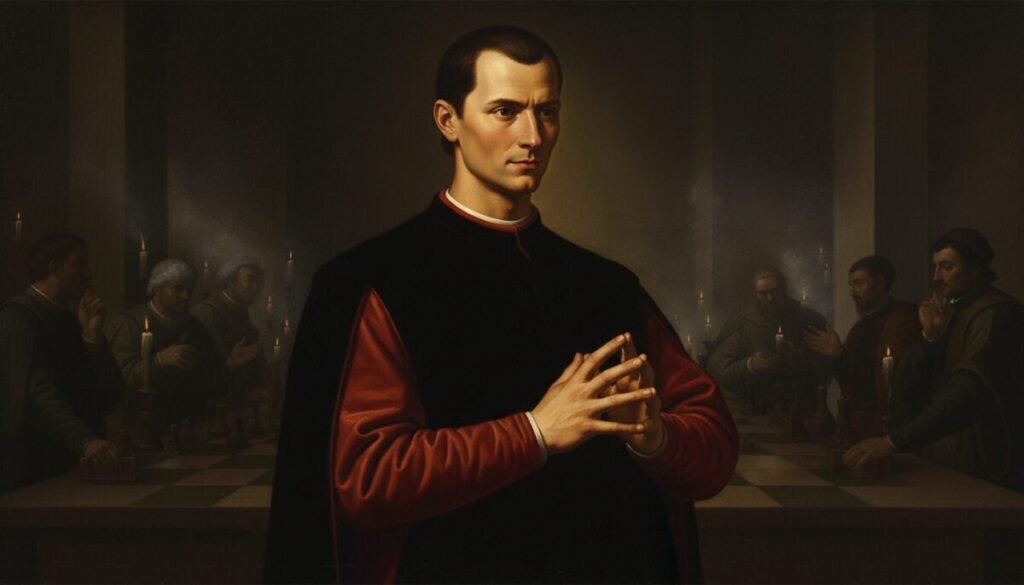
Was Niccolò Machiavelli the ultimate betrayer of Renaissance ideals, or was he the movement’s most honest intellectual successor? For centuries, the name “Machiavelli” has been synonymous with backstabbing, deceit, and a “the ends justify the means” mentality. Yet, if you were to step back into the dusty libraries of 16th-century Florence, you would find a man deeply steeped in the same “humanist” education that produced the great artists and poets we admire today. The tension is palpable: how does a culture obsessed with the “dignity of man” and the beauty of classical ethics produce a handbook for tyrants like The Prince?
Many students and history buffs struggle to reconcile the moralistic, light-filled teachings of Renaissance humanism with the cold, pragmatic strategies Machiavelli proposed. We like our heroes to be noble and our villains to be obvious. But Machiavelli refuses to fit into these neat boxes. To understand him, we have to stop looking at him as a departure from the Renaissance and start seeing him as its logical conclusion. He took the humanist tools of logic, historical analysis, and a focus on human agency, and applied them to the one place his predecessors were afraid to look: the raw, unvarnished reality of how power actually works.
1. The Foundations of Renaissance Humanism and Machiavelli’s Roots
To understand Machiavelli, you first have to understand the intellectual air he breathed. Renaissance Humanism wasn’t just about painting pretty pictures; it was a revolutionary educational program. The core principle was Ad Fontes—a Latin phrase meaning “to the sources.” After a thousand years of medieval scholars looking at the world through a strictly religious lens, humanists wanted to go back to the original Greek and Roman texts. They wanted to hear what Cicero, Virgil, and Plato had to say about life, politics, and ethics without the filter of the Church.
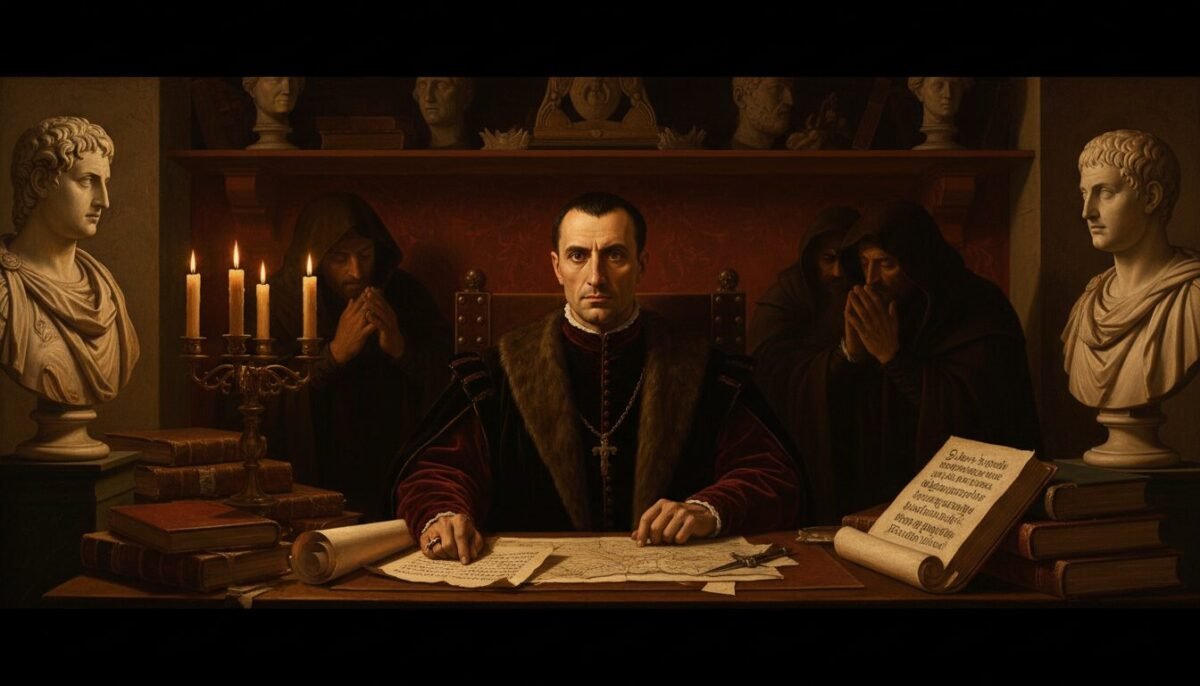
Machiavelli was a quintessential product of this environment. Born into a modest but well-connected Florentine family, his education was rigorous. He didn’t just read the classics; he lived them. By his early twenties, he was navigating the complex bureaucracy of the Florentine Republic, serving as a diplomat and a military strategist. He read Latin fluently and was deeply influenced by the Roman historians. For Machiavelli, the ancient world wasn’t a dead relic; it was a vibrant laboratory of human behavior.
The humanist movement also championed the “dignity of man.” Thinkers like Pico della Mirandola argued that humans were unique because, unlike animals or angels, we have the agency to choose our own nature. We can sink to the level of beasts or rise to the level of the divine. This focus on individual agency was a crucial precursor to Machiavelli’s thought. If man has the power to shape his own destiny, then the political leader has the power—and perhaps the obligation—to shape the destiny of the state through sheer will and intelligence, rather than waiting for divine intervention.
2. From Civic Humanism to Political Realism: The Great Transition
Before Machiavelli, there was a popular genre of literature known as “Mirrors for Princes.” These were essentially “how-to” guides for rulers, written by humanist scholars. The advice was always the same: to be a great leader, you must be a good man. They argued that a prince should be honest, merciful, and religious. The theory was that if a leader possessed all the Christian and classical virtues, God would bless the state with peace and prosperity. It was a beautiful, moralistic vision of politics.
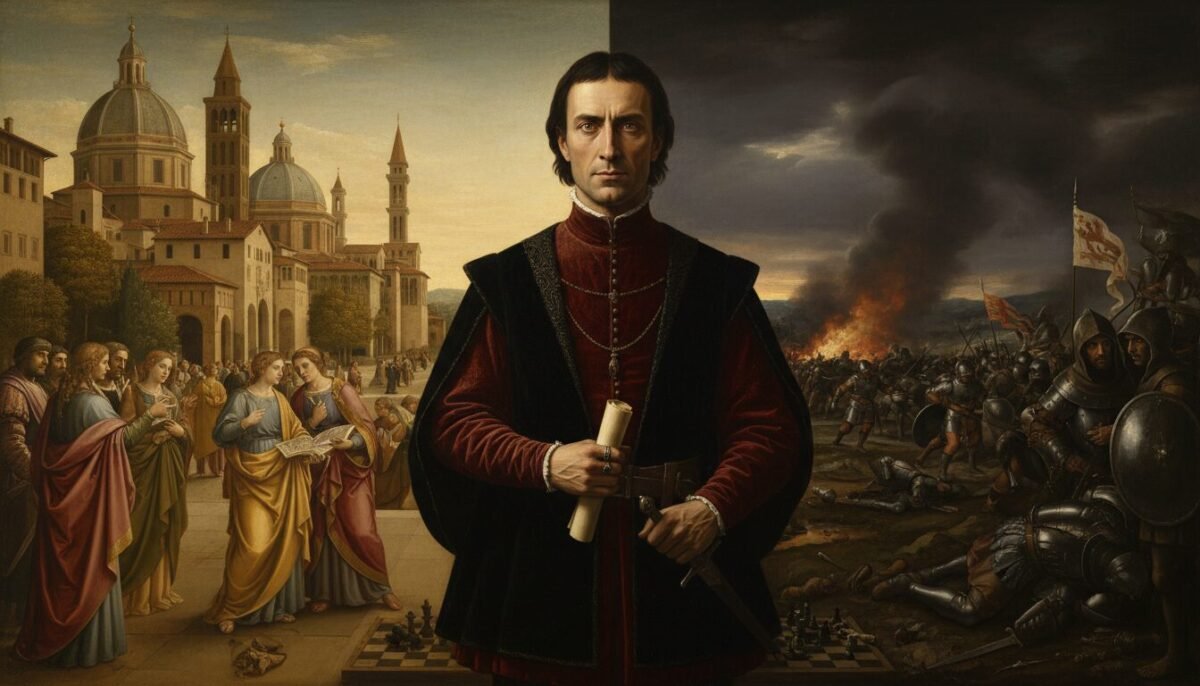
Machiavelli looked at these books and, essentially, threw them out the window. He famously wrote that he preferred to follow the “effectual truth” (verità effettuale) of the matter rather than the “imagination of it.” He pointed out a glaring problem: many people have imagined republics and principalities that have never been seen or known to exist in reality. To Machiavelli, writing about how a leader *ought* to behave in an ideal world was not only useless but dangerous.
Why the shift? Look at the map of Italy in the late 1400s. It was a chaotic mess of warring city-states—Florence, Milan, Venice, the Papal States—all being trampled by the “barbarian” superpowers of France and Spain. Machiavelli saw firsthand that the “virtuous” leaders were the ones getting conquered, exiled, or executed. The instability of the Italian peninsula necessitated a shift from idealism to pragmatism. He realized that in a world where everyone else is playing dirty, the man who insists on being “good” in every circumstance will inevitably be destroyed. Realism wasn’t a choice for Machiavelli; it was a survival strategy for the state.
3. Redefining Virtù: Humanist Excellence vs. Machiavellian Necessity
One of the most fascinating aspects of Machiavelli’s work is how he took a standard humanist term and completely flipped its meaning. That word is virtù. To a traditional humanist, virtù meant “virtue” in the moral sense—justice, temperance, fortitude, and prudence. It was about being a “good” person according to Christian and Platonic standards.
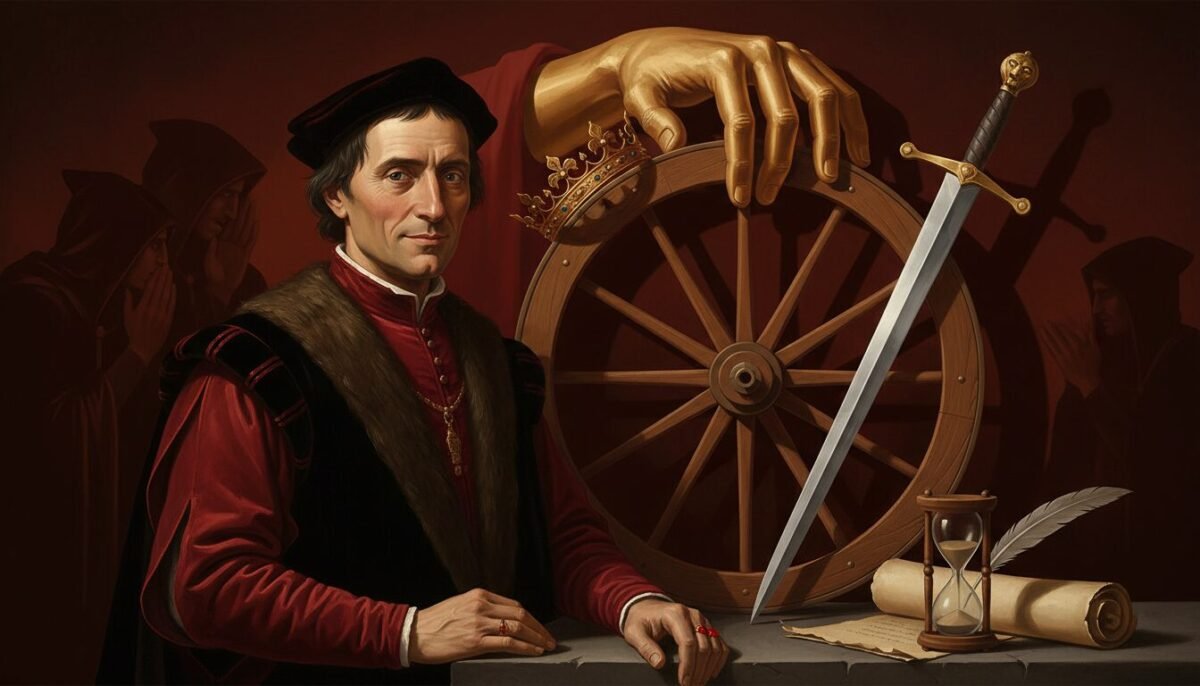
Machiavelli hijacked the word. For him, virtù was not moral goodness; it was political and military “prowess.” It was the ability of a leader to be flexible, bold, and effective. A leader with virtù knows when to be as fierce as a lion and as cunning as a fox. Most controversially, Machiavelli argued that a leader must have the strength to act *against* traditional morality—to lie, to break treaties, or to use cruelty—if it is necessary to maintain the safety and stability of the state. In his eyes, the greatest “sin” a ruler could commit was allowing the state to fall into chaos, because that leads to the suffering of everyone.
This redefinition was tied to his view of Fortuna (Fortune). The humanists often depicted Fortune as a goddess who favored the brave. Machiavelli took this further, famously (and controversially) comparing Fortune to a violent river. When she is angry, she destroys everything in her path. However, a leader with virtù builds dikes and dams during the calm times so that when the floods come, the damage is contained. You cannot control Fortune, but through sheer skill and preparation, you can master it. This is the ultimate humanist dream—man controlling his environment—stripped of its Sunday-school morality.
4. The Role of Classical Antiquity in the Discourses on Livy
While The Prince is his most famous work, many scholars argue that his Discourses on Livy is his most important. Here, we see the “Ad Fontes” principle in full effect. Machiavelli spent years obsessively studying the first ten books of Titus Livius’s history of Rome. He wasn’t reading it for entertainment; he was looking for universal laws of political behavior. He believed that because human nature never changes, the lessons of ancient Rome were perfectly applicable to 16th-century Florence.
Machiavelli’s analysis of Rome led him to a surprising conclusion for a man often associated with tyranny: he deeply admired the Roman Republic. He saw the Roman model of “civic humanism”—where citizens were actively involved in the defense and governance of their city—as the gold standard. He argued that the friction between the common people (the Plebeians) and the nobility (the Senate) actually made Rome stronger and more free, because it forced the creation of laws that protected liberty.
He used this historical lens to critique his own time. Why were the Italian states so weak? Because they had abandoned the Roman model. They relied on expensive, disloyal mercenary armies instead of citizen militias. They were divided and indecisive. By using historical analysis as a rigorous tool, Machiavelli moved politics away from “divine right” and toward a social science based on observable patterns and historical data.
5. Human Nature: A Departure from Humanist Optimism
If there is one point where Machiavelli truly breaks ranks with the mainstream Renaissance thinkers, it is on the subject of human nature. The typical humanist view was optimistic—man was a noble creature, capable of infinite improvement. Machiavelli, having spent years in the trenches of diplomacy and war, had a much darker perspective.
In one of the most famous passages of The Prince, he writes that men are generally “ungrateful, fickle, deceptive, and cowardly.” He observes that people are quick to offer their loyalty when things are going well, but the moment danger approaches, they turn and run. This isn’t just cynical grumbling; it’s the foundation of his political strategy. If people are inherently unreliable, then a leader cannot base his power on the “love” of the people alone.
This leads to his famous question: Is it better to be loved or feared? His answer is a masterpiece of pragmatic psychology. Ideally, a leader should be both. But since that is difficult to achieve, it is much safer to be feared than loved. Why? Because love is a bond of obligation that men, being miserable creatures, break whenever it serves their interest. But fear is maintained by a dread of punishment which “never fails.” Note that Machiavelli is careful to say a leader should avoid being *hated*—hatred leads to rebellion. But fear? Fear is a stable foundation for a functioning society.
6. The Prince and Humanist Ideals: Critic or Continuation?
So, was Machiavelli a “failed humanist” or the first modern political scientist? The answer is likely both. He utilized the “active life” (vita activa) encouraged by humanists to its fullest extent. The humanists believed that the purpose of knowledge was to serve the public good. Machiavelli took this to heart, but he redefined the “public good” as the survival of the state at any cost.
There is a profound tension here. The humanists taught that rhetoric and logic should be used to persuade people toward the “Good.” Machiavelli used those same rhetorical tools to subvert traditional values. He used the language of the classics to argue that sometimes, to be a “good” leader, you must learn how *not* to be good. He didn’t reject the humanist method; he used it to dismantle the humanist dream.
In many ways, Machiavelli is the moment the Renaissance grows up and loses its innocence. He took the intellectual tools of his era and turned them on the era itself. He showed that the “dignity of man” included the capacity for profound cruelty and that “reason” could be used to justify the most cold-blooded actions. He wasn’t necessarily cheering for the tyrant; he was simply reporting from the front lines of reality.
7. The Lasting Impact: Secularism and Modern Political Science
Machiavelli’s legacy is nothing short of a total shift in Western thought. By separating politics from theology and traditional ethics, he effectively founded the secular study of power. Before him, political theory was a branch of moral philosophy or religion. After him, it became a strategic discipline. He paved the way for later thinkers like Thomas Hobbes, who would further explore the dark side of human nature, and John Locke, who would build on the ideas of republicanism and the social contract.
Even the founding fathers of the United States were deeply influenced by Machiavelli’s Discourses. They understood his warnings about the fragility of republics and the necessity of checks and balances to manage the inherent selfishness of human nature. Machiavelli’s “realism” became the bedrock of modern international relations and political strategy. He taught us that to change the world, you first have to see it as it actually is, not as you wish it to be.
Ultimately, Machiavelli was both a product of Renaissance humanism and its most formidable critic. By applying the humanist method of classical study to the harsh realities of power, he founded political realism and changed the course of Western thought forever. He remains a haunting figure because he forces us to confront a question we still haven’t answered: can a leader be both effective and purely “good”?
Frequently Asked Questions
Did Machiavelli actually say “the ends justify the means”?
Surprisingly, no. That exact phrase never appears in his writings. However, he did argue that in the actions of princes, where there is no court to appeal to, one looks at the final result. If a prince succeeds in maintaining the state, his “means” will always be judged honorable by the masses.
Was Machiavelli an atheist?
It’s complicated. He certainly criticized the Church of his day for being corrupt and for making Italians “weak” by focusing too much on humility. However, he often spoke of “God” and “Providence.” Most scholars believe he viewed religion as a vital tool for social cohesion—a “civil religion” that keeps people disciplined.
Why is “Machiavellian” used as an insult today?
After his death, Machiavelli’s works were banned by the Church and he was painted as a teacher of evil by various monarchs and theologians (who often used his tactics while publicly condemning them). The “stage Machiavel” became a popular villain trope in Elizabethan drama, cementing his reputation as a master of deceit.
If you found this deep dive into the mechanics of power and history intriguing, you might enjoy our other explorations into the human psyche and the structures of influence.
- Explore the intersection of Machiavelli & Political Philosophy.
- Understand the dark side of Power & Human Nature.
- Deconstruct the modern traits of Machiavellianism.
- Learn the secrets of Influence & Leadership.
- Dive into a Comparative Philosophy of East and West.
Ready to look deeper into the shadows of the human mind? Browse more articles on DeepPsyche.blog and challenge your perspective on what it means to lead and to be human.