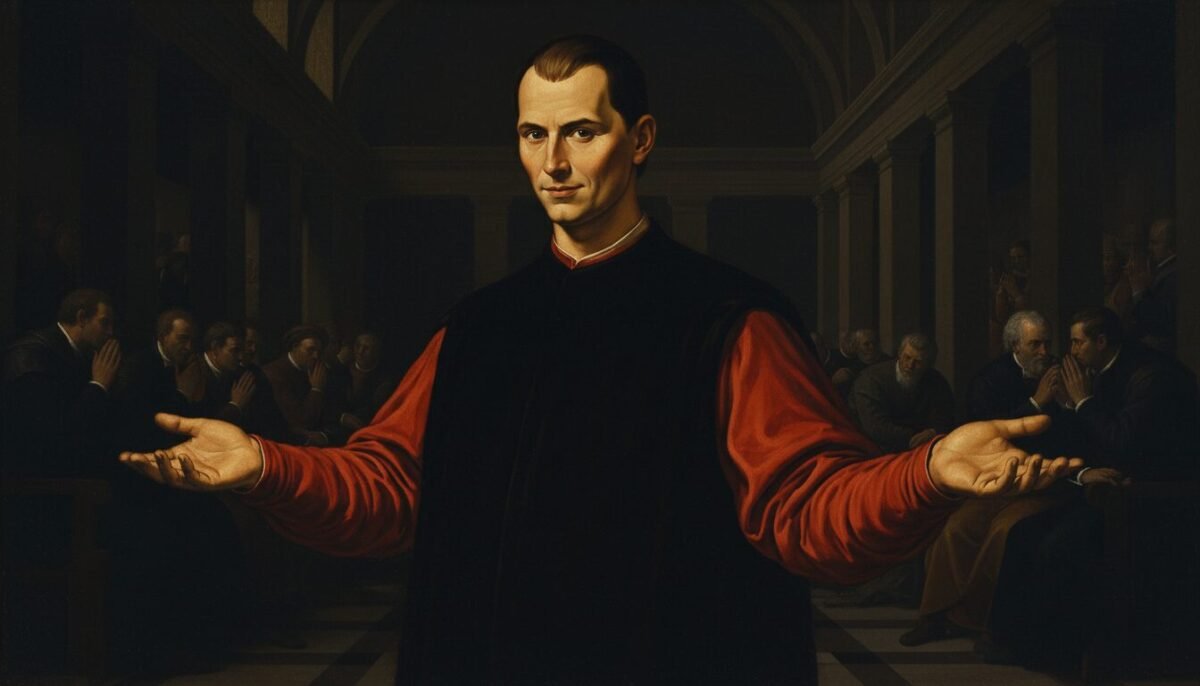
Is it better to be loved than feared, or is the safety of the state worth the sacrifice of one’s soul? This question has echoed through the corridors of power for over five centuries, yet it feels more pressing today, in the complex geopolitical landscape of 2026, than ever before. For generations, Niccolò Machiavelli has been branded a “teacher of evil,” a man whose name became an adjective for deceit, manipulation, and cold-blooded pragmatism. Students and scholars alike have grappled with whether his brand of “realism” is a blueprint for tyranny or a necessary, albeit uncomfortable, guide for survival in a world that does not always play by the rules of Sunday school morality.
To understand Machiavelli is to look into a mirror that reflects the darkest and most pragmatic corners of the human psyche. He did not invent the harsh realities of politics; he simply had the audacity to describe them without the veil of religious or moral idealism. This comprehensive guide deconstructs the complex relationship between ethics and statecraft, providing a deep dive into Machiavellian thought and its startling application in 2026 geopolitics. We are not here to judge him by modern standards of “niceness,” but to understand the mechanics of power as he saw them—raw, unfiltered, and devastatingly effective.
1. The Historical Crucible: 16th-Century Italy and the Need for Stability
To appreciate why Machiavelli wrote The Prince, one must first understand the chaos of his environment. In the early 16th century, Italy was not the unified, serene cultural hub we imagine today. It was a fragmented collection of city-states—Florence, Milan, Venice, the Papal States, and the Kingdom of Naples—constantly at each other’s throats. This internal bickering made the peninsula a playground for foreign superpowers. France, Spain, and the Holy Roman Empire treated Italian soil as a chessboard, invading at will, toppling governments, and leaving destruction in their wake.
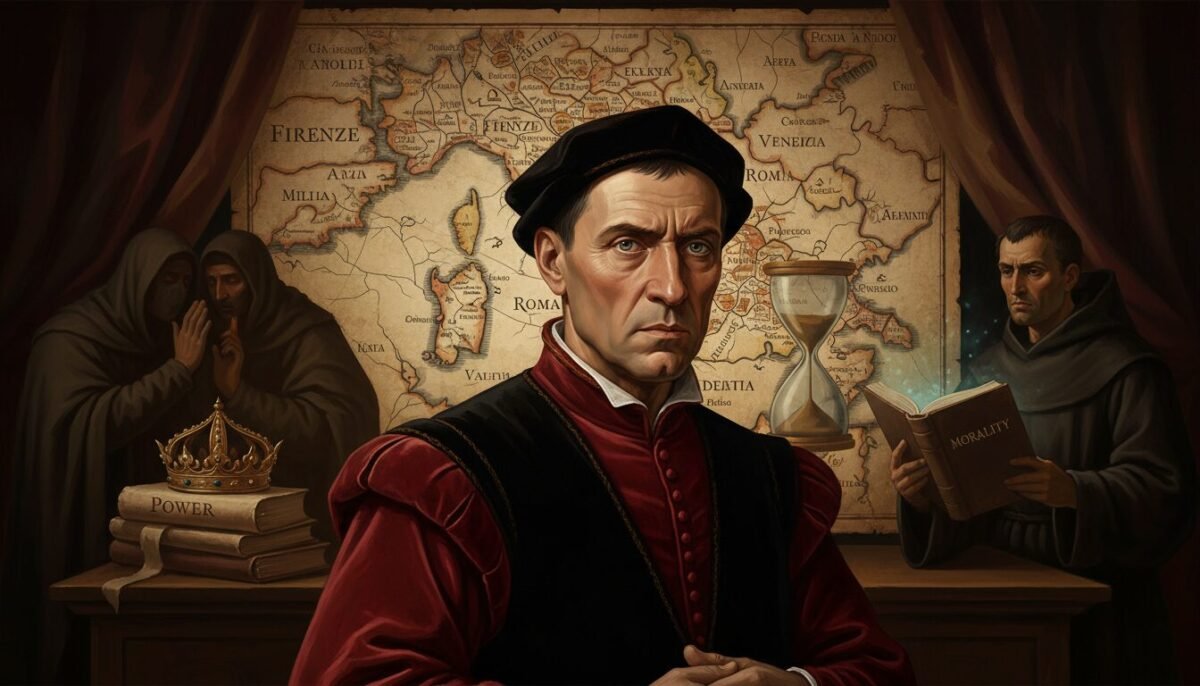
Machiavelli was not an armchair philosopher; he was a man of action. As a high-ranking diplomat and civil servant for the Florentine Republic, he spent years traversing Europe, observing the great leaders of his time. He saw firsthand the brilliance of some and the catastrophic failures of others. When the Medici family returned to power in 1512, the Republic fell, and Machiavelli was ousted, imprisoned, and even tortured. It was during his forced retirement in the countryside that he penned his most famous works, fueled by a desperate desire to see Italy unified and strong enough to repel “the barbarians.”
The shift he represented was seismic: a move from medieval idealism to Renaissance pragmatism. For centuries, political writing followed the “Mirror for Princes” tradition—manuals that told leaders to be pious, kind, and virtuous in the Christian sense. Machiavelli looked at the ruins of his country and realized that “good” men were being slaughtered by “effective” men. He concluded that the ultimate moral imperative for a leader was not the salvation of their own soul, but the stability and security of the state. If the state falls, everyone suffers; therefore, the leader’s primary duty is to keep the state standing, by any means necessary.
In this historical crucible, stability wasn’t just a political preference; it was a matter of life and death. Machiavelli’s realism was born from the blood-soaked streets of Florence and the treacherous courts of Rome. He saw that the traditional virtues of honesty and mercy often led to political ruin, which in turn led to civil war and foreign occupation. To him, the “moral” choice was the one that prevented the greater evil of societal collapse.
2. The Great Divorce: Separating Private Morality from Political Necessity
The core of Machiavelli’s scandal lies in what scholars call “The Great Divorce.” He was the first to argue that the rules of private morality—the ethics we use when dealing with our neighbors, friends, and family—simply do not apply to the sphere of high politics. This is the foundation of Raison d’État, or “Reason of State.” It suggests that the commonwealth has its own set of moral requirements that may directly contradict the Ten Commandments.
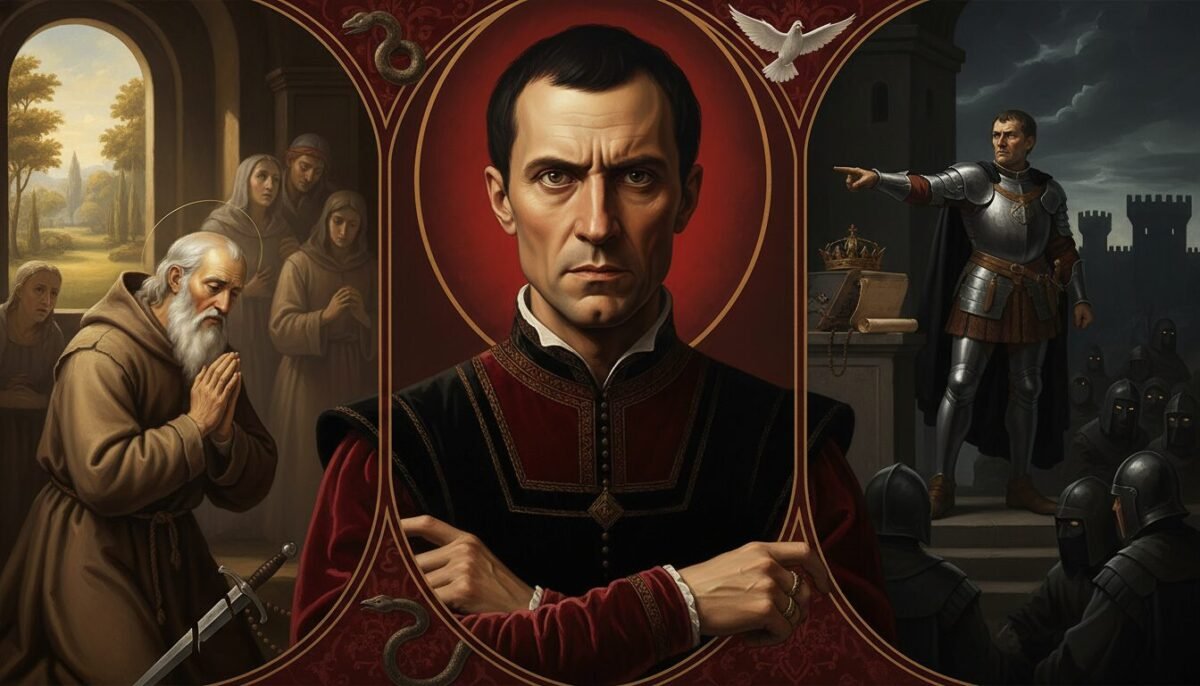
Machiavelli argued that a prince who tries to be “good” in all circumstances will inevitably come to ruin among the many who are not good. A leader is responsible for the lives of thousands, perhaps millions. If a leader’s “honesty” results in a surprise invasion that kills ten thousand citizens, was that leader truly “moral”? Machiavelli would argue no. In his view, the leader who lies to prevent that invasion has fulfilled a higher political duty. He makes a sharp distinction between “doing evil” for the sake of cruelty and “entering into evil” out of necessity.
This brings us to the infamous phrase often attributed to him: “the end justifies the means.” While he never wrote those exact words in Italian, the sentiment permeates his work. However, it is frequently misunderstood. Machiavelli did not give a blank check for any behavior. The “end” he refers to is specifically the preservation and greatness of the state—not the personal enrichment or petty whims of the ruler. If the goal is the common good (stability), then methods that would be considered “sins” in a private context become “virtues” in a political context.
He suggests that a prince must be a “great pretender and dissembler.” He should appear to be religious, merciful, and faithful, but he must be mentally prepared to act in the opposite way when the situation demands it. This isn’t because Machiavelli hated religion or mercy; it’s because he believed that the political arena is a competitive, often violent space where the “pure” are easily exploited. By separating private ethics from public necessity, he created a new category of “political virtue” that prioritized the survival of the collective over the moral purity of the individual leader.
3. Virtù and Fortuna: The Mechanics of Power and Fate
To navigate this treacherous landscape, Machiavelli introduces two central concepts: Virtù and Fortuna. These are not your standard definitions. In the Machiavellian sense, Virtù has nothing to do with “virtue” as we know it today. It is not about being a “good person.” Instead, it refers to a combination of skill, strength, boldness, and the uncanny ability to adapt to changing circumstances. A leader with virtù is like a master sailor who can read the winds and adjust the sails before the storm hits.
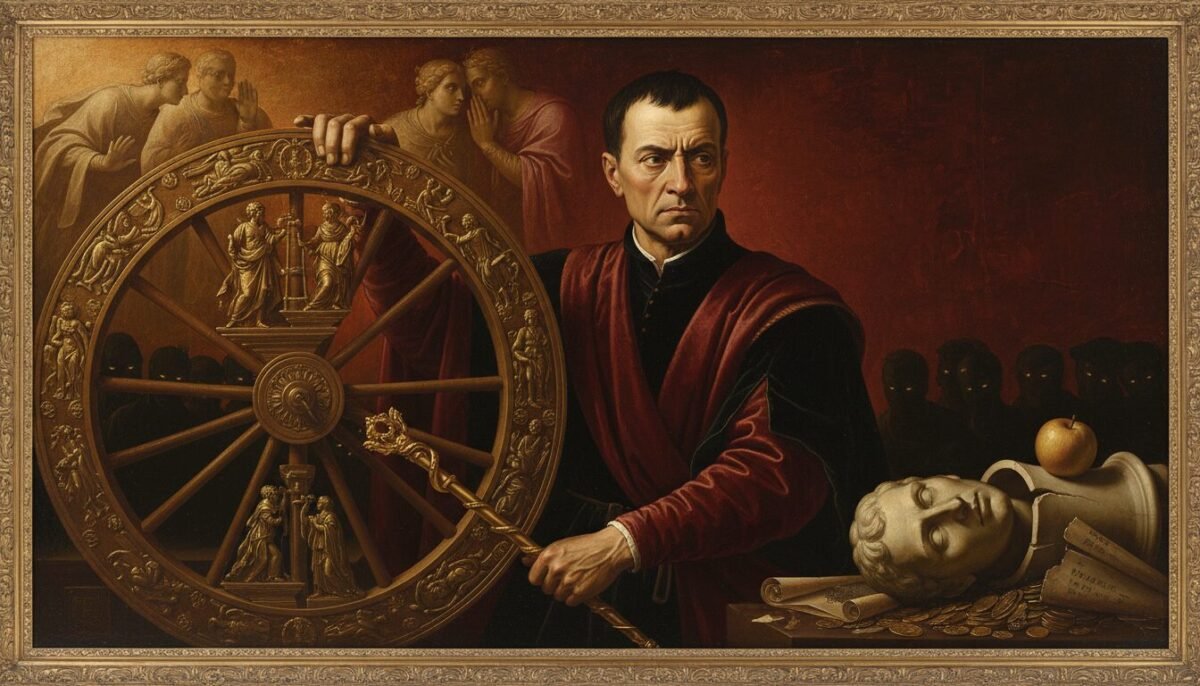
On the other side of the equation is Fortuna—luck, fate, or the unpredictable chaos of the world. Machiavelli famously describes Fortuna as a volatile river. When it floods, it destroys everything in its path, and no one can stop it. However, a leader with virtù builds dikes and dams during the dry season so that when the river rises, its force is channeled or contained. He also uses a more controversial metaphor, describing Fortuna as a woman who must be “beaten and coerced” to be kept under control, reflecting the aggressive, proactive nature he believed a leader must possess.
The success of a leader is determined by the interaction between these two forces. You can have all the virtù in the world, but if Fortuna is overwhelmingly against you, you may still fail. Conversely, a weak leader might succeed temporarily through pure luck, but without virtù, they will lose everything the moment the wind changes. The goal is to maximize your virtù so that you are less dependent on the whims of Fortuna.
Machiavelli points to Cesare Borgia as a prime example of virtù. Borgia was the son of Pope Alexander VI and a man of immense ambition. He used a combination of brutal force and clever diplomacy to carve out a state for himself in central Italy. Machiavelli admired how Borgia dealt with a group of rebellious captains by luring them to a “friendly” meeting and then having them all strangled. To Machiavelli, this was a masterstroke of virtù because it eliminated a threat to the state’s stability with surgical precision. Borgia eventually fell, but Machiavelli blamed this on “extraordinary and extreme malignity of fortune” (the simultaneous death of his father and his own near-fatal illness) rather than a lack of skill.
4. The Psychology of Power: Being Feared vs. Being Loved
Perhaps the most famous passage in The Prince addresses the question: “Is it better to be loved than feared, or the reverse?” Machiavelli’s answer is chillingly pragmatic. He concludes that while it would be ideal to be both, the two rarely go together. Therefore, if one must choose, it is far safer to be feared than loved.
His reasoning is based on a deeply cynical view of human nature. Machiavelli believed that men are generally “ungrateful, fickle, pretenders and dissemblers, evaders of danger, eager for gain.” When things are going well, they are all yours; they offer you their blood, their property, and their children. But when danger approaches, they turn against you. Love, according to Machiavelli, is a bond of obligation that men break whenever it serves their self-interest. Fear, however, is maintained by a “dread of punishment which never fails.”
However, there is a crucial caveat: a prince must be feared, but he must avoid being hated. Hatred is the spark of rebellion. To avoid hatred, a prince must respect the property and the women of his subjects. “Men forget the death of their father more quickly than the loss of their patrimony,” he dryly notes. As long as the leader provides security and doesn’t interfere with the private lives and wealth of the citizens, they will remain passive and manageable.
To achieve this balance, Machiavelli uses the metaphor of the Lion and the Fox. A leader must know how to play both roles. The Lion is strong and can drive away wolves, but he is easily trapped. The Fox is cunning and can recognize traps, but he cannot defend himself against wolves. A successful ruler must be a Fox to discover the snares and a Lion to terrify the wolves. Force (the Lion) is necessary, but it is often inefficient. Cunning (the Fox) allows a leader to achieve their goals through deception and diplomacy, saving the “Lion’s” strength for when it is truly needed. This “necessary cruelty” is justified if it prevents the greater civil disorder that would result from a weak, “loving” leader who allows the state to descend into anarchy.
5. Secularism and the Instrumental Use of Religion
Machiavelli’s approach to religion was revolutionary and, for his time, deeply dangerous. He was one of the first thinkers to treat religion not as a source of divine truth, but as a social and political tool. He looked back at the Roman Empire and admired how they used pagan religion to instill courage, discipline, and civic duty in their soldiers and citizens. In contrast, he was highly critical of the Christianity of his day.
He argued that the Catholic Church had made men “weak” and “effeminate” by emphasizing humility, suffering, and the afterlife over worldly glory and strength. By teaching men to turn the other cheek, Christianity had, in Machiavelli’s view, handed the world over to “wicked men” who could operate without fear of resistance. Furthermore, he blamed the Papacy for the political fragmentation of Italy, noting that the Church was strong enough to prevent any other power from unifying the country, but not strong enough to unify it itself.
For Machiavelli, religion should be used instrumentally. A wise prince should encourage religious practice among the people because it fosters social cohesion, obedience to the law, and a sense of shared identity. It doesn’t matter if the prince himself is a believer; what matters is that the people believe, as this makes them easier to govern and more willing to fight for the state. This is a radical departure from the “Mirror for Princes” tradition, which urged leaders to be genuinely pious to ensure their place in heaven.
By stripping the “divine right” from kingship and analyzing the state as a purely human construct, Machiavelli paved the way for modern secular political science. He moved the conversation from “How should a leader act to please God?” to “How does power actually function in the material world?” This secularization of politics allowed for a more objective, almost scientific study of governance, free from the constraints of theological dogma. It was the beginning of the idea that the state is a machine that can be understood and manipulated through reason and observation.
6. Machiavelli in 2026: Realpolitik and Modern Statecraft
As we navigate the mid-2020s, the ghost of Machiavelli is everywhere. The post-Cold War era of “liberal internationalism” has given way to a stark resurgence of Realpolitik. In 2026, we live in a multipolar world where the competition for resources, technological dominance, and ideological influence is fierce. Modern leaders, whether they admit it or not, are applying Machiavellian principles to everything from trade wars to regional conflicts.
Consider the realm of cybersecurity and information warfare. In 2026, the “Fox” has moved from the court to the digital cloud. State-sponsored hacking, deepfake campaigns, and the strategic manipulation of social media algorithms are the modern equivalents of Machiavelli’s “dissembling.” Leaders today understand that controlling the narrative—creating a “perceived reality”—is often more important than the truth itself. The ability to destabilize an opponent’s internal social fabric without firing a single shot is the ultimate expression of Machiavellian virtù in the 21st century.
The rise of Artificial Intelligence also presents a new Machiavellian frontier. As governments integrate AI into their decision-making processes, we face the prospect of “Algorithmic Realism.” If an AI determines that sacrificing a specific economic sector or a minority interest is necessary for the long-term stability of the national economy, is that not the “Reason of State” in digital form? The ethics of AI governance are essentially a debate over how much “Lion” and “Fox” we are willing to delegate to machines. Can an algorithm be “virtuous” in the Machiavellian sense? If its goal is the preservation of the system at all costs, it might be the most Machiavellian entity ever created.
Furthermore, the 2026 geopolitical landscape is defined by a shift away from global cooperation toward strategic “self-interest.” We see this in the race for semiconductor sovereignty and the weaponization of supply chains. Leaders are realizing that being “loved” by the international community is a liability if it means being dependent on a rival for essential technology. The drive for “de-risking” and “strategic autonomy” is a modern echo of Machiavelli’s warning that a prince must always rely on his own arms and his own virtù, rather than the fickle support of others.
7. The Legacy of Machiavellianism: Myth vs. Reality
Over the centuries, the term “Machiavellian” has become a pejorative, synonymous with a “dark triad” of personality traits: narcissism, psychopathy, and a lack of empathy. We use it to describe the office politician who stabs colleagues in the back or the ruthless CEO who destroys lives for a stock bump. But is this a fair representation of the man himself? Machiavelli’s legacy is far more nuanced than the “villain” archetype suggests.
While The Prince focuses on the necessity of autocracy in times of crisis, his other major work, The Discourses on Livy, reveals a man who deeply loved republics. In The Discourses, he argues that a free, self-governing people is more stable and resilient than any principality. He champions the role of the common people in checking the ambitions of the elite. This has led some scholars, like Jean-Jacques Rousseau, to suggest that The Prince was actually a “whistleblower” manual—a book written to show the people exactly how tyrants operate so that they could better defend their liberty.
Whether he was a teacher of tyrants or a secret republican, Machiavelli’s true contribution was his honesty. He forced us to confront the “moral cost” of political action. He didn’t advocate for evil for its own sake; he advocated for the survival of the state in a world that is not always good. He recognized that in the real world, leaders often face “tragic choices” where there is no “clean” option—only a choice between different shades of necessity.
The enduring tension between ethics and the reality of power remains the central challenge of leadership. Machiavelli didn’t resolve this tension; he simply stripped away the comforting illusions that allow us to ignore it. As we look at the world of 2026, his work serves as a reminder that power is a dangerous tool, and those who wield it must have the virtù to handle its weight, the cunning to see the traps, and the courage to act when the “river” of Fortuna begins to rise.
Machiavelli remains relevant because human nature—the “fickle, ungrateful” core he described—has changed very little in five hundred years. We still crave security, we still fear loss, and we still look for leaders who can navigate the storm. By separating private morality from political action, he provided a lens through which we still view power, leadership, and the harsh, unyielding realities of governance in our modern age.
Frequently Asked Questions
- Did Machiavelli actually say “the end justifies the means”? No, he never used that exact phrasing. He argued that the actions of a prince will be judged by their results, specifically if they lead to the stability and preservation of the state.
- Was Machiavelli an atheist? It’s unclear. He was a critic of the Church’s political influence and its impact on the Italian spirit, but he believed religion was a vital tool for social order and should be supported by the state.
- Is Machiavellianism the same as being a sociopath? In modern psychology, it is part of the “Dark Triad,” but in political philosophy, it refers to a pragmatic approach to power where the survival of the collective takes precedence over individual moral purity.
- Why did he write The Prince for the Medici? He likely wrote it as a “job application” to prove his political expertise and regain a position in the Florentine government after being ousted and tortured.
The study of power is never truly finished. If you found this analysis of Machiavellian thought intriguing, we invite you to explore our further readings on Renaissance political theory, the psychology of influence, and the foundations of modern democracy to deepen your understanding of how the world really works. Explore more at DeepPsyche.