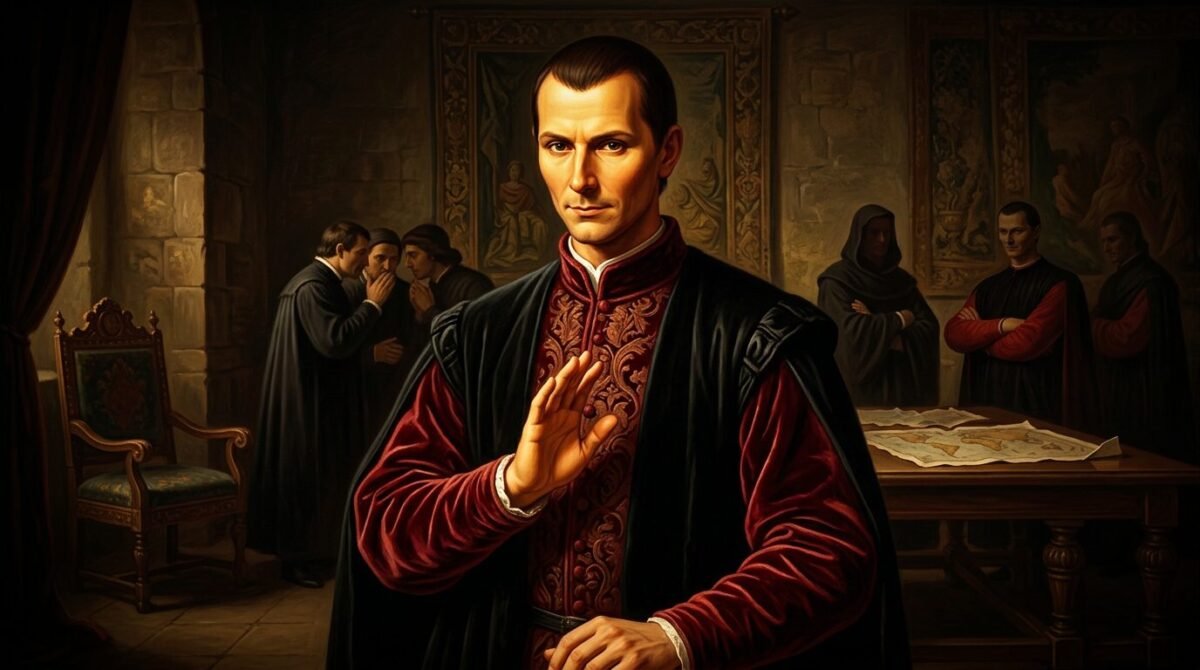
Imagine a leader who never lies, never breaks a promise, and always turns the other cheek. Now, imagine how quickly that leader is devoured by the wolves of the real world. For over five centuries, the name Niccolò Machiavelli has been synonymous with ruthless ambition, cunning deceit, and moral bankruptcy—but is this notorious reputation truly deserved? When we strip away the centuries of pearl-clutching and moral outrage, we are left with a startlingly clear-eyed observer of human nature and power dynamics.
Navigating the complex intersection of ethics, human nature, and statecraft can be daunting for students of political philosophy who are trying to separate the myth of ‘Machiavellianism’ from the author’s actual historical texts. We are conditioned to believe that good people make good leaders, and that moral purity is the highest virtue of governance. Machiavelli shattered this illusion. He dared to say the quiet part out loud: the rules of personal morality do not, and cannot, apply to the survival of a state.
This comprehensive guide unpacks Machiavelli’s theory of political realism, exploring his views on morality, human nature, and how his Renaissance principles continue to shape modern international relations and classical realism. It is an invitation to look at the mechanics of power not as we wish them to be, but exactly as they are.
1. The Foundations of Machiavellian Political Realism
To understand the profound shockwaves generated by Niccolò Machiavelli, one must first step into the blood-soaked, treacherous, and brilliantly vibrant world of Renaissance Italy. In the late 15th and early 16th centuries, Italy was not a unified nation. It was a fractured mosaic of warring city-states—Florence, Venice, Milan, Naples, and the Papal States—constantly locked in a deadly dance of shifting alliances, betrayals, and mercenary warfare. Foreign powers like France and Spain routinely marched across the Alps, turning the Italian peninsula into their personal chessboard.
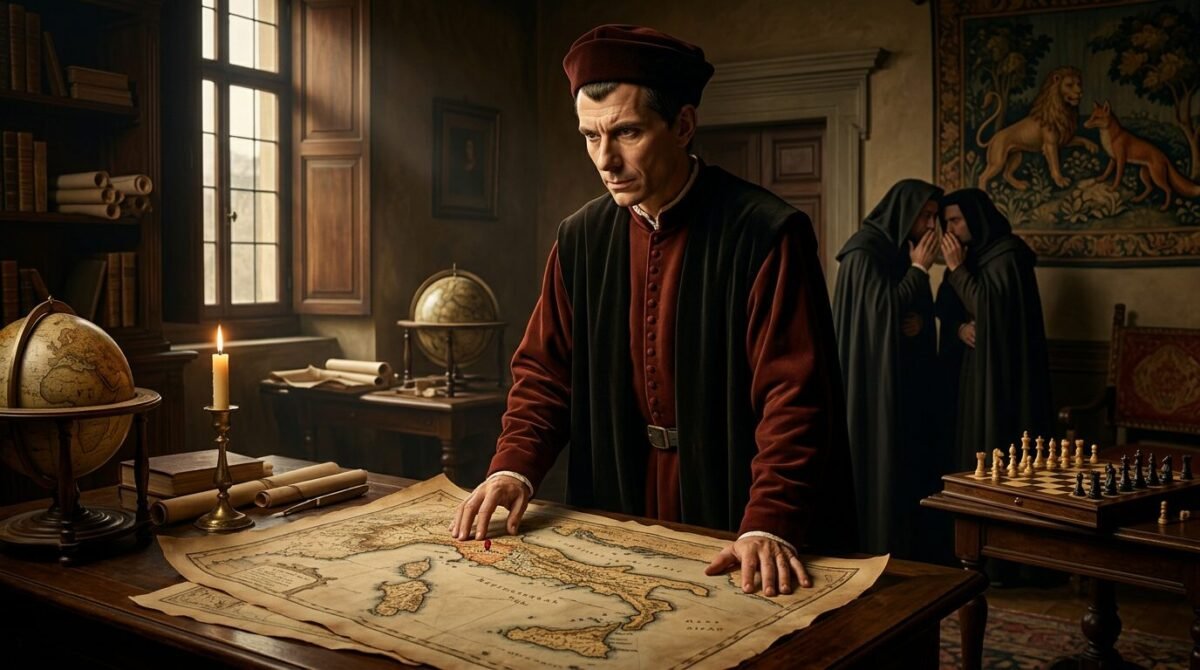
Machiavelli was not an armchair philosopher theorizing from an ivory tower; he was a senior diplomat and civil servant in the Florentine Republic. He rode on horseback across Europe, negotiating with kings, popes, and warlords. He saw firsthand how the sausage of power was made. When the Medici family returned to power in Florence in 1512, Machiavelli was stripped of his position, imprisoned, and subjected to the strappado—a brutal form of torture. Exiled to his small estate outside the city, he channeled his despair, his brilliant analytical mind, and his vast political experience into writing The Prince (Il Principe) in 1513.
The historical context behind the writing of The Prince is crucial because it marks a violent departure from the utopian philosophy that had dominated Western thought for centuries. Before Machiavelli, political treatises were essentially “mirrors for princes”—moralistic guidebooks that told rulers to be just, merciful, generous, and pious. Thinkers like Plato, Aristotle, and St. Thomas Aquinas focused on the ideal state and the moral perfection of the ruler.
Machiavelli viewed this idealistic tradition as not just useless, but actively dangerous. He introduced the core definition of political realism: focusing on how the world is, rather than how it ought to be. In a famous passage, he wrote that there is such a gap between how one lives and how one should live that a man who neglects what is actually done for what should be done learns the way to his ruin rather than his preservation.
This was the birth of the “effectual truth” (verità effettuale). Machiavelli argued that a leader who insists on being good in a world full of people who are not good will inevitably be destroyed. Therefore, the foundation of political realism is the absolute necessity of dealing with empirical reality. If you want to study Machiavelli & Political Philosophy, you must first accept his foundational premise: the world is a dangerous place, and survival requires a clear, unblinking assessment of the threats that surround you, free from the blinding fog of wishful thinking.
2. Machiavelli’s Pragmatic View of Human Nature
You cannot build a sturdy house on a foundation of sand, and you cannot build a secure state on a delusion about human goodness. At the very heart of Machiavelli’s political realism is his deeply pessimistic, yet arguably accurate, assessment of human behavior. He viewed human beings as inherently fickle, selfish, cowardly in the face of danger, and driven primarily by base self-interest.
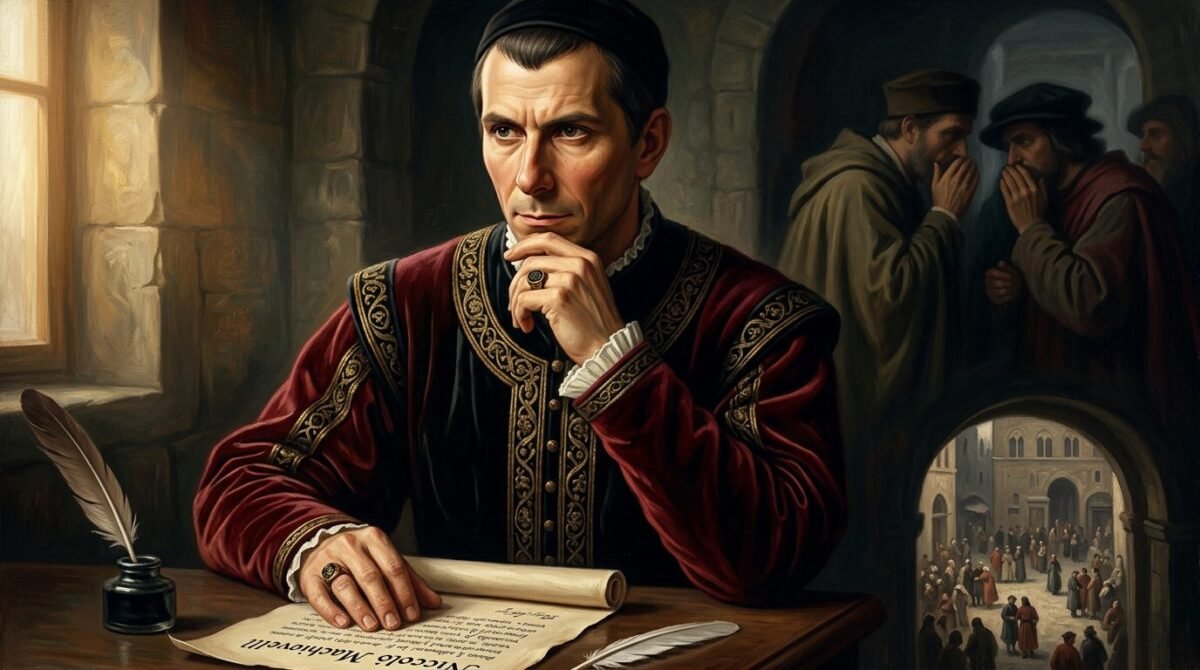
In Chapter 17 of The Prince, Machiavelli delivers one of the most devastating psychological profiles of humanity ever committed to paper: “For this can be said of men in general: that they are ungrateful, fickle, hypocrites and dissemblers, evaders of dangers, lovers of gain.” As long as you are benefiting them, he notes, they are entirely yours—they will offer you their blood, their property, their lives, and their children. But the moment the danger approaches and the benefits stop, they will turn against you.
Why is this dark view so critical? Because understanding human flaws and base motivations is essential for effective leadership and statecraft. If a leader operates under the delusion that their subjects or allies are bound by honor, loyalty, or moral duty, they will leave themselves fatally exposed. Machiavelli was a pioneer of applied psychology. He understood that human beings are driven by two primary emotions: fear and love. While it is ideal for a leader to be both loved and feared, the two rarely coexist perfectly. When a choice must be made, Machiavelli famously concluded that it is much safer to be feared than loved.
Love, he argued, is a bond of obligation that men—being wretched creatures—will break whenever it serves their advantage. Fear, however, is maintained by a dread of punishment that never fails. This is not an endorsement of mindless tyranny; rather, it is a calculated understanding of Power & Human Nature. A leader must avoid being hated, for hatred breeds rebellion, but a calibrated, respectful fear keeps the social order intact.
The philosophical contrast between idealized human virtue and the practical reality of human actions is the chasm where most leaders fail. We want to believe that people will do the right thing because it is right. Machiavelli recognized that people do the right thing only when they are compelled to do so by necessity or by the architecture of laws and power. By accepting the selfish nature of humanity, a ruler can design systems of incentives, punishments, and alliances that actually work, rather than relying on the fragile hope of human benevolence.
3. Statecraft and the Separation of Morality from Politics
If there is one concept that has cemented Machiavelli’s infamy, it is his revolutionary divorce of political action from Christian ethics and traditional moral frameworks. For centuries, the Church and classical philosophers dictated that a good leader must be a good Christian—meek, honest, generous, and peaceful. Machiavelli looked at the graveyard of fallen empires and murdered princes and concluded that traditional morality is a luxury a state cannot afford.
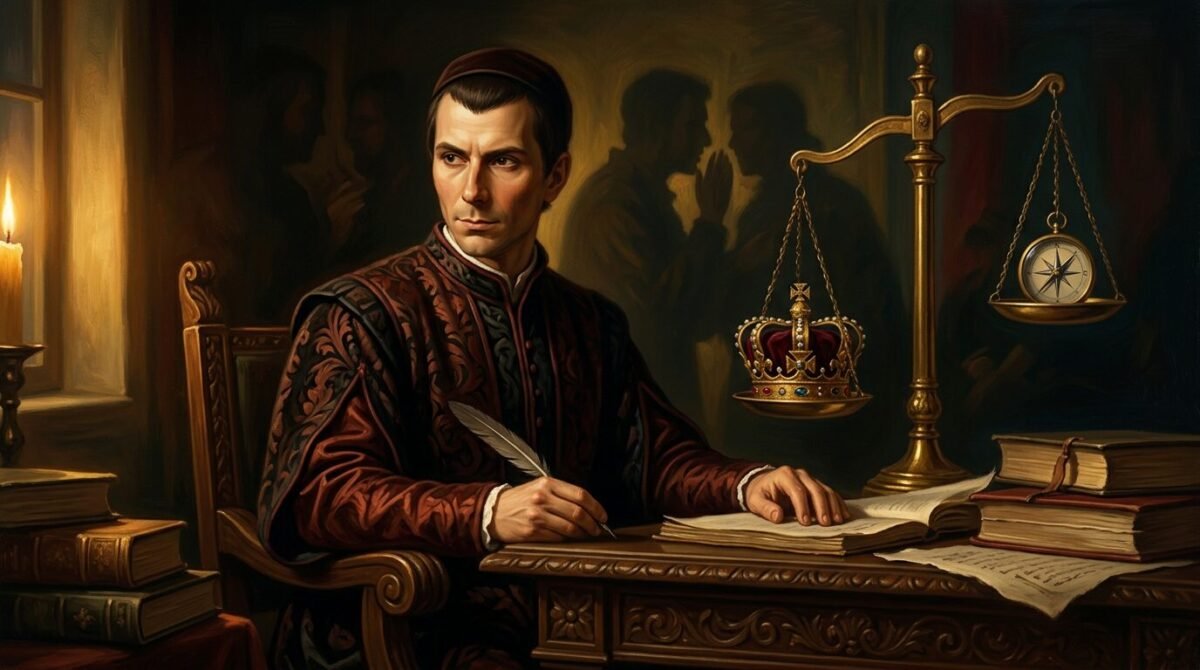
Machiavelli did not argue that morality doesn’t exist, nor did he suggest that people should be wicked in their private lives. Instead, he proposed a dual morality: one set of ethical rules for the private citizen, and an entirely different set of rules for the ruler. The morality of the statesman is consequentialist. It is judged not by the purity of the action, but by the outcome.
This brings us to the necessity of analyzing the infamous concept of ‘the ends justify the means’ in the context of political survival. While Machiavelli never actually wrote that exact phrase, the sentiment permeates his work. He wrote, “In the actions of all men, and especially of princes, where there is no court to appeal to, one looks to the end. So let a prince win and maintain his state: the means will always be judged honorable, and will be praised by everyone.”
To illustrate this, Machiavelli frequently pointed to Cesare Borgia, a ruthless nobleman who sought to carve out a state in the Romagna region. The region was plagued by crime and lawlessness. Borgia appointed a cruel and efficient enforcer, Remirro de Orco, to pacify the territory using extreme violence. Once the region was pacified, Borgia knew the people hated Remirro. To win the people’s favor and distance himself from the cruelty, Borgia had Remirro sliced in half and left his body in the public square. The people were simultaneously satisfied and terrified. The region remained peaceful. Was the action deeply immoral by Christian standards? Yes. Did it secure the state and stop the endless cycle of banditry and murder? Yes. For Machiavelli, this was successful statecraft.
The supreme priority of state security, stability, and maintaining order always overrides a ruler’s personal moral purity. A leader who refuses to get their hands dirty—who refuses to lie, break treaties, or use violence when necessary—is not being noble; they are being selfish. They are prioritizing their own clean conscience over the safety and survival of their people. In the brutal arena of geopolitics, weakness is the greatest sin, because weakness invites invasion, civil war, and chaos. True Influence & Leadership requires the psychological fortitude to bear the burden of doing “evil” so that the greater good of the state’s survival can be achieved.
4. The Dynamics of Power: Virtù vs. Fortuna
To master Machiavellian thought, one must understand the two great cosmic forces that dictate the rise and fall of leaders: Virtù and Fortuna. These are not merely Italian translations of English words; they are complex philosophical concepts that form the engine of Machiavelli’s worldview.
First, we must redefine our understanding of virtue. Machiavelli’s Virtù is not moral goodness, chastity, or charity. Derived from the Latin virtus (manliness), Machiavellian Virtù encompasses martial skill, relentless drive, audacity, ruthlessness, and, above all, adaptability. It is the sheer force of will and competence that allows a leader to impose their design upon the world. A leader with Virtù is proactive, energetic, and willing to do whatever the moment demands. Machiavelli famously used the metaphor of the beast to describe this adaptability: a ruler must know how to be both the lion and the fox. The lion is powerful but cannot recognize traps; the fox is cunning but cannot defend itself against wolves. A leader must have the Virtù to switch between brute force and cunning deception as circumstances dictate.
Opposing and interacting with Virtù is Fortuna. Understanding Fortuna as the unpredictable, often destructive force of luck, chance, or circumstance is vital. Machiavelli compared Fortuna to a raging, torrential river. When it floods, it destroys trees, ruins buildings, and washes away the earth. Everyone flees before it, unable to stop its fury. Half of our actions, Machiavelli conceded, are ruled by Fortuna.
However, the other half is ruled by us. How a successful ruler must utilize Virtù to anticipate, tame, and navigate the chaotic waters of Fortuna is the ultimate test of leadership. You cannot stop the raging river when it is already flooding. But in times of fair weather, a leader with Virtù builds dams, dikes, and canals. When the flood inevitably comes, the waters are channeled and the destruction is mitigated.
Machiavelli also offered a highly controversial, gendered metaphor for Fortuna, describing it as a woman who favors the young, the bold, and the aggressive. Stripped of its 16th-century misogyny, the psychological core of this metaphor remains potent: fortune favors the bold. Passivity, hesitation, and reliance on the status quo are punished by the chaotic nature of the universe. To survive the unpredictable shocks of history—be it a sudden economic collapse, a pandemic, or a surprise military attack—a leader must possess the dynamic, aggressive adaptability of Virtù to force Fortuna into submission.
5. From The Prince to Modern Realpolitik
Machiavelli’s scandalous little book did not just shock the Renaissance; it laid the permanent architectural blueprint for how we understand global power today. Tracing the evolution of Machiavellian thought into modern Realpolitik and classical realism reveals that his ideas are not historical artifacts, but the operating system of modern geopolitics.
Realpolitik—a term coined in the 19th century by German writer Ludwig von Rochau and famously embodied by Otto von Bismarck—is the practice of diplomacy based primarily on considerations of given circumstances and factors, rather than explicit ideological notions or moral and ethical premises. This is Machiavelli’s “effectual truth” scaled up to the level of nation-states. In the 20th century, thinkers like Hans Morgenthau and Henry Kissinger built upon this foundation to develop the school of classical realism in international relations.
How is Machiavelli’s political realism applied in contemporary international relations and foreign policy? Look at the anarchic nature of the global stage. Unlike a domestic society, there is no global police force, no supreme world court with the power to enforce its rulings, and no universal moral authority. States exist in a state of nature where survival is the only guaranteed imperative. Therefore, nations act out of self-interest. When modern superpowers engage in proxy wars, form alliances of convenience with dictators, or use economic sanctions to cripple rivals, they are operating straight out of the Machiavellian playbook.
Comparing Renaissance statecraft with modern geopolitical strategies and the balance of global power shows striking parallels. Florence, Venice, and Milan have been replaced by the United States, China, and Russia. The tools have evolved from mercenaries and pikes to nuclear deterrence, cyber warfare, and artificial intelligence, but the psychological game remains identical. The doctrine of Mutually Assured Destruction (MAD) during the Cold War was a perfect Machiavellian construct: peace maintained not through mutual love, but through the absolute, terrifying fear of annihilation.
When modern leaders prioritize national security over human rights concerns abroad, they are echoing Machiavelli’s assertion that the state’s survival supersedes moral idealism. By studying Comparative Philosophy, we see that while liberal internationalism dreams of a world governed by laws and institutions, realism recognizes that those institutions only function when backed by the hard power of dominant states.
6. Criticisms, Misinterpretations, and Enduring Legacy
Despite his profound insights, Machiavelli remains one of the most misunderstood figures in human history. To call someone “Machiavellian” today is to accuse them of being a manipulative, toxic sociopath. We must address the common misconceptions about ‘Machiavellianism’ as pure evil, tyranny, or clinical psychopathy.
In modern psychology, the “Dark Triad” of personality traits includes narcissism, psychopathy, and Machiavellianism (characterized by manipulation, cynicism, and a cold, calculating nature). While this psychological construct borrows his name, it does a disservice to his philosophy. Machiavellianism in the clinical sense is about selfish, interpersonal exploitation for personal gain. Machiavelli the philosopher, however, was advocating for the survival of the state and the collective good of the people, even if it required the ruler to damn their own soul. He despised tyrants who used cruelty pointlessly or for mere personal gratification.
Nevertheless, there are major philosophical and ethical criticisms of his work from contemporary and modern scholars. In his own time, the Catholic Church placed The Prince on the Index of Prohibited Books. Later philosophers, like Leo Strauss, famously labeled Machiavelli a “teacher of evil” who deliberately destroyed the classical and Christian traditions of virtue. Others argue that by separating politics from morality, Machiavelli created a slippery slope that justifies horrific atrocities, genocides, and totalitarianism in the name of “state security.” If the ends always justify the means, critics ask, what prevents a leader from committing unspeakable crimes against humanity?
Yet, there is another school of thought. Thinkers like Jean-Jacques Rousseau and Antonio Gramsci argued that Machiavelli was actually a republican at heart (which is evident in his longer, more comprehensive work, Discourses on Livy). Rousseau suggested that The Prince was a satirical warning to the people, exposing the brutal methods of tyrants so the public could recognize and resist them.
Regardless of how one interprets his ultimate motives, the enduring relevance of Machiavelli’s political thought in modern academia, law, and leadership studies is undeniable. He forced humanity to look in the mirror. He stripped away the comforting illusions of divine right and inherent human goodness, revealing the raw, mechanical gears of power. As long as human beings organize themselves into hierarchies, compete for scarce resources, and face existential threats, the shadow of the Florentine diplomat will loom large over our decisions.
Frequently Asked Questions
What is the main idea of Machiavelli’s political realism?
The core idea is that politics must be based on empirical reality (how the world actually is) rather than moral idealism (how the world ought to be). It prioritizes the survival, stability, and power of the state above traditional ethical or religious rules.
Did Machiavelli actually say “the ends justify the means”?
He never used that exact English phrasing, but the concept is central to his philosophy. In The Prince, he wrote that in the actions of rulers, “one looks to the end.” If a ruler successfully secures the state, the methods used will be judged as honorable by the masses.
Is Machiavellianism a psychological disorder?
In modern psychology, “Machiavellianism” is considered a personality trait within the Dark Triad, characterized by manipulation and a cynical view of human nature. However, this clinical term is a modern adaptation and differs significantly from Machiavelli’s actual historical and political philosophy, which was focused on statecraft rather than petty personal manipulation.
Conclusion
Machiavelli’s theory of political realism revolutionized philosophy by prioritizing practical statecraft and survival over idealized morality. Through his concepts of Virtù, Fortuna, and a deeply pragmatic view of human nature, he laid the permanent groundwork for modern Realpolitik. He taught us that power is neither inherently good nor evil; it is a tool, a force of nature that must be harnessed with clear-eyed ruthlessness and strategic brilliance if one hopes to survive the chaotic tides of history.
Deepen your understanding of political philosophy, human psychology, and the hidden dynamics of power by exploring our related guides on classical realism. Share this article with your peers to spark a debate on the role of Machiavellianism in modern leadership, and continue your journey into the depths of the human mind here at DeepPsyche.blog.