
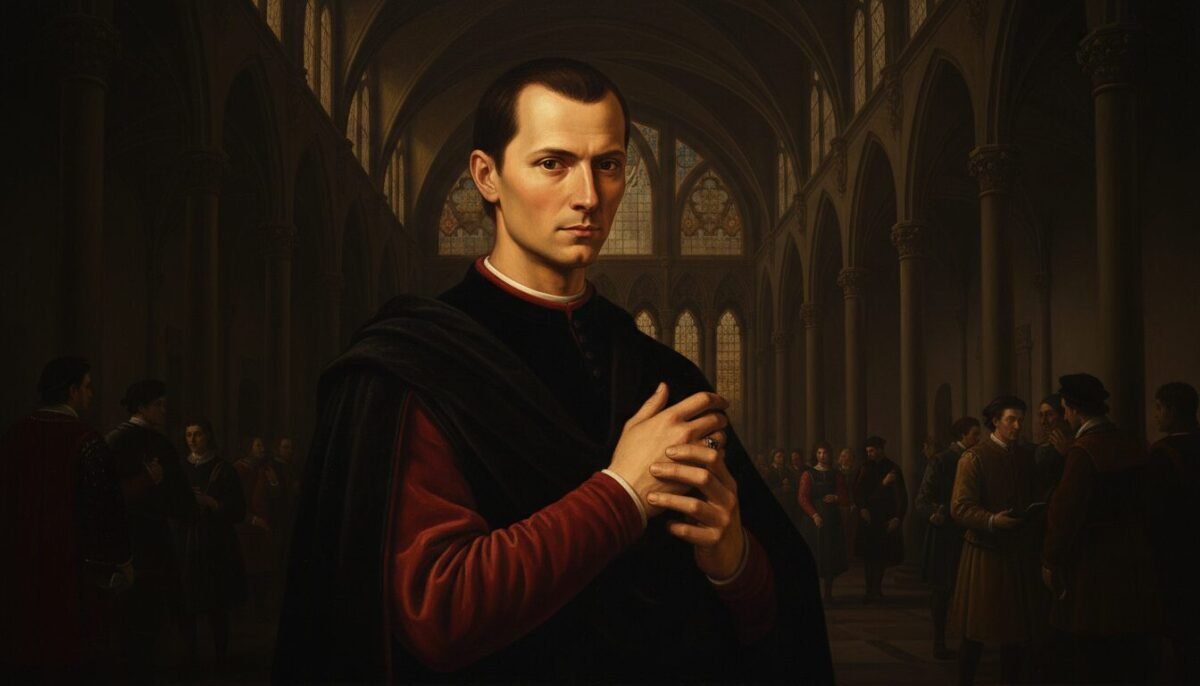
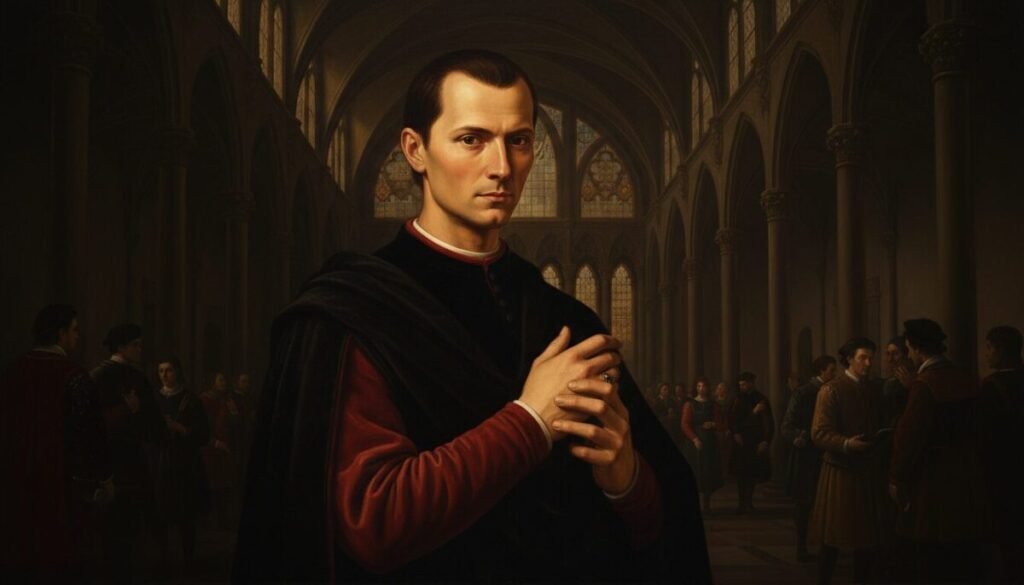
Before his name became synonymous with political cynicism and the dark arts of manipulation, Niccolò Machiavelli was a tireless civil servant fighting to preserve the liberty of his beloved Florence. We often encounter him today as a caricature—a shadowy advisor whispering “the ends justify the means” into the ears of tyrants. But this image is a historical distortion. For fourteen years, Machiavelli was the engine room of the Florentine Republic, a man who spent his days in the dust of diplomatic corridors and the mud of military camps rather than the ivory towers of abstract theory.
Many readers view Machiavelli only through the narrow lens of The Prince, missing the grueling, high-stakes political experience that actually informed his theories. He didn’t invent his ideas in a vacuum; he forged them in the fires of a collapsing Italy, surrounded by predatory superpowers and internal betrayals. To understand the man, we must look at the official who desperately tried to keep a fragile republic from being swallowed by history. This is the story of how a career in the trenches of Renaissance governance birthed the foundations of modern political science.
1. The Secretary of the Second Chancery: Machiavelli’s Rise to Power
In 1498, the city of Florence was a vacuum of power and anxiety. The charismatic but polarizing friar Girolamo Savonarola had just been executed, leaving the city’s administrative structures in disarray. It was into this volatile environment that a twenty-nine-year-old Niccolò Machiavelli was appointed as the head of the Second Chancery. While the First Chancery dealt with high-level foreign policy and official state secrets, the Second Chancery was the operational heart of the state, managing internal affairs, city-state relations, and the logistics of war.
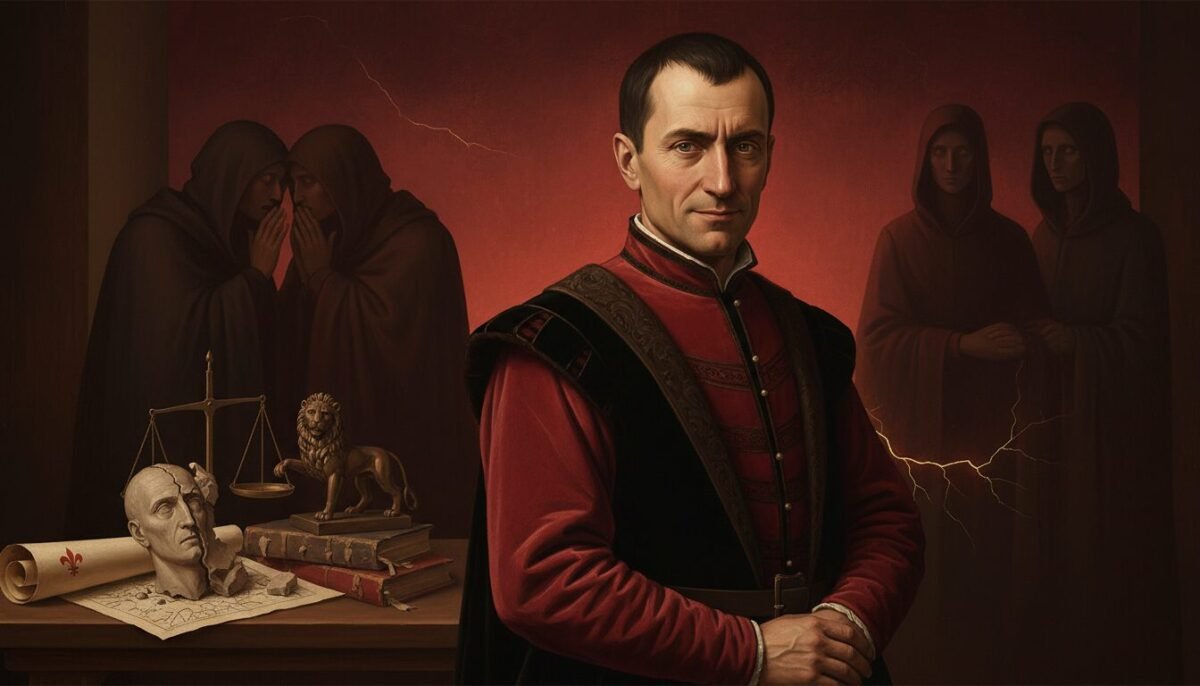
Machiavelli was also named Secretary to the Dieci di Libertà e Pace (the Ten of Liberty and Peace), a committee responsible for the Republic’s military efforts and diplomatic correspondence. This wasn’t a position of inherited nobility; it was a meritocratic role that required immense stamina and a sharp mind. For over a decade, Machiavelli was the man who drafted the letters, organized the supplies, and communicated the orders that kept the Republic functioning.
This administrative foundation was his laboratory. While other philosophers were reading Plato’s Republic and dreaming of ideal states, Machiavelli was reading reports about grain shortages, unpaid soldiers, and rebellious territories. He observed the mechanics of statecraft firsthand, learning that a decree is only as good as the person tasked with enforcing it. He saw how bureaucracy could either protect a state or paralyze it, providing him with a grounded, empirical perspective that would later distinguish his writing from the “mirror for princes” literature of his contemporaries.
2. Renaissance Diplomacy: Missions to Kings, Popes, and Tyrants
Machiavelli’s role frequently took him away from the desks of Florence and onto the dangerous roads of Europe. Between 1499 and 1512, he undertook dozens of diplomatic missions, acting as the eyes and ears of the Republic at the courts of the most powerful and dangerous figures of the age. He spent months at the court of King Louis XII of France, where he learned the harsh reality of international power dynamics: to the great monarchs of Europe, the wealthy but militarily weak Florence was little more than a “Mr. Nothing.”
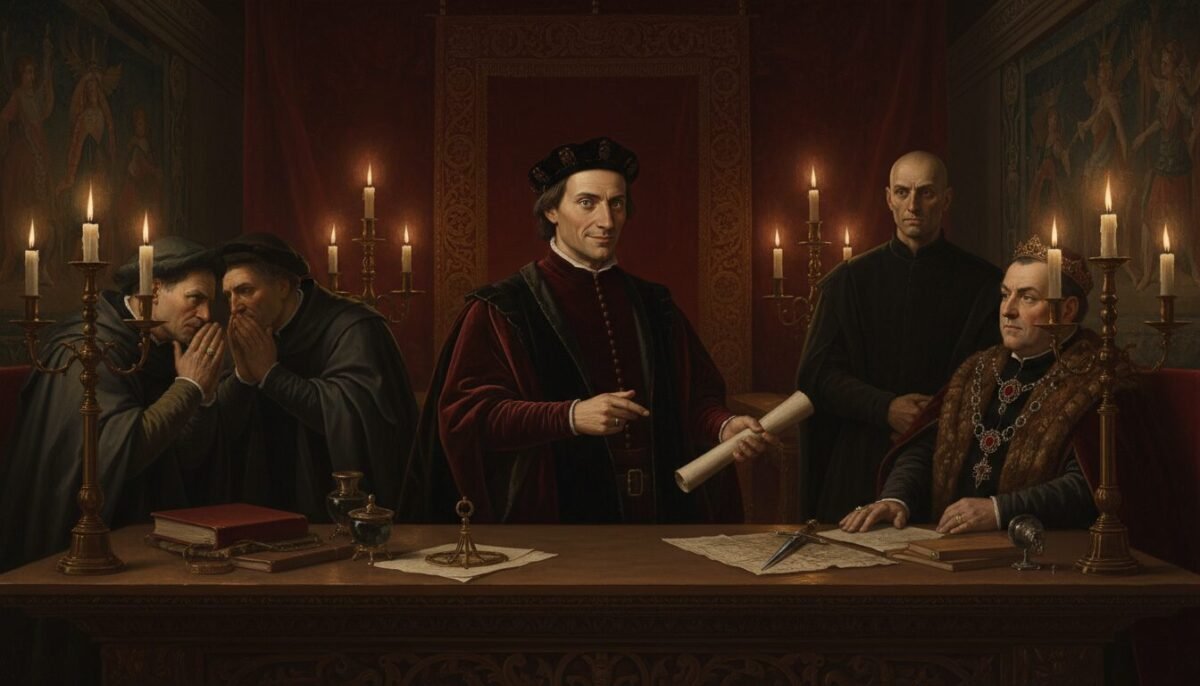
However, the most pivotal encounter of his life occurred in 1502 when he was sent to the court of Cesare Borgia, the son of Pope Alexander VI. Borgia was a man of terrifying ambition and ruthless efficiency. Machiavelli watched as Borgia invited his rebellious generals to a “peace summit” in Senigallia, only to have them all strangled simultaneously. While Machiavelli did not necessarily admire Borgia’s cruelty, he was mesmerized by his virtù—his ability to act decisively, to anticipate threats, and to use both force and fraud to achieve stability in a chaotic region.
He also observed Pope Julius II, the “Warrior Pope,” whose impetuousness and aggression often caught more cautious leaders off guard. These missions provided the “raw data” for the character studies found in his later writings. He wasn’t just theorizing about leadership; he was conducting a psychological autopsy on the men who were currently carving up Italy. He saw that the most successful leaders weren’t the most “moral” in a Christian sense, but those who understood the specific demands of their historical moment.
3. The Florentine Militia: Machiavelli’s Military Vision
One of Machiavelli’s most persistent obsessions was the inherent danger of mercenary forces, known as condottieri. In the Renaissance, most Italian city-states “rented” their armies. Machiavelli saw this as a fatal flaw. Mercenaries, he argued, were “useless and dangerous.” They were brave when there was no danger and cowards when the fighting began; they were expensive in peace and treacherous in war. His experiences in the Second Chancery showed him that these soldiers of fortune were more interested in prolonging conflicts for pay than in winning them for the state.
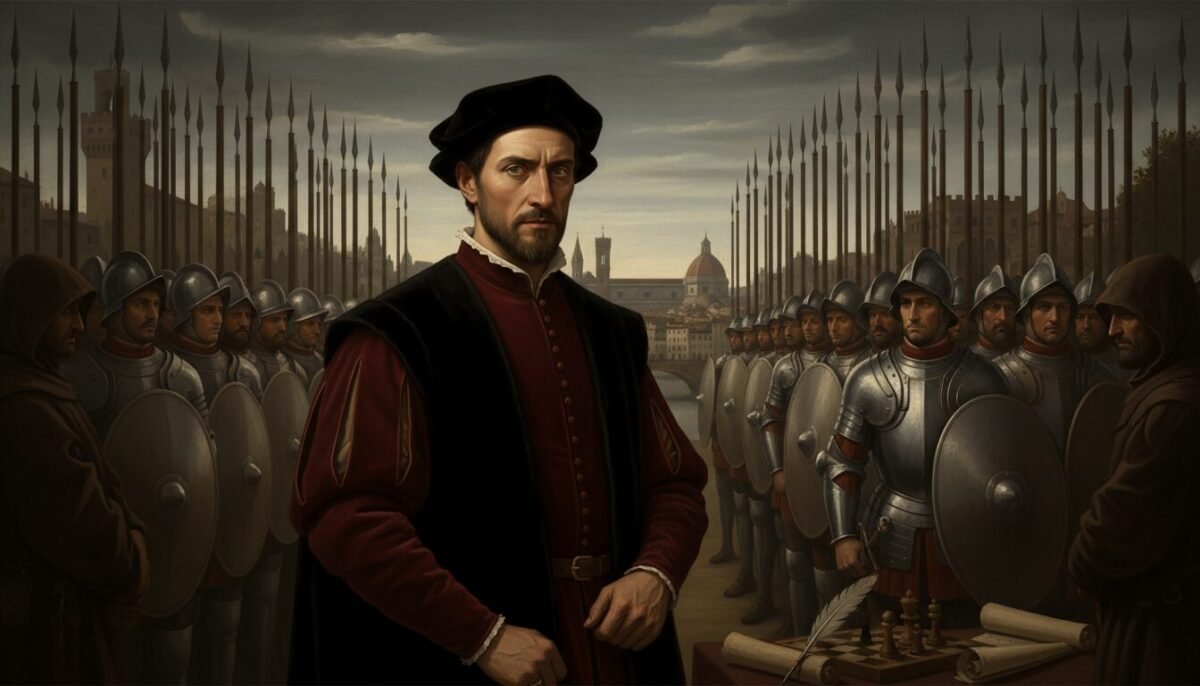
In 1506, Machiavelli finally persuaded the Florentine leadership to allow him to establish a national militia—a body of citizen-soldiers recruited from the Florentine countryside. He believed that a man fighting for his own home, family, and liberty would always outperform a man fighting for a paycheck. This was a radical idea for the time, blending military strategy with a deep philosophical belief in civic duty.
The validation of this theory came in 1509. After years of a stalemate, the Florentine militia played a crucial role in the recapture of Pisa, a city that had long defied the Republic. For Machiavelli, this was his greatest professional triumph. It proved that the health of a Republic was inextricably linked to the willingness of its citizens to bear arms in its defense. He saw the military not just as a tool of force, but as a school for civic virtue, where the individual’s interests were subordinated to the survival of the collective.
4. Piero Soderini and the Governance of the Republic
During much of his career, Machiavelli served under Piero Soderini, who in 1502 was elected Gonfaloniere (Standard-bearer) for Life. Machiavelli became Soderini’s right-hand man, a trusted advisor who handled the most sensitive tasks of the administration. Their relationship was one of mutual dependence, but it also provided Machiavelli with a front-row seat to the failures of “good” men in politics.
Soderini was a man of integrity and a committed republican, but he was often paralyzed by his own desire to follow the law and maintain his reputation for goodness. Machiavelli watched with growing frustration as Soderini hesitated to take the ruthless actions necessary to secure the Republic against its enemies, both internal and external. This relationship created significant friction within the Florentine elite; the old aristocratic families resented Machiavelli’s influence, viewing him as a low-born upstart who had the ear of the city’s leader.
Soderini’s eventual downfall informed one of the most famous warnings in Machiavelli’s work: that a leader who tries to be good in all circumstances will inevitably be destroyed by those who are not good. He saw that Soderini’s indecision and his refusal to “extinguish” the enemies of the state—out of a misplaced sense of morality—eventually led to the ruin of the very Republic he loved. It was a lesson in the tragic necessity of political realism.
5. 1512: The Fall of the Republic and the Return of the Medici
The end of Machiavelli’s political career was as sudden as it was brutal. In 1512, the geopolitical tides turned against Florence. The Spanish and Papal forces, seeking to restore the Medici family to power, marched on the city. The Florentine defense collapsed at Prato, where Machiavelli’s militia was overwhelmed by the professional Spanish infantry. The Republic, which Machiavelli had served for fourteen years, dissolved almost overnight.
The Medici returned to Florence, and the republican institutions were dismantled. Machiavelli was immediately dismissed from office. But his troubles were only beginning. In early 1513, his name was found on a list of potential conspirators in a plot against the Medici. He was arrested, thrown into a dungeon, and subjected to the strappado—a form of torture where the victim’s hands are tied behind their back and they are dropped from a height, wrenching the shoulders out of their sockets.
Machiavelli survived six “drops” without confessing to a crime he likely didn’t commit. Eventually released during an amnesty following the election of a Medici Pope, he was banished from the city. He retreated to his small, modest farm in Sant’Andrea in Percussina. The man who had once negotiated with kings was now reduced to supervising the cutting of timber and playing cards with the local butcher and miller in the village tavern.
6. From Practice to Theory: How the Republic Shaped ‘The Prince’
It was in this state of forced retirement and profound isolation that Machiavelli began his transition from a man of action to a man of letters. In a famous letter to his friend Francesco Vettori, he described his nightly ritual: after a day of mundane farm work, he would strip off his muddy clothes, put on “royal and courtly garments,” and enter his study to “converse” with the ancient writers. This was the environment in which The Prince was written.
We must understand The Prince not as a cold textbook of evil, but as a desperate “job application” to the Medici. Machiavelli was trying to show the new rulers that his fourteen years of experience in the Republic had given him a unique understanding of the “art of the state.” He was essentially saying, “I have seen how power works in the real world, and I can help you keep it.”
His practical failures in the Republic led directly to his realist focus on “what is” rather than “what ought to be.” He had seen the Republic fall because it was too slow, too moralistic, and too reliant on others. While The Prince focused on the survival of a single ruler, his more expansive work, The Discourses on Livy, revealed his true heart: a deep-seated belief that a republic, if properly armed and led by virtuous citizens, was the most stable and glorious form of government. His service to the Republic provided the empirical evidence that allowed him to bridge the gap between Renaissance civil service and the birth of modern political realism.
Conclusion
Niccolò Machiavelli was not a “Machiavellian” in the way we use the term today. He was a man who loved his country more than his soul, a civil servant who saw the highest ideals of the Renaissance crushed by the cold reality of power politics. His legacy isn’t a manual for villains, but a reminder that political liberty is fragile and requires more than just good intentions to survive. It requires an unsentimental understanding of the world as it actually is.
Frequently Asked Questions
Was Machiavelli a Republican or a Monarchist?
Machiavelli was a committed Republican at heart, as evidenced by his long service to the Florentine Republic and his writings in The Discourses on Livy. However, he believed that in times of extreme chaos or when founding a new state, a strong “Prince” might be necessary to establish order before a republic could be formed.
Why is Machiavelli’s name associated with evil?
This association began shortly after his death, largely due to the Catholic Church placing his works on the Index Librorum Prohibitorum (List of Prohibited Books). Critics were shocked by his suggestion that a leader might need to act immorally to preserve the state, leading to the “Old Nick” caricature of him as a devilish figure.
Did Machiavelli ever return to politics after 1512?
He made several attempts to regain favor with the Medici and was eventually given minor tasks, such as writing a history of Florence. However, he never regained the level of influence or the high-ranking positions he held during the Republic.
Explore more of our deep dives into the mechanics of power:
- Machiavelli & Political Philosophy: How his ideas changed the way we think about the state.
- Power & Human Nature: Why the Renaissance remains the best laboratory for understanding modern psychology.
- Influence & Leadership: Lessons from the most effective (and most dangerous) leaders in history.
If you want to understand how Machiavelli’s republican ideals balanced his more famous advice to princes, explore our deep dive into The Discourses on Livy and discover the heart of a true patriot.