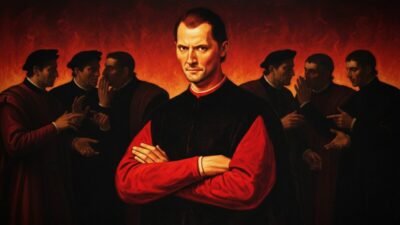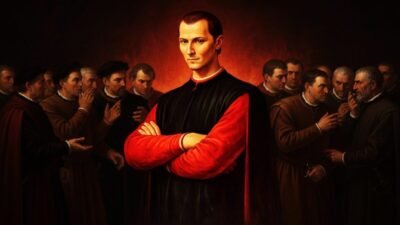
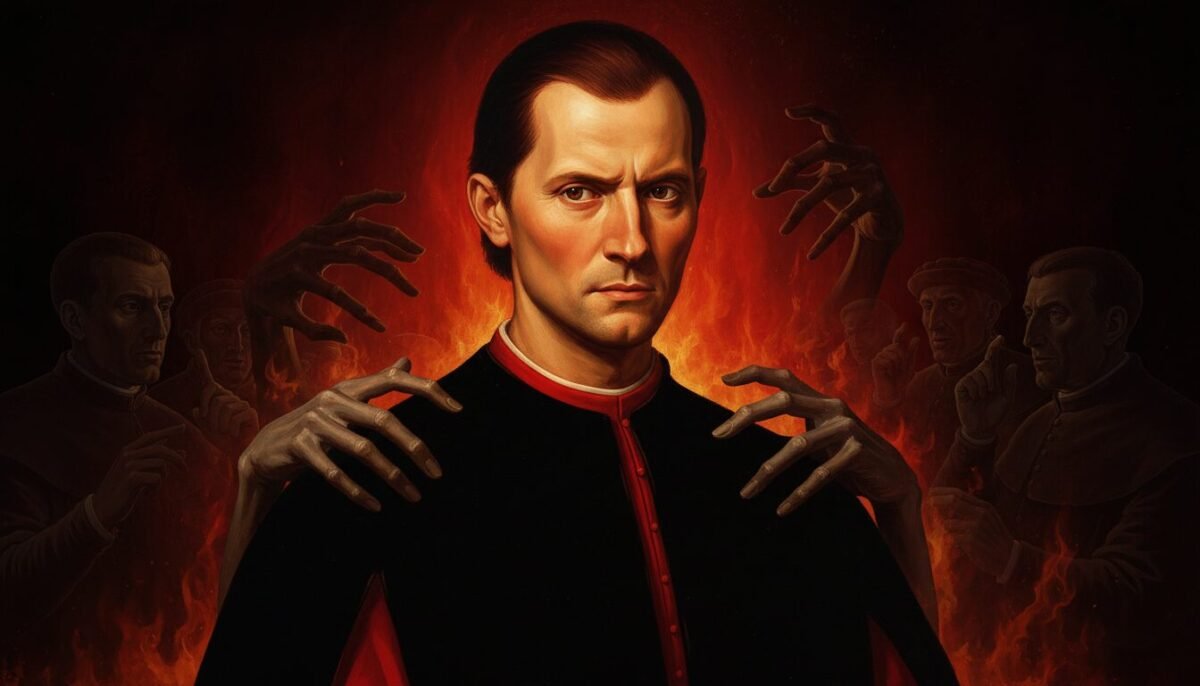
Is it truly better for a leader to be feared than loved, or is this a dangerous misinterpretation of one of history’s most controversial thinkers? Imagine you are a ruler in 15th-century Italy. Your city-state is surrounded by powerful enemies, your internal allies are plotting your downfall, and the mercenary army you hired is more interested in gold than your survival. In this world of shifting shadows, do the moral platitudes of “being a good person” actually keep your people safe, or do they invite a bloody coup?
For centuries, the term “Machiavellian” has been used as a slur—a synonym for deceit, cold-heartedness, and the ruthless pursuit of power. Yet, few truly understand the profound philosophical shift Niccolò Machiavelli triggered in how we view the mechanics of the world. He didn’t invent cruelty; he simply had the courage to describe it as a tool of governance. By stripping away the religious and idealistic masks of his era, he became the first thinker to treat politics as a cold, hard science. This exploration provides a comprehensive deep dive into Machiavelli’s core principles, debunking common myths and explaining why he remains the undisputed father of modern political science.
1. The Historical Context: Renaissance Italy and the Life of Machiavelli
To understand Machiavelli, one must first understand the chaos of his home. Renaissance Italy was not just a period of breathtaking art and architecture; it was a fragmented landscape of warring city-states, shifting alliances, and foreign invasions. Florence, Machiavelli’s beloved city, was the epicenter of this volatility. The rise and fall of the Medici family, the fiery religious fundamentalism of Savonarola, and the constant threat of French and Spanish armies created an environment where political survival was a daily miracle.
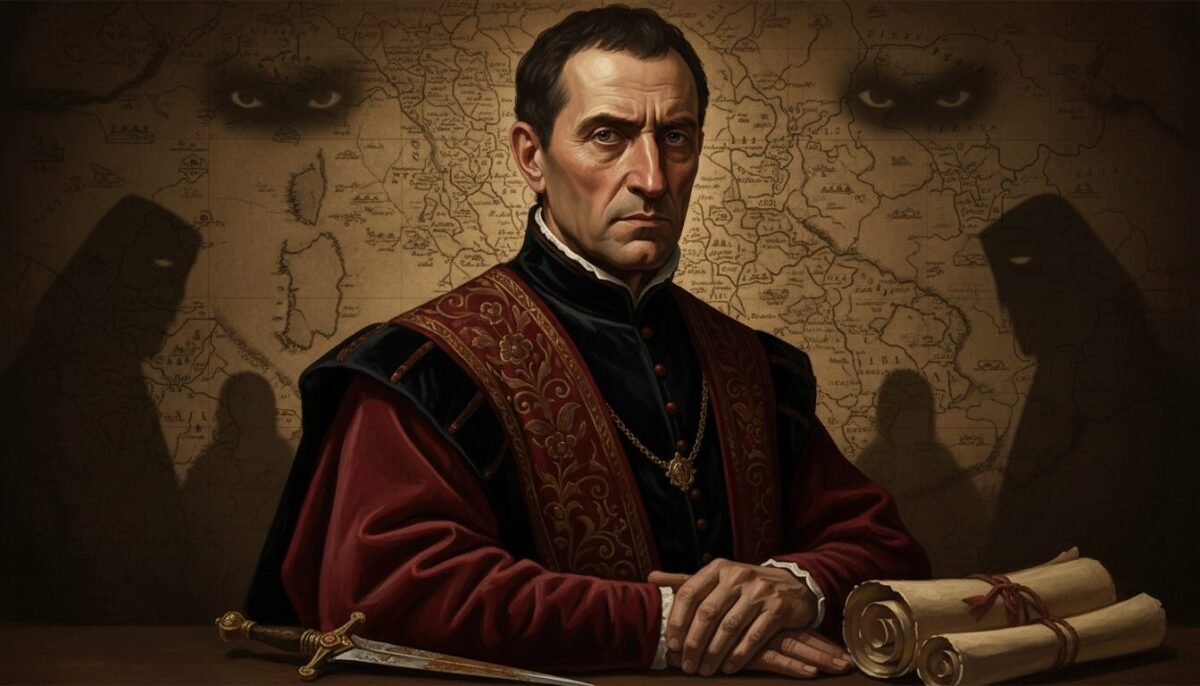
Machiavelli was not an armchair philosopher. He was a practitioner. As a high-ranking diplomat and civil servant for the Florentine Republic, he traveled across Europe, observing the greatest power players of his day. He watched Cesare Borgia—a man of immense ambition and calculated brutality—and realized that the leaders who succeeded were rarely the ones who followed the traditional rules of Christian morality. They were the ones who understood the pulse of the people and the necessity of force.
When the Medici family returned to power in 1512, Machiavelli’s world collapsed. He was accused of conspiracy, tortured on the rack, and eventually exiled to a small farm outside the city. It was in this state of forced isolation and professional heartbreak that he wrote his most famous works. His writing was a desperate attempt to show the new rulers how to unify Italy and protect it from the “barbarians” who were tearing the peninsula apart. He wasn’t writing for the sake of being “evil”; he was writing out of a desperate need for stability in a land defined by blood and betrayal.
2. From Idealism to Realism: The ‘Verità Effettuale’
Before Machiavelli, political philosophy was largely a branch of ethics or theology. Thinkers like Plato and Cicero wrote about “imaginary republics”—ideal states governed by philosopher-kings or virtuous citizens. They focused on how leaders ought to behave to achieve a state of moral perfection. Machiavelli famously took a sledgehammer to these ivory towers.
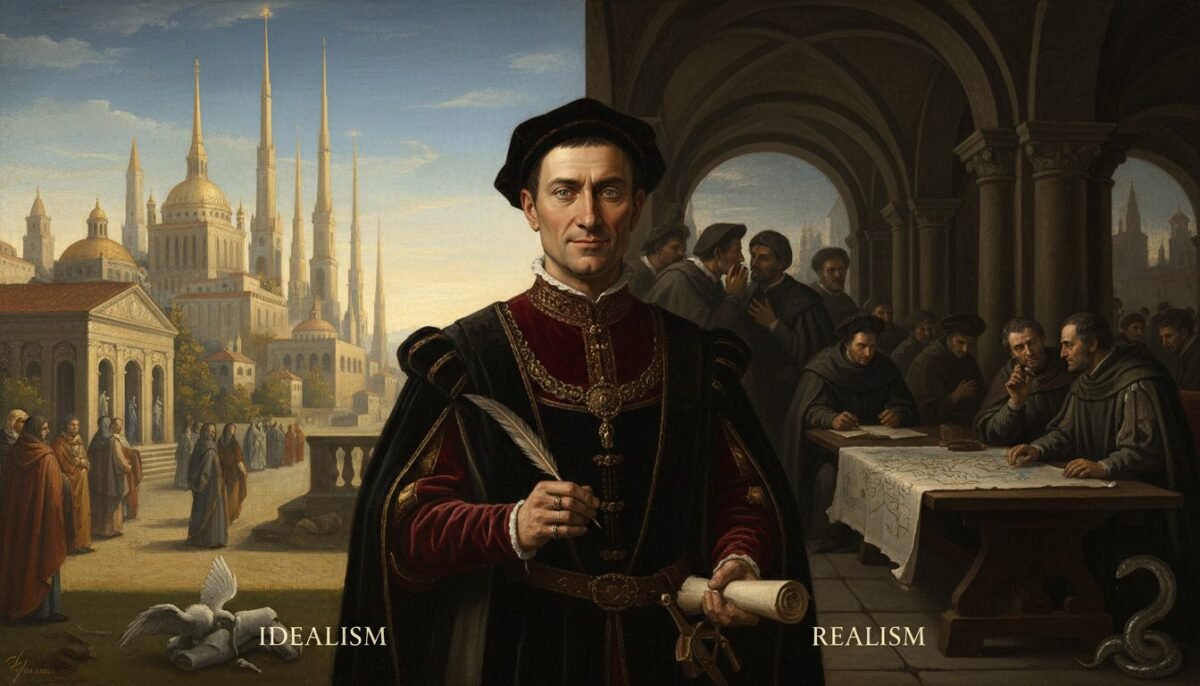
He introduced the concept of the verità effettuale—the “effectual truth” of the matter. He argued that if you want to understand how power works, you must look at how people actually live, not how they should live. In his view, a leader who tries to be “good” in a world where so many are “not good” will inevitably meet his ruin. This was a revolutionary shift from political idealism to political realism.
By prioritizing “what is” over “what ought to be,” Machiavelli laid the groundwork for what we now call empirical political science. He treated the state like a biological organism or a mechanical system that could be studied, diagnosed, and managed. He didn’t care about the salvation of the ruler’s soul; he cared about the survival of the state. If a doctor has to perform a painful surgery to save a patient’s life, we don’t call the doctor “evil.” Machiavelli viewed the statesman in much the same way—as a surgeon of the body politic who must sometimes use “cruel” methods to prevent the total collapse of society.
3. Power Dynamics in ‘The Prince’: Acquisition and Maintenance
The core of Machiavelli’s most famous work, The Prince, is not about how to be a tyrant, but about how to maintain stability. In a world of chaos, stability is the ultimate moral good, because without it, trade, art, and family life are impossible. He breaks down power into two primary phases: the acquisition of power and the maintenance of it.
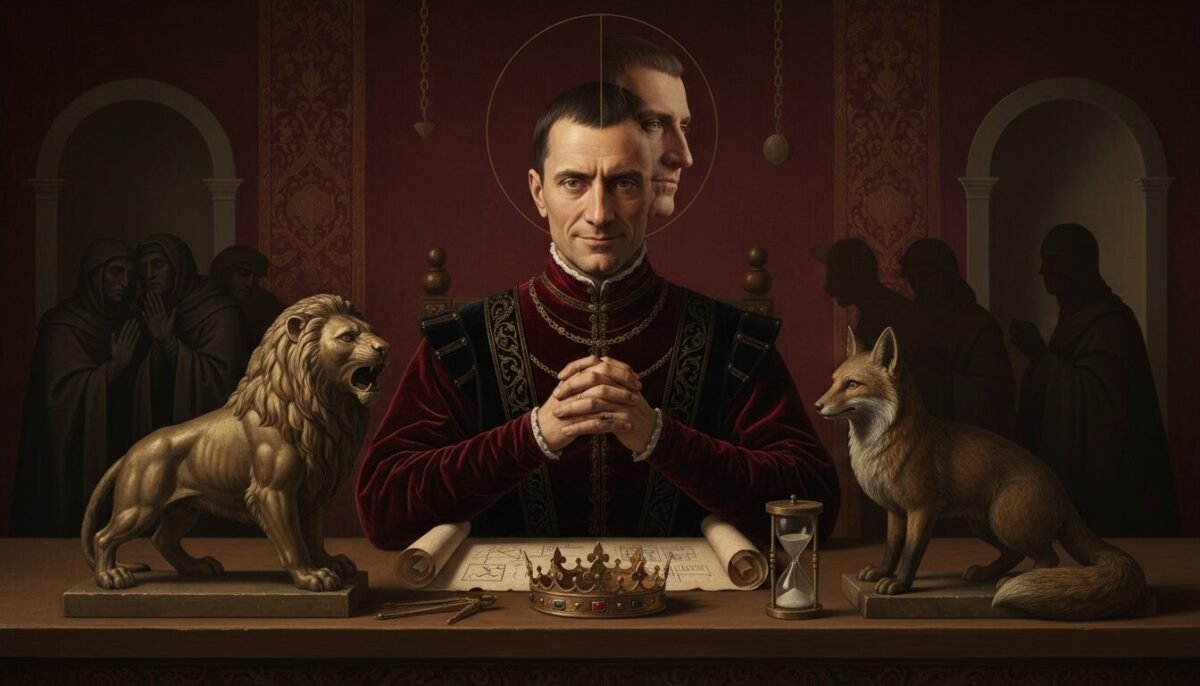
One of his most debated points is the pragmatic choice between being feared and being loved. Machiavelli admits it would be ideal to be both, but since they rarely go together, he concludes it is safer to be feared than loved. Why? Because love is a bond of obligation that men, being “ungrateful, fickle, and greedy,” break whenever it serves their self-interest. Fear, however, is maintained by a “dread of punishment” which never fails. Crucially, he warns that a leader must be feared but not hated. Hatred is what leads to conspiracies and revolutions. To avoid hatred, a leader must respect the property and the women of his subjects—practical advice that shows his focus was always on the psychology of the masses.
To navigate these dynamics, Machiavelli introduces the metaphor of the Fox and the Lion. A leader cannot rely on force alone (the Lion), nor on cunning alone (the Fox). The Lion is defenseless against traps, and the Fox is defenseless against wolves. A truly successful leader must be a Fox to recognize the traps and a Lion to frighten the wolves. This duality suggests that leadership is a performance; a ruler must know when to be merciful and when to be harsh, when to keep his word and when to break it for the greater good of the state.
4. Virtù vs. Fortuna: The Interplay of Skill and Luck
To understand Machiavelli’s psychology of leadership, one must grasp his unique definitions of Virtù and Fortuna. In the Renaissance context, “virtue” usually meant Christian piety and moral goodness. Machiavelli hijacked the word. For him, Virtù is prowess, talent, energy, and the ruthless drive to achieve one’s goals. It is the ability of a leader to adapt to any situation, no matter how dire, and impose their will upon it.
Standing against Virtù is Fortuna—the unpredictable, chaotic nature of external circumstances. Machiavelli famously compared Fortuna to a “raging river” that, when it overflows, destroys everything in its path. No one can stop the river from flooding, but a leader with Virtù can build dikes and dams during the dry season to minimize the damage. In other words, you cannot control luck, but you can prepare for it.
This interplay creates a dynamic view of human agency. Machiavelli believed that roughly half of our lives are governed by chance, but the other half is ours to command through skill and foresight. A leader who relies entirely on good fortune will fall the moment the wind changes. However, the leader who possesses Virtù can turn even a disaster into an opportunity. This isn’t about being “lucky”; it’s about being so strategically flexible that you can master the “river” of history itself.
5. Political Ethics: Does the End Justify the Means?
Perhaps the most persistent myth about Machiavelli is that he wrote the phrase “the end justifies the means.” He never actually used those exact words. What he did argue was that in the actions of all men, and especially of princes, where there is no court of appeal, one looks at the final result. If a prince succeeds in establishing and maintaining a state, his “means” will always be judged honorable and approved by everyone.
This introduces the concept of Reason of State (Raison d’État). Machiavelli argued that there is a fundamental separation between private morality and political necessity. A private citizen should be honest, kind, and loyal. But a leader responsible for the lives of thousands cannot always afford these luxuries. If being “honest” leads to a war that kills ten thousand people, was being honest actually “good”?
Machiavelli viewed certain actions—what we might call “necessary evils”—as vital tools to prevent greater societal collapse. He didn’t advocate for cruelty for cruelty’s sake; in fact, he criticized leaders who were “senselessly” cruel because it made them hated and weakened the state. His ethics were utilitarian: the “good” is that which preserves the collective, even if it requires the leader to “enter into evil” when necessary. It is a haunting, unsentimental look at the burdens of leadership that most modern politicians still grapple with behind closed doors.
6. The Legacy: Why Machiavelli is the Father of Modern Political Science
While The Prince is his most famous work, it is only half of the story. In his other major work, Discourses on Livy, Machiavelli reveals himself to be a staunch supporter of republicanism. He argues that a republic, governed by laws and the participation of the people, is more stable and resilient than any principality. This tension between his “handbook for tyrants” and his “praise for republics” has fascinated scholars for centuries.
Machiavelli’s influence on the Enlightenment was seismic. Thinkers like Thomas Hobbes, John Locke, and Montesquieu all built upon his foundation. By separating politics from religion, he allowed for the development of secular governance. He taught us to look at power as a resource to be managed rather than a divine right. Even today, his fingerprints are everywhere—from the “realpolitik” of Henry Kissinger to the strategic maneuvering of modern corporate boardrooms.
In the world of contemporary geopolitics, Machiavelli’s lessons on the “fox and the lion” and the “river of fortune” remain startlingly relevant. He reminds us that power is not a moral reward, but a functional tool. Whether we like it or not, we live in a world where the “effectual truth” often trumps our highest ideals. Machiavelli was not a teacher of evil, but a realist who stripped away the illusions of power to reveal the mechanics of statecraft. He didn’t want us to be cruel; he wanted us to be awake.
Frequently Asked Questions
Was Machiavelli actually “Machiavellian” in his own life?
Ironically, no. Machiavelli was known by his friends as a witty, loyal, and patriotic man who suffered greatly for his commitment to the Florentine Republic. He wrote The Prince while in exile, largely as a job application to the Medici, which they ultimately ignored.
Did he believe a leader should always be dishonest?
Not at all. Machiavelli argued that a leader should be honest whenever possible. However, he insisted that a leader must know how to be dishonest when the survival of the state depends on it. The appearance of virtue is often more important than the virtue itself.
Why is he called the father of political science?
He was the first to apply an empirical, “scientific” method to politics. Instead of basing his theories on religious texts or moral ideals, he based them on historical data and direct observation of human behavior, treating politics as a distinct field of study.
If you found this analysis of power and human nature compelling, explore our further readings on Influence & Leadership and Power & Human Nature to see how these Renaissance principles continue to shape our modern world at DeepPsyche.blog.