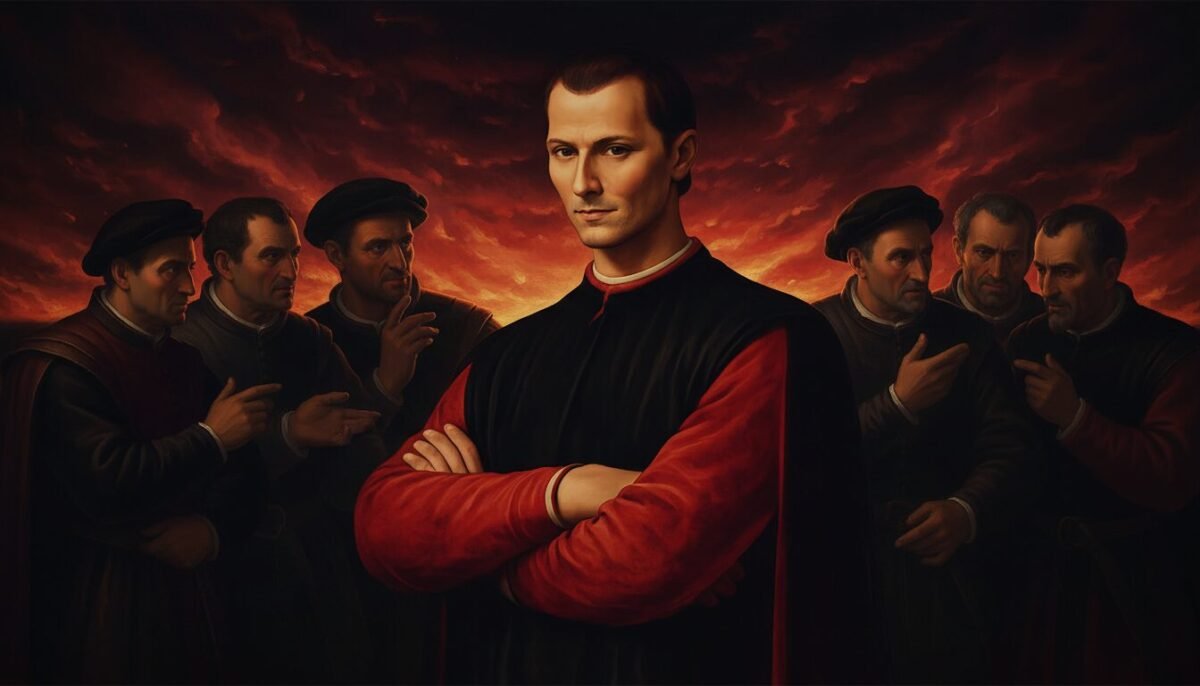
Is it better to be loved or feared? This chilling question, posed by Niccolò Machiavelli five centuries ago, continues to haunt the corridors of power today. Imagine a CEO deciding on a massive layoff to save a company from bankruptcy, or a world leader navigating a delicate ceasefire where every concession feels like a betrayal. In these moments, the comforting blankets of traditional morality often wear thin. We are forced to look at the world not as we wish it to be, but as it actually is—raw, competitive, and often unforgiving.
For centuries, the name “Machiavelli” has been used as a slur, a synonym for deceit, manipulation, and the cold-blooded pursuit of power. He has been called a “teacher of evil” and a “handbook for dictators.” Yet, this narrow perspective overlooks his true role: the architect of modern political science and secular statecraft. Machiavelli didn’t invent the dark side of human nature; he simply had the courage to turn on the lights and describe what he saw. By shifting the focus from idealistic philosophy to political realism, he fundamentally changed how Western civilization understands governance, leadership, and the very nature of Power & Human Nature.
1. The Historical Crucible: Renaissance Florence and Machiavelli’s Career
To understand the man, we must understand the chaos that birthed him. Niccolò Machiavelli was born in 1469 in Florence, a city that was the beating heart of the Italian Renaissance. While we often associate this era with the sublime art of Michelangelo and Da Vinci, the political reality was far more visceral. Italy was not a unified nation; it was a fractured collection of city-states—Florence, Venice, Milan, Rome, and Naples—constantly at each other’s throats, often serving as a playground for the larger imperial ambitions of France and Spain.
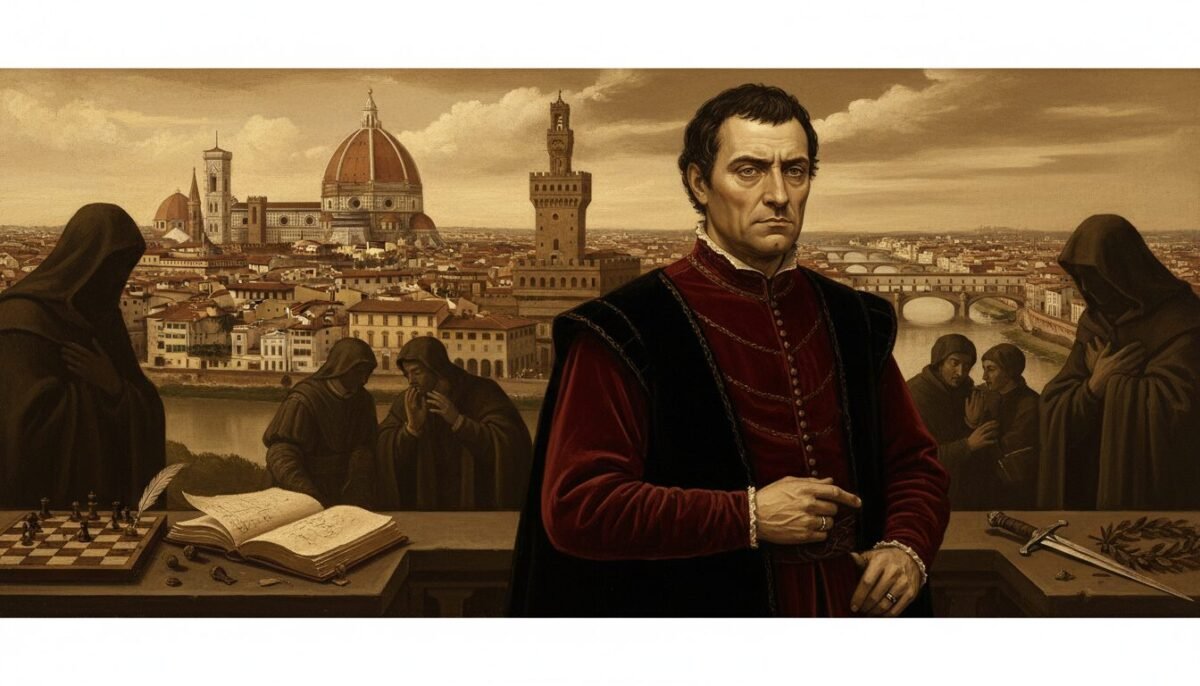
Machiavelli was not a philosopher living in an ivory tower. He was a practitioner. As a high-ranking diplomat and civil servant for the Florentine Republic, he spent fourteen years in the “field.” He stood in the courts of kings, watched the maneuvers of Popes, and observed firsthand the rise and fall of “Great Men.” He saw the Medici family, who had ruled Florence for decades, ousted in a revolution, only to see the republic they left behind struggle with internal factionalism and external threats.
One of the most pivotal figures in Machiavelli’s development was Cesare Borgia, the ruthless son of Pope Alexander VI. Borgia was a man who could be charming one moment and devastatingly violent the next. Machiavelli watched as Borgia consolidated power through a mix of brilliant strategy and calculated cruelty. He realized that in the shifting sands of 15th-century Italy, the traditional medieval worldview—which held that a leader’s success was tied to his Christian piety—was failing. The world was moving toward humanism, a perspective that placed human agency, rather than divine providence, at the center of history. Machiavelli’s career was a front-row seat to this transition, providing him with the empirical evidence that would eventually fill the pages of his most famous works.
2. The Birth of Political Realism: From ‘What Ought to Be’ to ‘What Is’
Before Machiavelli, political writing belonged to a genre known as “Mirrors for Princes.” These were essentially advice manuals for rulers, filled with platitudes about how a prince should be the embodiment of every Christian virtue: kind, merciful, honest, and humble. The underlying assumption was that if a leader was a “good person” in the eyes of God, his state would naturally prosper. Machiavelli famously took this tradition and set it on fire.
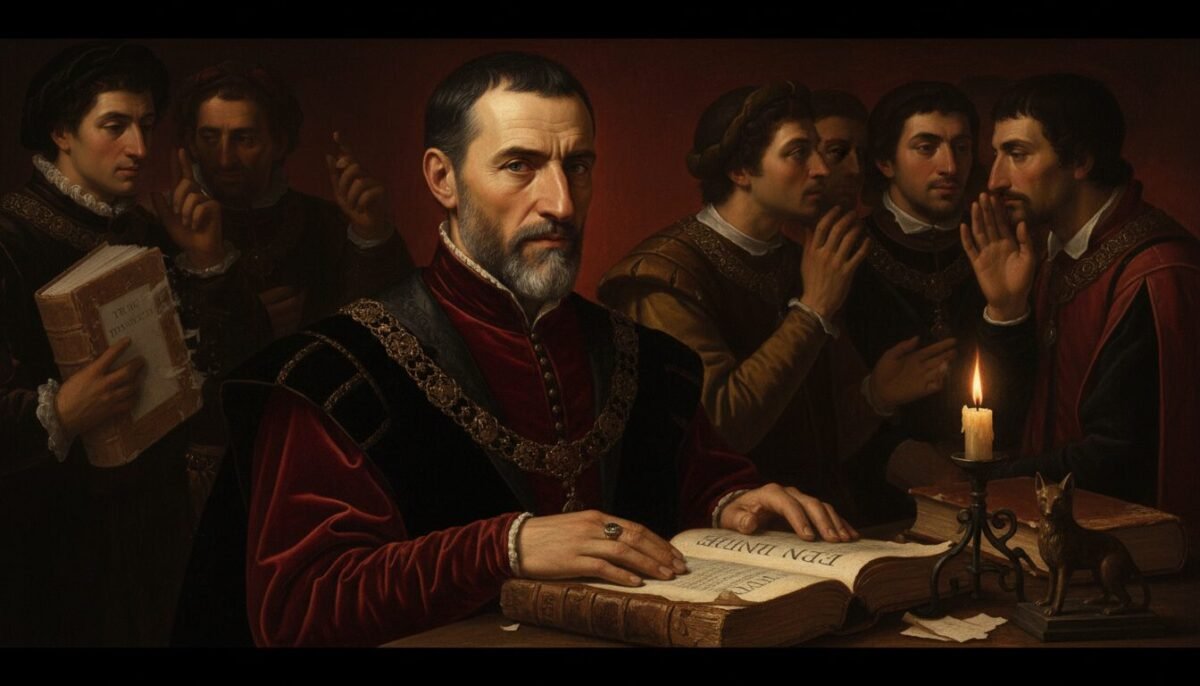
In The Prince, he writes: “Many have imagined republics and principalities that have never been seen or known to exist in reality; for there is such a gap between how one lives and how one ought to live that anyone who abandons what is done for what ought to be done learns his ruin rather than his preservation.” This is the birth of political realism. Machiavelli argued that if a leader tries to be “good” in a world where so many others are “not good,” he will inevitably be destroyed.
He introduced the concept of the “effectual truth” (verità effettuale). This means looking at the actual results of an action rather than the noble intentions behind it. If a leader’s honesty leads to the invasion of his city and the slaughter of his people, was that honesty truly a “virtue”? Machiavelli’s realism, or what we now call Realpolitik, suggests that the primary duty of a leader is the stability and survival of the state. If the state falls, all other virtues—justice, art, religion, and commerce—fall with it. Therefore, the pragmatic pursuit of stability must take precedence over the performance of religious virtue. This was a revolutionary break from the past, signaling that Machiavelli & Political Philosophy would forever be linked to the cold, hard facts of the human condition.
3. The Autonomy of Politics: Separating Private Morality from State Necessity
Perhaps the most controversial aspect of Machiavelli’s thought is his insistence that political ethics are distinct from personal or Christian morality. In our private lives, we are taught that it is wrong to lie, wrong to break promises, and wrong to use violence. Machiavelli does not necessarily disagree with these values for individuals. However, he argues that the “morality of the state” is a different beast entirely.
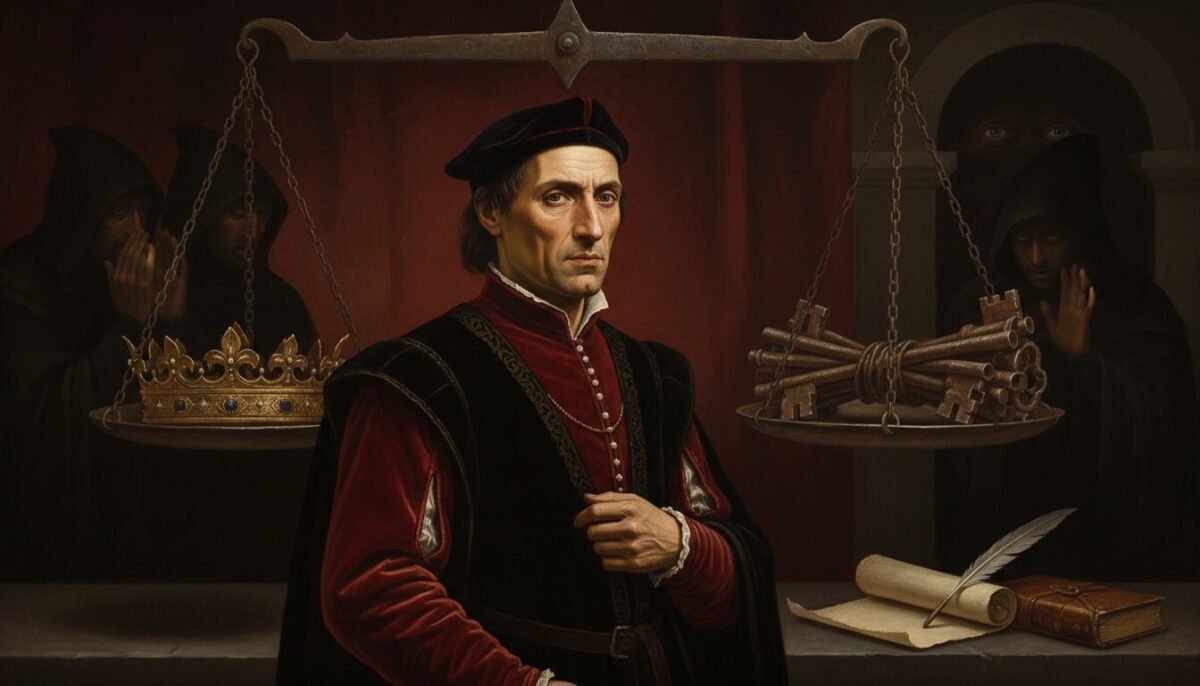
This is where the infamous phrase “the end justifies the means” originates, though Machiavelli never actually wrote those exact words. His actual argument was more nuanced: in the actions of all men, and especially of princes, where there is no court to appeal to, one looks at the final result. If a prince succeeds in establishing and maintaining his state, the means he used will always be judged honorable and approved by everyone. This isn’t a license for mindless evil; it is a recognition of “state necessity.”
Machiavelli makes a sharp distinction between “necessary cruelty” and “senseless violence.” He cites the example of Agathocles of Sicily, who rose to power through extreme brutality but was never truly “great” because his violence was excessive and lacked a higher purpose. Conversely, a leader who uses a “surgical” strike of cruelty early on to prevent a long, bloody civil war is, in Machiavelli’s eyes, more “merciful” than the leader whose hesitation allows the entire country to burn. This separation of the “private man” from the “public office” is a cornerstone of modern governance. We expect our leaders to make the “hard choices” that we, in our private lives, would find abhorrent. This tension is central to any study of Machiavellianism and the ethics of leadership.
4. Virtù and Fortuna: The Machiavellian Framework for Leadership
To navigate this dangerous world, Machiavelli proposed a new framework for leadership based on two competing forces: Virtù and Fortuna. It is essential to note that when Machiavelli speaks of Virtù, he is not talking about “virtue” in the sense of moral goodness. Instead, he draws on the Latin root vir (man), implying manliness, strength, skill, and prowess. Virtù is the ability of a leader to adapt to changing circumstances, to be a “lion” when strength is needed and a “fox” when cunning is required.
On the other side is Fortuna—the unpredictable, often violent nature of fate. Machiavelli famously compares Fortuna to a torrential river that, when it overflows, destroys everything in its path. A person of high Virtù cannot stop the river from rising, but they can build dikes and dams during the dry season to direct its flow.
The interplay between luck and ability is what determines the success of a ruler. A leader might be brilliant (high Virtù) but be struck down by a freak illness or an unexpected betrayal (bad Fortuna). Conversely, a mediocre leader might find success simply because they were born into the right family at the right time. However, Machiavelli’s message is one of empowerment: while we cannot control Fortuna entirely, we can master it through preparation and bold action. He famously remarked that Fortuna is a woman, and if you wish to keep her under, it is necessary to beat and ill-use her—a metaphor that, while jarring to modern ears, underscores his belief that the bold and the skilled are more likely to succeed than the cautious and the timid. This dynamic remains a vital part of Influence & Leadership theory today.
5. The Father of Modern Political Science: Secularism and Empirical Analysis
Machiavelli’s impact extends far beyond his advice to princes; he changed the very methodology of how we study society. Before him, political thought was often a branch of theology. If a kingdom fell, it was “God’s punishment.” If a king was successful, it was “God’s blessing.” Machiavelli stripped away this divine providence and replaced it with empirical analysis. He treated history as a laboratory.
He believed that human nature is constant—that people in ancient Rome were driven by the same desires for power, security, and wealth as people in Renaissance Florence. By studying the “data” of history, Machiavelli believed one could formulate “laws” of politics. If a certain strategy worked for Julius Caesar, and a similar strategy worked for a contemporary general, Machiavelli concluded that there was a cause-and-effect relationship at play. This is the foundation of the social sciences: the belief that human behavior can be observed, categorized, and predicted without needing to invoke the supernatural.
This shift toward secularism allowed for the development of the modern nation-state. By viewing the state as a human-made institution rather than a divinely ordained one, Machiavelli opened the door for discussions on institutional power, checks and balances, and the importance of civic institutions. He was a staunch advocate for a citizen militia over mercenaries, arguing that a state is only as strong as the commitment of its people. His focus on the “mechanics” of power—how it is seized, how it is held, and how it is lost—provided the blueprint for the administrative and strategic structures that define modern government.
6. A Lasting Legacy: Influence on Hobbes, Locke, and Modern Statecraft
The ripples of Machiavelli’s thought can be felt through the entire history of Western political philosophy. In the 17th century, Thomas Hobbes’s Leviathan echoed Machiavelli’s realism. Hobbes’s famous description of the state of nature as “solitary, poor, nasty, brutish, and short” is a direct descendant of Machiavelli’s pessimistic view of human nature. Both men agreed that without a strong, central authority to maintain order, humanity would descend into chaos.
Even the thinkers who seemed to oppose Machiavelli were deeply influenced by him. John Locke and the American Founding Fathers, while focused on liberty and individual rights, engaged deeply with Machiavelli’s Discourses on Livy. In that work, Machiavelli explores republicanism, the importance of the rule of law, and the idea that a healthy state requires a degree of “productive conflict” between different social classes. James Madison’s design of the U.S. Constitution—with its intricate system of checks and balances—is a practical application of the Machiavellian idea that you cannot rely on the “goodness” of leaders; you must build a system where “ambition is made to counteract ambition.”
In the modern era, Machiavelli is the silent guest at every high-stakes diplomatic summit. The field of International Relations, particularly the “Realist” school, is built on his foundations. When we talk about “national interests,” “spheres of influence,” or “deterrence,” we are speaking Machiavelli’s language. His influence is not just limited to politics; it permeates corporate strategy and even psychological studies of personality. To engage in Comparative Philosophy is to see Machiavelli’s shadow everywhere—from the legalism of ancient China to the power dynamics of 21st-century Silicon Valley.
Conclusion
Niccolò Machiavelli did not create the darkness of the world; he simply refused to look away from it. By stripping away the comforting illusions of medieval idealism, he revealed the raw mechanics of power that drive human history. He taught us that leadership is not just about being “good,” but about being effective; that the survival of the community sometimes requires choices that would break an individual’s conscience; and that while we cannot control fate, we can meet it with strength and skill.
Whether we find his ideas liberating or terrifying, we cannot ignore them. Every time a leader weighs the cost of a necessary evil, or a citizen questions the motives of those in power, Machiavelli is there. He remains the essential guide for anyone who wishes to understand the world as it is, rather than as we hope it might be. By separating ethics from statecraft, he didn’t just write a book for a prince; he laid the groundwork for the modern world.
If you found this exploration of power and philosophy intriguing, consider diving deeper into the hidden drivers of human behavior. Explore more about the origins of modern thought by subscribing to our newsletter on political philosophy at DeepPsyche.
Frequently Asked Questions
Did Machiavelli actually say “the end justifies the means”?
No, he never used that exact phrase. He argued that the “results” of a prince’s actions are what people judge, and if those results are the preservation of the state, the means will be seen as “honorable.” It was a commentary on public perception and state necessity rather than a blanket moral excuse.
Was Machiavelli a supporter of dictators?
While The Prince is a guide for autocratic rulers, Machiavelli’s other major work, The Discourses on Livy, shows he was a strong supporter of republics. He believed that a republic with active, engaged citizens was ultimately more stable and successful than a principality.
Why is “Machiavellian” used as a negative term?
The term became popular shortly after his death, largely due to the Catholic Church and other critics who were shocked by his secular approach and his suggestion that a leader might need to act immorally. It became a shorthand for any kind of cold, calculating manipulation.
How is Machiavelli relevant to modern business?
Many modern leadership and strategy courses use Machiavellian principles to discuss competitive advantage, organizational politics, and the “hard” side of decision-making, emphasizing the need for leaders to be pragmatic and adaptable in a cutthroat environment.