
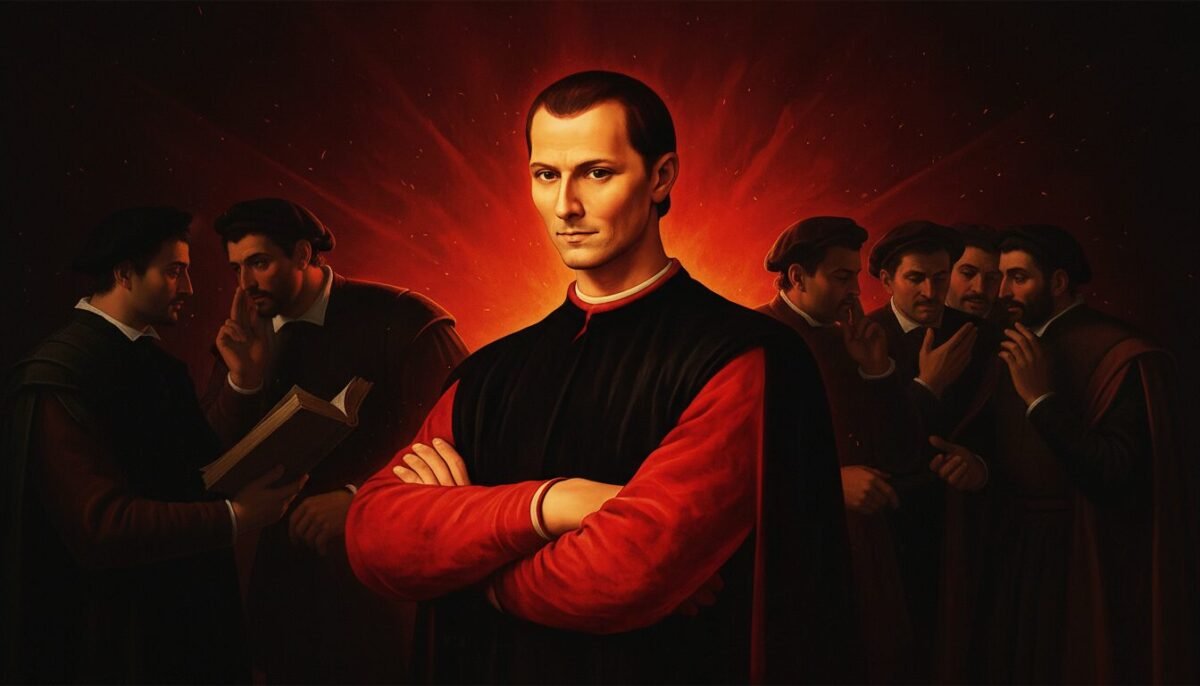
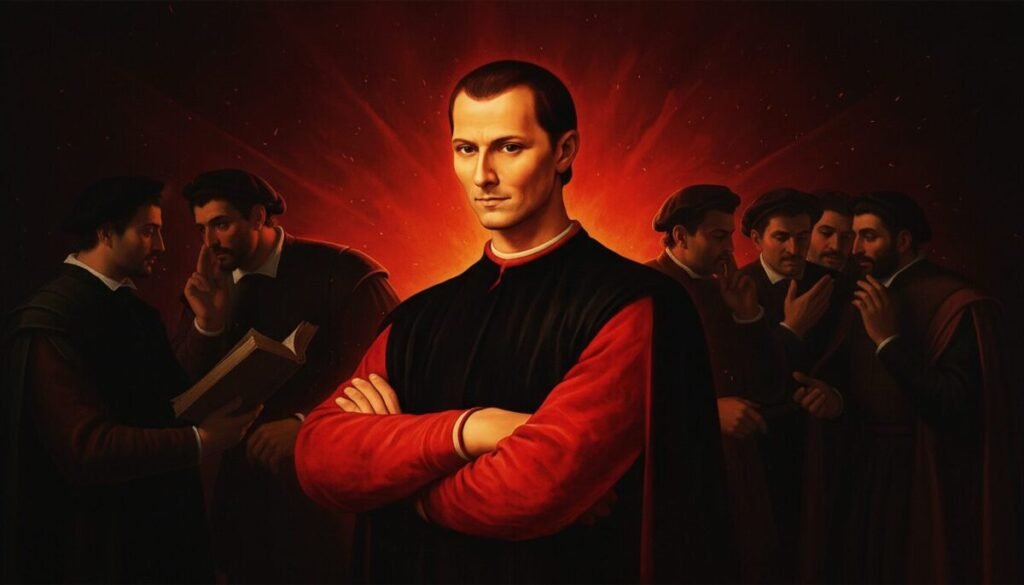
Before he became the infamous architect of modern political realism, was Niccolò Machiavelli merely a product of the very system he sought to deconstruct? We often imagine the author of The Prince as a shadowy figure whispering cold-blooded advice into the ears of tyrants, a man born with a cynical heart and a pre-packaged philosophy of power. But the reality is far more human—and far more fascinating. Machiavelli did not emerge from a vacuum; he was forged in the heat of a crumbling Republic and the quiet dust of a father’s library.
Most readers focus exclusively on his later works, overlooking the formative years and the rigorous classical education that shaped his profound worldview. To understand why Machiavelli believed that it is “better to be feared than loved,” one must first understand the boy who walked the streets of Florence while the Medici family pulled the strings of power, and the young man who realized that in a world of wolves, the sheep are rarely invited to the table. His early life was a masterclass in survival, intellectual rigor, and the observation of a world in constant flux.
1. Birth and Family Lineage: The Impoverished Nobility of Florence
On May 3, 1469, Niccolò Machiavelli was born into a Florence that was the beating heart of the Italian Renaissance. It was a city of soaring cathedrals, groundbreaking art, and a brutal, underlying current of political instability. However, Niccolò did not enter the world in a gilded palace. He was born into what historians often call “impoverished nobility.” The Machiavelli family was ancient and distinguished, with deep roots in the Oltrarno district—the “other side” of the Arno River—but by the time Niccolò arrived, the family’s coffers were significantly lighter than their pedigree suggested.
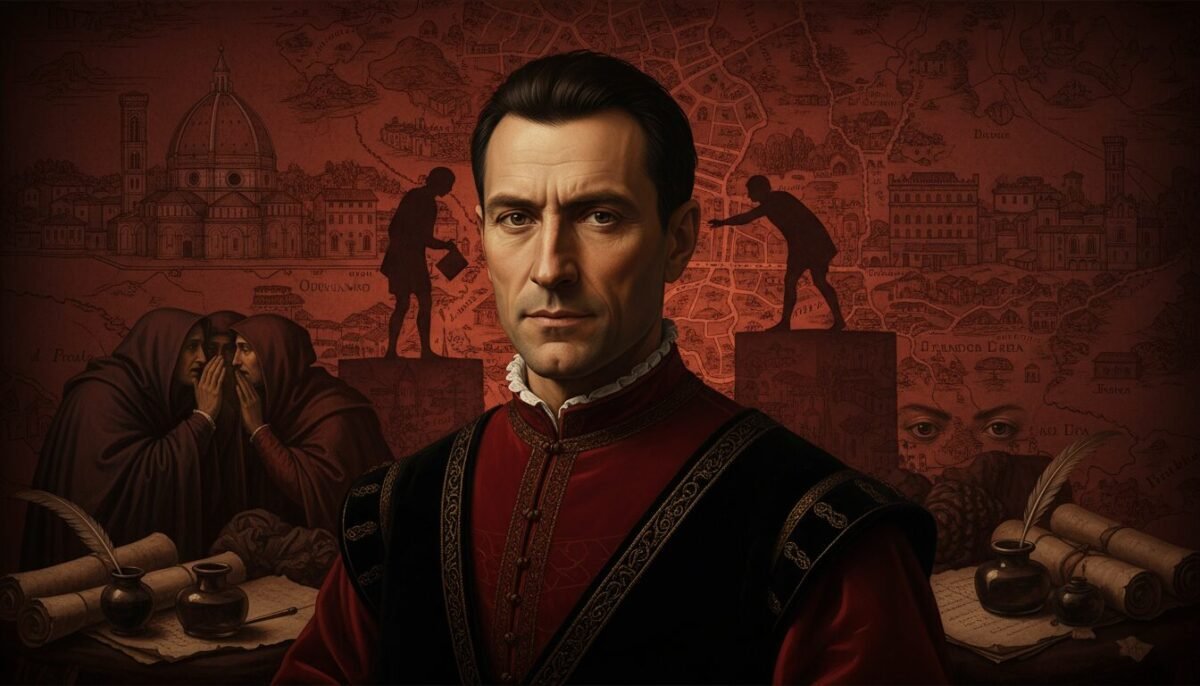
His mother, Bartolomea di Stefano Nelli, was a woman of culture and piety, known to have written religious poems. Yet, the family’s social standing was a complex puzzle. They were popolani grassi—the wealthy merchant class—by lineage, but they lacked the liquid capital to compete with the banking giants of the era. This discrepancy between status and wealth is a critical psychological marker for the young Niccolò. He grew up with the pride of an aristocrat but the daily anxieties of a man who knew exactly how much a loaf of bread cost. This “outsider-insider” perspective allowed him to observe the elite with a detached, often critical eye, never fully belonging to the inner circles of the ultra-wealthy.
Living in the Oltrarno, a neighborhood known for its independent spirit and occasional defiance of the central authorities, Machiavelli was exposed to the raw mechanics of urban life. He saw the disparity between the high-minded rhetoric of the Florentine elite and the gritty reality of the streets. This early exposure to the “impoverished nobility” lifestyle instilled in him a lifelong pragmatism. He learned early on that a noble name meant little if one did not have the power or the resources to defend it.
2. The Influence of Bernardo Machiavelli and the Family Library
If Florence was Machiavelli’s playground, his father’s library was his sanctuary. Bernardo di Niccolò Machiavelli was a lawyer by profession, but his career was perpetually hampered by financial struggles and a legal status that occasionally barred him from holding public office due to unpaid taxes. Bernardo was a man of “modest means,” yet he possessed an intellectual hunger that he passed directly to his son. We know much of this through Bernardo’s Libro di Ricordi (Book of Memories), a meticulous diary and ledger that documents the family’s daily life, from the purchase of wine to the education of his children.
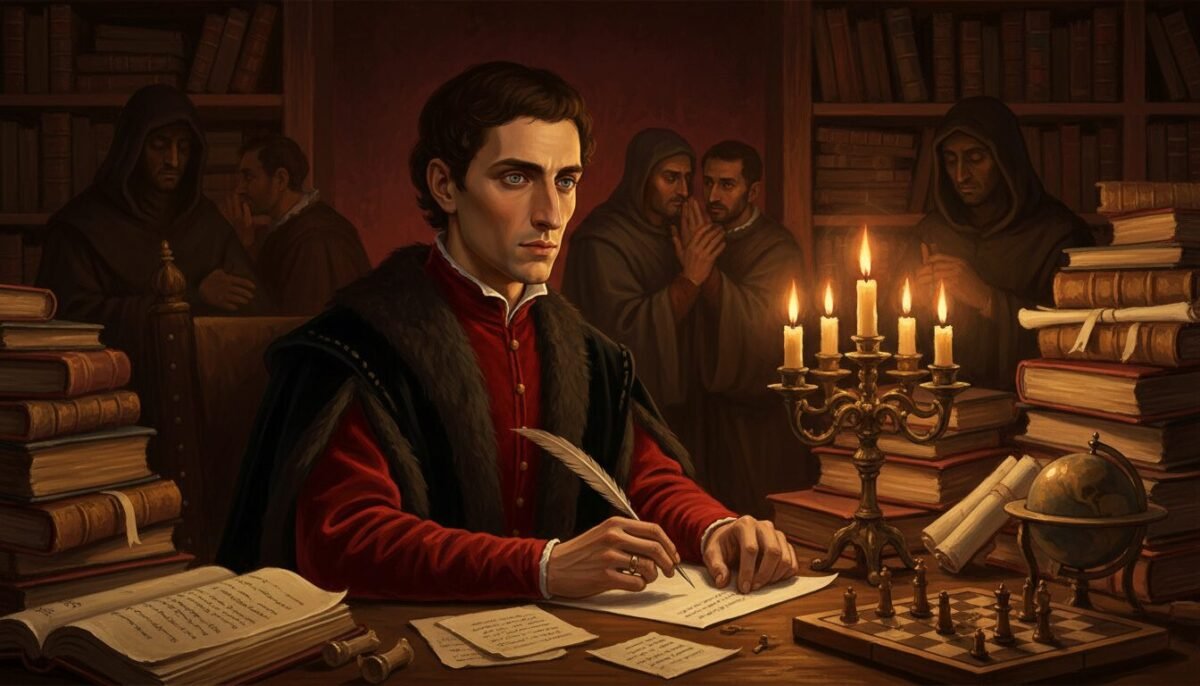
The Libro di Ricordi reveals a father who prioritized books over almost any other luxury. In an era where books were hand-copied or printed in small, expensive batches, Bernardo managed to amass a private library that was nothing short of extraordinary for a man of his standing. This library was Niccolò’s true inheritance. Since the family could not afford the lavish tutors employed by the Medici, Niccolò’s education was largely self-directed through the texts his father painstakingly acquired—sometimes trading legal services for a rare volume of history or philosophy.
This access to classical texts compensated for the family’s lack of liquid wealth. While his peers might have been learning the nuances of courtly life, Machiavelli was devouring the works of the ancients. He wasn’t just reading for entertainment; he was looking for a blueprint. In the silence of that library, the young Machiavelli began to see patterns in history. He saw that the problems facing 15th-century Florence were not new—they had been faced, and sometimes solved, by the Greeks and Romans centuries prior. This realization—that human nature is a constant and history is a cycle—became the cornerstone of his later political philosophy.
3. A Humanist Education: Latin, Rhetoric, and Classical Studies
The 15th-century Florentine curriculum was designed to produce “citizens,” not just workers. For a young man like Machiavelli, this meant a transition from the “abacus school”—where he learned the basic arithmetic and accounting necessary for the merchant life—to a formal, rigorous study of Latin and the studia humanitatis. Under the tutelage of Paolo da Ronciglione, a renowned teacher of the time, Machiavelli mastered Latin grammar by the age of seven. By his teens, he was reading complex texts in their original language, a skill that allowed him to bypass the filtered interpretations of medieval scholars.
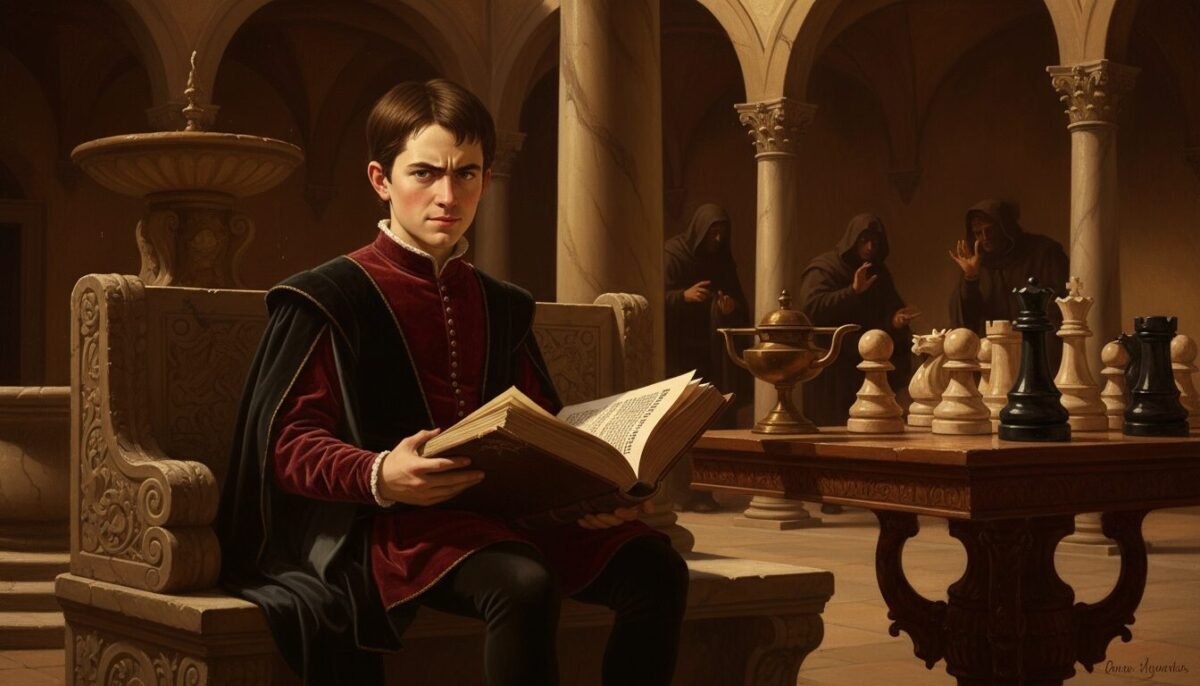
The studia humanitatis—comprising grammar, rhetoric, history, poetry, and moral philosophy—was not merely an academic exercise. It was a vocational training for civic life. Rhetoric, in particular, was the art of persuasion. In the Republic of Florence, where political power often shifted based on one’s ability to sway a council or a crowd, the mastery of language was a weapon. Machiavelli learned how to structure an argument, how to appeal to an audience’s emotions, and how to use historical precedent to justify modern action.
This education instilled in him the belief that the “humanities” were the key to effective governance. He was taught that a leader must be well-versed in the successes and failures of the past to navigate the present. However, unlike many of his contemporary humanists who used these studies to argue for a moral, idealized version of politics, Machiavelli began to use them to strip away the veneer of morality. He looked at the classical world and saw not just “virtue” in the Christian sense, but virtù—the strength, skill, and boldness required to maintain a state.
4. The Shadow of the Classics: Studying Cicero, Livy, and Lucretius
Three ancient voices, in particular, echoed through Machiavelli’s early studies: Cicero, Livy, and Lucretius. Each provided a different layer to his developing worldview. From Cicero, the Roman statesman and orator, Machiavelli learned about the “duty” of the citizen to the state and the importance of republican institutions. However, he also observed Cicero’s ultimate failure to save the Roman Republic from the rise of Caesar, a lesson in the limitations of rhetoric when faced with raw military force.
Livy’s History of Rome was perhaps the most influential text of his life. Machiavelli didn’t just read Livy; he lived within his pages. He was fascinated by the early Roman Republic—how a small city-state grew into a global empire through a combination of civic discipline, military prowess, and a pragmatic approach to conflict. His later work, Discourses on Livy, would be a direct result of these early years of immersion. He saw in the Roman model a blueprint for a strong, stable, and expansionist state that Florence desperately lacked.
Perhaps most surprisingly for his time, Machiavelli showed an early and profound interest in Lucretius’ De rerum natura (On the Nature of Things). This poem, which had been rediscovered only decades earlier, presented an Epicurean view of the universe—a world made of atoms, governed by chance rather than divine providence, where the gods, if they existed, were indifferent to human affairs. This secularism was radical. It provided Machiavelli with a philosophical framework to view politics as a purely human endeavor, free from the constraints of religious dogma. It allowed him to analyze power as a scientist analyzes a chemical reaction: objectively, without the need to label it “good” or “evil.”
5. Florence Under the Medici: A Political Landscape in Flux
While Machiavelli was buried in his books, the world outside was a theater of high-stakes drama. During his youth, Florence was dominated by Lorenzo the Magnificent, the head of the Medici family. On the surface, Florence was a Republic; in reality, it was a principality in all but name, with Lorenzo acting as the puppet master. This “illusion of republicanism” was Machiavelli’s first real-world lesson in political optics. He saw how a leader could maintain the outward forms of liberty while exercising absolute control.
The year 1478 brought a pivotal moment: the Pazzi Conspiracy. When Machiavelli was just nine years old, an attempt was made to assassinate Lorenzo and his brother Giuliano inside the Florence Cathedral during High Mass. Giuliano was killed; Lorenzo escaped. The retaliation was swift and brutal. Machiavelli likely witnessed, or at least heard the vivid accounts of, the conspirators being hung from the windows of the Palazzo Vecchio. This was not a textbook lesson; this was the visceral reality of power, violence, and the consequences of a failed coup. It taught him that in politics, half-measures are fatal.
Later, the rise of the radical friar Girolamo Savonarola provided a different kind of lesson. After the Medici were expelled in 1494, Savonarola turned Florence into a “Republic of Virtue,” burning books and vanities in the streets. Machiavelli watched as the city fell under the spell of religious extremism, only to see Savonarola eventually burned at the stake when he lost his popular support and failed to produce a miracle. From this, Machiavelli derived one of his most famous observations: “All armed prophets have conquered, and the unarmed ones have been destroyed.” He saw that faith without a sword was a recipe for disaster.
6. The Transition to Public Life: Entering the Florentine Chancery
By 1498, the formal phase of Machiavelli’s education ended, and his life as a man of action began. The execution of Savonarola created a political vacuum and a need for new, capable administrators who were not tainted by the previous regime. At the age of 29, despite having no prior experience in public office, Machiavelli was appointed as the Second Chancellor of the Republic of Florence. This was not a minor clerical role; it involved overseeing the city’s territories and handling diplomatic correspondence.
His appointment was a testament to his reputation for intelligence and his mastery of the humanist skills of rhetoric and analysis. He was quickly thrust into the world of international diplomacy, traveling to the courts of kings, popes, and emperors. The transition from the library to the chancery was seamless because he had spent his youth preparing for exactly this. His formative years—the financial struggles, the deep reading of Roman history, and the observation of Medici power—directly translated into his first diplomatic reports.
He didn’t just write reports; he wrote psychological profiles of the leaders he met. He applied the lessons of Livy and Cicero to the kings of France and the Borgia popes. He was no longer just a student of power; he was a practitioner. The “roots of power” he had studied in the classics were now the very things he was managing in the real world. This was the moment the philosopher became the strategist.
Conclusion
Machiavelli’s early life was a unique blend of financial hardship, elite humanist education, and a front-row seat to the political instability of Renaissance Florence. He was a man who understood the value of a classical education but also knew the smell of blood in the streets. These elements combined to create the pragmatic and often controversial political philosopher we study today. He didn’t invent the “dark side” of politics; he simply had the courage and the education to describe it as it actually was, rather than how we wish it to be.
By looking back at his youth, we see that his “cynicism” was actually a form of radical honesty, born from a life spent watching the world prove his books right. If you want to understand the mind that wrote The Prince, look not at the man in power, but at the boy in the library, wondering why the great Republics of the past fell, and how a new one might finally endure.
Curious about how these early lessons manifested in his most famous works? Dive deeper into Machiavelli’s later works by reading our comprehensive guide to The Prince and Discourses on Livy.
Frequently Asked Questions
Was Machiavelli’s family wealthy?
No. While they were of noble lineage and belonged to the established merchant class, they were considered “impoverished nobility.” They had social status but struggled with significant financial debt and lack of liquid assets.
What was the most important part of Machiavelli’s education?
His mastery of Latin and the studia humanitatis (humanist studies) was crucial. This allowed him to read classical Roman historians like Livy and philosophers like Lucretius in their original form, shaping his secular and pragmatic view of history.
How did the Medici family influence his youth?
Machiavelli grew up under the de facto rule of Lorenzo the Magnificent. Observing the Medici taught him how a family could maintain power behind the scenes of a Republic, and events like the Pazzi Conspiracy showed him the brutal reality of political violence.
Did Machiavelli hold a high-ranking position in the government?
Yes, in 1498 he was appointed as the Second Chancellor of the Florentine Republic. This role gave him direct experience in diplomacy and military affairs, which served as the raw material for his later political writings.
Explore more on DeepPsyche:
- Machiavelli & Political Philosophy: The Birth of Realism
- Power & Human Nature: Why We Follow Leaders
- Machiavellianism: Personality Trait or Strategic Necessity?
- Influence & Leadership: Lessons from the Renaissance