
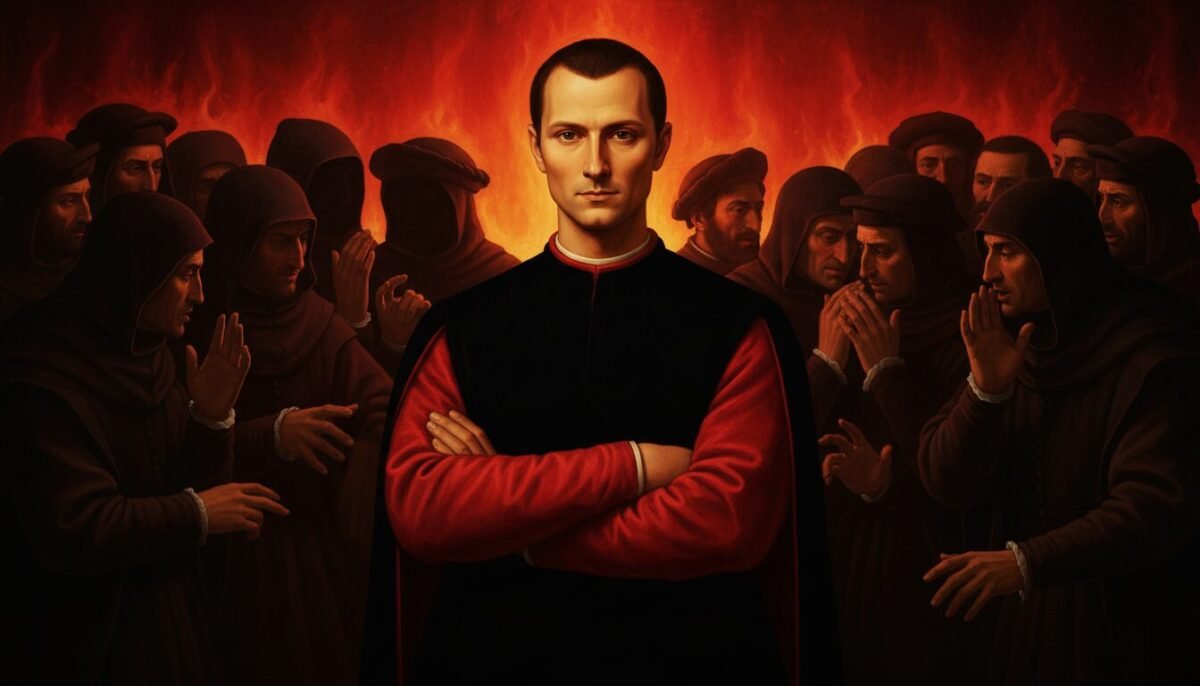
Imagine a man riding hard across the muddy tracks of 16th-century Italy, his cloak heavy with the dust of a dozen principalities. He is not a knight, nor a king, but a middle-aged bureaucrat with a sharp nose and an even sharper eye for human frailty. Before the name “Machiavelli” became a synonym for cold-blooded manipulation, Niccolò Machiavelli was a man in the trenches of Renaissance power, navigating the treacherous courts of kings and popes where a single diplomatic misstep didn’t just mean a lost contract—it meant the extinction of his city-state.
Most modern readers view Machiavelli as a cynical theorist, a dark philosopher who sat in a vacuum and dreamt up ways to be cruel. Yet, this perspective overlooks the fourteen years of high-stakes diplomatic failure and success that forged his worldview. He wasn’t theorizing from an armchair; he was documenting the carnage he saw from the front row. His masterpiece, The Prince, was not a work of imagination, but a post-mortem of the political reality he lived through. This article provides a comprehensive look at Machiavelli’s official role in the Florentine Republic, his most influential diplomatic missions, and how his practical experience birthed modern political science.
1. The Second Chancery: Machiavelli’s Rise in the Florentine Republic
In 1498, the city of Florence was a vacuum of power and anxiety. The fire-and-brimstone preacher Girolamo Savonarola had just been executed, leaving the Republic in desperate need of competent administrators who weren’t tainted by the previous religious fanaticism. Into this void stepped a 29-year-old Niccolò Machiavelli. He was appointed as the head of the Second Chancery, a position that placed him at the heart of the Florentine government’s daily operations.
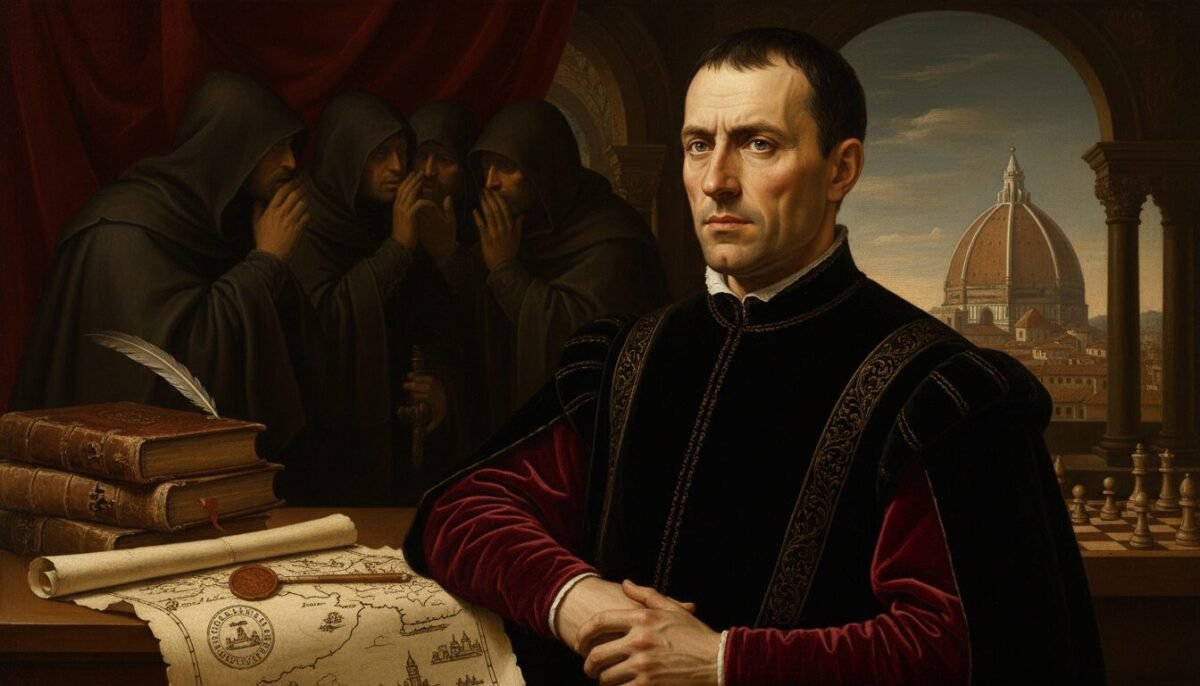
The Second Chancery was responsible for the city’s correspondence regarding its territories and foreign affairs. Shortly after, Machiavelli was also named secretary to the “Council of Ten,” the committee in charge of Florence’s war efforts and diplomatic relations. This wasn’t a glamorous role; it was a grind of logistics, troop movements, and endless letter-writing. However, it provided Machiavelli with a front-row seat to the internal and external machinery of the state. He saw how decisions were made in the heat of crisis and, more importantly, how they were unmade by indecision.
Machiavelli’s transition from a middle-class citizen to a key figure in the diplomatic machinery was rapid. He lacked the noble lineage that usually paved the way for such influence, which meant he had to rely entirely on his wits and his ability to read people. He became the “eyes and ears” of the Republic, sent on “legations”—diplomatic missions—to represent Florentine interests. It was during these missions that the idealistic notions of his youth began to erode, replaced by a gritty, functional understanding of how power actually moves through the world.
2. Missions to the Great Powers: Louis XII and the Holy See
One of Machiavelli’s earliest and most sobering lessons came during his missions to the court of Louis XII of France. At the time, Florence was a secondary power, frequently bullied by the larger European monarchies. In the halls of the French court, Machiavelli was treated not as the representative of a proud Republic, but as “Ser Nihilo”—Mr. Nothing. He watched as the French ministers dismissed Florentine pleas because Florence lacked a standing army and a decisive will.
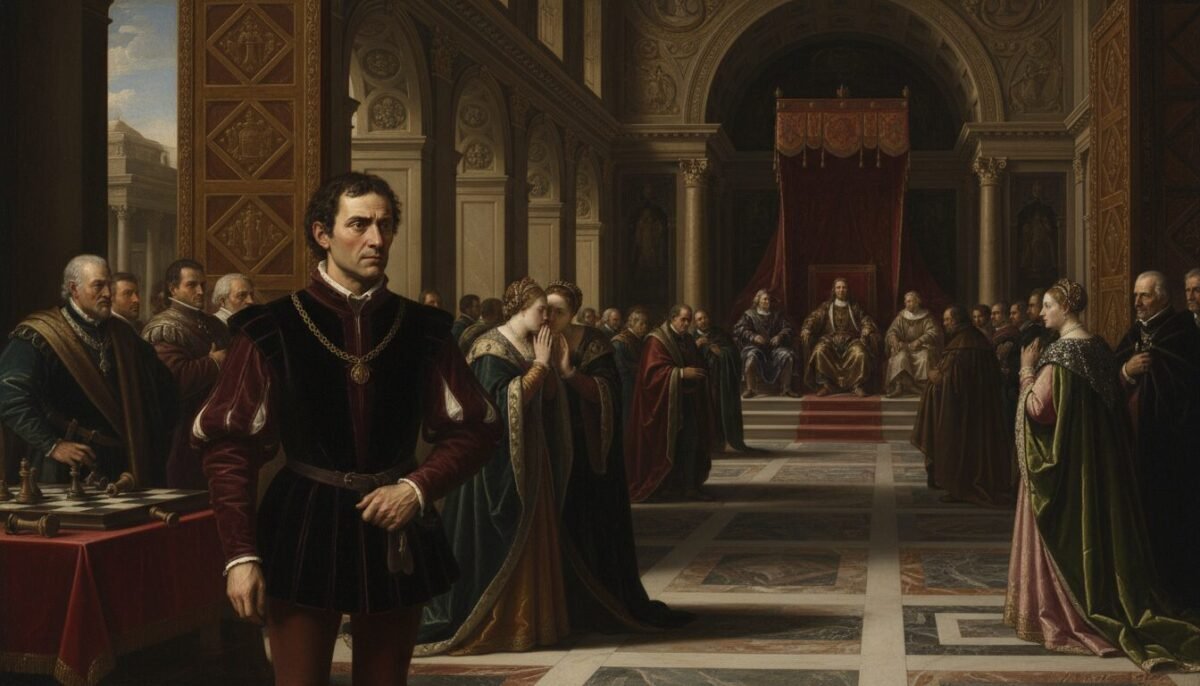
This exposure to the “great players” of Europe taught Machiavelli a fundamental truth: in international politics, your voice is only as loud as your military. He realized that Florence’s reliance on “gold instead of iron” to buy off invaders was a recipe for eventual ruin. His reports back to Florence were increasingly urgent, characterized by a bluntness that often unsettled his superiors. He was witnessing the birth of the modern nation-state in France—centralized, militarized, and decisive—and comparing it to the fractured, bickering nature of the Italian states.
His interactions with the Papacy and the strategic maneuvers of the Holy See during the Italian Wars further refined this perspective. Under the warrior-pope Julius II, Machiavelli saw the church not as a spiritual institution, but as a formidable political entity that used both excommunication and cannons to achieve territorial goals. He observed that the most successful leaders were those who could adapt their “nature” to the times—being a lion when force was needed and a fox when cunning was required. The Holy See’s ability to manipulate the shifting alliances of the Holy League showed Machiavelli that morality was often a secondary concern to the preservation of the state.
3. The Shadow of the Borgia: Cesare Borgia and the Birth of Realism
If France taught Machiavelli about the power of the state, Cesare Borgia taught him about the power of the individual. In 1502, Machiavelli was sent to the court of Borgia, the son of Pope Alexander VI, who was then carving out a dukedom in the Romagna region through a combination of sheer brilliance and terrifying violence. This encounter was the single most transformative experience of Machiavelli’s life.
Machiavelli watched, fascinated, as Borgia invited his rebellious captains to a “friendly” meeting in Senigallia, only to have them all strangled simultaneously. To the average observer, this was a horrific act of treachery. To Machiavelli, it was a masterstroke of political efficiency. By eliminating his enemies in one fell swoop, Borgia had prevented a long, bloody civil war that would have devastated the region and its people. This was the birth of Machiavellian realism: the idea that a leader’s primary duty is the stability of the state, even if it requires “necessary cruelty.”
Why did Machiavelli view Borgia as the “ideal” prince despite his obvious ruthlessness? Because Borgia was effective. Unlike the Florentine government, which hesitated and debated while its enemies gathered at the gates, Borgia acted with “virtù”—a term Machiavelli used to describe a combination of energy, courage, and strategic prowess. He saw a distinction between Borgia’s calculated use of force, which established order, and the ineffective idealism of other Italian leaders, whose “kindness” led to chaos, famine, and foreign occupation. In Borgia, Machiavelli saw the only hope for a unified Italy that could stand against the “barbarian” invasions of France and Spain.
4. From Diplomacy to Defense: The Florentine Militia and the Mercenary Problem
Machiavelli’s diplomatic missions led him to a radical conclusion: a state’s diplomatic strength is inextricably linked to its military self-sufficiency. He had seen firsthand how mercenary captains (the condottieri) would drag out wars to keep getting paid, or worse, switch sides the moment a better offer appeared. To Machiavelli, mercenaries were the cancer of Italy. They were “useless and dangerous,” brave in the tavern but cowards on the battlefield.
In 1506, he finally persuaded the Florentine government to allow him to organize a national militia. He believed that men who were fighting for their own homes, families, and freedom would always outperform those fighting for a paycheck. This was a massive administrative undertaking. Machiavelli spent months traveling through the Florentine countryside, recruiting peasants, and overseeing their training. He was essentially trying to revive the ancient Roman model of the citizen-soldier.
The practical challenges were immense. He had to deal with the deep-seated suspicion of the Florentine elite, who feared that an armed peasantry might turn against them. Despite the skepticism, the militia saw a temporary but glorious success in 1509 when they played a key role in the reconquest of Pisa, a city that had defied Florence for fifteen years. For a brief moment, Machiavelli’s theory that “good laws” and “good arms” were the twin pillars of a successful state seemed to be vindicated. However, the success was short-lived, as the militia would eventually prove no match for the professional, battle-hardened Spanish veterans who would soon descend upon Tuscany.
5. The Fall of the Republic and the End of a Diplomatic Career
The wheels of fortune, or Fortuna as Machiavelli called it, turned violently in 1512. The Spanish-backed Medici family returned to Florence, overthrew the Republic, and dismantled the government Machiavelli had served for fourteen years. For Machiavelli, the fall was total. He was not only dismissed from his post but was also accused of participating in a conspiracy against the new Medici regime.
What followed was the darkest chapter of his life. He was imprisoned and subjected to the “strappado”—a form of torture where the victim’s hands are tied behind their back and they are dropped from a height, wrenching the shoulders out of their sockets. Machiavelli endured four such drops without confessing to a crime he likely didn’t commit. Eventually released during an amnesty, he was penniless and forbidden from entering the city center. He retreated to his small farm in San Casciano, a broken man in the eyes of the world.
The psychological toll of losing his diplomatic status was devastating. In his famous letter to his friend Francesco Vettori, he described his days spent in the mud of the farm, arguing with local woodcutters and playing cards for pennies at the local inn. But at night, he would return home, strip off his muddy clothes, and put on his “curial robes”—the fine garments he wore during his diplomatic missions. In his mind, he would then enter the courts of the ancient greats, conversing with them about the nature of power. This was the environment in which The Prince was written: a desperate attempt to prove his worth to the Medici and regain his place in the halls of power.
6. The Legacy of the Legations: How Diplomacy Birthed ‘The Prince’
It is a mistake to view The Prince as a purely philosophical text. It is, in many ways, the ultimate “job application.” Machiavelli was writing to the Medici, saying, “I have seen how the world works, I have seen why states fail, and I can tell you how to keep this one.” The raw data for his masterpieces—The Prince and the Discourses on Livy—came directly from his “Legazioni,” the official reports he wrote during his years as a diplomat.
When he writes about the need for a prince to be feared rather than loved, he is thinking of the chaos he saw in Romagna before Borgia took control. When he warns against the use of mercenaries, he is recalling the humiliating negotiations he had to conduct on behalf of a defenseless Florence. His diplomatic career was the laboratory where he tested his hypotheses on human nature. He concluded that men are generally “ungrateful, fickle, simulators and deceivers,” and that a leader who ignores this reality does so at their own peril.
The enduring influence of his diplomatic realism is visible today in the “Realpolitik” of modern international relations. From the Cold War strategies of Henry Kissinger to the modern balance-of-power dynamics in the Middle East, the ghost of Machiavelli’s diplomatic reports still haunts the corridors of power. He moved the study of politics from the realm of “how things ought to be” to the cold, hard light of “how things actually are.”
Machiavelli’s career as a diplomat was the crucible in which his political philosophy was forged. By moving from the halls of power to the quiet of exile, he transformed his lived experiences into the foundational texts of political realism. He remains a reminder that the most profound insights into human nature often come not from the sanctuary of the academy, but from the messy, dangerous business of trying to keep a society from falling apart.
Frequently Asked Questions
Was Machiavelli actually “Machiavellian” in his personal life?
Surprisingly, no. In his personal correspondence, Machiavelli often appears as a loyal friend, a devoted (if occasionally unfaithful) husband, and a dedicated civil servant. His “Machiavellian” advice was intended for the preservation of the state, not for personal petty gain.
Did the Medici ever hire him back?
Only partially. He was eventually commissioned to write the Florentine Histories and given some minor diplomatic tasks, but he never regained the level of influence he held during the Republic. He died in 1527, shortly after the Republic was briefly restored, but he was seen as too “Medicean” by the new government to be trusted.
Why is ‘The Prince’ so much more famous than his other works?
The Prince is short, punchy, and intentionally provocative. However, many scholars believe his Discourses on Livy, which argues for the superiority of a republic over a principality, represents his true political heart. The Prince was a specific response to a specific time of crisis.
Internal Link Suggestions:
- Explore the deeper roots of Machiavelli & Political Philosophy to see how his ideas challenged the medieval status quo.
- Understand the dark side of leadership in our analysis of Power & Human Nature.
- Is it a personality trait or a strategy? Read our breakdown of Machiavellianism in the modern workplace.
- Discover the shift from fear to inspiration in Influence & Leadership.
If you found this deep dive into the mind of the Renaissance’s most controversial diplomat intriguing, explore our other profiles on the thinkers who shaped the modern world at DeepPsyche.blog.