

Imagine you are standing in a high-stakes boardroom in the spring of 2026. Your company is facing a hostile takeover that could dismantle a decade of innovation. To save the firm, you have two options. You could leak a fabricated scandal about the rival CEO to tank their stock price—a move that is deceptive but guaranteed to work. Or, you could pivot your entire business model in forty-eight hours, making your company so indispensable to a new market that the takeover becomes irrelevant. One path relies on the strategic manipulation of people; the other relies on the strategic manipulation of reality.
Is the pursuit of success inherently ruthless, or can it be grounded in practical wisdom without sacrificing integrity? In the high-stakes environments of 2026, leaders often struggle to distinguish between effective strategic thinking and cold, manipulative opportunism. We live in an era where “getting things done” is the ultimate currency, yet the line between being a “shrewd operator” and a “moral vacuum” has never been thinner. This article provides a comprehensive breakdown of Machiavellianism and Pragmatism, clarifying their historical roots, ethical boundaries, and psychological impacts to help you refine your own decision-making framework.
1. Historical Foundations: From ‘The Prince’ to American Pragmatism
To understand the friction between these two mindsets, we must look back at the intellectual giants who defined them. Machiavellianism finds its roots in 16th-century Florence with Niccolò Machiavelli. His seminal work, The Prince, was not intended as a guide to villainy, but as a cold-blooded observation of political realism. Machiavelli lived in a fractured Italy plagued by foreign invasions and internal betrayal. For him, the primary goal of a leader was the preservation of the state and the maintenance of power. If a leader had to be “a fox to discover the snares and a lion to terrify the wolves,” it was simply a requirement of the job. His focus was on power preservation—the idea that the stability of the collective justifies the moral flexibility of the individual.

Fast forward to the late 19th century, and we see the birth of American Pragmatism, led by thinkers like William James and John Dewey. This was a philosophy born not of political desperation, but of scientific and social inquiry. Pragmatism asks a deceptively simple question: “What is the truth of an idea?” For James, the answer was its “cash value”—the practical difference it makes in the world. If a theory works and produces beneficial results, it is, for all intents and purposes, true. Unlike Machiavelli’s focus on the ruler’s dominance, Dewey and James prioritized functional solutions to social, educational, and scientific problems.
The contrasting motivations here are stark. Machiavellianism is born from a quest for absolute power in a chaotic world. Pragmatism is born from a quest for functional truth in a complex world. While both value “results,” the Machiavellian defines results by how much control they have gained, whereas the Pragmatist defines results by how effectively a problem has been solved for the benefit of the system.
2. The ‘Ends Justify the Means’ Debate: Ethical Boundaries
The most common point of confusion between these two philosophies is the famous (or infamous) adage: “The ends justify the means.” Both the Machiavellian and the Pragmatist might agree with this statement on the surface, but they differ radically on what constitutes a justifiable “end.”
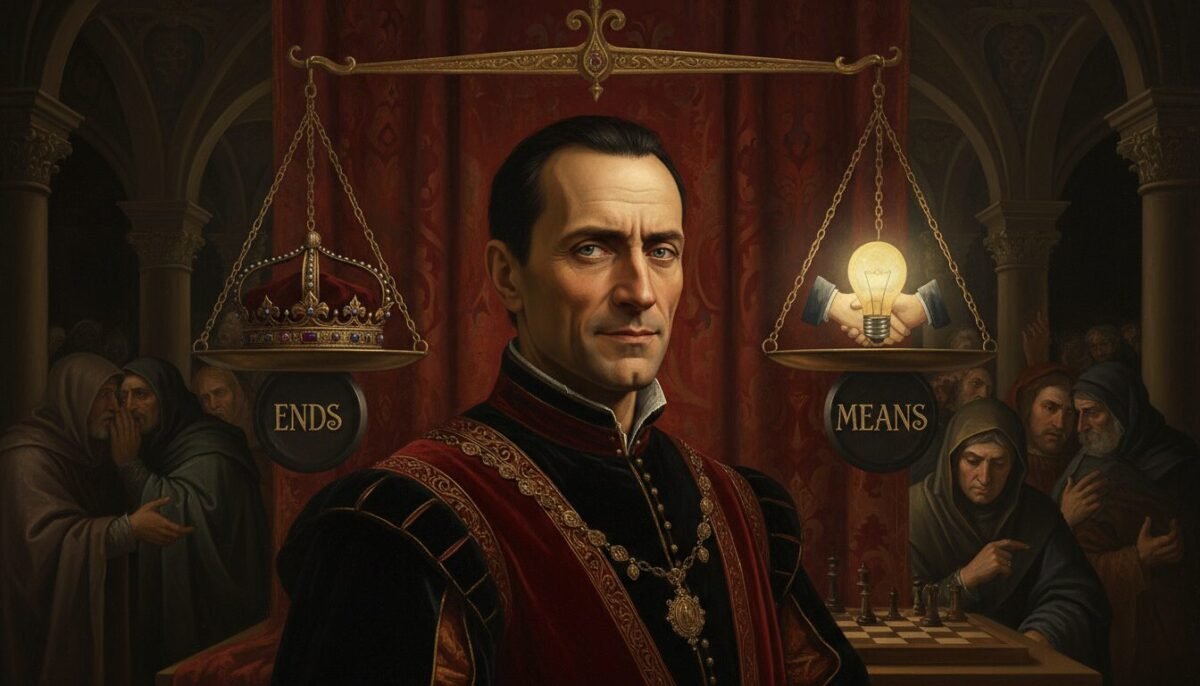
For the Machiavellian, the “end” is almost always the acquisition or maintenance of personal or state power. Because power is the ultimate goal, any “means”—including deceit, betrayal, or the strategic use of fear—is considered a valid tool. In this framework, ethics are secondary to efficacy. If lying to a business partner prevents a corporate collapse that would benefit the leader, the lie is seen as a necessary tactical maneuver. The Machiavellian operates in the shadows; secrecy is their greatest asset because their motives are often self-serving.
The Pragmatic “end,” however, is the improvement of the human experience and the resolution of tangible problems. A pragmatist might also exhibit moral flexibility, but it is directed toward a constructive outcome. For example, a pragmatic leader in 2026 might bypass a rigid, outdated corporate policy to ensure a team gets the resources they need during a crisis. They are willing to bend the rules, but they do so to make the system work better, not to consolidate their own ego. This is where ethical pragmatism diverges from pure utilitarianism; it isn’t just about the “greatest good for the greatest number,” but about the most functional path forward in a messy reality.
Crucially, pragmatists value public accountability. Because their goal is a functional solution, they need the solution to stand up to the light of day. If a pragmatic solution requires constant lying to maintain, it isn’t actually a “working” solution—it’s a liability. Machiavellians rely on the dark; Pragmatists rely on the data.
3. Psychological Perspectives: Dark Triad vs. Cognitive Method
The difference between these two frameworks isn’t just philosophical; it’s deeply psychological. In modern psychology, Machiavellianism is recognized as one of the “Dark Triad” personality traits, alongside narcissism and psychopathy. It is characterized by a cynical view of human nature, a lack of conventional morality, and a tendency toward interpersonal manipulation. For a Machiavellian, other people are not collaborators; they are chess pieces to be moved or sacrificed.
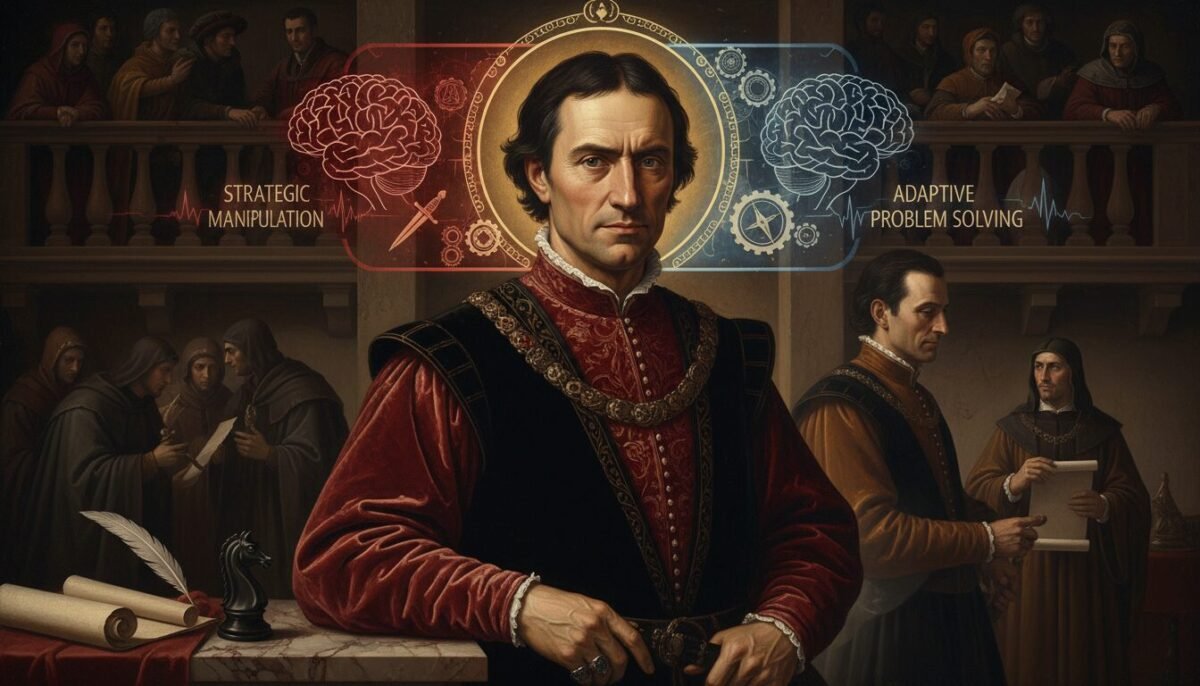
Pragmatism, by contrast, is a cognitive style and a philosophical method rather than a fixed personality trait. Anyone can learn to be pragmatic. It involves a high degree of cognitive flexibility—the ability to change one’s mind when presented with new evidence. While a Machiavellian is rigid in their goal (power) but flexible in their tactics, a Pragmatist is flexible in both their methods and their goals based on what the situation requires.
This leads to a fascinating divide in how these two types use empathy. The Machiavellian often possesses high “cognitive empathy”—they understand exactly what you are feeling, but they use that knowledge to exploit your vulnerabilities. They read the room to control it. The Pragmatist uses empathy as a tool for collaboration. They seek to understand the needs of stakeholders so they can design a solution that actually sticks. In terms of team trust, the Machiavellian’s presence eventually erodes the social fabric, leading to a “every person for themselves” mentality. The Pragmatist builds trust by consistently delivering results that benefit the collective, even if they have to make tough, unpopular calls to get there.
4. Leadership Styles: Strategic Pragmatist vs. Machiavellian Opportunist
In the corporate landscape of 2026, identifying which type of leader you are working for—or becoming—is vital for long-term survival. A Machiavellian leader is often easy to spot once you look past their initial charisma. They prioritize short-term gains that make them look good to superiors or shareholders, often at the expense of long-term stability. You will notice high turnover in their departments, a “divide and conquer” management style where teammates are pitted against each other, and a trail of “burned” mentors and peers. They thrive in chaos because it allows them to mask their maneuvers.
A pragmatic leader, however, is defined by adaptability and data-driven decisions. They aren’t interested in being the “hero” or the “ruler”; they are interested in what works. In 2026, as companies navigate the total integration of AI and the complexities of a fully remote, global workforce, the pragmatic leader shines. They don’t cling to “the way we’ve always done it” if the data shows a better way. They foster a culture of innovation and practical feedback. If a project fails, a Machiavellian looks for someone to blame; a Pragmatist looks for the flaw in the process.
The organizational cultures they create are polar opposites. A Machiavellian culture is one of fear and information hoarding. A pragmatic culture is one of transparency and iterative growth. In an era where talent can move to a new job with a single click, the Machiavellian leader finds themselves increasingly isolated, while the Pragmatist attracts the best minds because they provide a stable, functional environment where work actually gets done.
5. The Overlap: When Pragmatic Logic Mirrors Machiavellian Tactics
It would be a mistake to suggest these two worlds never touch. There are moments—crisis management, wartime, or radical corporate restructuring—where “necessary evils” are required. When a CEO has to lay off 1,000 people to save the jobs of 10,000, the action itself looks cold and calculating. Is this Machiavellian or Pragmatic?
This is the “Subset Argument”: some argue that Machiavellianism is simply a narrow, amoral subset of pragmatism. However, the distinction lies in the underlying “why.” If the CEO makes those cuts to protect the company’s future and ensures the transition is handled with as much dignity and support as possible, it is a pragmatic move. If the CEO makes those cuts specifically to hit a quarterly bonus target, knowing the company will suffer in the long run, it is Machiavellian opportunism.
The danger for many well-meaning leaders is “Pragmatic Drift.” This occurs when a leader starts with pragmatic intentions but slowly adopts Machiavellian habits—like withholding information or manipulating perceptions—to maintain efficiency. They tell themselves it’s “for the good of the project,” but eventually, the tactics become the strategy. Distinguishing intent is the only way to prevent this drift. You must constantly ask: “Am I doing this to solve the problem, or to protect my position?”
6. Long-Term Consequences: Impact on Culture and Reputation
History and modern data both suggest a “Machiavellian Trap.” While manipulative tactics can lead to rapid ascent, they almost always result in a spectacular collapse. In the hyper-connected world of 2026, where transparency tools and blockchain-verified reputations make it nearly impossible to hide one’s track record, the “fox” eventually runs out of places to hide. Social isolation is the natural end state for the Machiavellian; once people realize they are being used, they stop cooperating.
The “Pragmatic Legacy,” conversely, is built on the creation of long-term institutional value. Pragmatists leave behind systems that work, teams that are empowered, and a reputation for being a “straight shooter” even when the news is bad. In the digital age, your reputation is your most valuable asset. Choosing a pragmatic framework isn’t just “nicer”—it is strategically superior for career longevity. It allows you to build a network of genuine allies rather than a list of temporary accomplices.
While Machiavellianism and Pragmatism both value results, they are separated by their ethical foundations and psychological roots. Machiavellianism focuses on the self-serving acquisition of power through manipulation, whereas Pragmatism seeks effective, adaptable solutions for the greater good. Understanding these nuances is essential for any leader or student of philosophy in 2026. Are you leading with purpose or just playing the game? Evaluating your strategic framework today will determine the legacy you leave tomorrow.
Frequently Asked Questions
Can a person be both Machiavellian and Pragmatic?
While the two share a focus on results, they are often mutually exclusive in their core intent. A person might use pragmatic methods to achieve Machiavellian ends, but the psychological drive—power vs. function—usually leans toward one pole or the other.
Is Machiavellianism always “evil”?
In a strictly philosophical sense, Machiavelli argued his methods were “amoral” rather than “immoral”—tools to be used for the survival of the state. However, in interpersonal and modern business contexts, these tactics often cause significant harm to trust and culture.
How can I become more pragmatic without becoming manipulative?
Focus on transparency and the “why” behind your decisions. A pragmatist is willing to show their work and explain the logic of their choices, whereas a manipulator relies on keeping others in the dark.
Which philosophy is better for a startup environment?
Pragmatism is almost always superior for startups. The need for rapid iteration, honest feedback, and intense team collaboration makes the “divide and conquer” tactics of Machiavellianism toxic to a growing company.
If you found this analysis of power and logic compelling, you might also enjoy our deep dives into Machiavellianism, the intersection of Power & Human Nature, or our guide to Influence & Leadership. Explore more at DeepPsyche.blog to refine your strategic mind.