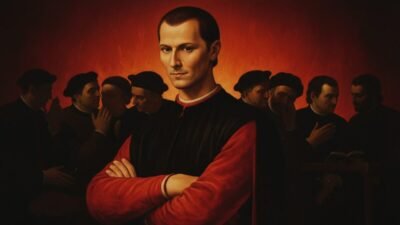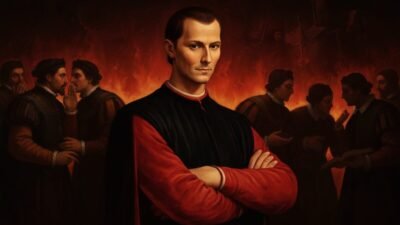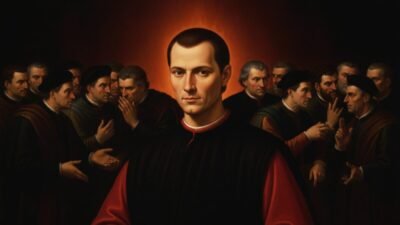
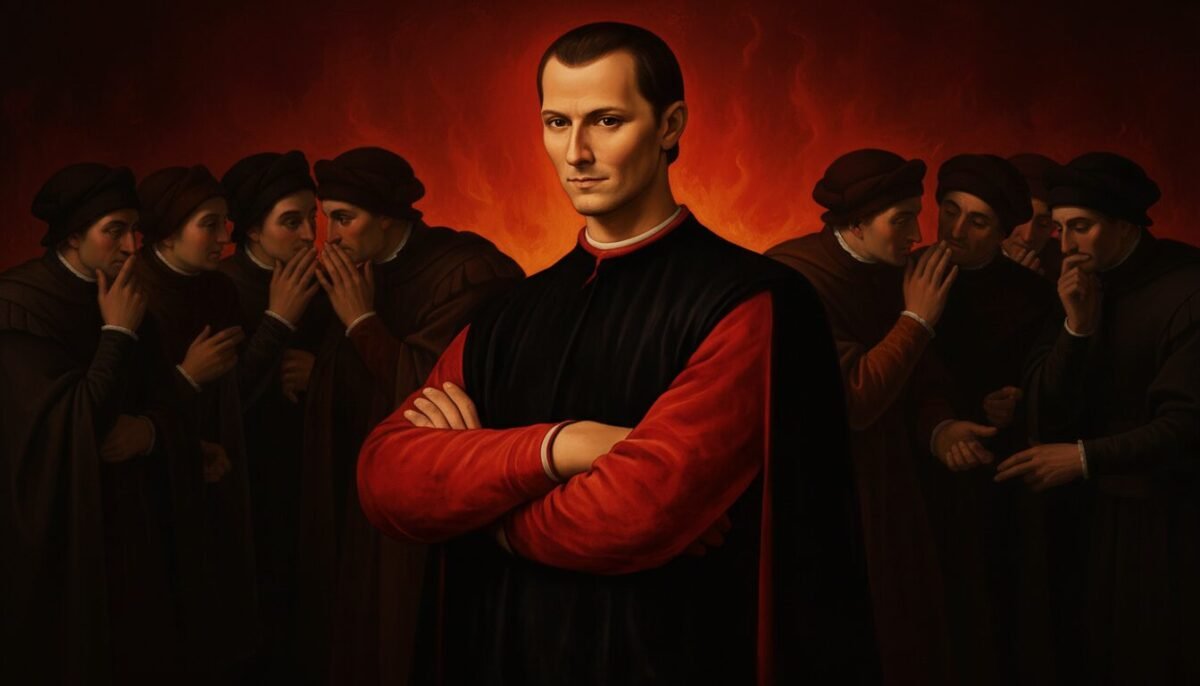
Is Niccolò Machiavelli truly the “teacher of evil” history claims him to be, or is his name being used to describe a personality type he never actually embodied? For centuries, the name “Machiavelli” has been whispered with a mix of fear and disdain, conjuring images of shadowy figures, backstabbing courtiers, and the cold-blooded pursuit of power at any cost. We call people “Machiavellian” when they are manipulative, deceitful, and emotionally detached. But if you were to travel back to 16th-century Florence and meet the man himself, you might be surprised to find not a monster, but a dedicated civil servant, a lover of liberty, and a man who was deeply concerned with the survival of his community.
Most people today conflate the ruthless psychological trait of Machiavellianism with the actual political philosophy of the man who wrote The Prince. This confusion has done a great disservice to both history and psychology. By stripping Machiavelli’s ideas of their context, we have turned a complex political theorist into a cartoon villain. To understand the truth, we need to peel back the layers of myth and look at the world Machiavelli inhabited, the crisis he was trying to solve, and how a 500-year-old job application became the blueprint for modern psychological manipulation.
1. The Man Behind the Myth: Niccolò Machiavelli and the Italian Renaissance
To understand Machiavelli, you have to understand the chaos of the Italian Renaissance. While we often think of this era as a time of beautiful art and intellectual rebirth, for those living through it, it was a period of terrifying instability. Italy was not a unified nation; it was a collection of warring city-states—Florence, Milan, Venice, Rome—constantly being trampled by the massive professional armies of France and Spain. Betrayal was the standard currency of diplomacy, and a city could be sacked and burned overnight because of a single failed alliance.
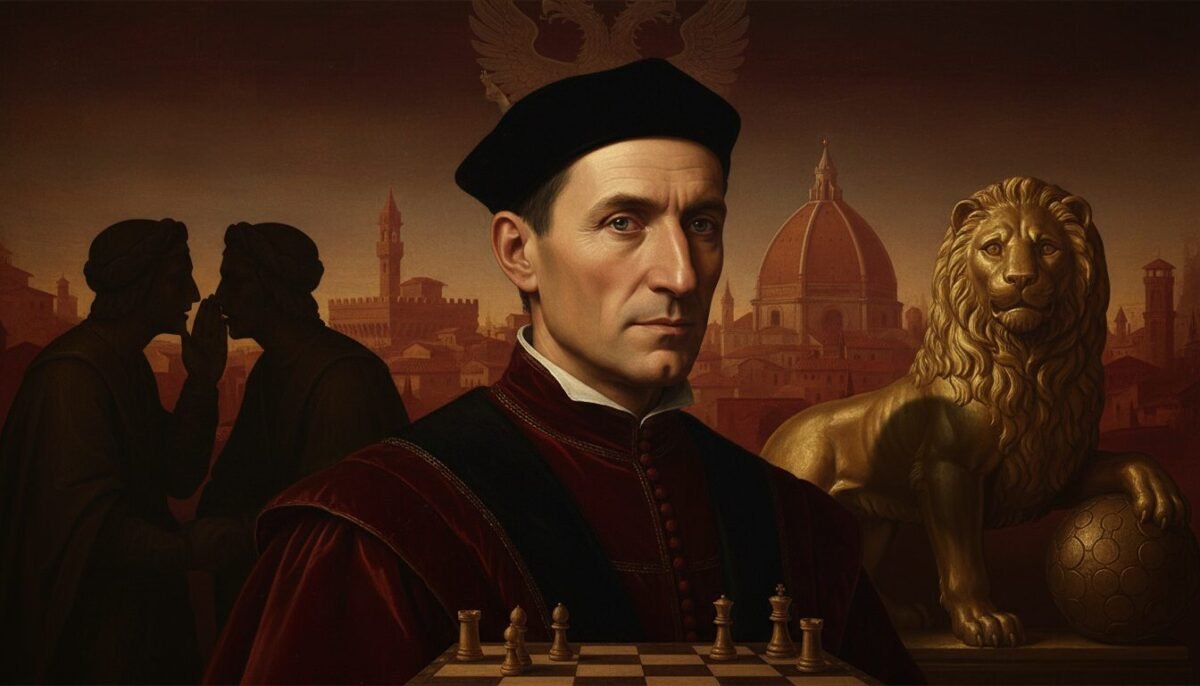
Machiavelli was not a prince or a nobleman. He was a diplomat and a civil servant in the Florentine Republic. For fourteen years, he traveled across Europe, meeting with kings, popes, and warlords. He saw firsthand how the “idealistic” leaders—those who tried to play by the rules of Christian morality—were often the first to be executed or exiled, leaving their citizens to suffer the consequences of their “virtue.”
Crucially, Machiavelli was a staunch republican. In his longer, more academic work, Discourses on Livy, he argued passionately for a government with checks and balances, the rule of law, and a citizen militia. He loved Florence and believed that the best form of government was one where the people had a voice. So, why did he write The Prince, a book that seems to advocate for autocracy?
The answer is simpler and more human than many realize: he was unemployed and desperate. After the Medici family retook power in Florence, Machiavelli was ousted from his position, imprisoned, and tortured. The Prince was essentially a job application—a “look what I know” manual intended to prove his worth to the new rulers so he could return to the service of his city. It wasn’t a moral manifesto; it was a pragmatic survival guide for a leader who needed to stabilize a fractured state before it was swallowed by foreign invaders.
2. Deconstructing ‘The Prince’: Political Realism vs. Moral Villainy
When people read The Prince today, they often react with shock at its coldness. But Machiavelli wasn’t trying to be “evil”; he was practicing what we now call political realism. He believed that if you want to fix a problem, you have to see the world as it actually is, not as you wish it to be. He famously wrote that a man who tries to be good in all matters will inevitably come to ruin among so many who are not good.
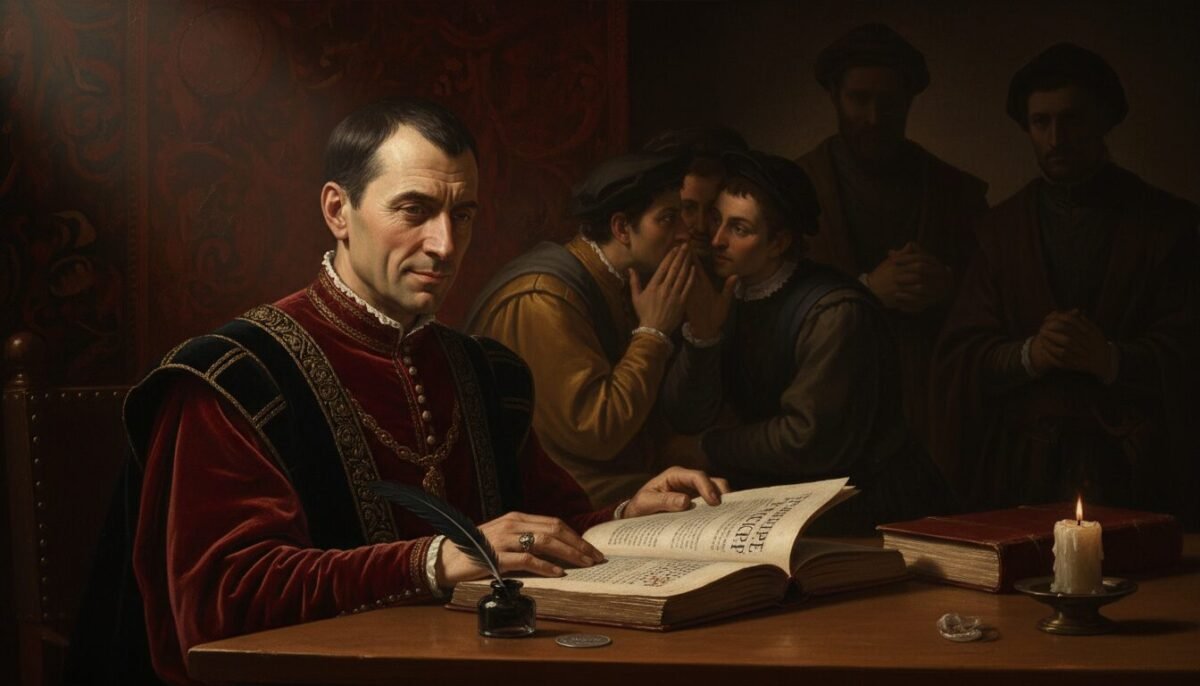
One of the biggest myths surrounding Machiavelli is that he coined the phrase “the end justifies the means.” In reality, he never wrote those exact words. What he actually suggested was that in the actions of all men, and especially of princes, “one looks at the result” (si guarda al fine). This is a subtle but vital distinction. He wasn’t giving everyone a license to be a jerk in their daily lives; he was arguing that a leader’s primary responsibility is the safety and stability of the state. If a leader has to break a promise to prevent a civil war that would kill thousands, Machiavelli argued that the “result”—peace and security—justifies the difficult choice.
He also made a sharp distinction between “necessary cruelty” and senseless violence. To Machiavelli, a leader who uses violence for personal gain or out of sheer malice is a tyrant, and he had no respect for tyrants. However, a leader who uses a “well-placed” act of severity to prevent greater chaos is actually being more merciful in the long run. For Machiavelli, the ultimate sin for a leader wasn’t being “bad”—it was being weak. Weakness led to instability, and instability led to the ruin of the common people.
3. The Psychological Evolution: Machiavellianism as a Personality Trait
If Machiavelli was a political theorist focused on the state, how did his name become a clinical term for a specific type of person? The transition happened in the 1970s, when social psychologists Richard Christie and Florence Geis became interested in how some people are naturally better at manipulating others than others.
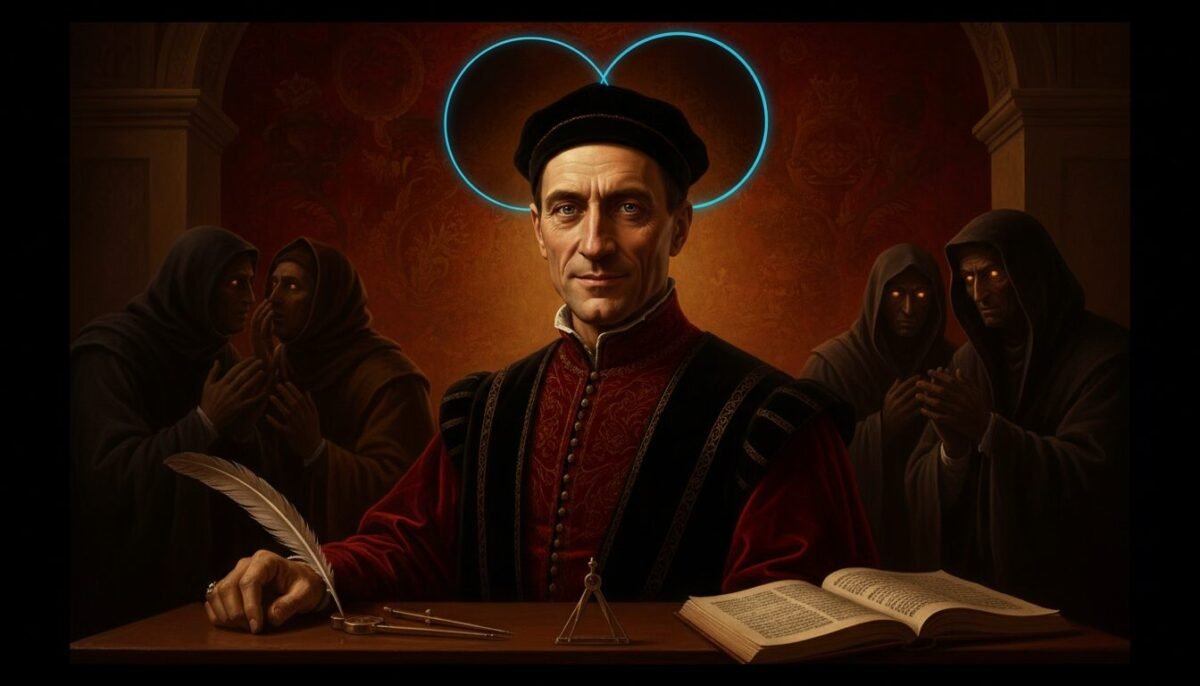
They developed what is known as the Mach-IV scale, a personality survey designed to measure a person’s level of “Machiavellianism.” They took themes from Machiavelli’s writings—cynicism about human nature, a preference for expediency over morality, and a detached approach to social interaction—and turned them into a psychological profile. A “High Mach” individual is someone who views others as pawns in a game. They are emotionally cool, highly strategic, and lack the internal moral compass that usually prevents people from exploiting their peers.
In modern psychology, Machiavellianism is now recognized as one-third of the “Dark Triad,” alongside narcissism and psychopathy. While narcissists crave attention and psychopaths lack empathy and impulse control, Machiavellians are the “calculators.” They aren’t necessarily loud or aggressive; they are the ones who quietly observe the room, identify everyone’s weaknesses, and move the pieces to ensure they come out on top. They don’t manipulate for the “good of the state”—they do it for their own ego, career, or bank account.
4. Machiavellianism vs. Machiavelli: Key Philosophical Differences
This is where the man and the trait diverge sharply. The primary difference lies in the purpose of the manipulation. For Niccolò Machiavelli, the goal was always collective. He valued the state, the community, and the long-term survival of the republic. He believed a leader should be willing to “lose his soul” for the sake of his people. There is a sense of tragic duty in his writing—a realization that power is a heavy, often dirty burden that must be carried for the common good.
In contrast, the “High Mach” personality is purely individualistic. A modern Machiavellian doesn’t care about the stability of the company or the health of the community; they care about their own advancement. Where Machiavelli advocated for virtù—a Renaissance concept meaning prowess, skill, and civic energy—the modern Machiavellian often lacks any sense of civic duty. They use deceit not as a last resort to save a city, but as a first resort to get a promotion.
Furthermore, Machiavelli’s strategy was rooted in deep historical analysis and long-term thinking. He studied the rise and fall of Rome to understand patterns of human behavior. The “High Mach” trait, however, can often manifest as impulsive deceit. While they are strategic, their goals are frequently short-sighted. They might win the immediate battle by burning a bridge, but they fail to see that they have destroyed the very network they need to survive in the future. Machiavelli would have called this “bad statecraft.”
5. Why the Name Became a Pejorative: The History of a Bad Reputation
Machiavelli’s reputation didn’t just happen by accident; it was a coordinated effort. Shortly after his death, the Catholic Church placed his works on the Index Librorum Prohibitorum (the list of prohibited books). To the Church, Machiavelli was dangerous because he dared to suggest that politics and religion should be separate. He argued that a leader couldn’t always follow the Ten Commandments if he wanted to keep his country from being invaded. This was heresy.
The term “Old Nick,” a popular English nickname for the Devil, is even thought by some to be a jab at Niccolò Machiavelli. During the Elizabethan era, English playwrights like Shakespeare and Christopher Marlowe created a stock character known as the “Machiavel.” This character was a stage villain who would look at the audience and boast about his cleverness and lack of conscience. These plays were massive hits, and they successfully cemented the idea in the public mind that “Machiavellian” meant “sneaky and evil.”
The irony is that while the world was busy calling him a devil, they were ignoring his most important work: The Discourses on Livy. In those pages, Machiavelli reveals himself to be a lover of freedom who hated tyrants. He argued that the people are wiser and more constant than a prince. But because The Prince was shorter, punchier, and more scandalous, it became the only book anyone remembered. The nuanced political scientist was buried under the weight of a catchy, pejorative label.
6. Reclaiming the Legacy: Machiavelli’s Contribution to Modern Political Science
Despite the “evil” label, Machiavelli is rightfully considered the father of modern political science. Before him, political writing was mostly “mirror for princes” literature—books that told leaders they should be pious, kind, and generous. Machiavelli was the first to say, “Let’s stop talking about how things should be and look at how they are.”
His realism cleared the way for future thinkers like Thomas Hobbes, Baruch Spinoza, and even the American Founding Fathers. John Adams and James Madison studied Machiavelli not because they wanted to be “evil,” but because they wanted to understand how to build a government that could survive the inherent selfishness of human nature. They took his idea of “checks and balances” and turned it into a cornerstone of modern democracy.
Understanding the difference between the man and the trait matters because it teaches us how to look at power. If we simply dismiss Machiavelli as “the guy who liked evil,” we miss out on his vital insights into how systems actually work. At the same time, if we understand the “High Mach” personality trait, we can better protect ourselves from individuals who use those same strategies for purely selfish, destructive ends.
Frequently Asked Questions
Did Machiavelli actually say “the end justifies the means”?
No. He wrote that “one looks at the result,” specifically in the context of a leader maintaining the security of a state. He did not believe that individuals have a moral green light to do whatever they want for personal gain.
Is being Machiavellian always a bad thing?
In psychology, high levels of Machiavellianism are associated with manipulation and lack of empathy. However, in leadership, a degree of “strategic pragmatism”—the ability to make tough decisions for the greater good—is often necessary. The key is the intent behind the action.
What is the difference between a Machiavellian and a sociopath?
While they share some traits, sociopaths (or psychopaths) often have poor impulse control and a complete lack of remorse. Machiavellians are usually very controlled, highly patient, and strategic. They don’t necessarily enjoy hurting people; they just see it as a tool to reach a goal.
What should I read to understand the real Machiavelli?
While The Prince is the most famous, you should read Discourses on Livy to see his true political heart. It shows his preference for republics, liberty, and the power of the people over the whims of a single ruler.
The next time you hear someone labeled as “Machiavellian,” ask yourself: are they acting for the benefit of the community, or are they just playing a game where they are the only winner? Niccolò Machiavelli would have known the difference. He knew that power, when stripped of its purpose, is nothing more than vanity. But power used to protect a people? That was the only thing worth writing about.
Want to dive deeper into the mind of the Renaissance’s most misunderstood thinker? Explore our related guides on Machiavelli & Political Philosophy or learn how to spot the “Dark Triad” in our analysis of Influence & Leadership.