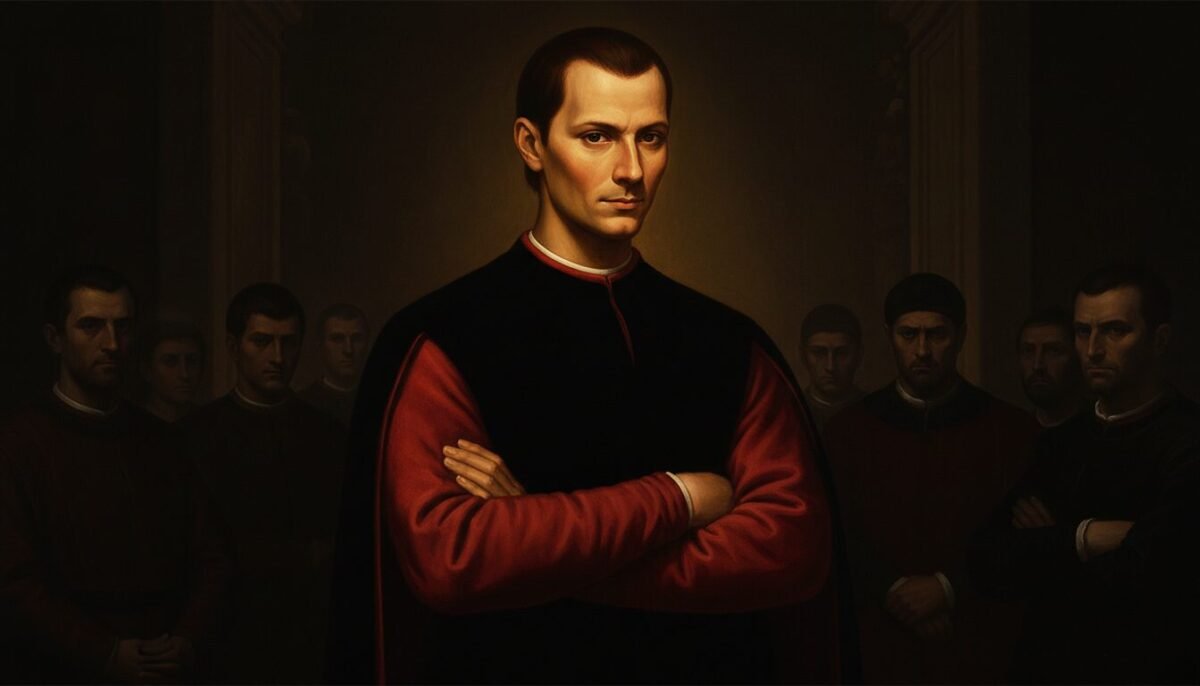
Is it better to be loved or feared? This provocative question, posed by Niccolò Machiavelli over five centuries ago, continues to define the boundaries of modern political strategy. Imagine a CEO in 2026 facing a hostile takeover, or a world leader navigating a delicate ceasefire. They are forced to choose between the path of the “saint” and the path of the “pragmatist.” Most people, when hearing the term “Machiavellian,” immediately think of a shadowy figure, a puppet master pulling strings with a cynical smirk. We associate him with “evil” manipulation, yet this surface-level dismissal fails to grasp his profound contributions to secular governance and political realism.
Machiavelli did not invent the dark side of human nature; he simply had the courage to describe it without the comforting lens of religious dogma. By stripping away the “shoulds” of medieval philosophy, he revealed the “is” of power. This article provides a deep dive into Machiavelli’s core principles, his distinction between private and political morality, and why he remains the undisputed father of modern political science.
1. The Historical Context of Niccolò Machiavelli and the Italian Renaissance
To understand Machiavelli, one must first understand the chaos of 16th-century Italy. Far from being a unified nation, Italy was a fractured collection of city-states—Florence, Venice, Milan, Naples, and the Papal States—constantly at each other’s throats. It was a playground for foreign powers like France and Spain, who treated the Italian peninsula as a chessboard for their own imperial ambitions.
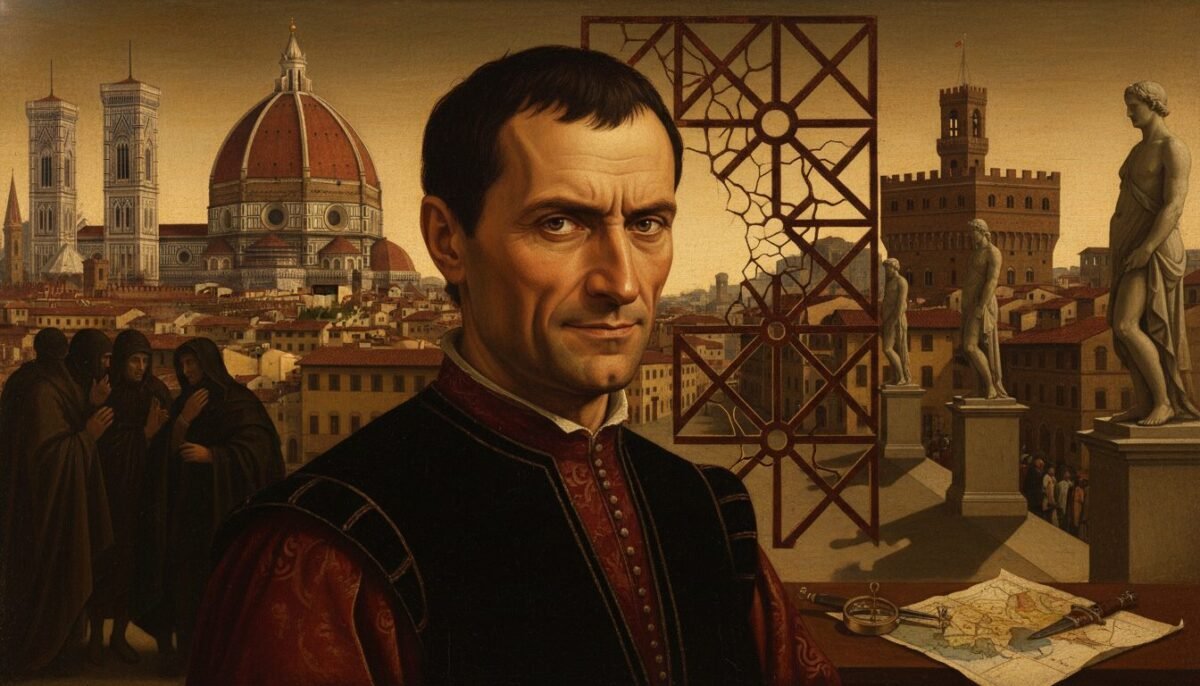
Niccolò Machiavelli was not a philosopher sitting in an ivory tower. He was a man of action, a diplomat, and a civil servant for the Florentine Republic. For fourteen years, he witnessed firsthand the betrayals, the sudden shifts in loyalty, and the brutal efficiency of leaders like Cesare Borgia. However, his world collapsed in 1512 when the Medici family, backed by Spanish troops, returned to power in Florence. Machiavelli was dismissed from his post, imprisoned, and even tortured on suspicion of conspiracy. It was during his subsequent exile to a small farm in San Casciano that he penned his most famous works.
This period marked a seismic shift in European thought. The world was moving away from Medieval Scholasticism—where political theory was a subset of theology and leaders were expected to follow divine law—toward Renaissance Humanism. This new movement emphasized human agency, classical learning, and secular logic. Machiavelli was the ultimate product of this transition. He looked back at the Roman Republic not for moral fables, but for practical lessons in governance. He realized that the survival of a state depended not on the favor of God, but on the skill of its leaders and the strength of its institutions.
2. Core Principles of ‘The Prince’: Statecraft and the Maintenance of Power
If you were to boil down the message of The Prince into a single objective, it would be the maintenance of the stato (the state). For Machiavelli, the state is the only thing standing between civilization and the “war of all against all.” Therefore, the primary duty of a ruler is to ensure the state’s survival and stability. Everything else is secondary.
This leads us to the most famous, and most misunderstood, concept in his writing: the idea that “the end justifies the means.” It is important to note that Machiavelli never actually wrote that specific phrase. Instead, he argued that in the actions of all men, and especially of princes, where there is no court of appeal, one judges by the result. If a prince succeeds in establishing and maintaining his authority, the means will always be judged honorable and be approved by everyone. This isn’t a license for mindless cruelty; it is a recognition of political necessity. If a leader’s “kindness” leads to a civil war that kills thousands, was that leader truly “moral”? Machiavelli would argue no.
In his view, political stability is the highest moral good. A stable state provides the framework for trade, art, family life, and safety. A leader who allows the state to crumble because they were too “pure” to make a difficult, perhaps even “evil,” decision has failed in their ultimate moral duty. This is the core of political realism: the understanding that the rules of the political arena are fundamentally different from the rules of the Sunday school classroom.
3. Virtù and Fortuna: Navigating the Chaos of Politics
Machiavelli’s world was governed by two competing forces: Virtù and Fortuna. To grasp his philosophy, one must abandon the modern definition of “virtue” as moral goodness. For Machiavelli, Virtù is derived from the Latin vir (man). It represents prowess, skill, energy, and the “masculine” ability to impose one’s will on the world. It is the quality of the lion and the fox combined—the strength to frighten wolves and the cunning to recognize traps.
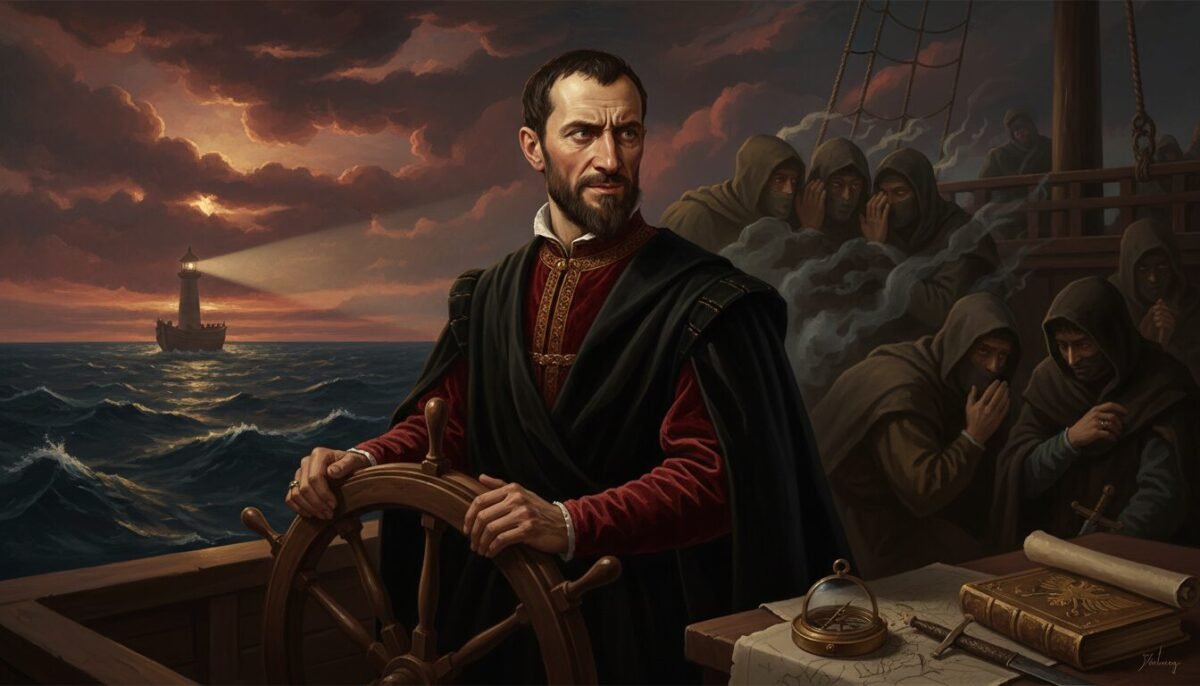
On the other side of the equation is Fortuna. Machiavelli famously compared Fortuna to a “violent river” that, when it overflows, floods the plains, uproots trees, and destroys buildings. Everyone flees before it; no one can resist its fury. However, Machiavelli argues that when the weather is calm, men can build dams and dikes so that when the river rises again, it will be channeled into a canal or its force will be less uncontrolled. Fortuna, he says, shows her power where Virtù has not been prepared to resist her.
The successful leader is the one who can adapt their Virtù to the temperament of the times. If the situation requires caution, they are cautious; if it requires audacity, they are bold. The tragedy of many leaders is their inability to change their nature. A leader who has always succeeded through aggression will likely fail when the situation calls for diplomacy. Mastery of power, therefore, is the constant struggle of individual agency (Virtù) against the unpredictable and often cruel whims of external circumstances (Fortuna).
4. The Separation of Private Morality and Political Necessity
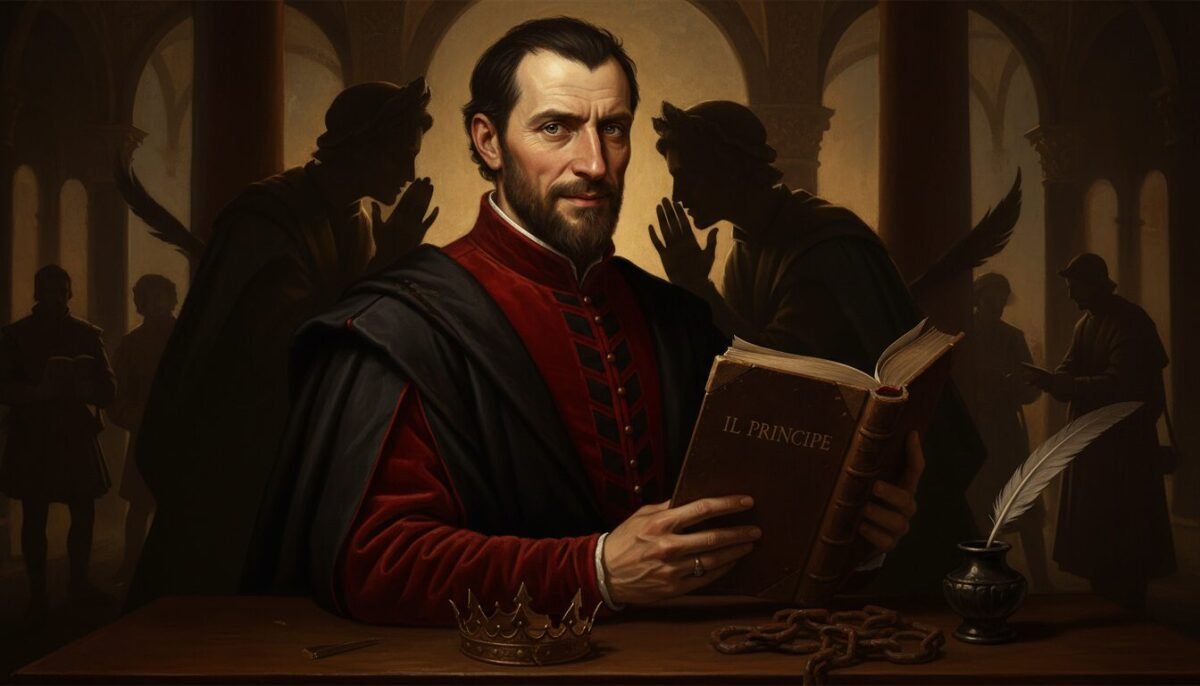
Perhaps Machiavelli’s most radical contribution was the “dual morality” framework. He was the first to explicitly state that the standards of behavior for an individual are not the same as the standards for a ruler. A private citizen should be honest, kind, and forgiving. But a prince? A prince must learn “how not to be good.”
This critique of traditional Christian ethics was revolutionary. In the 16th century, the prevailing view was that a good king was a good Christian. Machiavelli countered that if a prince tries to be “good” in a world where so many are “not good,” he will inevitably come to ruin. To protect the collective, the leader must be willing to enter into evil when necessity commands it. He must be a “great pretender and dissembler.”
He introduces the concept of “cruelty well-used.” He cites the example of Cesare Borgia, who used a brutal lieutenant to pacify the region of Romagna and then had that same lieutenant executed and left in a public square to satisfy and appease the people. This single act of “cruelty” prevented a much larger and more prolonged cycle of violence and lawlessness. In Machiavelli’s calculus, a short, sharp burst of violence that restores order is more “merciful” than a weak leader whose hesitation allows society to descend into chaos. The leader’s “dirty hands” are the price paid for the people’s peace.
5. Republicanism and the ‘Discourses on Livy’
Many readers are surprised to learn that the author of The Prince—a book often seen as a manual for autocrats—was actually a staunch supporter of republicanism. In his longer and more comprehensive work, Discourses on Livy, Machiavelli analyzes the Roman Republic and argues that a republic is a superior form of government to a principality.
While The Prince was a handbook for an “emergency” situation—how to build a state from scratch or save one in crisis—the Discourses focus on how to maintain a state over the long term. Machiavelli believed that the collective wisdom of the people was generally better than that of a single prince. He advocated for a system of checks and balances, where the interests of the nobility and the common people were pitted against each other to create a dynamic stability.
He admired the Roman Republic because it allowed for “conflict” without “collapse.” He argued that the friction between the Senate and the Plebeians was actually what made Rome free and powerful. For Machiavelli, liberty is not the absence of conflict, but the presence of institutions that can channel that conflict into productive ends. He saw the common people as the ultimate guardians of liberty, as they have less desire to oppress than the “great” have to dominate. This side of Machiavelli’s thought deeply influenced the Enlightenment and the founding fathers of modern democracies.
6. Legacy: Machiavelli as the Father of Modern Political Science
Machiavelli’s legacy is the transition from “what ought to be” to “what is.” Before him, political writing was largely “Mirror for Princes” literature—books telling leaders how to be virtuous and godly. Machiavelli threw the mirror away and looked out the window. He was the first to apply an empirical, almost scientific method to politics, analyzing historical data and contemporary events to find patterns of power.
His influence on modern realism in international relations is immeasurable. Thinkers like Hans Morgenthau and Kenneth Waltz, and practitioners like Henry Kissinger, operate on the Machiavellian assumption that states act in their own self-interest and that power is the primary currency of the global stage. Even in 2026, we see Machiavellian thought in the way corporations navigate “disruptive” markets or how political campaigns use data to exploit the fears and desires of the electorate.
Whether we like it or not, we live in a Machiavellian world. Every time a leader makes a “pragmatic” choice that sacrifices a minor principle for a major gain, they are walking in his footsteps. He didn’t create the “dark arts” of politics; he simply gave us the vocabulary to talk about them honestly. By understanding the interplay of Virtù and Fortuna, Machiavelli provided a timeless blueprint for navigating the complexities of power.
Machiavellianism is not a manual for tyranny, but a foundational pillar of political realism that separated ethics from statecraft. It challenges us to look past our moral comfort zones and ask the hard questions about what it truly takes to lead and to survive in an unpredictable world.
If you found this analysis of power dynamics intriguing, explore our further readings on Renaissance political thought to deepen your understanding of the origins of modern democracy and the psychology of leadership.
Frequently Asked Questions
What is the main idea of Machiavellianism?
It is the belief that in politics, the survival and stability of the state are the highest priorities, justifying the use of pragmatism and even manipulation over traditional moral virtues.
Did Machiavelli really say “the end justifies the means”?
Not in those exact words. He argued that the results of a leader’s actions are what the public uses to judge the legitimacy and “honor” of the methods used.
Is Machiavellianism relevant in the 21st century?
Absolutely. Its principles are seen in modern international relations, corporate strategy, and any scenario where leaders must balance ethical ideals with the harsh realities of power and competition.
What is the difference between ‘The Prince’ and ‘The Discourses’?
‘The Prince’ focuses on how an individual ruler can gain and keep power in a crisis, while ‘The Discourses’ explores how a republic can maintain liberty and stability through collective governance and institutions.
Interested in more? Check out our deep dives on:
- Machiavelli & Political Philosophy
- Power & Human Nature
- Influence & Leadership
- Comparative Philosophy