

Imagine a high-stakes boardroom negotiation. On one side of the table sits an executive who is well-liked, charismatic, and seemingly transparent. On the other sits a quiet strategist who has spent the last six months mapping out the personal debts, professional ambitions, and hidden rivalries of everyone in the room. When the deal is struck, the strategist walks away with 70% of the value, leaving the “charismatic” leader wondering how the ground shifted so quickly beneath their feet. Is this strategist a villain, or simply the only person in the room who truly understands how the world works?
We often use the term “Machiavellian” as a shorthand for “evil” or “treacherous.” In our cultural imagination, the Machiavellian is the cinematic antagonist—the Iago, the Frank Underwood, or the Littlefinger—who weaves webs of deceit for the sheer joy of destruction. However, the psychological reality is far more nuanced, and frankly, more unsettling. Machiavellianism isn’t about a love for chaos; it is about a profound, icy commitment to utility. It is the belief that the shortest distance between two points is often a path paved with calculated maneuvers. To understand this trait is to look into a mirror that reflects the darker, more pragmatic corners of human nature.
1. The Historical Roots: From Niccolò Machiavelli to Modern Psychology
To understand the psychological trait, we must first travel back to 16th-century Florence. Niccolò Machiavelli was not a “Machiavellian” in the way we use the word today. He was a diplomat, a civil servant, and a patriot who lived through a period of intense political instability. When he wrote The Prince in 1513, he wasn’t trying to create a manual for serial killers; he was writing a job application to the Medici family, offering a brutally honest assessment of how power actually functions, rather than how it should function in a perfect world.

Machiavelli’s core contribution was the separation of private morality from political necessity. He argued that a leader who tries to be “good” in every circumstance will inevitably be destroyed by those who are not. This “political realism” suggested that a ruler must be both a lion (for strength) and a fox (for cunning). For centuries, his name became synonymous with atheism and deceit, but in the mid-20th century, psychologists began to wonder if this philosophy wasn’t just a political strategy, but a measurable personality type.
In the 1960s, social psychologists Richard Christie and Florence Geis took Machiavelli’s ideas out of the palace and into the laboratory. They realized that some people naturally navigate life with the same cold, tactical mindset that Machiavelli recommended for princes. They developed the “Mach-IV” scale, effectively transforming a 500-year-old political philosophy into a quantifiable psychological construct. The shift was monumental: Machiavellianism moved from being a description of a “bad person” to a description of a specific cognitive style characterized by emotional detachment and strategic focus.
2. Defining the Machiavellian Personality: Pragmatism and Detachment
What does a “High Mach” individual actually look like in the 21st century? Psychology defines this personality through three primary characteristics: interpersonal manipulation, a cynical worldview, and a lack of conventional morality. However, these aren’t just “bad habits”; they are part of a cohesive survival strategy.

The Cynical Worldview
A High Mach believes that people are, by nature, fickle, ungrateful, and self-serving. They don’t necessarily hate people; they simply view them as predictable variables. If you believe that everyone is out for themselves, then manipulating them isn’t “wrong”—it’s simply getting ahead of the curve. This cynicism acts as a psychological shield, justifying their own behavior as a necessary response to a dog-eat-dog world.
Emotional Coolness and Cognitive Empathy
This is perhaps the most critical distinction. Most people possess “affective empathy”—if they see someone crying, they feel a twinge of sadness. High Machs, however, excel in “cognitive empathy.” They understand exactly what you are feeling and why, but they don’t feel it with you. This emotional detachment allows them to remain calm in high-pressure situations where others would be paralyzed by guilt or fear. They can fire a friend, negotiate a ruthless contract, or end a relationship with the same clinical precision one might use to prune a hedge.
Strategic Long-Term Planning
Unlike the impulsive thrill-seeker, the Machiavellian is a master of the “long game.” They are willing to delay gratification for months or even years to achieve a specific goal. They don’t lie for the sake of lying; they lie because it is the most efficient way to reach an objective. Every social interaction is an investment, and every “favor” is a credit they expect to collect later. This focus on utility over impulse is what makes them so formidable in corporate and political environments.
3. The Dark Triad Framework: Machiavellianism vs. Narcissism and Psychopathy
In the world of personality psychology, Machiavellianism is one-third of the “Dark Triad,” alongside Narcissism and Psychopathy. While these three traits often overlap—forming a “dark core” of low empathy and high self-interest—they are driven by very different engines.
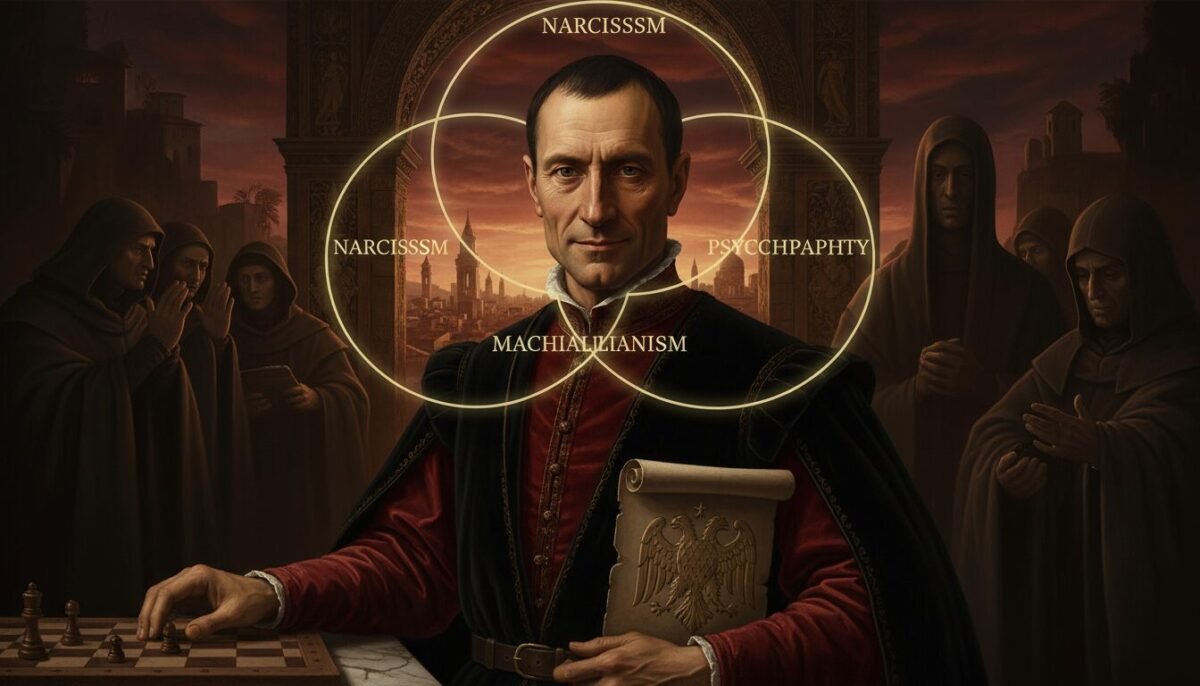
- The Narcissist is driven by the ego. They need admiration, validation, and the spotlight. A narcissist might manipulate you because they want you to tell them how great they are. If you hurt their ego, they react with “narcissistic rage.”
- The Psychopath is driven by impulse and stimulation. They lack a “braking system” for their behavior and often act without regard for consequences. They might manipulate you for the sheer thrill of the game or because they want something right now.
- The Machiavellian is driven by the goal. Unlike the narcissist, they don’t need your praise; in fact, they often prefer to pull the strings from the shadows where they are less vulnerable. Unlike the psychopath, they are not impulsive. They are highly sensitive to consequences and will rarely take a risk that hasn’t been carefully calculated.
Consider a failing company. The Psychopath might embezzle funds and flee to a tropical island, not caring about the fallout. The Narcissist might give a series of grandstanding speeches to convince everyone they are the savior, even as the ship sinks. The Machiavellian, however, will have identified the sinking ship six months ago, quietly secured a position at a rival firm, and leveraged their current company’s secrets to ensure a massive signing bonus. They are the “successful” members of the Dark Triad because their behavior is tempered by a rational, albeit cold, intellect.
4. Debunking the ‘Evil’ Myth: Strategic Manipulation vs. Malice
We have a tendency to label anything we find uncomfortable as “evil.” But in the realm of psychology, Machiavellianism is better described as amoral rather than immoral. An immoral person knows the rules and breaks them to cause harm. An amoral person simply views the rules as optional guidelines that can be bypassed if they interfere with a logical outcome.
There is a fundamental difference between proactive manipulation and reactive malice. A malicious person might spread a rumor to hurt someone they dislike. A Machiavellian might spread that same rumor, but only if that person stands in the way of a promotion. If that person is useful to the Machiavellian, they will be their most loyal ally. Their behavior isn’t personal; it’s functional.
In some contexts, this trait is even seen as a virtue. We want our surgeons to have a degree of emotional detachment so their hands don’t shake. We want our high-level diplomats to be able to sit across from dictators and negotiate without being overcome by moral outrage. The “High Mach” individual is essentially a human algorithm, processing social data to find the most efficient path to a result. While this can lead to toxic behavior, it is also the foundation of what we often call “shrewdness” or “strategic brilliance.”
5. Machiavellianism in Leadership and Workplace Dynamics
The modern workplace is the natural habitat of the Machiavellian. In an environment of limited resources, hierarchical power, and complex social networks, the ability to navigate “office politics” is often more important than technical skill. Research suggests that High Machs are frequently found in leadership positions, but their impact on an organization is a double-edged sword.
On the positive side, Machiavellian leaders are often excellent at navigating external threats. They are not easily intimidated, they are masters of negotiation, and they can make the difficult, “unpopular” decisions that more empathetic leaders might avoid. They are experts at building alliances and “social capital”—they know who holds the real power in an organization and how to make themselves indispensable to those people.
However, the downside is often a “toxic” culture. Because High Machs view others as tools, they may engage in selective disclosure (withholding information to maintain power), flattery to manipulate superiors, or “throwing subordinates under the bus” to protect their own reputation. They are the masters of the “gaslight,” making others doubt their own perceptions to maintain control. Over time, this erodes trust within a team, leading to high turnover and a culture of paranoia. The Machiavellian doesn’t mind a culture of paranoia, as long as they are the ones holding the keys to everyone’s safety.
6. Measuring the Trait: The Mach-IV Scale and Research Insights
How do we know if someone—or even ourselves—leans toward this trait? The Mach-IV scale, developed by Christie and Geis, remains the gold standard. It consists of 20 statements that participants rate based on their level of agreement. These statements are designed to probe the individual’s fundamental worldview.
Some sample insights from the test include agreement with statements like:
- “The best way to handle people is to tell them what they want to hear.”
- “Anyone who completely trusts anyone else is asking for trouble.”
- “It is hard to get ahead without cutting corners here and there.”
- “Generally speaking, people won’t work hard unless they’re forced to do so.”
Research using this scale has revealed fascinating trends. For instance, High Machs tend to perform better in “unstructured” environments where the rules are ambiguous. In a highly regulated environment with strict oversight, their manipulative tendencies are easily spotted and neutralized. But in the “wild west” of a startup or a shifting political landscape, they thrive. Furthermore, studies have shown that while High Machs are often successful in the short term, their “success” often plateaus because they eventually run out of people to burn. Reputation, it turns out, is the one variable even a Machiavellian can struggle to manipulate indefinitely.
7. How to Identify and Navigate Machiavellian Behavior
Living or working with a High Mach individual requires a specific set of survival skills. You cannot “out-manipulate” a master manipulator, but you can change the game they are playing. The first step is identification. Look for the red flags: someone who is a “chameleon” (changing their personality depending on who they are talking to), someone who uses excessive flattery with superiors but is dismissive of subordinates, or someone who always seems to have “inside information” that they use as currency.
Strategies for Protection:
- Maintain Radical Transparency: Machiavellians thrive on “information asymmetry.” They win when they know things you don’t. By keeping communications open, CC-ing relevant parties on emails, and documenting agreements, you shrink the shadows where they operate.
- Set Firm Boundaries: A High Mach will test your boundaries to see how much they can get away with. If you allow them to take credit for your work once, they will do it forever. Be polite, but be immovable.
- Don’t Share Personal Vulnerabilities: To a Machiavellian, your “secrets” or “fears” are not bonds of friendship; they are leverage. Keep the relationship professional and focused on the task at hand.
- Focus on Mutual Interest: If you must collaborate, don’t appeal to their “kindness” or “loyalty.” Instead, show them how helping you is in their best interest. This is the only language they truly trust.
Machiavellianism is not a monster under the bed; it is a complex, deeply human adaptation to a world that isn’t always fair. By understanding the mechanics of this trait—the cold pragmatism, the strategic detachment, and the cynical worldview—we can stop being pawns in someone else’s game and start navigating our professional and personal lives with our eyes wide open. Power, after all, is only dangerous when it is invisible.
Enjoyed this deep dive into the human psyche? Subscribe to our DeepPsyche newsletter for weekly insights into behavioral science, power dynamics, and the hidden forces that shape our world.
Frequently Asked Questions
Is Machiavellianism a mental illness?
No, it is not a clinical diagnosis found in the DSM-5. It is considered a personality trait that exists on a spectrum. While “High Machs” may have difficulty with social relationships, they are usually highly functional and often very successful in their careers.
Can a Machiavellian person change?
Personality traits are relatively stable over time, but people can learn to manage their behavior. A High Mach might learn that “pro-social” behavior (being helpful and honest) is actually more strategically effective in the long run than constant manipulation.
Are all leaders Machiavellian?
Not all, but many successful leaders possess some Machiavellian tendencies, such as strategic thinking and emotional resilience. The difference between an effective leader and a toxic one is whether they use these skills for the benefit of the organization or solely for personal gain.
Is it possible to be a “Low Mach”?
Yes. Low Machs tend to be trusting, empathetic, and believe in the inherent goodness of people. While this makes them very likable, they can sometimes be vulnerable to exploitation by those higher on the scale.