
In a world that prizes transparency, why do the most successful leaders often operate in the shadows of strategic ambiguity? We are taught from childhood that “honesty is the best policy,” yet the corridors of power—from the boardrooms of Silicon Valley to the high-stakes arenas of international diplomacy—tell a different story. Most people equate Machiavellianism with pure villainy, picturing a mustache-twirling antagonist or a cold-blooded corporate raider. However, this simplistic view fails to distinguish between malicious deception and the cold, hard realism required for survival in high-stakes environments.
Is it possible that what we call “evil” is actually just a heightened sense of awareness? When the stakes involve the survival of an organization, the stability of a nation, or the security of a family, the luxury of moral purity often evaporates. This exploration dissects the psychological and philosophical roots of Machiavellianism, revealing whether it is merely a tool for exploitation or an essential framework for navigating the labyrinthine complexity of human systems.
1. The Historical Genesis: Niccolò Machiavelli and the Birth of Political Realism
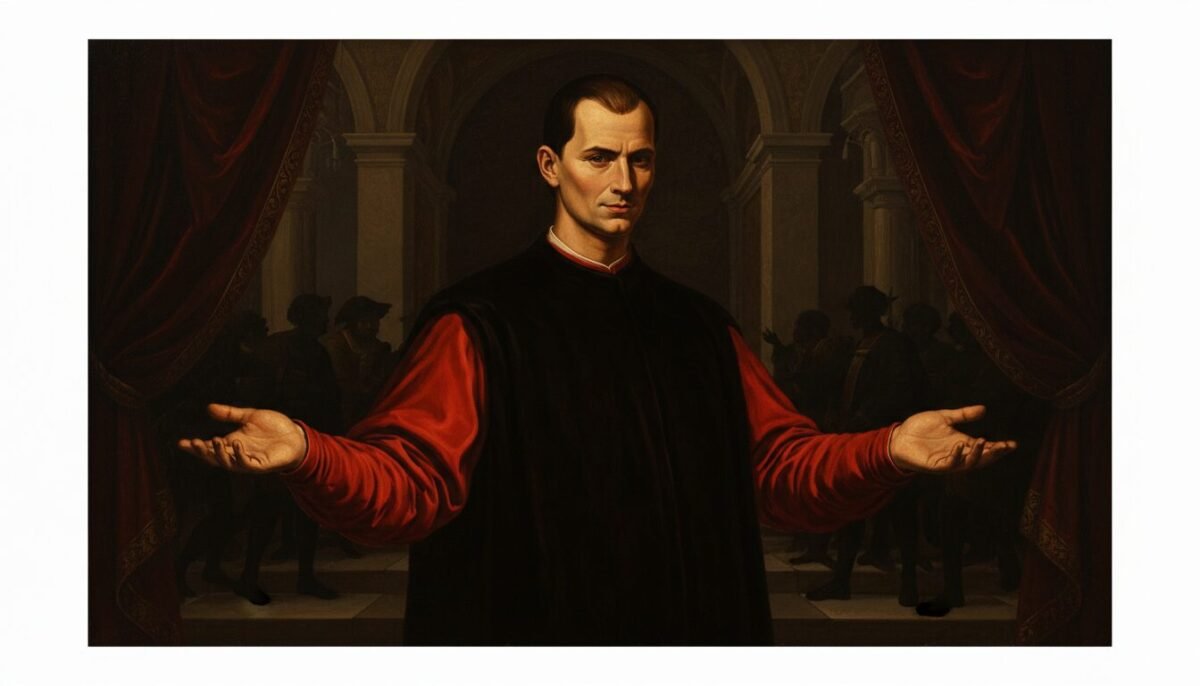
To understand the modern “Mach” personality, we must travel back to the fractured landscape of 16th-century Italy. Niccolò Machiavelli was not a monster; he was a civil servant in a Florence that was constantly under threat of invasion, internal coups, and religious upheaval. His seminal work, The Prince, was essentially a job application—a manual written for the Medici family to show them how to maintain power in a world that didn’t play by the rules of the Sunday school version of morality.

Machiavelli birthed what we now call Realpolitik. He argued that the primary duty of a leader is the stability and security of the state. If a leader is too “good”—too trusting, too merciful, too honest—they invite chaos, which ultimately hurts more people than a few calculated acts of cruelty would. He prioritized state stability over individual morality, famously suggesting that it is “better to be feared than loved, if one cannot be both.”
The radical shift Machiavelli introduced was moving the conversation from “how one ought to live” to “how one actually lives.” He observed that people are generally ungrateful, fickle, and deceptive. Therefore, a leader who acts as if everyone else is virtuous is destined for ruin. This was the birth of political realism: the idea that policy should be based on power and practical factors rather than ideological or moralistic premises.
It is crucial to distinguish the historical figure from the modern psychological construct. The real Machiavelli was a patriot who valued the republic; the “Machiavellianism” we discuss today is a distilled psychological trait characterized by interpersonal manipulation, a cynical disregard for morality, and a focus on self-interest and personal gain. While the man sought to save Florence, the “trait” seeks to win the game, whatever that game may be.
2. The Dark Triad: Machiavellianism as a Psychological Personality Trait
In modern psychology, Machiavellianism doesn’t stand alone. It is one-third of the “Dark Triad,” a trio of personality traits that include Narcissism and Psychopathy. While they overlap, they are distinct. Narcissism is driven by a need for ego-inflation and admiration. Psychopathy is defined by impulsivity and a lack of empathy. Machiavellianism, however, is the “strategic” member of the group. It is characterized by long-term planning, calculated manipulation, and a cold, detached perspective on human relationships.

Psychologists measure this trait using the MACH-IV scale, a series of questions developed by Richard Christie and Florence Geis in the 1970s. High-scorers on this scale tend to agree with statements like, “The best way to handle people is to tell them what they want to hear,” or “Anyone who completely trusts anyone else is asking for trouble.” It’s important to note that Machiavellianism is not a mental disorder. It is a non-clinical personality dimension. You likely work with, live near, or are even related to someone who sits high on this spectrum.
What makes the Machiavellian mind unique is the combination of emotional detachment and cognitive empathy. Unlike a psychopath, who might struggle to understand social cues, a high-Mach individual is often an expert at reading them. They have “cold empathy”—they know exactly what you are feeling, not because they feel it too, but because it is valuable data. They understand your vulnerabilities, your desires, and your triggers, and they use that information to navigate social hierarchies with surgical precision.
This detachment allows them to remain calm in situations that would paralyze others with guilt or anxiety. They view the social world as a giant chessboard. While others are playing for connection or validation, the Machiavellian is playing for position. They aren’t necessarily looking to cause pain; they are simply indifferent to it if it stands in the way of a strategic objective.
3. Deception vs. Realism: Analyzing the Core Dichotomy
The central tension in Machiavellianism lies in the thin line between deception and realism. To the critic, the Machiavellian is a liar. To the practitioner, they are simply a realist who refuses to be blinded by sentimentality. Deception, for a high-Mach individual, is rarely impulsive. It is a tactical tool used only when necessary. They understand that a reputation for honesty is a powerful asset, so they often tell the truth—until the moment when a lie provides a significant strategic advantage.

Pragmatic realism is the ability to see the world as it is, devoid of the “shoulds” that cloud most people’s judgment. For example, in a failing company, a “sentimental” manager might refuse to lay off loyal employees until the entire firm goes bankrupt. A “Machiavellian” realist would identify the necessity of cutting 20% of the workforce immediately to save the other 80%. Is this cruel? Perhaps. Is it realistic? Absolutely.
This long-term orientation separates the Machiavellian from the common liar. An impulsive liar deceives to get out of trouble in the moment. A Machiavellian might plant a seed of misinformation today that won’t bear fruit for six months. They are comfortable with the “long game.” They anticipate threats that others ignore because they aren’t hampered by the “just-world hypothesis”—the belief that good things happen to good people.
Consider a case study in organizational survival: A CEO realizes a competitor is about to launch a product that will make their own flagship offering obsolete. A realist doesn’t waste time on “positive thinking” or morale-boosting speeches. They might quietly begin a smear campaign against the competitor’s safety record or strategically poach the competitor’s lead engineers. While these actions are manipulative, from a realist perspective, they are defensive measures intended to prevent organizational failure and protect thousands of jobs. The line between “saving the company” and “destroying the competition” becomes dangerously blurred.
4. The Machiavellian Leader: Navigating the Modern Corporate Landscape
In the C-suite, Machiavellianism is often the “secret sauce” of leadership, even if it’s never listed on a resume. Modern corporate environments are complex ecosystems of competing interests. A leader who is purely transparent is often a leader who is easily bypassed. High-Mach leaders excel here because of the “Social Chameleon” effect. They can mirror the values of their board of directors, the passion of their engineers, and the concerns of their customers, all while maintaining a private agenda.
They are masters of building strategic alliances. They know who holds the real power (which is often not the person with the highest title) and how to make themselves indispensable to that person. However, there is a dark side to this office politics. When Machiavellianism is untethered from a larger goal, it devolves into exploitative behavior. This includes “gaslighting”—manipulating someone into doubting their own perceptions—or taking credit for the work of subordinates to climb the ladder faster.
Yet, the question remains: Can a Machiavellian leader be “good”? In times of crisis, the answer is often yes. When a ship is sinking, you don’t want a captain who is worried about everyone’s feelings; you want a captain who can make the cold, hard decisions necessary to get the lifeboats in the water. The efficiency of cold pragmatism is a powerful tool in crisis management. A Machiavellian leader can cut through red tape, silence dissenters, and mobilize resources with a speed that a more democratic, consensus-seeking leader never could.
The danger is that the “crisis mode” becomes the permanent mode. When the ends always justify the means, the culture of an organization can become toxic, characterized by paranoia and a lack of psychological safety. The very traits that save a company in a storm can destroy it in a time of peace.
5. The Ethical Paradox: Do the Ends Ever Justify the Means?
This brings us to the ultimate ethical paradox of the Machiavellian mindset. Most modern ethics are based on either deontology (rules-based morality) or virtue ethics (character-based morality). Machiavellianism, however, aligns with a radical form of Utilitarianism: the idea that the most ethical action is the one that results in the greatest good for the greatest number, regardless of the methods used.
If a diplomat lies to a dictator to prevent a war that would kill millions, is that lie “evil”? Most would say no. This is “Ethical Machiavellianism”—the use of strategic influence and deception for pro-social or organizational goals. The problem is that human beings are remarkably good at self-deception. Almost every tyrant in history believed they were “doing what was necessary” for the greater good. This is the slippery slope where pragmatic realism devolves into systemic corruption.
At the heart of this is psychological egoism—the belief that all human actions are ultimately self-serving. The Machiavellian assumes that everyone else is also acting in their own self-interest, they just aren’t as honest about it. By stripping away the “veneer of virtue,” they believe they are acting with a higher form of honesty. They see themselves as the only ones in the room with the courage to admit how the world really works.
But when we stop valuing the “means” and only focus on the “ends,” we lose something fundamental to the human experience. Trust is the “social glue” that allows for complex cooperation. If everyone becomes a Machiavellian strategist, the cost of doing business—the “trust tax”—becomes so high that the system eventually collapses under the weight of its own cynicism.
6. Identifying the Traits: How to Spot a Machiavellian Individual
How do you know if you’re dealing with a high-Mach individual? They rarely announce themselves. Instead, look for a consistent pattern of cynicism and a highly calculating nature. They often view people as “tools” rather than “ends in themselves.” In conversation, they are masters of selective honesty—telling you a small, vulnerable truth to build trust, only to use that trust later for a much larger gain.
Their communication style often involves “strategic silence.” They listen more than they speak, gathering information while giving away very little of their own. They are adept at flattery, but it often feels slightly “off”—as if they are testing to see how you respond to praise. In professional relationships, a major red flag is a person who is charming to superiors but dismissive or exploitative of those “below” them.
To protect yourself, you don’t need to become a cynic, but you do need to be a realist. Verify information independently. Set clear boundaries. Most importantly, watch what people do, not what they say. A Machiavellian’s greatest weapon is your own desire to believe in their projected image. By staying grounded in objective reality, you remove their ability to manipulate your perceptions.
Ultimately, Machiavellianism exists on a spectrum. At its worst, it is a path to tyranny and isolation. At its best, it is the “brutal realism” that allows us to navigate a world that is not always kind, fair, or honest. Whether it is a vice or a virtue depends entirely on the hand that wields it—and the purpose for which it is used.
Frequently Asked Questions
Is Machiavellianism the same as being a sociopath?
No. While both share a lack of empathy, Machiavellianism is a personality trait focused on strategic manipulation and long-term goals, whereas sociopathy (a form of psychopathy) involves more impulsivity, social irresponsibility, and a total disregard for laws and norms.
Can a Machiavellian person truly love someone?
Yes, but their expression of love may be different. They may view a partner as a “teammate” in their strategic goals. However, their tendency toward emotional detachment can make deep, vulnerable intimacy challenging.
Are all successful CEOs Machiavellian?
Not all, but many possess high-Mach traits. The ability to make cold, calculated decisions and navigate complex power dynamics is often a prerequisite for reaching the top of large, competitive organizations.
Can you “cure” Machiavellianism?
Since it is a personality trait and not a clinical disorder, it isn’t “cured.” However, individuals can learn to use their strategic skills for pro-social ends (Ethical Machiavellianism) through self-awareness and cognitive behavioral coaching.
If you found this analysis of power and personality intriguing, you might also enjoy our deep dives into Machiavelli & Political Philosophy, the hidden mechanics of Influence & Leadership, or our comparative look at Power & Human Nature across different cultures.
Are you a strategist or a manipulator? The line is thinner than you think. Explore more of the hidden architecture of the human mind at DeepPsyche.blog.