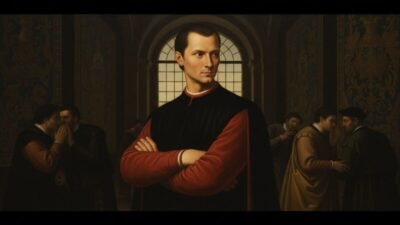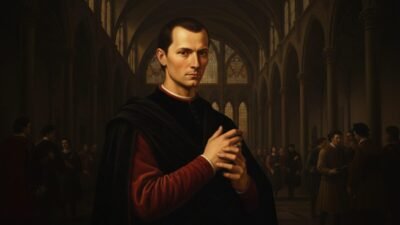

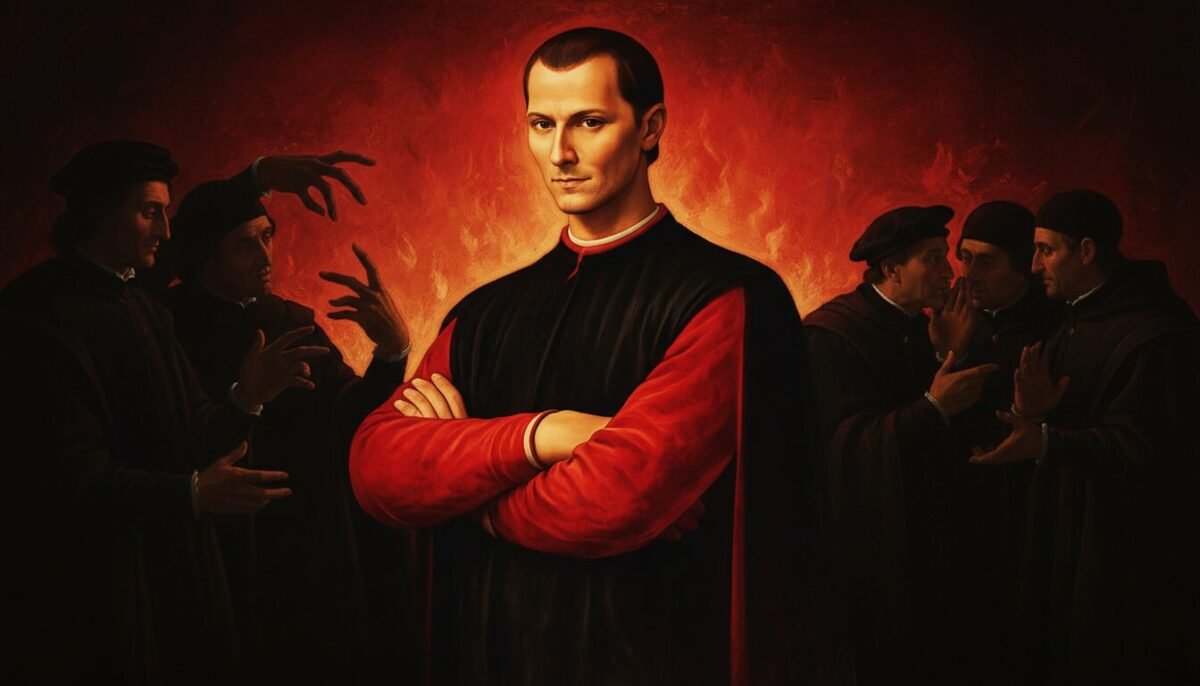
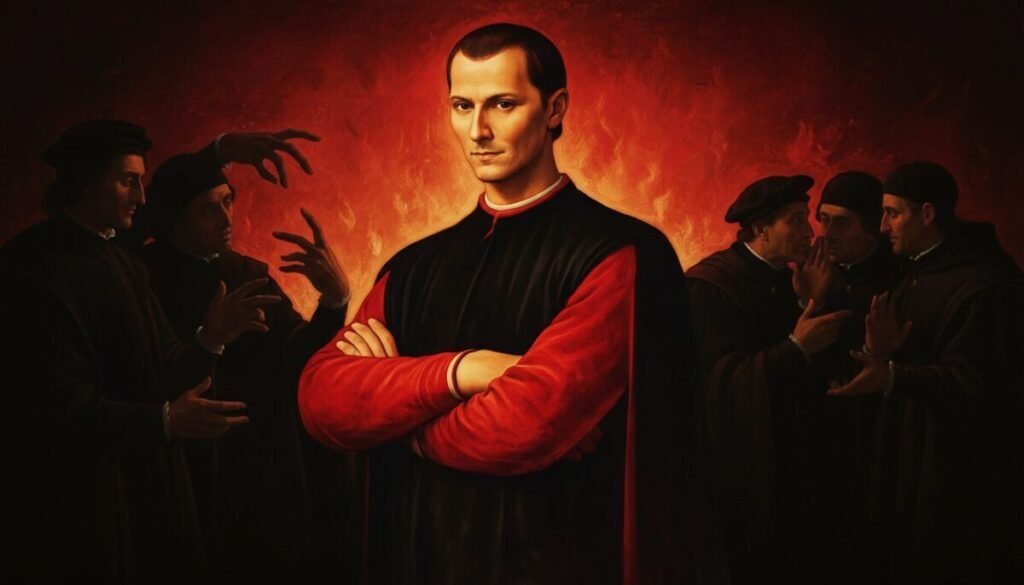
Could one of history’s greatest champions of republicanism truly be the same man who wrote the ultimate handbook for autocrats? It is one of the most enduring paradoxes of Western thought. We picture Niccolò Machiavelli as a shadowy figure whispering cold-blooded advice into the ears of tyrants, yet for most of his life, he was a devoted servant of a free state, a man who believed that the collective wisdom of the people was superior to the whims of a single ruler. This tension defines the very soul of his work.
The relationship between Niccolò Machiavelli and the Medici family is often misunderstood as simple sycophancy or pure enmity, leaving students of history confused about his true intentions. Was he a traitor to his republican ideals, or a desperate patriot trying to save a crumbling Italy by any means necessary? To understand The Prince, one must look past the infamous maxims and into the bruised reality of a man who had been tortured, exiled, and silenced by the very family he eventually sought to advise. This is not just a story of political theory; it is a story of personal survival and the birth of modern political realism under the shadow of the Medici.
1. The Florentine Republic and Machiavelli’s Rise as a Diplomat
Before he was a disgraced author living in a rural farmhouse, Machiavelli was the beating heart of the Florentine Republic. From 1498 to 1512, he served as the Second Chancellor, a role that placed him at the center of the city’s administrative and diplomatic machinery. He wasn’t an ivory-tower philosopher; he was a man of the “active life,” frequently found on horseback, galloping across Europe to negotiate with kings, popes, and warlords.
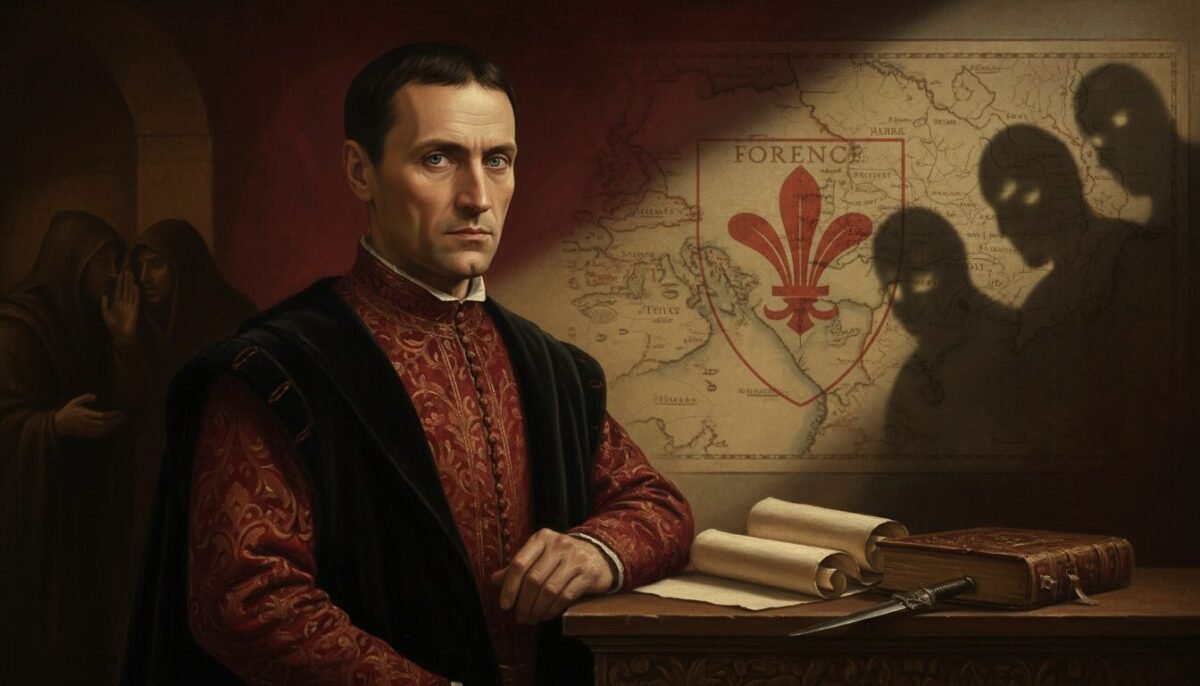
His diplomatic missions took him to the courts of Louis XII of France and the Holy Roman Emperor Maximilian I. More importantly, they brought him face-to-face with Cesare Borgia, the ruthless Duke whose calculated brutality would later serve as a primary case study in The Prince. During these years, Machiavelli observed a terrifying truth: the traditional moral virtues taught by the Church and classical philosophers were often a liability in the cutthroat world of 15th-century geopolitics. He saw that Italy was a “fragmented mosaic,” vulnerable to the “barbarians”—the powerful foreign monarchies of France and Spain.
Machiavelli’s most significant contribution during this era was the formation of the Florentine militia. He harbored a deep-seated disdain for mercenary soldiers, whom he viewed as “useless and dangerous.” He believed that a state could only be secure if it was defended by its own citizens—men who had a stake in the survival of their home. This project was a testament to his republican fervor; he wanted to arm the people to protect their liberty. The stark contrast between this period of civic engagement and the later Medici era highlights the profound shift in his circumstances. In the Republic, he was an insider, a strategist, and a patriot. When the Medici returned, he became a ghost in his own city.
2. The 1512 Restoration: From Political Insider to Prisoner
The collapse of the Florentine Republic in 1512 was not just a political shift; for Machiavelli, it was a personal apocalypse. The Medici family, backed by Spanish troops and the authority of the Pope, marched back into Florence, dismantling the republican institutions Machiavelli had spent fourteen years building. Within weeks, he was stripped of his office, banned from the Palazzo della Signoria, and forced to pay a massive fine he could ill afford.
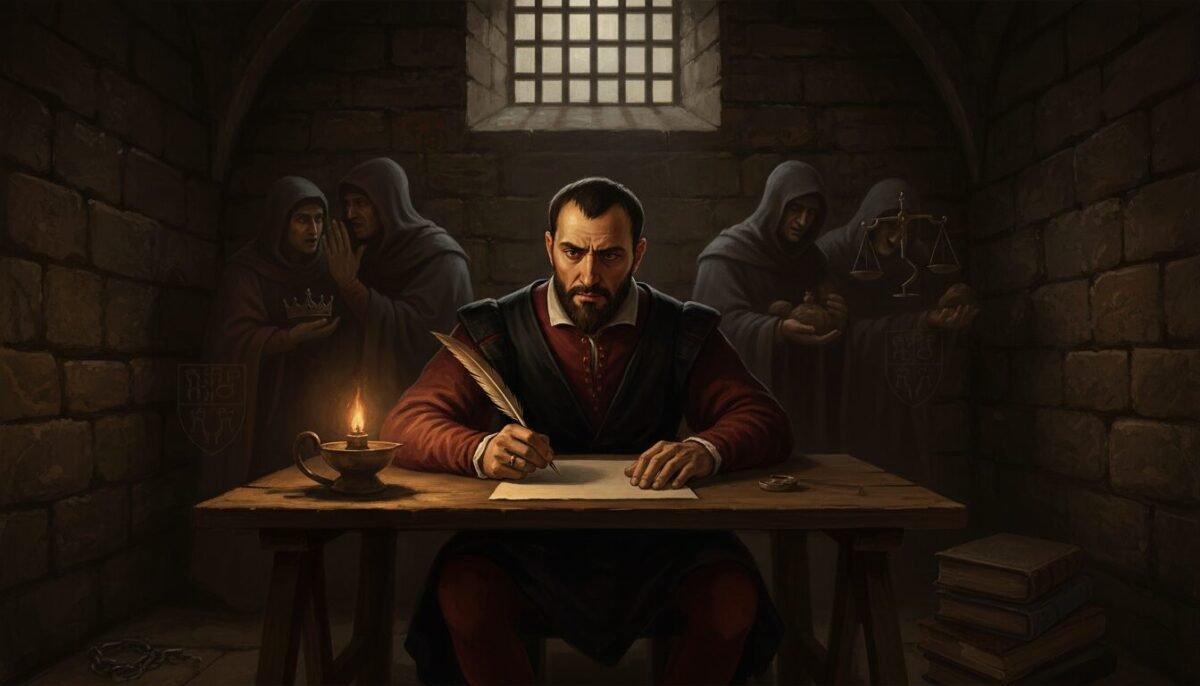
But the humiliation didn’t end with professional ruin. In early 1513, Machiavelli’s name appeared on a list of potential conspirators in a plot to overthrow the Medici. Although there was little evidence of his involvement, he was arrested and thrown into the “Le Stinche” prison. It was here that he experienced the strappado—a brutal form of torture where the victim’s hands are tied behind their back and they are hoisted up by a rope, then dropped, causing the shoulders to dislocate with a sickening pop. Machiavelli endured six “drops” without confessing. This was the visceral reality of Power & Human Nature: the same state he had served so loyally was now literally tearing his body apart.
Released during an amnesty following the election of Giovanni de’ Medici as Pope Leo X, Machiavelli was a broken man. He was banished to his small family estate in Sant’Andrea in Percussina, a quiet village outside Florence. There, he spent his days overseeing his farm, arguing with local woodcutters, and playing cards in the local tavern. But at night, he would shed his muddy clothes, put on his “courtly garments,” and enter his study to “converse” with the great minds of antiquity. It was in this state of forced retirement and existential isolation that he began to write the works that would change the world.
3. Why Machiavelli Dedicated ‘The Prince’ to Lorenzo de’ Medici
The dedication of The Prince is one of the most controversial “cover letters” in history. Originally, Machiavelli intended to dedicate the work to Giuliano de’ Medici, but after Giuliano’s death, he shifted the focus to Lorenzo de’ Medici, the Duke of Urbino. To many, this looked like a blatant betrayal of his republican past—a desperate “job application” intended to regain political favor and employment. Machiavelli was, quite literally, bored to death in the countryside; he craved the “great things” of statecraft.
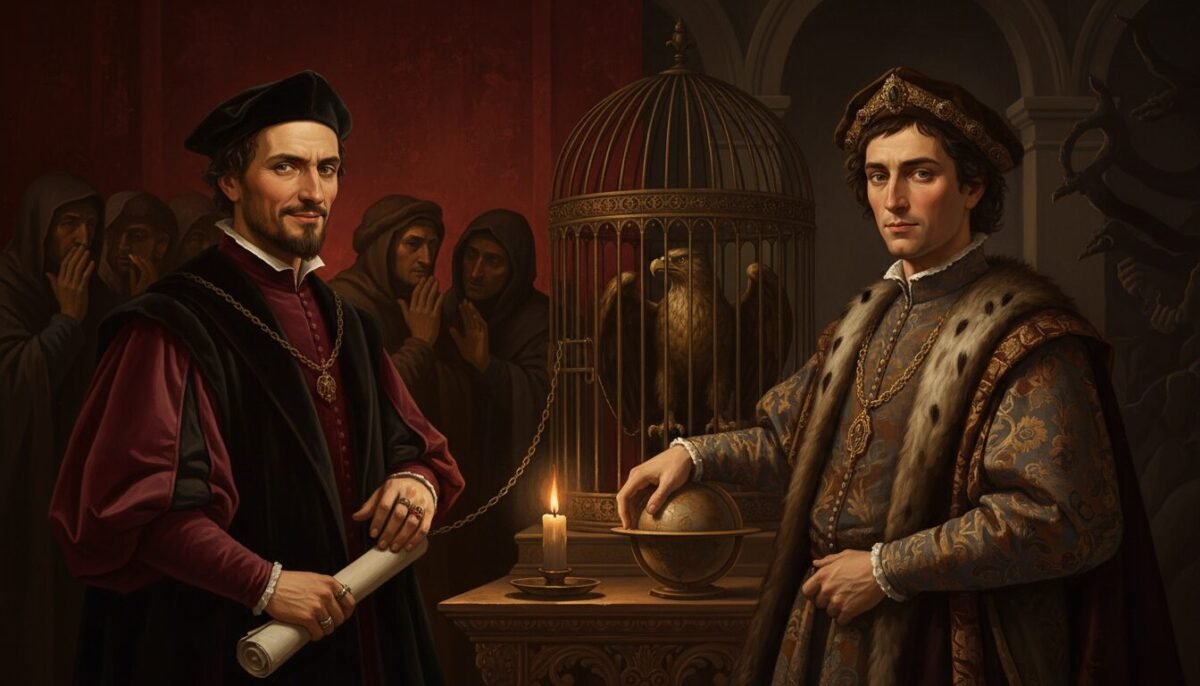
However, the dedication was more than just a plea for a paycheck. It was a strategic maneuver born of a desperate need for a strong leader to unify Italy. Machiavelli looked at the map of Italy and saw a land “without a head, without order, beaten, despoiled, torn, overrun.” He believed that only a “new prince,” unburdened by the traditional constraints of morality, could expel the foreign invaders and bring stability to the peninsula. He saw the Medici, who now controlled both Florence and the Papacy, as the only family with the resources to achieve this Herculean task.
This creates a fascinating tension between personal survival and ideological purity. Machiavelli was a realist. He understood that a republic was the best form of government for a virtuous people, but he also realized that Florence was no longer virtuous—it was corrupt and divided. In such a state, a republic would fail. He offered The Prince to Lorenzo not as a declaration of love for autocracy, but as a map for a surgeon who needed to perform a violent operation on a dying patient. He was willing to sacrifice his own reputation for the sake of an Italian “Redeemer.”
4. Supporter or Enemy? The Paradox of Machiavelli’s Loyalty
To understand Machiavelli’s true loyalty, one must reconcile The Prince with his other major work, The Discourses on Livy. While The Prince focuses on the absolute power of a single ruler, The Discourses is a passionate defense of republicanism, checking the power of the elite, and the importance of civic liberty. This leads to the “paradox of Machiavelli”: how can one man hold two such opposing views?
One popular theory, famously championed by Jean-Jacques Rousseau, is that The Prince was actually a satirical warning. By “teaching” princes how to be tyrants, Machiavelli was actually exposing the brutal mechanics of power to the common people, showing them exactly what to watch out for. Under this lens, he wasn’t a supporter of the Medici; he was an undercover agent for the people, stripping the mask off the ruling class. This interpretation aligns with his deep-seated Machiavellianism—using deception to reveal a deeper truth.
A more pragmatic view is that Machiavelli valued the stability of the state over the specific morality of the ruler. He believed that an effective tyrant was better than a weak, “good” leader who allowed the state to descend into civil war. This pragmatism eventually earned him a modicum of trust from the Medici. In the 1520s, Cardinal Giulio de’ Medici (the future Pope Clement VII) commissioned him to write The Florentine Histories. It was a minor role compared to his days as Chancellor, but it allowed him back into the political conversation, albeit on a leash. He remained a man caught between two worlds: a republican at heart, but a realist by necessity.
5. The Medici Response: Was Machiavelli’s Advice Ever Followed?
If Machiavelli hoped that The Prince would be his ticket back to the inner circle of power, he was sorely disappointed. The reception of the book by Lorenzo de’ Medici was famously lukewarm. Legend has it that when Machiavelli presented the manuscript to Lorenzo, the Duke was more interested in a pair of hunting dogs he had just received as a gift. The intellectual brilliance of the work was lost on a man who preferred the tangible trappings of aristocratic life.
Historical evidence suggests that the Medici largely ignored Machiavelli’s specific tactical advice. He urged the prince to avoid fortresses (believing they made rulers complacent) and to rely on a citizen militia rather than mercenaries. The Medici did the exact opposite, building massive fortifications and continuing to hire foreign soldiers. There was a profound disconnect between Machiavelli’s visionary Influence & Leadership theories and the Medici’s practical disdain for the “upstart” civil servant who had once served the Republic.
The Medici used Machiavelli for what we might today call “consultancy” or “PR.” They gave him minor diplomatic tasks and the task of writing history, but they never allowed him near the levers of real power. They recognized his intelligence but feared his history. To the Medici, Machiavelli was a useful tool, but he was also a reminder of a republican past they wanted to bury. He was kept at arm’s length—close enough to be watched, but too far away to influence the direction of the state.
6. The Lasting Impact: How the Medici Shaped Machiavellianism
The failure of the Medici to follow Machiavelli’s advice—and their subsequent failure to unite Italy—ultimately validated his darker observations. The Italian peninsula remained a playground for foreign powers for centuries, precisely because no “Prince” emerged who was willing to apply the cold logic Machiavelli prescribed. From the ashes of this Florentine instability, the concept of Realpolitik was born. Machiavelli didn’t invent political “evil”; he simply described it with a honesty that the world found terrifying.
The term “Machiavellian” eventually became a shorthand for deviousness and lack of conscience, largely because of the way his work was interpreted by his enemies (and the Church). However, his legacy is far more complex. He serves as the bridge between medieval idealism—where politics was a branch of theology—and modern political science, where politics is a study of power, psychology, and outcomes. His interaction with the Medici provided the “laboratory” for these ideas. Without the trauma of the 1512 restoration and his subsequent exile, The Prince might never have been written.
In the end, Machiavelli’s life was a testament to the fact that ideas are often more powerful than the dynasties they describe. The Medici are gone, but Machiavelli’s analysis of Machiavelli & Political Philosophy remains the foundation of how we understand statecraft today. He taught us that power is not a matter of divine right or moral superiority, but a calculated game of perception, force, and fortune.
Frequently Asked Questions
Did Machiavelli actually like the Medici?
It is unlikely he “liked” them in a personal sense, especially after they tortured him. However, he respected their power and saw them as the only viable vehicle for Italian unification. His relationship with them was one of pragmatic necessity rather than genuine affection.
Was ‘The Prince’ written as a joke?
While some scholars argue it was a satire intended to warn the public about tyrants, most historians believe Machiavelli was sincere in his desire to provide a practical guide for a ruler who could save Italy from foreign invasion.
What is the difference between ‘The Prince’ and ‘The Discourses’?
The Prince focuses on how a single ruler can gain and maintain power in a “new” or unstable state. The Discourses on Livy explores how a republic should be structured to ensure long-term liberty and stability through the involvement of the people.
How did the Medici family eventually fall?
The Medici were expelled from Florence multiple times, including in 1494 and 1527. While they eventually returned and became hereditary Grand Dukes of Tuscany, they never achieved the total unification of Italy that Machiavelli had envisioned.
The relationship between Machiavelli and the Medici was one of necessity, survival, and intellectual friction. While he sought their favor to save his career and his country, his work ultimately transcended their dynasty to become the foundation of modern political science. If you found this exploration of power and history compelling, consider diving deeper into our Comparative Philosophy series or exploring our guide to The Discourses on Livy to see the republican side of this complex thinker.
Explore more about the hidden mechanics of the human mind and the structures of power at DeepPsyche.blog.