

In the high-stakes world of 2026 corporate leadership, where AI-driven volatility and shifting geopolitical landscapes are the norm, a specific type of leader is emerging from the shadows. Imagine a boardroom during a hostile takeover. While others are paralyzed by the emotional weight of potential layoffs or the bruising of their professional egos, one individual remains eerily calm. They are not cold because they lack feeling; they are calm because they are already three steps ahead, calculating the exact sequence of moves required to preserve the organization’s core. Is this person a villain, or are they simply the most prepared person in the room?
For decades, Machiavellianism has been dismissed as a purely “evil” trait, lumped into the dark corners of psychology alongside more destructive tendencies. This knee-jerk reaction often leads us to overlook the profound strategic advantages it offers in complex, modern environments. By re-examining Machiavellianism through a 2026 lens, we can begin to distinguish it from its more volatile cousins and explore how its pragmatic, goal-oriented nature can be harnessed for both personal career success and broader pro-social goals.
1. Defining Machiavellianism: Beyond the ‘Evil’ Stereotype
To understand the modern Machiavellian, we must first strip away the centuries of “villain” branding. The term originates from Niccolò Machiavelli, the 16th-century diplomat whose seminal work, The Prince, shocked the world not because it was inherently wicked, but because it was devastatingly honest. Machiavelli gave birth to political realism—the idea that leaders should focus on how the world actually works, rather than how we wish it would work.

In psychological terms, “High Machs” (individuals scoring high on the Machiavellian scale) are characterized as pragmatic, cynical, and emotionally detached strategists. They view the world as a chessboard. While a “Low Mach” might be guided by sentimentality or rigid moral codes that don’t account for nuance, a High Mach prioritizes the objective. The “evil” label is often a simplification of what is, in reality, a complex cognitive style. It isn’t necessarily a desire to cause harm; it is a refusal to let emotion cloud the path to a goal.
The core components of this trait are manipulation, a degree of callousness, and a relentless strategic long-term orientation. Manipulation, in this context, isn’t always about deceit; it is about the skillful management of people and resources to achieve a specific outcome. Callousness is often a form of emotional shielding—the ability to make a hard decision, such as a necessary budget cut, without being paralyzed by the immediate social backlash. Finally, their long-term orientation ensures they aren’t distracted by short-term praise or temporary setbacks.
2. The Dark Triad: Distinguishing Machiavellianism from Narcissism and Psychopathy
In the realm of personality psychology, Machiavellianism is one-third of the “Dark Triad,” a trio of traits that also includes narcissism and psychopathy. While they share a common thread—a lack of empathy and a focus on self-interest—the differences are what make Machiavellianism uniquely valuable in a professional setting.
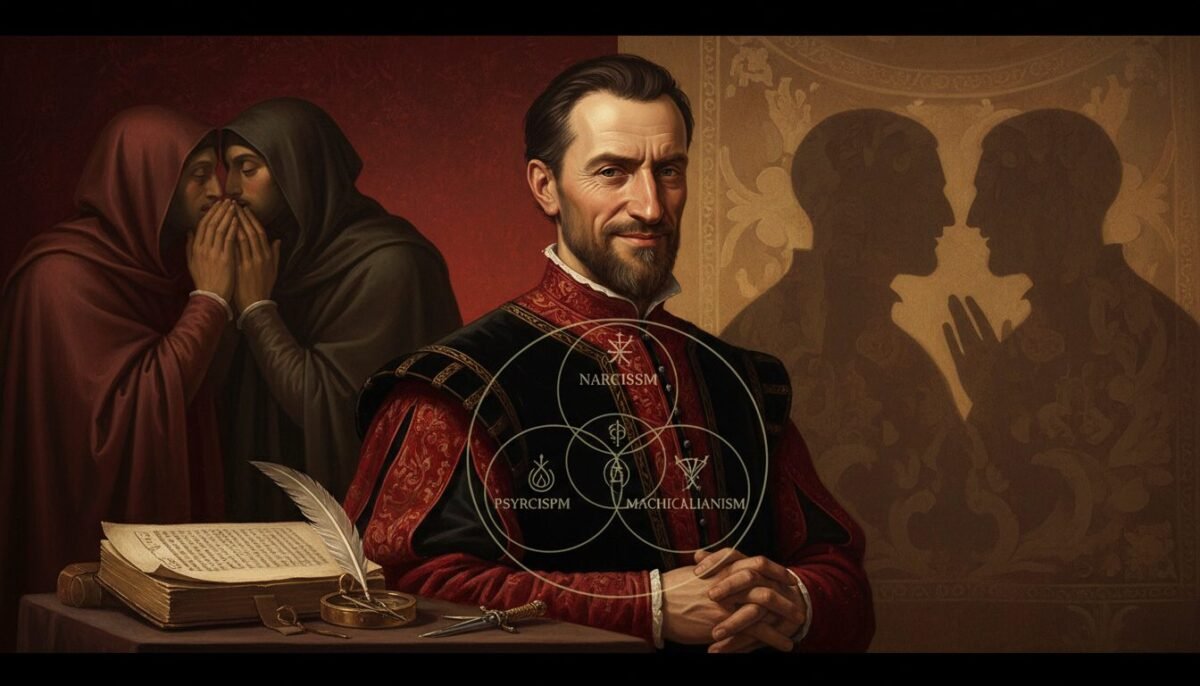
The primary distinction lies in impulse control and calculation. A psychopath is often characterized by impulsivity and a lack of foresight; they might burn a bridge just to see the fire. In contrast, a Machiavellian is deeply calculated. They won’t burn a bridge unless they have already built a better one or determined that the bridge leads to a dead end. Their actions are rarely random; they are moves in a larger game.
Then there is the ego factor. A narcissist is driven by a desperate need for external validation and admiration. They want to be the hero of the story, often at the expense of the actual mission. A Machiavellian, however, focuses on utility. They don’t care if they are liked or even if they get the credit, as long as the desired outcome is achieved. They are perfectly comfortable being the “power behind the throne” if it serves their strategic interests.
Because of this, Machiavellianism is often considered the most “stable” and adaptable trait of the three. While narcissists eventually alienate others through their vanity and psychopaths through their recklessness, Machiavellians can blend into an organization for decades, quietly navigating power structures and maintaining their influence through sheer competence and strategic foresight.
3. The Strategic Advantage: Machiavellianism in Leadership and Career Success
In the modern workplace, “politics” is often treated like a dirty word, yet it is the invisible architecture of every organization. Machiavellians excel here because they see these power structures with objective clarity. They understand who holds the real influence (which isn’t always the person with the loftiest title) and how to navigate those dynamics to get things done.

One of their greatest assets is crisis management. When a company faces a PR disaster or a sudden market shift, the emotional temperature in the room skyrockets. High Machs possess a unique ability to remain emotionally detached. This isn’t because they don’t care about the company, but because they understand that panic is a luxury they cannot afford. This detachment allows them to make the cold, hard decisions that often save the ship from sinking.
Negotiation is another arena where they shine. While others might be swayed by a “likable” opponent or feel guilty about pushing for better terms, the Machiavellian uses strategic influence to secure favorable outcomes. They understand the psychology of the person across the table and can leverage that information to find the precise point of pressure that leads to a win for their organization.
Furthermore, their “the end justifies the means” mindset—while controversial—is often what drives sustainable corporate growth. In 2026, where “quarterly capitalism” is being challenged by the need for long-term sustainability, a Machiavellian leader is often the only one willing to endure short-term unpopularity to ensure the company’s survival ten years down the line. They are the ones willing to automate a legacy department or pivot a product line even when it causes internal friction, because they see the looming obsolescence that others ignore.
4. The Rise of the ‘Pro-Social’ Machiavellian
Perhaps the most fascinating evolution in our understanding of this trait is the concept of “pro-social Machiavellianism.” This occurs when an individual uses their manipulative and strategic skills not for personal gain, but for the benefit of a group, a cause, or a mission. Think of the “Protector” archetype: the leader who uses their political savvy to shield their creative team from the soul-crushing bureaucracy of a parent corporation.
Pro-social Machiavellians are the ones who know how to “play the game” to secure funding for a non-profit, or who use their influence to outmaneuver a corrupt executive. They understand that in a world where not everyone plays fair, having a “good” person who knows how to use “bad” tactics is an essential defense mechanism for any ethical organization.
Can you be a “good” person while using “bad” tactics? The answer lies in the intent and the outcome. If a leader manipulates a board of directors to ensure a massive investment in carbon-capture technology, the “deceit” serves a higher moral purpose. History is full of such figures—mission-driven leaders who were deeply pragmatic and often ruthless in their pursuit of a greater good. They were not “nice” in the traditional sense, but they were incredibly effective.
5. Identifying High Mach Individuals: Signs and Behaviors
How do you spot a High Mach in your own circle or mirror? They rarely announce themselves with a villainous laugh. Instead, they exhibit subtle, consistent behaviors:
- Emotional Regulation: They are the masters of the “poker face.” Even in high-stress situations, their outward demeanor remains steady. They are rarely swayed by sentimentality or appeals to tradition if those things don’t serve the current goal.
- Social Chameleonism: They have an uncanny ability to adapt their behavior to suit their audience. They can be the charming extrovert at a networking event and the data-driven introvert in a technical meeting, all while maintaining a consistent internal focus on their objective.
- Information Control: High Machs understand that information is the ultimate currency. They are careful about what they disclose and to whom. They manage the flow of information to maintain leverage and ensure they are never caught off guard.
- The ‘Cold Empathy’ Phenomenon: Unlike a psychopath who may lack empathy entirely, a High Mach often possesses “cold empathy.” They understand exactly what you are feeling and why—they just don’t feel it with you. This allows them to predict your reactions and influence your behavior without being burdened by your emotional state.
6. The Ethical Boundary: Managing the Risks and Costs
While the strategic benefits are clear, Machiavellianism comes with a significant psychological and organizational price tag. For the individual, the constant state of “strategic calculation” can lead to profound isolation. When you view every interaction as a move in a game, it becomes incredibly difficult to form genuine, vulnerable interpersonal bonds. The “loneliness at the top” is often exacerbated for those who cannot turn off their strategic brain.
For the organization, the risk is that strategic manipulation can easily slide into toxic workplace behavior. If a High Mach’s goals become decoupled from the organization’s mission, they can become a “parasite,” using their skills to consolidate personal power at the expense of team morale and productivity. This is why the integration of High Machs requires careful oversight.
The key to tempering these tendencies is Emotional Intelligence (EQ). A Machiavellian with high EQ understands that maintaining a positive, trusting culture is actually a strategic advantage. They realize that being “too Machiavellian” is counter-productive because it destroys the very social capital they need to operate. HR professionals and senior leaders should look to place High Machs in roles that require high-stakes negotiation or long-term strategy, while ensuring they are paired with “High Empathy” partners who can provide a moral and social compass.
Conclusion
Machiavellianism is not a moral failing; it is a neutral tool. Like a scalpel, it can be used to heal or to harm, depending on the hand that holds it. When combined with high emotional intelligence and a clear ethical framework, it becomes a powerful asset for leadership and organizational stability in an increasingly chaotic world. It is time we stop fearing the “ruthless strategist” and start understanding how their unique orientation can be harnessed for the greater good.
Are you a high Mach leader? Understanding your own strategic traits is the first step toward leveraging them for pro-social success. Take our personality assessment to discover your unique psychological profile.
Frequently Asked Questions
Is Machiavellianism a mental health disorder?
No, Machiavellianism is considered a personality trait, not a clinical diagnosis or mental health disorder. It exists on a spectrum, and many people possess moderate levels of the trait without it being pathological.
Can a Machiavellian person be a good friend or partner?
Yes, but the relationship may function differently. High Machs often value loyalty and stability as strategic assets, but they may struggle with the “messy” emotional vulnerability that some partners require. Communication about needs and boundaries is essential.
How can I protect myself from a negative Machiavellian at work?
The best defense is transparency and documentation. Because Machiavellians rely on information control and “gray areas,” keeping clear records and maintaining open communication with multiple stakeholders reduces their leverage.
Is it possible to “learn” Machiavellianism?
While the core trait is often deeply ingrained, anyone can learn “Machiavellian tactics,” such as strategic negotiation, power-mapping, and emotional regulation. This is often referred to as developing “political skill” in a professional context.
Explore more on DeepPsyche:
- Machiavelli & Political Philosophy: Lessons for the Modern CEO
- Power & Human Nature: Why We Seek Influence
- Influence & Leadership: The Fine Line Between Guidance and Manipulation
- Comparative Philosophy: Eastern vs. Western Views on Strategy