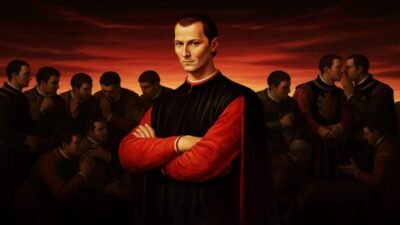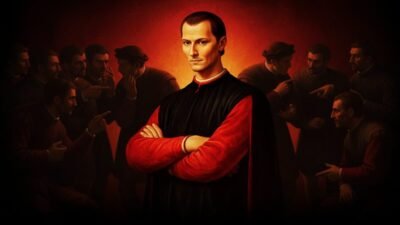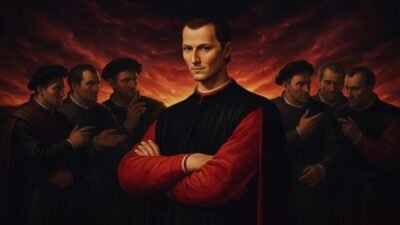
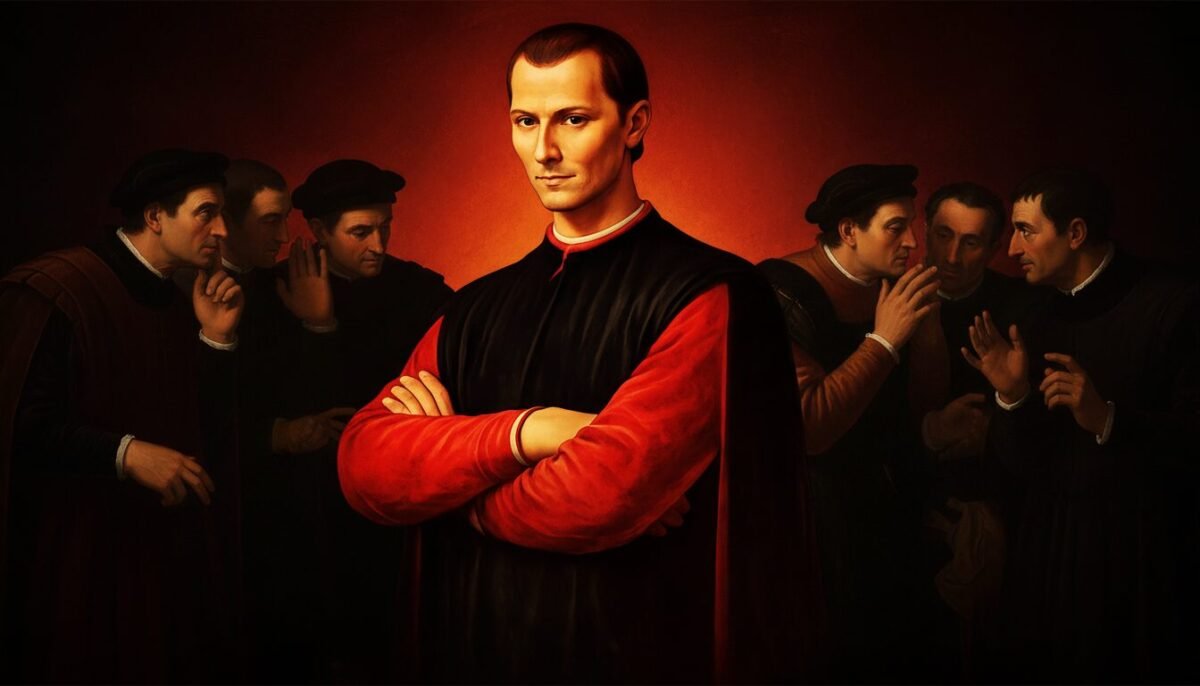
For centuries, the name “Machiavelli” has been whispered in the corridors of power as a synonym for deceit, ruthlessness, and the dark arts of manipulation. To call a politician “Machiavellian” is rarely a compliment; it is an accusation that they have traded their soul for a seat at the table. We picture a shadowy figure in a velvet cloak, advising tyrants on how to betray their friends and crush their enemies with a cold, calculating smile.
But what if our collective image of Niccolò Machiavelli is not just a caricature, but a profound misunderstanding? Most people dismiss him as a teacher of evil without ever grappling with the desperate historical chaos that birthed his ideas. When we strip away the centuries of stigma, we find a man who wasn’t trying to destroy morality, but rather trying to save his country from total collapse. This analysis will deconstruct the misconceptions surrounding his most famous work, The Prince, exploring whether his philosophy is truly a guide to immorality or simply a groundbreaking exercise in political realism.
1. The Historical Crucible: 16th-Century Italy and the Need for Stability
To understand Machiavelli, you must first understand the blood-soaked soil of 16th-century Italy. This was not the serene, postcard-perfect Italy of today. It was a fragmented collection of city-states—Florence, Milan, Venice, the Papal States—that were perpetually at each other’s throats. Worse, Italy had become the playground for the great European superpowers. France, Spain, and the Holy Roman Empire used the Italian peninsula as a battlefield, marching armies across the land, sacking cities, and leaving behind a trail of famine and instability.
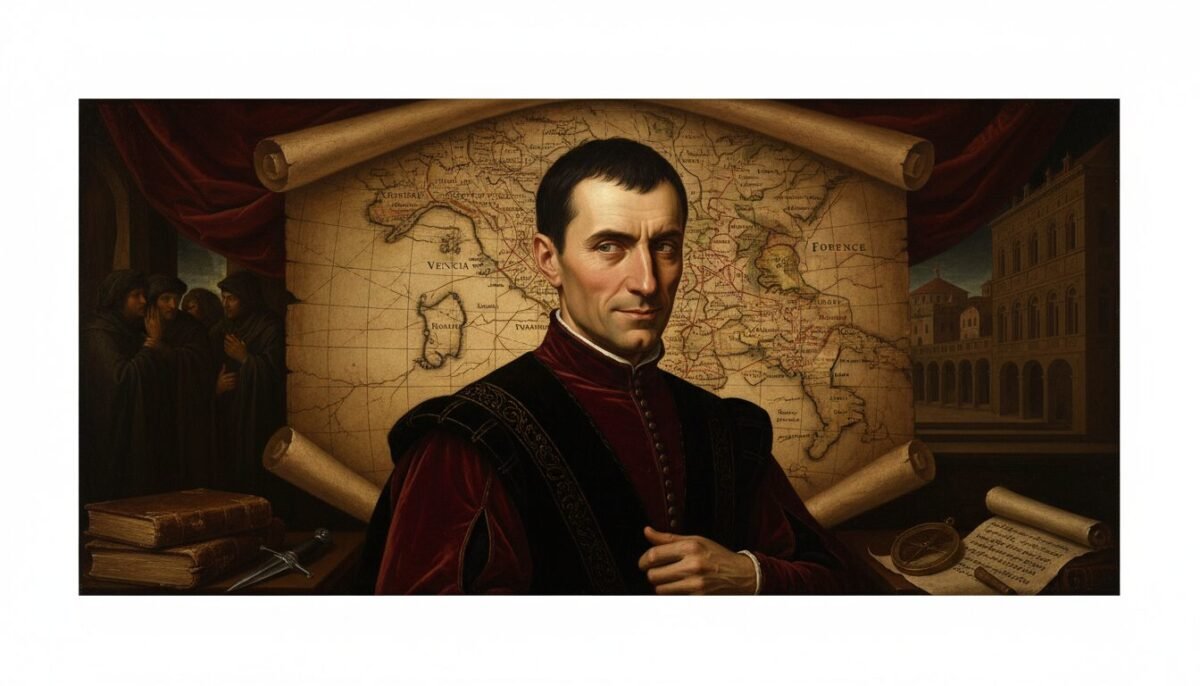
Machiavelli wasn’t an armchair philosopher dreaming of power; he was a high-level diplomat and civil servant for the Florentine Republic. He spent years traveling to the courts of kings and popes, witnessing firsthand the brutal reality of how power was actually exercised. He saw the weakness of Florence—a city of art and culture that was constantly bullied and extorted because it lacked a strong military and a decisive leader. In 1512, when the Medici family returned to power with the help of Spanish troops, the Florentine Republic collapsed. Machiavelli was stripped of his office, imprisoned, and tortured on the rack.
It was in this state of exile and physical pain that he wrote The Prince. His primary goal was not to encourage tyranny for the sake of ego, but to find a way to achieve the unification and preservation of the state. To Machiavelli, the “highest moral good” was not the personal salvation of the ruler, but the stability and security of the people. He believed that a fractured Italy was a dying Italy, and only a leader with the strength to be “Machiavellian” could stop the bleeding. In his eyes, the greatest sin a leader could commit was not cruelty, but weakness—because a weak leader allows the state to fall into anarchy, which causes far more suffering than a few strategic executions ever could.
2. Virtù vs. Christian Morality: Redefining the ‘Good’ Leader
The fundamental tension in Machiavelli’s work lies in his redefinition of the word Virtù. In the traditional Christian context of his time, virtue meant humility, charity, honesty, and turning the other cheek. A “good” man followed the Ten Commandments and hoped for a reward in the afterlife. Machiavelli looked at this moral framework and realized it was a recipe for political suicide. If you are the only person playing by the rules of a “saint” in a world full of “wolves,” you will be devoured.
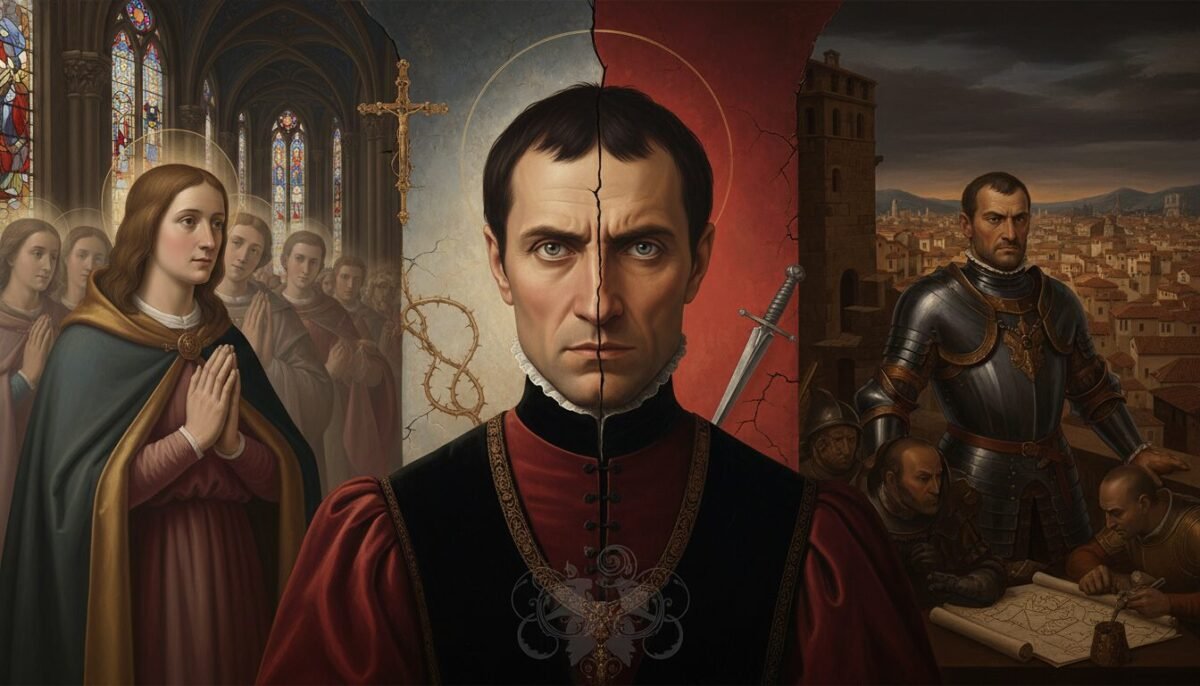
Machiavelli’s Virtù is not moral goodness; it is prowess, vitality, and the strategic skill to master one’s circumstances. It is the ability of a leader to be both the “lion” (to scare away the wolves) and the “fox” (to recognize the traps). He famously argued that a leader must learn “how not to be good” when the situation demands it. This isn’t an invitation to be a psychopath; it is a recognition that the ethics of the private individual and the ethics of the political leader are two different species.
He rejected the idealistic utopias of Plato and the religious moralists who wrote about how men ought to live. Instead, he sought the “effectual truth” of the matter. If a leader’s honesty leads to the invasion of his city and the slaughter of his citizens, is that leader truly “good”? Machiavelli’s answer was a resounding no. In his view, a leader who sacrifices the safety of the collective to keep his own conscience clean is actually the most immoral person in the room. This shift from “what is right” to “what works” is the foundation of modern political science.
3. The Great Misconception: Did He Say ‘The End Justifies the Means’?
If you ask the average person to summarize Machiavelli, they will likely quote the phrase: “The end justifies the means.” Interestingly, Machiavelli never actually wrote those exact words. The closest he came was the Italian phrase “Si guarda al fine,” which translates more accurately to “one must consider the final result.”
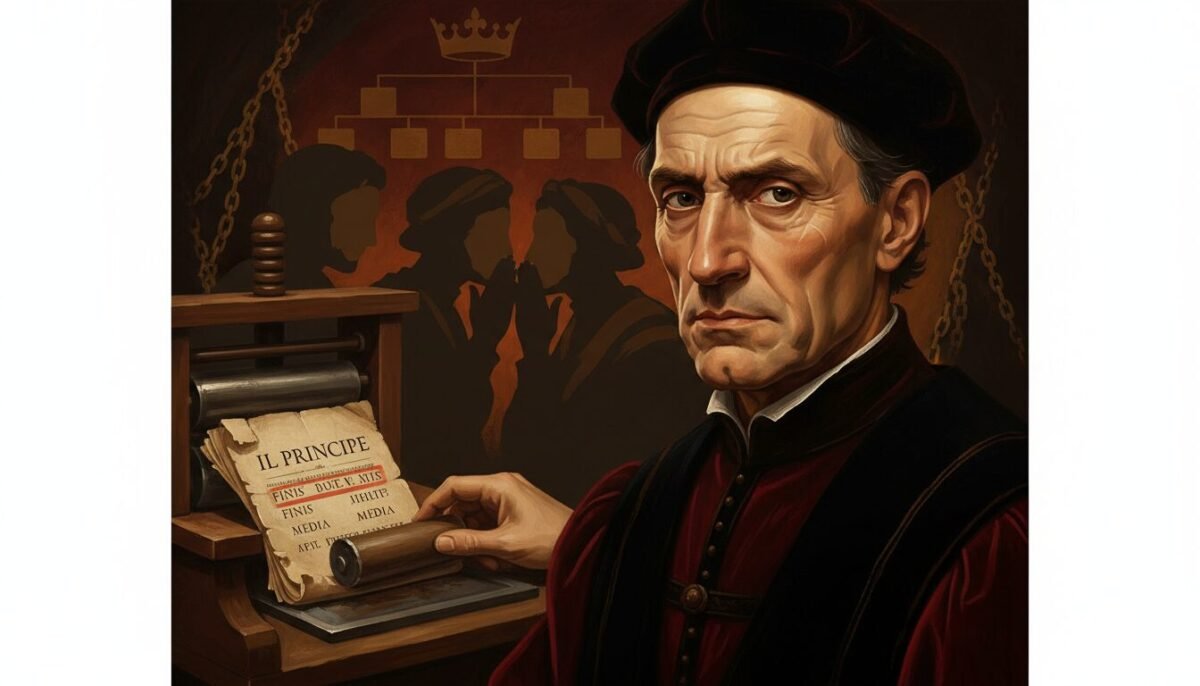
This subtle distinction matters. Machiavelli wasn’t giving a blank check for gratuitous cruelty. He was making a psychological observation about how the public perceives power. He noted that the common people judge a leader by the outcome of his actions. If a leader secures the state and brings peace, the methods he used—even if they were harsh—will always be judged as honorable.
He provided a stark contrast between “well-used” and “ill-used” cruelty. Well-used cruelty is done once, out of necessity, to secure the state, and then is converted into benefits for the subjects as quickly as possible. For example, he praised Cesare Borgia for using a brutal lieutenant to pacify the lawless region of Romagna, and then publicly executing that same lieutenant to satisfy the people’s sense of justice and distance himself from the violence. On the other hand, “ill-used” cruelty is violence that increases over time, serving only the ruler’s ego and leading to his eventual downfall. Machiavelli wasn’t a sadist; he was a surgeon who believed that a single, deep cut was better than letting a gangrenous limb slowly kill the patient.
4. Fortuna and the Art of Adaptation
One of the most poetic and misunderstood concepts in Machiavelli’s philosophy is Fortuna. He viewed history not as a divine plan, but as a chaotic force—unpredictable, wild, and often destructive. He famously compared Fortuna to a torrential river that, when it overflows, destroys everything in its path.
However, Machiavelli did not believe humans were helpless victims of fate. He argued that while we cannot control the river, we can build dikes and dams during the dry season to prepare for the flood. This is where the leader’s Virtù meets Fortuna. A leader’s greatest asset is not a fixed set of principles, but the ability to adapt.
The reason most leaders fail, according to Machiavelli, is that they are unable to change their nature. A cautious leader will succeed as long as the times require caution, but when the times turn turbulent and require audacity, he will be ruined. Machiavelli’s “immorality” is often just a call for extreme flexibility. If the world changes, the leader must change with it. In a world of shifting alliances and sudden betrayals, the only constant is the need to stay one step ahead of the “river” of luck. This requires a level of psychological detachment that most people find chilling, but Machiavelli saw it as the only way to survive.
5. Private Ethics vs. Political Realism: The Dual Morality
Machiavelli’s work forced a wedge into the Western mind that has never been removed: the separation of private conscience from public duty. Before Machiavelli, the “Mirror for Princes” genre of literature taught that a king should be a model of Christian piety. Machiavelli shattered this mirror. He suggested that a ruler might have to sacrifice his own personal salvation for the sake of the people he governs.
This is the “dirty hands” problem of leadership. Imagine a modern scenario: a leader knows that by telling a lie to the public, they can prevent a mass panic that would lead to thousands of deaths. A “moral” person in the private sense might say lying is always wrong. Machiavelli would say that the leader who tells the truth and allows the deaths is a criminal.
He is often called the father of Realpolitik—a system of politics based on practical and material factors rather than moral or ideological premises. By stripping away the religious veneer from the state, he paved the way for secular political science. He recognized that the state is a cold monster with its own logic of survival, and those who operate its machinery cannot be judged by the same standards as those who live within its protection. It is a haunting thought: that the peace we enjoy in a stable society might be bought with the “immoral” actions of those who maintain it.
6. Is Machiavellianism Inherently Evil or Just Realistic?
Over time, “Machiavellian” has become a pejorative term used to describe anyone who is manipulative or power-hungry. We see this in the “Dark Triad” of psychology, where Machiavellianism is grouped with narcissism and psychopathy. But is this fair to the man himself?
Modern scholars have begun to see Machiavelli in a different light. Some argue he was actually a secret patriot and a republican. In his other major work, The Discourses on Livy, he speaks passionately about the importance of liberty, checks and balances, and the role of the people in a republic. Some even suggest that The Prince was a satire or a warning—a way of showing the people exactly how tyrants operate so they could better defend themselves.
Regardless of his intent, Machiavelli’s pragmatism remains disturbingly relevant. In global diplomacy, we see nations making “Machiavellian” alliances with dictators to ensure regional stability. In business, we see leaders making “Machiavellian” pivots to save their companies from bankruptcy. We may not like to admit it, but we live in a world that operates on Machiavellian principles far more often than Christian ones. He was not a teacher of vice, but a surgeon of politics who diagnosed the world as it was, not as we wish it to be.
Ultimately, Machiavelli’s “immorality” was a new form of political ethics—one centered on the survival of the collective rather than the purity of the individual. He forces us to ask a terrifying question: If you had to choose between being a “good” person and being a “successful” leader who saves your country, which would you pick?
Challenge your perspective on power. If you want to understand the mechanics of the world we live in, read The Prince not as a manual for villains, but as a map of the landscape of human nature. Was he a villain or a visionary? Perhaps he was simply the only man brave enough to tell us the truth about ourselves.
Frequently Asked Questions
What is the main point of Machiavelli’s ‘The Prince’?
The main point is that a leader’s primary duty is to maintain the power and stability of the state, which often requires acting in ways that are traditionally considered “immoral,” such as using deceit or force, because the “effectual truth” of politics is different from private morality.
Why is Machiavelli considered the father of modern political science?
He is considered the father of modern political science because he was the first to analyze politics as a secular, practical craft based on observation and history, rather than on religious doctrines or idealized moral philosophy.
Did Machiavelli believe it is better to be feared than loved?
Machiavelli argued that it is best to be both, but since that is difficult to achieve, it is “much safer to be feared than loved.” However, he cautioned that a leader must avoid being hated, as hatred leads to rebellion and the downfall of the ruler.
Was Machiavelli himself a “Machiavellian” person?
Historically, Machiavelli was known for being a loyal civil servant and a man of integrity in his personal life. His writings were an analysis of the world he observed, not necessarily a reflection of his own personal behavior or desires for power.
If you found this analysis of power and human nature intriguing, you might also enjoy our deep dives into Machiavelli & Political Philosophy or our exploration of the psychological traits behind Influence & Leadership. Explore more at DeepPsyche.blog to uncover the hidden forces that shape our world.