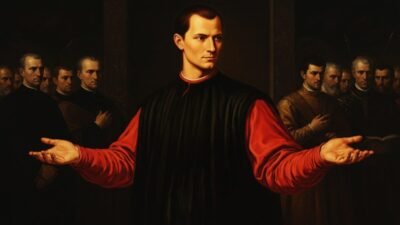

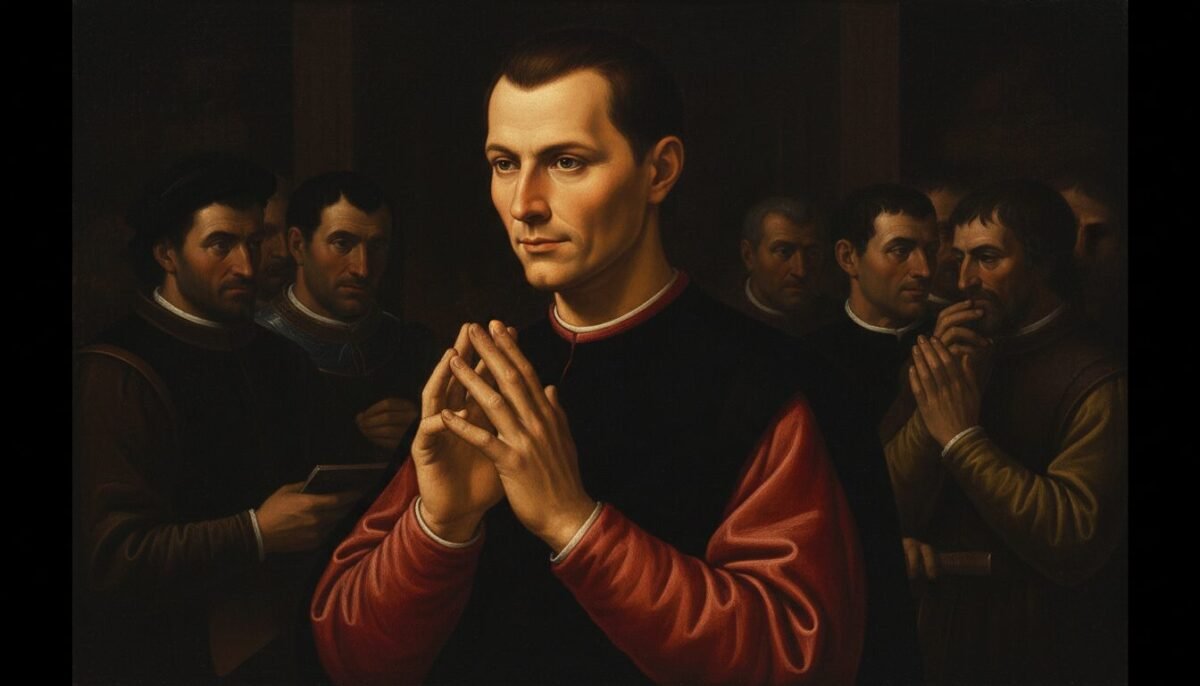
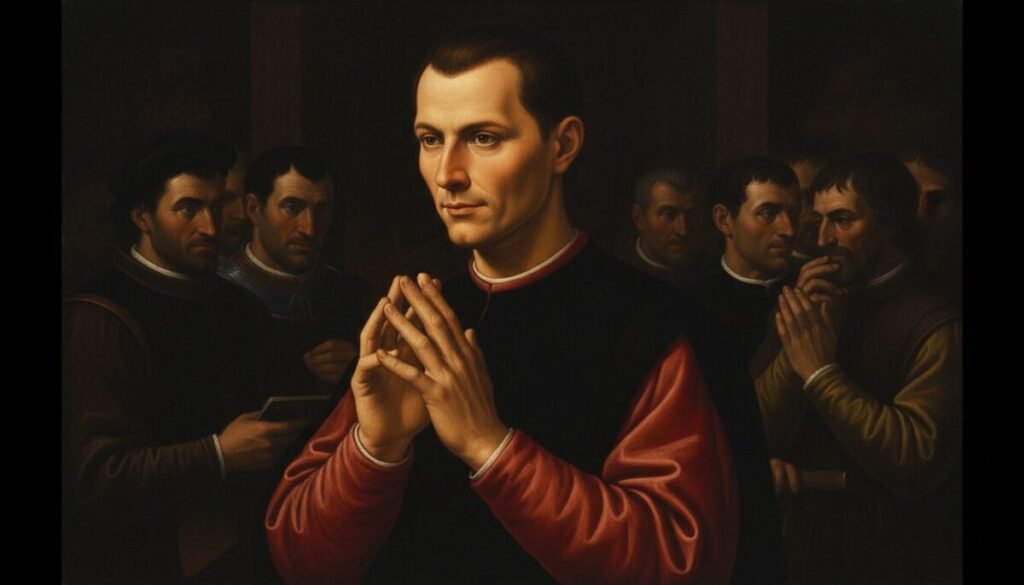
Is it better to be feared than loved? This famous Machiavellian dilemma wasn’t born in the quiet sanctuary of a library or the ivory towers of academia. It was forged on the blood-soaked battlefields of Renaissance Italy, amidst the screams of dying men and the smoke of early gunpowder. For centuries, readers have viewed Niccolò Machiavelli’s The Prince as a cynical manual for cruelty, a “handbook for gangsters.” But this perspective fails to account for the existential military threats that dictated his harsh political realism. Machiavelli wasn’t a man who enjoyed cruelty; he was a man who had seen his country humiliated, and he was obsessed with finding a way to stop the bleeding.
To understand Machiavelli, you must understand the chaos of the Italian Wars. He lived in a world where the “rules” of chivalry and Christian morality were being shredded by the reality of foreign invasion. The incompetence of mercenary armies didn’t just frustrate him—it disgusted him. He realized that a state’s survival was not guaranteed by its culture, its wealth, or its piety, but by its ability to exert force. This realization forced him to redefine the relationship between military power and state survival, moving away from the idealistic fantasies of his predecessors and toward a cold, hard look at how power actually functions in a violent world.
1. The Crucible of the Italian Wars: Context of Instability
In 1494, the Italian psyche was shattered. For decades, the various city-states—Florence, Milan, Venice, the Papal States, and Naples—had played a sophisticated, almost ritualized game of balance-of-power politics. Then came Charles VIII of France. He marched into the Italian peninsula with a massive, modernized army and heavy bronze cannons that could shatter the walls of medieval fortresses in hours. The Italians, who had grown accustomed to small-scale skirmishes fought by hired professionals, were utterly unprepared for “total war.”
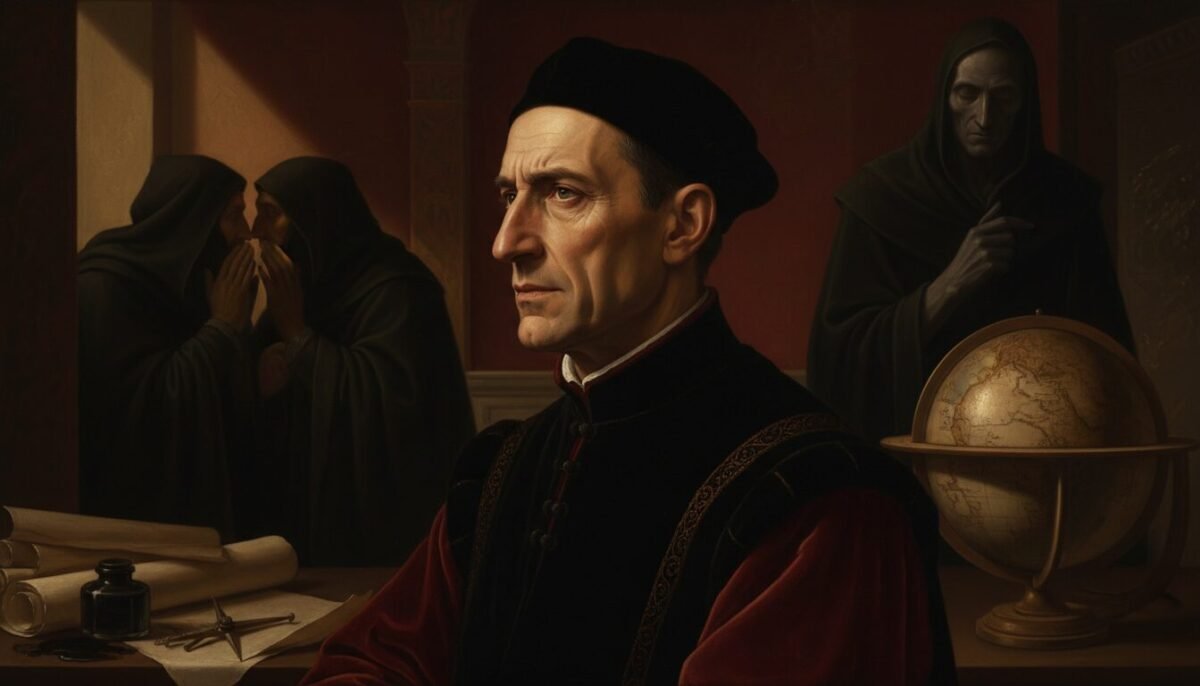
This invasion turned Italy into a playground for the great European monarchies. Fragmented city-states like Florence found themselves caught between the clashing gears of unified giants like France and Spain. Machiavelli, serving as a high-ranking diplomat and civil servant for the Florentine Republic, watched this collapse from the front lines. He saw that the traditional “mirror for princes” literature—books that told rulers to be kind, generous, and godly—was not just useless; it was dangerous. If a prince followed those rules while his neighbor was a wolf, the prince would be devoured.
The constant state of warfare necessitated a radical shift toward political realism. Machiavelli realized that the stability of a state depended on its ability to withstand external shocks. When the French invaded, they didn’t care about the artistic brilliance of the Renaissance or the theological debates of the Vatican. They cared about territory and tribute. This environment taught Machiavelli that the primary function of a political leader is not to ensure the salvation of his subjects’ souls, but to ensure the physical security of the state. Without security, there is no art, no commerce, and no law. The blood on the streets of 1494 was the ink Machiavelli used to write his new philosophy.
2. The Critique of the Condottieri: Why Mercenaries Failed Italy
Machiavelli’s most vitriolic writing was often reserved for the Condottieri—the mercenary leaders who dominated Italian warfare. These were professional soldiers of fortune who sold their services to the highest bidder. On paper, they were the elite. In practice, Machiavelli saw them as a cancer eating away at the Italian states. He observed them firsthand during his diplomatic missions and came to a devastating conclusion: mercenaries are “useless and dangerous.”
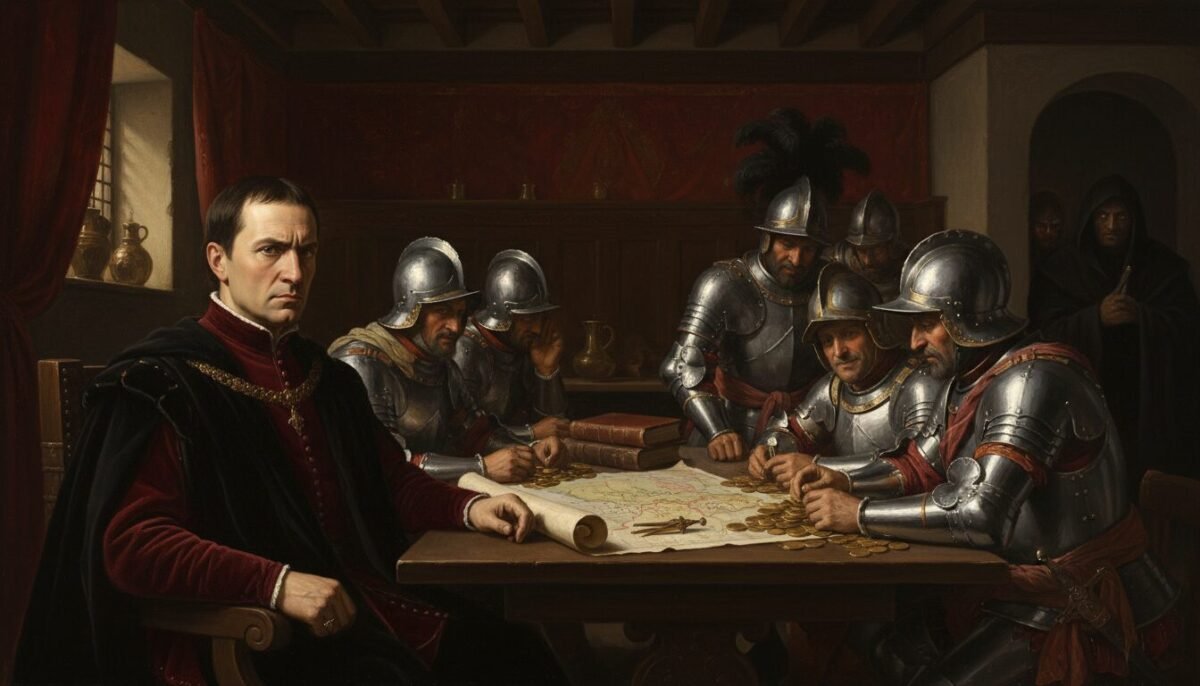
The problem was one of incentives. A mercenary’s primary goal is to get paid and stay alive to spend the money. They had no loyalty to the city they were defending. Machiavelli noted with bitter irony that these hired soldiers had developed a “code” of warfare that was essentially a scam. They would fight bloodless battles, taking prisoners only to ransom them back, and avoiding any real risk of death. They were “brave” when there was no danger and “cowards” when the stakes were high. When the French and Spanish arrived with soldiers who were actually willing to die for a cause or a king, the Condottieri melted away.
Furthermore, mercenaries were an economic drain. They demanded high wages during peacetime and were prone to extortion during wartime. If you were winning, they wanted more money; if you were losing, they deserted you. Machiavelli lamented the “cowardice” in Italian defense, arguing that relying on hired help had made the Italian princes soft and vulnerable. He saw that the pursuit of profit over victory had led to a strategic paralysis. A state that cannot defend itself with its own people is not a state at all; it is merely a temporary arrangement waiting to be dismantled by someone with a real army.
3. The Citizen-Soldier: Building a Republic on Virtù
Machiavelli wasn’t just a theorist; he was a man of action. In 1506, he convinced the Florentine government to allow him to organize a national militia. He spent years traveling through the Tuscan countryside, recruiting peasants and training them. This wasn’t just a military project; it was a deeply philosophical one. Machiavelli believed that the only way to save Florence was to reconnect the act of citizenship with the act of soldiering.
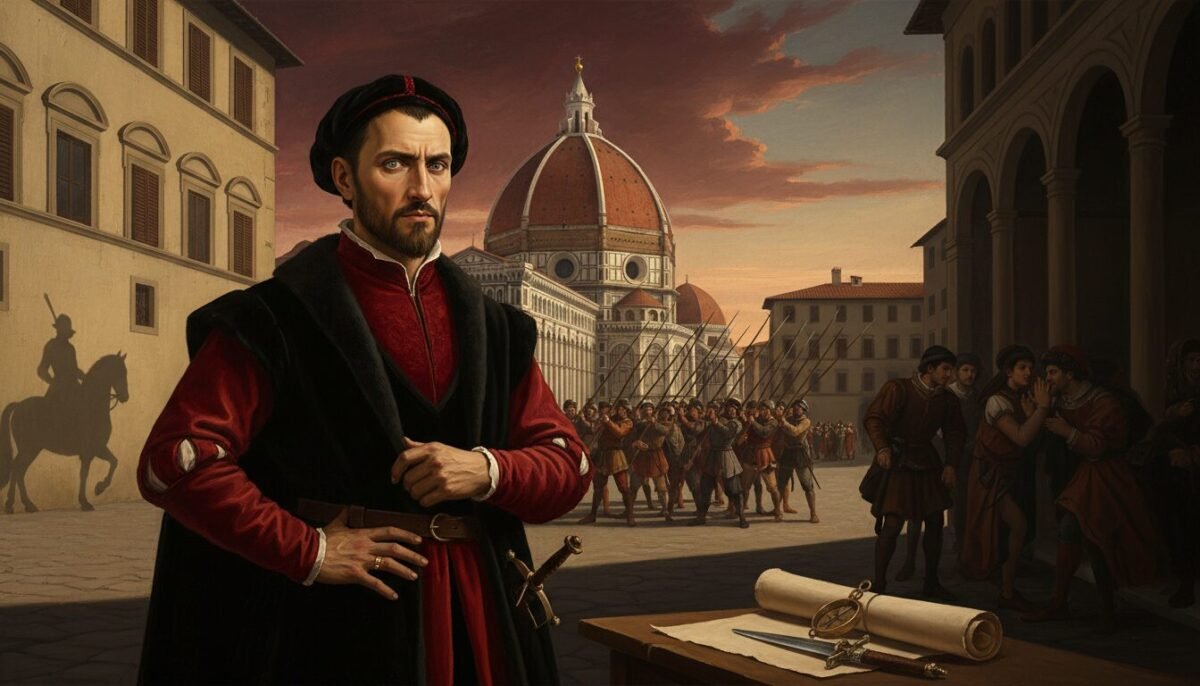
The concept of the “citizen-soldier” was a direct challenge to the mercenary system. Machiavelli argued that a man who fights for his own home, his own family, and his own freedom will always outperform a man who fights for a paycheck. This connection between civic participation and military service served as a safeguard against tyranny. If the people are the army, the ruler cannot easily use the army to oppress the people. Conversely, a people who refuse to fight eventually lose the right to govern themselves.
At the heart of this was Machiavelli’s concept of virtù. In modern English, “virtue” implies moral goodness or Christian piety. For Machiavelli, virtù meant something closer to the original Latin virtus: manliness, strength, cunning, and the ability to achieve great things. It was the energy and skill required for a state to survive in a hostile world. A citizen-soldier possessed virtù because he had a stake in the outcome. He wasn’t just a cog in a machine; he was the defender of his own existence. By building a militia, Machiavelli was trying to inject virtù back into a Florentine populace that he felt had become stagnant and weak.
4. Good Laws and Good Arms: The Foundation of The Prince
In Chapter 12 of The Prince, Machiavelli drops a bombshell that summarizes his entire worldview: “There cannot be good laws where there are not good arms, and where there are good arms there must be good laws.” This is often misinterpreted as a call for a military dictatorship, but the logic is more nuanced. Machiavelli is arguing that military strength is the absolute prerequisite for political stability and internal justice.
Think of it this way: a government can pass the most beautiful, progressive, and just laws in the world, but if a foreign invader can march in and burn the law books, those laws are worthless. The “arms” (the military) provide the protective shell within which the “laws” (the civil society) can exist. Without the shell, the interior is destroyed. Therefore, a ruler who neglects the military is effectively neglecting the law and the welfare of his people. This is why Machiavelli insists that a ruler’s primary duty—above all other arts—is the study and practice of war.
He famously wrote that a prince should “never lift his thoughts from the exercise of war,” and in peace, he should practice it even more than in war. This involves both physical training and intellectual study. A ruler must know the terrain of his country, understand the psychology of his troops, and study the history of great commanders. To Machiavelli, politics is simply war by other means, and war is politics at its most honest. If you don’t understand the mechanics of force, you will always be at the mercy of those who do.
5. The Art of War: Military Strategy as a Tool of Statecraft
While The Prince and The Discourses are his most famous works, The Art of War was the only major political work Machiavelli published during his lifetime. In it, he moves away from the “why” of military power and dives deep into the “how.” He was heavily influenced by Roman military history, particularly the writings of Vegetius. He looked back at the Roman Legion as the pinnacle of military organization and sought to adapt their discipline to the modern age.
Machiavelli was one of the first thinkers to recognize the transition from medieval warfare to modern tactics. He saw that the age of the armored knight on horseback—the symbol of the feudal aristocracy—was coming to an end. The future belonged to the infantry. He advocated for a disciplined, pike-and-shot formation that relied on collective movement rather than individual heroics. This wasn’t just a tactical preference; it was a social one. Infantry-centric warfare required a large, organized body of citizens, further reinforcing his argument for the citizen-soldier.
He also understood that strategy was a tool of statecraft. You didn’t just fight to win a battle; you fought to achieve a political objective. He analyzed the use of deception, the importance of morale, and the necessity of decisive action. For Machiavelli, the battlefield was a laboratory where the strength of a state’s “social contract” was tested. If the soldiers broke and ran, it was a sign that the state itself was hollow.
6. The Legacy of Realism: How War Defined Modern Politics
Machiavelli’s military-centric view of the world paved the way for the modern concept of the “monopoly on the legitimate use of physical force.” This idea, later formalized by sociologists like Max Weber, suggests that the defining characteristic of a state is its ability to be the sole provider of security within its borders. Machiavelli was the first to articulate that the state is, at its core, a security provider. Everything else—welfare, education, culture—is a luxury that depends on that primary function.
His theories remain the bedrock of “Realpolitik” and the “Realist” school of international relations. When modern strategists talk about “hard power” or “deterrence,” they are speaking Machiavelli’s language. He taught us that in a world of competing interests, hope is not a strategy. You cannot rely on the goodwill of others; you can only rely on your own strength and your own virtù. Understanding the soldier is key to understanding the statesman because both are engaged in the same fundamental task: navigating a world of uncertainty and danger to ensure survival.
Ultimately, Machiavelli’s political philosophy was a direct, visceral response to the military failures of his time. He didn’t write to be “evil”; he wrote to be effective. By advocating for citizen militias over mercenaries and linking “good arms” to “good laws,” he transformed statecraft from a branch of theology into a science of survival. He reminds us that the thin line between civilization and chaos is often held by those willing to study the art of war.
Frequently Asked Questions
Did Machiavelli actually fight in any wars?
While he wasn’t a frontline combat soldier in the traditional sense, Machiavelli was deeply involved in military operations. He personally oversaw the recruitment, training, and deployment of the Florentine militia and was present at the siege of Pisa in 1509, where his citizen-soldiers were actually successful.
Why did he hate mercenaries so much?
Machiavelli saw mercenaries as “parasites” who drained a state’s wealth without providing real security. He believed their lack of “skin in the game” made them unreliable in a crisis, leading to the repeated humiliations of Italian states during the French and Spanish invasions.
Is Machiavelli’s advice still relevant in the age of nuclear weapons?
While the technology has changed, his core psychological and strategic insights remain. His emphasis on the “monopoly of violence,” the importance of domestic stability for foreign strength, and the need for leaders to see the world as it is, rather than as they wish it to be, continues to influence modern global strategy.
What did he mean by “Good Arms”?
“Good arms” refers to a military force composed of a state’s own citizens who are well-trained, disciplined, and loyal. To Machiavelli, a military that is not integrated into the civic life of the state is a threat to that state’s survival.
If you found this analysis of power and strategy compelling, you might enjoy our deep dives into Machiavelli & Political Philosophy or our exploration of the darker side of Influence & Leadership. For more insights into the intersection of history, psychology, and power, subscribe to the DeepPsyche newsletter.