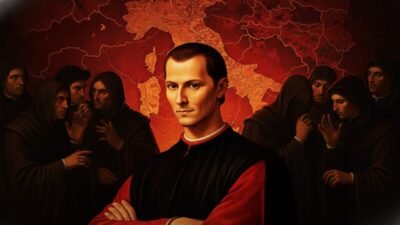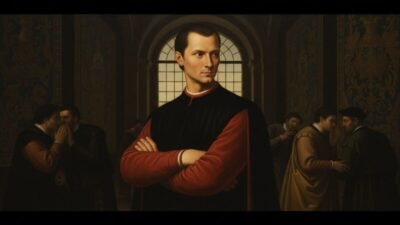

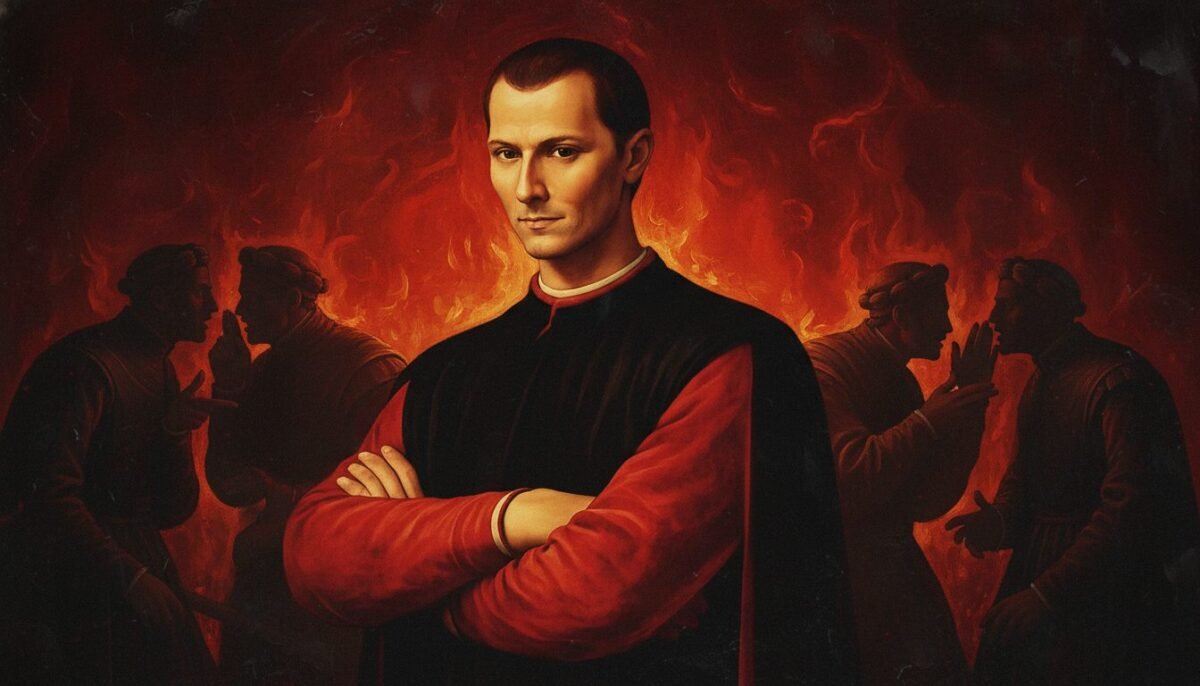
What happens when a man who lives for the pulse of power—a man who spent fourteen years at the heart of high-stakes Renaissance diplomacy—is suddenly stripped of everything and cast into the silence of the countryside? Imagine a life spent negotiating with kings, popes, and warlords, only to find yourself arguing with local woodcutters over the price of a stack of timber. This was the reality for Niccolò Machiavelli in 1513. To many modern readers, Machiavelli is a “teacher of evil,” a name synonymous with backstabbing and cold-blooded manipulation. Yet, this caricature fails to account for the personal trauma and political isolation that birthed his most controversial ideas.
The Machiavelli we know today—the father of modern political science—was not born in the halls of the Florentine Chancellery. He was forged in the crucible of exile. It was only when he was forcibly removed from the “game of thrones” that he gained the distance necessary to see the board clearly. This article explores the transformative period of Machiavelli’s exile, revealing how his fall from grace in Florence directly led to a philosophy that changed the Western world forever.
1. The Florentine Diplomat: Machiavelli’s Life Before the Fall
Before he was a disgraced exile, Machiavelli was the ultimate insider. In 1498, at the age of 29, he was appointed as the Second Chancellor of the Florentine Republic and Secretary to the Dieci di Libertà e Pace (The Ten of Liberty and Peace). This wasn’t a mere bureaucratic post; it was a role that placed him at the center of Florence’s foreign policy and military affairs. For over a decade, Machiavelli was the “eyes and ears” of the Republic, traveling across Europe on delicate diplomatic missions.
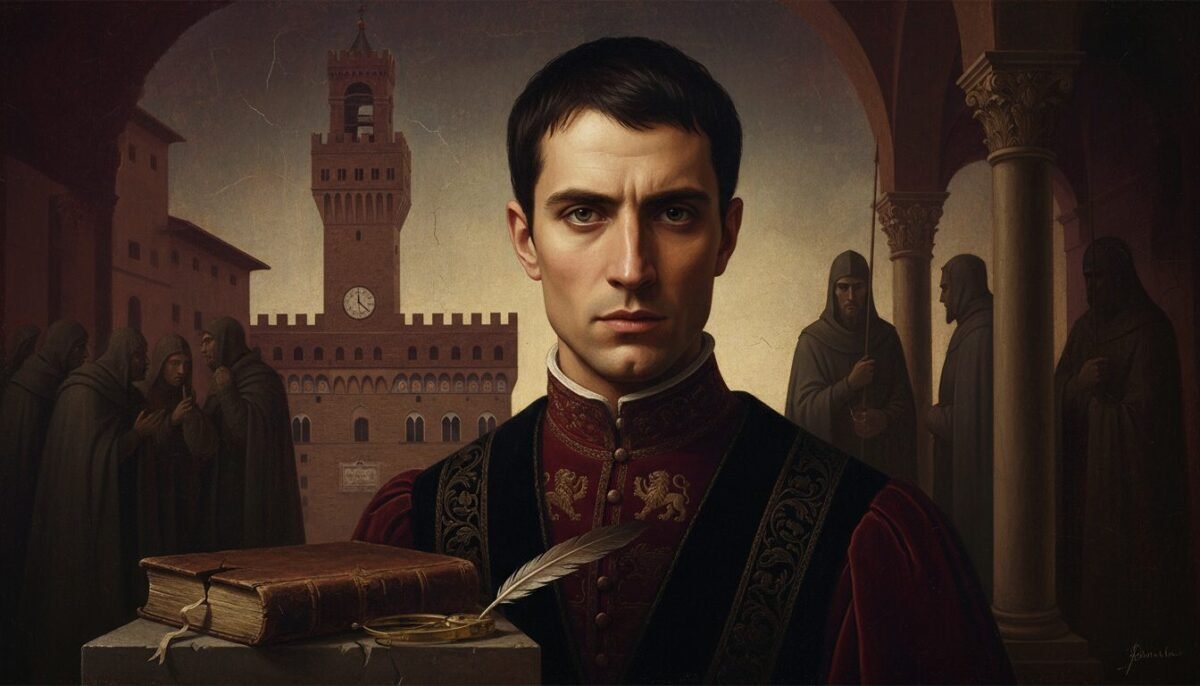
His practical experience was staggering. He spent months at the court of King Louis XII of France, observing how a centralized monarchy maintained its grip on power. He navigated the treacherous waters of the Papal Court in Rome, watching as popes played God and king simultaneously. These weren’t academic exercises; they were survival lessons. Machiavelli learned that in the real world, a diplomat’s word was only as strong as the army backing it—a realization that led him to champion the creation of a Florentine citizen militia, replacing the fickle and expensive mercenaries who often betrayed their employers.
Perhaps the most profound influence on his early career was Cesare Borgia, the Duke of Valentinois. While others saw Borgia as a monster, Machiavelli saw a masterclass in political efficiency. He watched Borgia pacify the chaotic region of Romagna through a blend of calculated cruelty and strategic benevolence. Borgia’s ability to use “well-used cruelty” to establish order left an indelible mark on Machiavelli’s psyche. He saw that the “moral” choice of a leader often led to ruin, while the “effective” choice—however distasteful—ensured the safety of the state. This tension between republican idealism and the harsh realities of power was already simmering within him long before he put pen to paper.
2. 1512: The Collapse of the Republic and the Medici Return
The year 1512 marked the end of Machiavelli’s world. The geopolitical landscape of Italy was a shifting mosaic of alliances, and Florence found itself on the wrong side of history. The French, Florence’s long-time allies, were driven out of Italy by the Holy League, a coalition led by Pope Julius II and backed by Spanish troops. Without French protection, the Florentine Republic was defenseless. The Spanish army marched on the city, and the republican government, which Machiavelli had served so faithfully, collapsed in a matter of days.
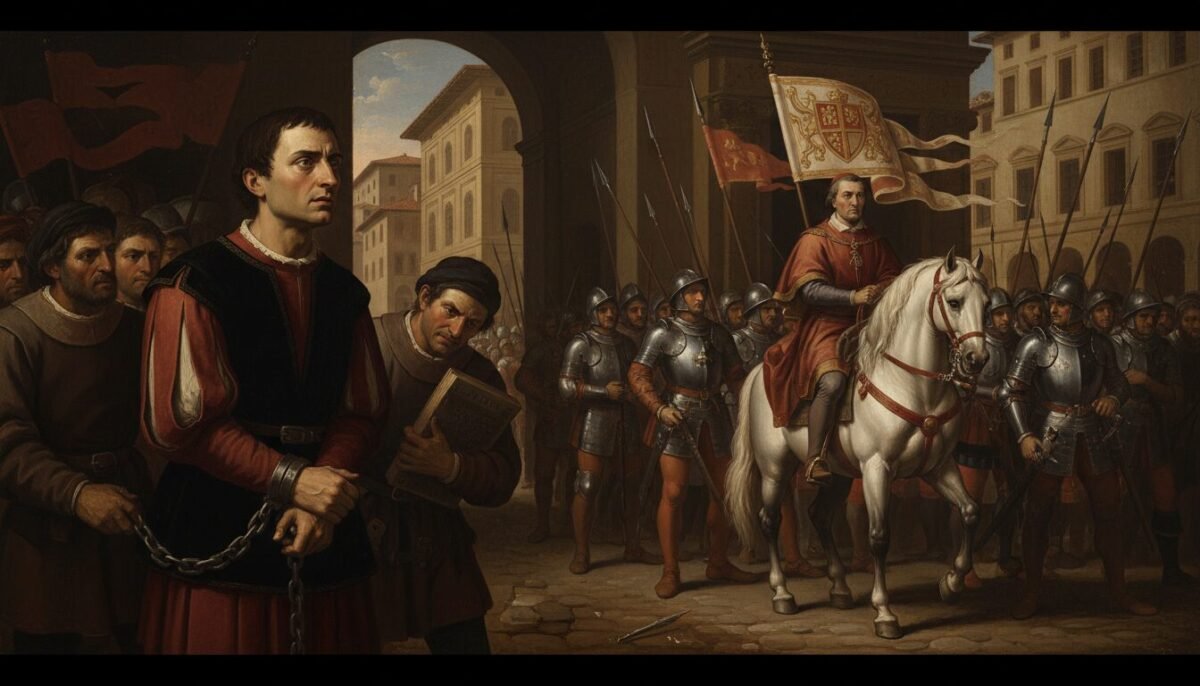
With the fall of the Republic came the return of the Medici family, who had been in exile for nearly two decades. The Medici were not interested in reconciliation; they were interested in restoration and revenge. A massive purge of republican officials followed. Machiavelli, despite his attempts to remain useful to the new regime, was dismissed from his posts in November 1512. He was banned from entering the Palazzo della Signoria and forced to pay a heavy bond for his “good behavior.”
Things went from bad to worse in early 1513. Machiavelli’s name appeared on a list of potential conspirators in a plot to overthrow the Medici. He was arrested and thrown into the Bargello, Florence’s notorious prison. There, he was subjected to the “strappado”—a form of torture where the victim’s hands are tied behind their back and they are hoisted up by a rope, then dropped, dislocating the shoulders. Machiavelli endured six “drops” without confessing. Though eventually released during a general amnesty following the election of Giovanni de’ Medici as Pope Leo X, his career was dead. He was banished to his small, modest family estate in San Casciano, a few miles outside the city walls.
3. Isolation at San Casciano: The Psychological Shift
The transition from the high-stakes world of international diplomacy to the mundane life of a rural farmer was a psychological shock. In San Casciano, Machiavelli’s days were filled with the trivialities of country living: supervising the harvest, bird-catching, and arguing with neighbors over card games at the local inn. For a man who had once advised kings, this was a living death. He felt “rotting” in the silence of the countryside, far from the “pulse” of power he craved.
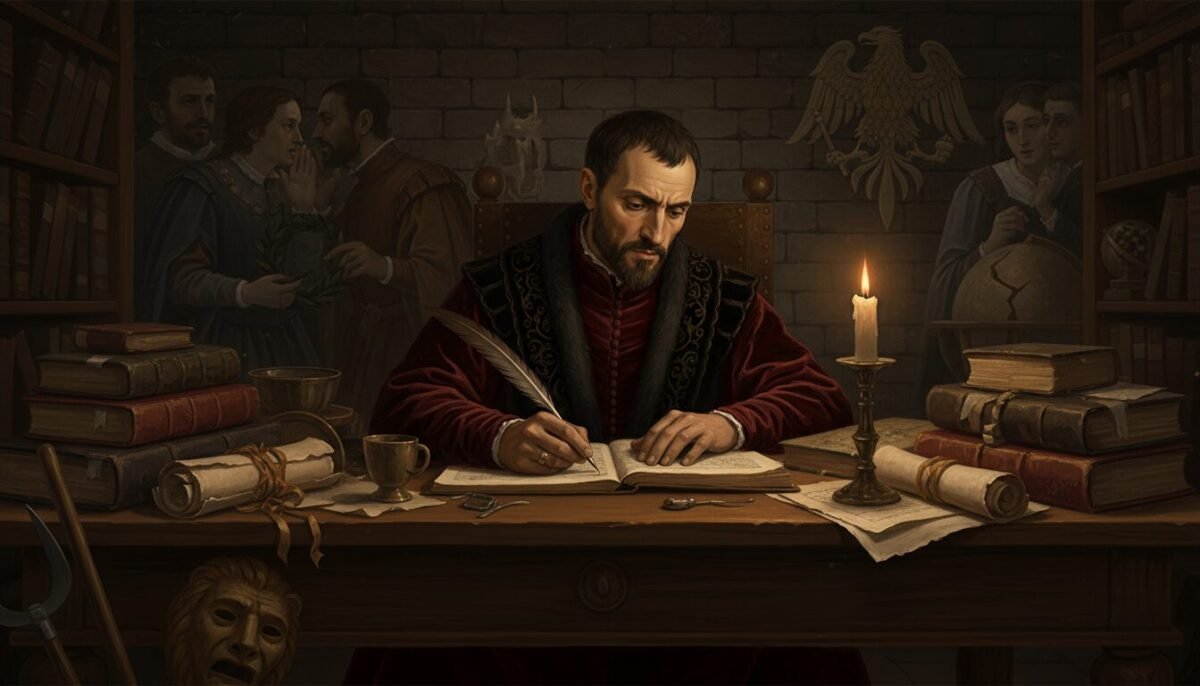
We know of his mental state through his famous letter to his friend Francesco Vettori, dated December 10, 1513. In it, he describes his daily routine: “I get up in the morning with the sun and go into a grove of mine… I pass into the road, go to the inn… I play at cricca and tric-trac, and this gives rise to a thousand disputes and countless insults with offensive words.” It was a life of “sordidness,” as he called it, a desperate attempt to keep his brain from “growing moldy.”
However, the most famous part of the letter describes his evening ritual. When evening fell, Machiavelli would return home, strip off his “muddy and dusty” work clothes, and put on “regal and courtly garments.” He would enter his study and, in his imagination, “commune with the ancients.” He read the great historians and philosophers of Rome and Greece, asking them why they did what they did. “And they, in their humanity, reply to me,” he wrote. This ritual was more than an escape; it was a transformation. Isolation forced him to stop being a “man of action” who reacted to events and start being a “man of letters” who analyzed the underlying mechanics of those events. The silence of San Casciano gave him the clarity that the noise of the Chancellery never could.
4. The Birth of Political Realism: Why ‘The Prince’ Required Exile
It is no coincidence that Machiavelli’s most famous work, The Prince, was written during this period of intense isolation. Without political agency, Machiavelli turned to objective, almost clinical, power analysis. If he could not practice power, he would dissect it. The Prince was, in many ways, a desperate “job application” addressed to Lorenzo de’ Medici. Machiavelli was trying to prove that his years of experience and his deep study of history made him an invaluable asset to the new rulers.
The trauma of his betrayal and torture is etched into every page of the book. When he famously argues that “it is much safer to be feared than loved,” he isn’t speaking from a place of abstract cruelty. He is speaking from the perspective of a man who saw the Florentine people abandon the Republic the moment things got difficult. He had seen “love” and “loyalty” evaporate in the face of Spanish pikes. His conclusion was pragmatic: love is a bond of obligation which, because men are wretched, is broken every time their own interest is at stake; but fear is strengthened by a dread of punishment which never abandons you.
Exile allowed Machiavelli to strip away the “ought” of politics—how things should be—and focus entirely on the “is”—how things actually are. This was the birth of political realism. He argued that a prince who tries to be “good” in a world full of people who are not good will inevitably come to ruin. By losing his place in the world, Machiavelli lost his illusions. He moved from the idealistic republicanism of his youth to a cold, hard pragmatism focused on the survival of the state at all costs. He realized that the ultimate “virtue” of a leader was not personal morality, but the ability to maintain the “Stato” (the state) and provide security for its people.
5. The Duality of Thought: ‘Discourses on Livy’ vs. ‘The Prince’
One of the great paradoxes of Machiavelli’s exile is that while he was writing The Prince (an instruction manual for autocrats), he was also working on the Discourses on Livy (a profound defense of republicanism). This duality is often confusing to modern readers, but it makes perfect sense when viewed through the lens of his intellectual development in San Casciano. Exile gave him the intellectual space to analyze long-term historical cycles, a concept known as Anacyclosis.
In the Discourses, Machiavelli argues that a republic is the most stable and “virtuous” form of government because it allows for the participation of the people and the balancing of different social classes. However, he also recognized that republics are fragile and prone to corruption. When a state becomes so corrupt that laws no longer function, a “New Prince” is required to restore order through any means necessary. This is where The Prince fits in—it is the “emergency manual” for a state in crisis.
At the heart of both works are two central concepts: Virtù and Fortuna.
- Virtù: Not “virtue” in the Christian sense, but rather “prowess,” “energy,” or “effectiveness.” It is the ability of a leader to adapt to changing circumstances and impose their will on the world.
- Fortuna: The unpredictable, often violent forces of chance. Machiavelli famously compared Fortuna to a “raging river” that destroys everything in its path, but noted that a leader with enough Virtù can build dikes and dams to direct its flow.
Exile was Machiavelli’s own encounter with Fortuna. She had knocked him down, but his Virtù—his intellectual resilience—allowed him to build a philosophical monument from the wreckage of his career.
6. The Enduring Legacy of Forced Retirement
There is a profound irony in Machiavelli’s life: his failure as a politician ensured his immortality as a philosopher. Had the Florentine Republic survived, or had the Medici immediately rehired him, Machiavelli would likely have spent the rest of his life writing memos, negotiating trade routes, and being a footnote in the history of the Italian Renaissance. He would have been a successful bureaucrat, but he would not have been Machiavelli.
His “exile works” laid the foundation for modern political thought. By separating ethics from politics, he opened the door for later thinkers like Thomas Hobbes, who looked at the “state of nature,” and Montesquieu, who looked at the separation of powers. Modern political science, with its focus on data, power dynamics, and institutional structures, owes its existence to the man who was forced to sit in a quiet room in San Casciano and think about why he lost his job.
The legacy of Machiavelli’s forced retirement is a testament to the relationship between suffering, isolation, and intellectual breakthrough. It suggests that sometimes, to understand a system, you must be cast out of it. His insights were not born from comfort, but from the sting of the strappado and the dust of the Tuscan roads. He proved that even when a man is stripped of his power, his mind can still command the future.
Machiavelli’s exile was not merely a punishment; it was the essential crucible that forged his political philosophy. By stripping him of his power, history forced him to observe it with a clarity that changed the Western world forever. He taught us that power is not a divine right or a moral reward, but a tool—one that requires a cold eye and a steady hand to wield. As we navigate the complexities of modern power, we are still, in many ways, living in the world that Machiavelli mapped out from his lonely study in the hills of Florence.
Frequently Asked Questions
Was Machiavelli actually “evil”?
Machiavelli wasn’t advocating for evil for its own sake. He was a “political realist” who argued that leaders must sometimes do distasteful things to prevent greater catastrophes, like civil war or foreign invasion. He saw “effective” leadership as the highest moral good for a ruler.
Did Machiavelli ever get his job back?
Not really. He was eventually given some minor tasks by the Medici, such as writing a history of Florence, but he never regained the high-level diplomatic influence he held during the Republic. He died in 1527, shortly after the Medici were once again expelled and the Republic was briefly restored—but the new republican government didn’t trust him either.
What is the main difference between ‘The Prince’ and ‘The Discourses’?
The Prince focuses on how an individual can gain and maintain power in a state that is unstable or corrupt. The Discourses focuses on how a republic can be maintained over a long period through civic virtue and the rule of law. They are two sides of the same coin: how to create and sustain a functioning state.
Why is he called the “father of modern political science”?
Because he was the first to analyze politics as it is actually practiced, rather than how it should be practiced according to religious or moral ideals. He treated politics as a science with its own rules, independent of theology or traditional ethics.
If you found this deep dive into the mind of Machiavelli intriguing, you might also enjoy our explorations of Power & Human Nature or our analysis of Influence & Leadership in the Renaissance. Discover more about how history’s greatest thinkers navigated the shadows of power at DeepPsyche.blog.