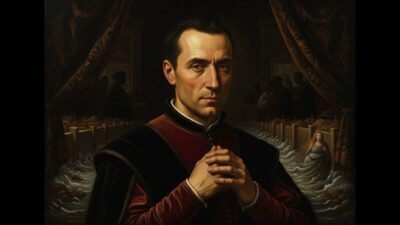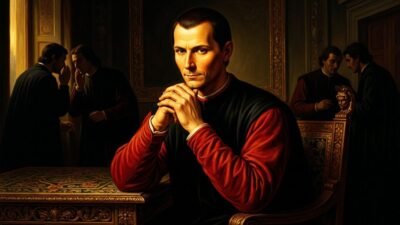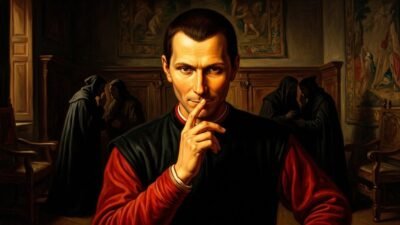
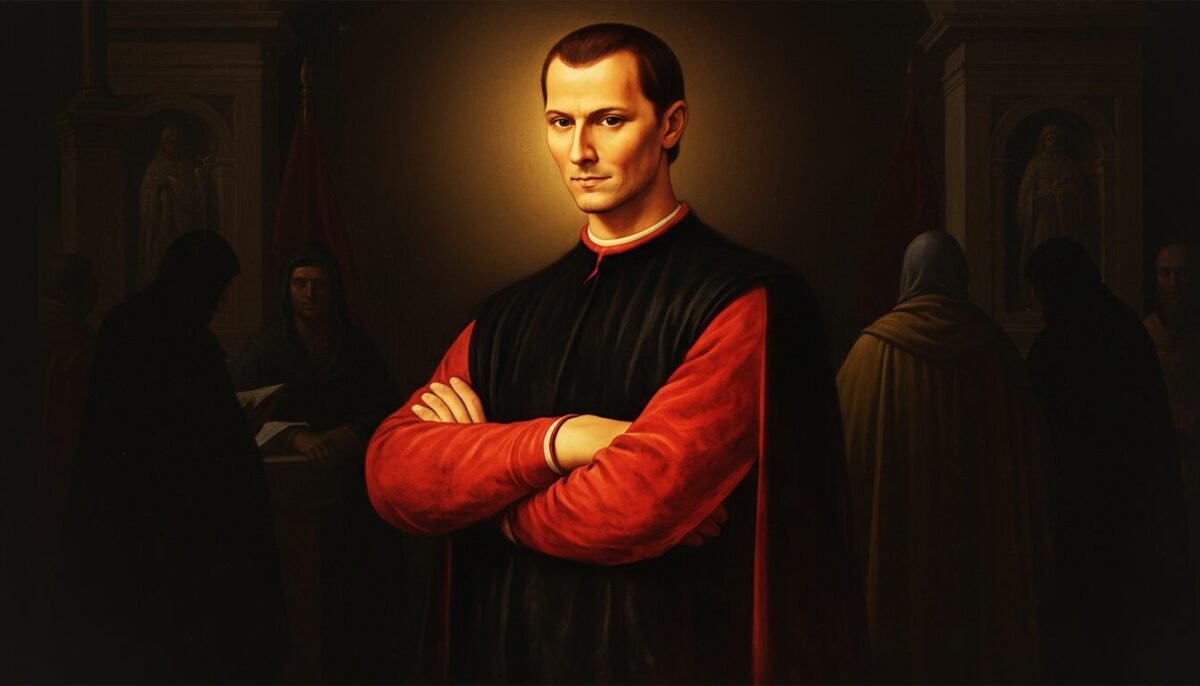
Is it truly better to be feared than loved? For five centuries, this single question has defined the legacy of Niccolò Machiavelli, a man whose name became synonymous with evil, manipulation, and the dark arts of statecraft. To call someone “Machiavellian” today is rarely a compliment; it implies a cold-blooded willingness to discard morality in favor of results. Yet, this reputation often rests on a surface-level reading of a single, slim volume written in a moment of personal and political desperation.
Most people associate Machiavelli with ruthless deceit without understanding the chaotic, blood-soaked reality of Renaissance Italy that birthed his ideas. He was not a man who loved tyranny; he was a man who had seen the Florentine Republic he served collapse under the weight of its own idealism and the boots of foreign invaders. To understand Machiavelli is to look past the caricature and into the eyes of a patriot who believed that a leader’s greatest sin was not cruelty, but incompetence. As we navigate the complex geopolitical landscape of 2026, his unflinching realism feels less like a manual for villains and more like a sobering mirror held up to the nature of power itself.
1. The Crucible of Florence: Political Instability and the Medici
To understand the man, we must understand the trauma of his city. Florence in the late 15th and early 16th centuries was a jewel of the Renaissance, but it was a jewel constantly under threat of being crushed. Machiavelli was a dedicated civil servant of the Florentine Republic, serving as a diplomat and overseer of the city’s militia. He spent his career watching the “Great Powers” of the era—France, Spain, and the Holy Roman Empire—treat the Italian city-states like pieces on a chessboard. He saw firsthand that treaties were only as strong as the armies backing them, and that “right” meant very little without “might.”
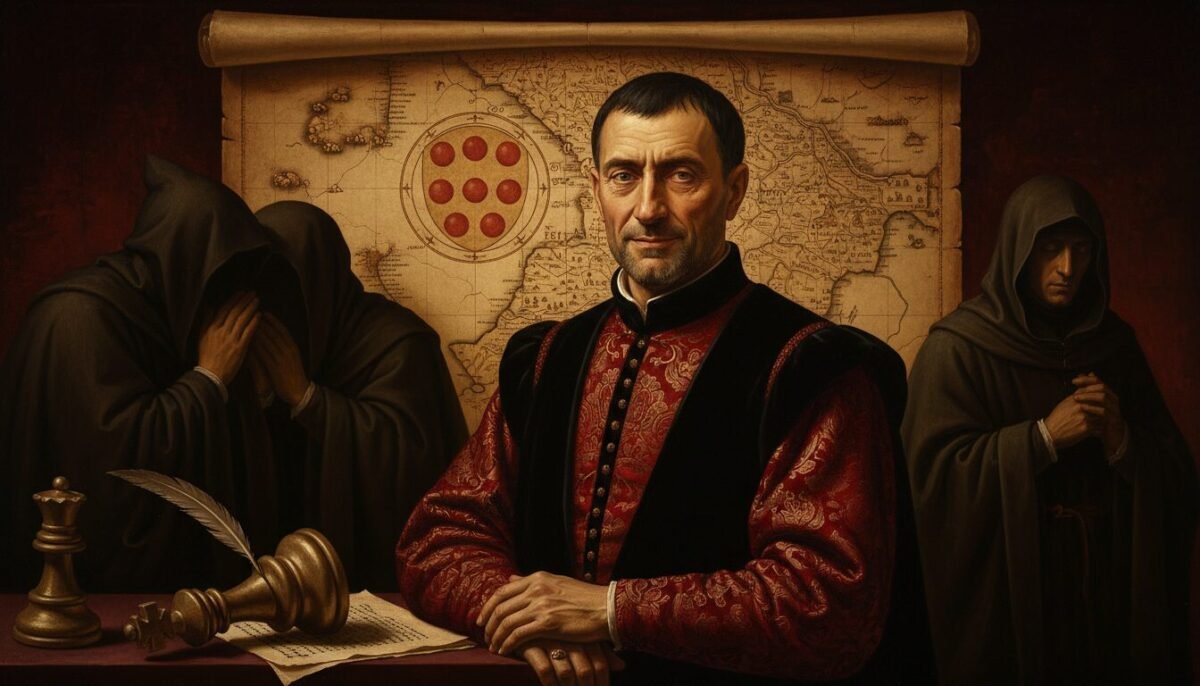
The turning point of his life came in 1512. The Florentine Republic, which Machiavelli had served for fourteen years, collapsed. The Medici family, backed by Spanish troops and the Pope, returned to power, dismantling the democratic institutions Machiavelli cherished. He was not just fired; he was accused of conspiracy, imprisoned, and subjected to the strappado—a form of torture where the victim’s hands are tied behind their back and they are dropped from a height, wrenching the shoulders out of their sockets. Machiavelli survived six drops without confessing to a crime he likely didn’t commit.
Exiled to a small farm outside the city, broken in body but sharp in mind, he wrote The Prince. It was a “job application” of sorts, dedicated to Lorenzo de’ Medici, intended to prove that he understood the brutal mechanics of power better than anyone else. His obsession with a strong, unified leader wasn’t born of a love for autocracy, but from the exhaustion of watching Italy be raped and pillaged by foreign armies. He believed that only a “New Prince,” one unburdened by traditional Christian ethics, could unify the fractured Italian states and drive out the “barbarians.” His realism was a desperate response to a failed state.
2. Challenging the Moral Order: The Core Arguments of ‘The Prince’
Before Machiavelli, political writing belonged to a genre known as “Mirrors for Princes.” These books, written by theologians and humanists like Erasmus, argued that the best way to be a successful ruler was to be a virtuous person. They claimed that if a prince was just, merciful, and pious, God would bless his reign and his people would be loyal. Machiavelli took these books and metaphorically threw them into the fire. He argued that there is a fundamental disconnect between how people live and how they ought to live.
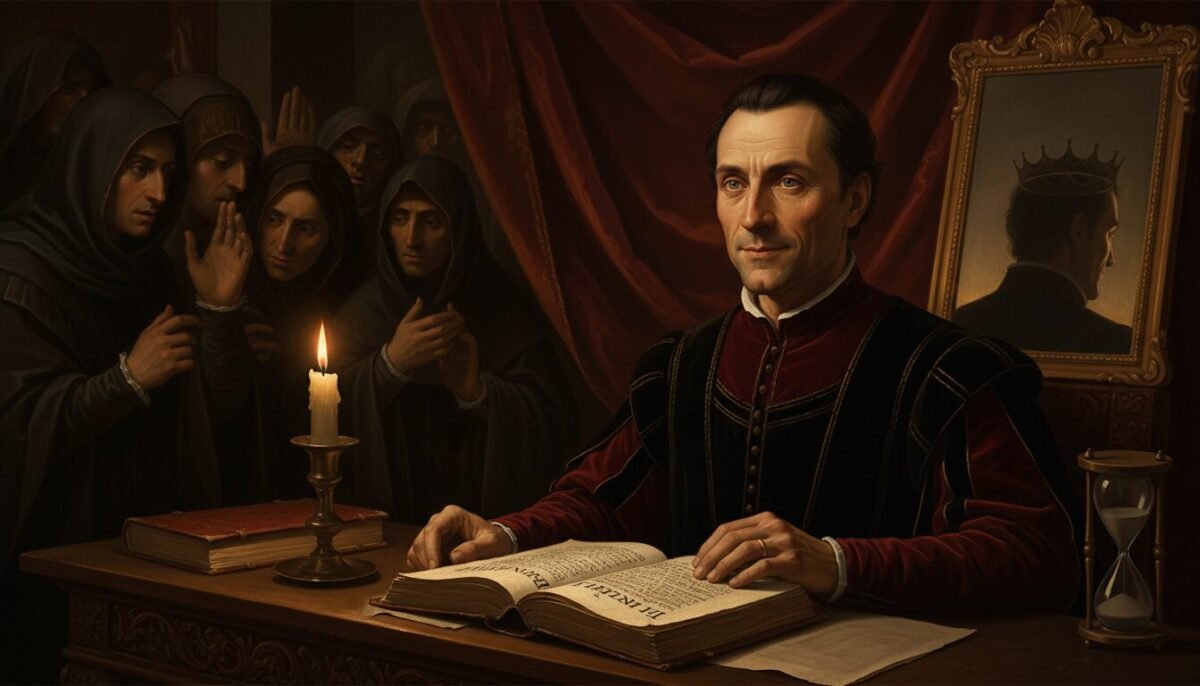
The core of his argument is the separation of private morality from political ethics. A private citizen can afford to be “good” in the Christian sense—to turn the other cheek, to be honest at all costs, to be humble. But a ruler who acts this way, Machiavelli argued, invites disaster. If a prince is always honest in a world where others are liars, he will be ruined. Therefore, a prince must learn “how not to be good” and to use that knowledge, or not use it, according to necessity (necessità).
This was the birth of secularism in governance. Machiavelli wasn’t necessarily saying that being “bad” is good; he was saying that the survival of the state is the highest moral good. If a ruler must lie, cheat, or even kill to prevent a civil war or a foreign invasion, those actions are “virtuous” in a political sense because they protect the collective. He replaced the “Mirror for Princes” with a cold, hard window into the reality of human behavior. He stripped away the divine right of kings and replaced it with the raw, secular mechanics of Realpolitik, suggesting that the state is a human creation that must be maintained by human—and sometimes inhumane—means.
3. The Church’s Wrath: The Index Librorum Prohibitorum and the ‘Old Nick’ Legend
It is no surprise that the Catholic Church did not take kindly to a man suggesting that the state should operate independently of divine law. By the mid-16th century, the Counter-Reformation was in full swing, and the Church was tightening its grip on intellectual life. In 1559, Pope Paul IV placed Machiavelli’s entire body of work on the Index Librorum Prohibitorum—the list of prohibited books. He was branded an atheist and a teacher of evil, his works seen as a direct assault on the moral authority of the Papacy.
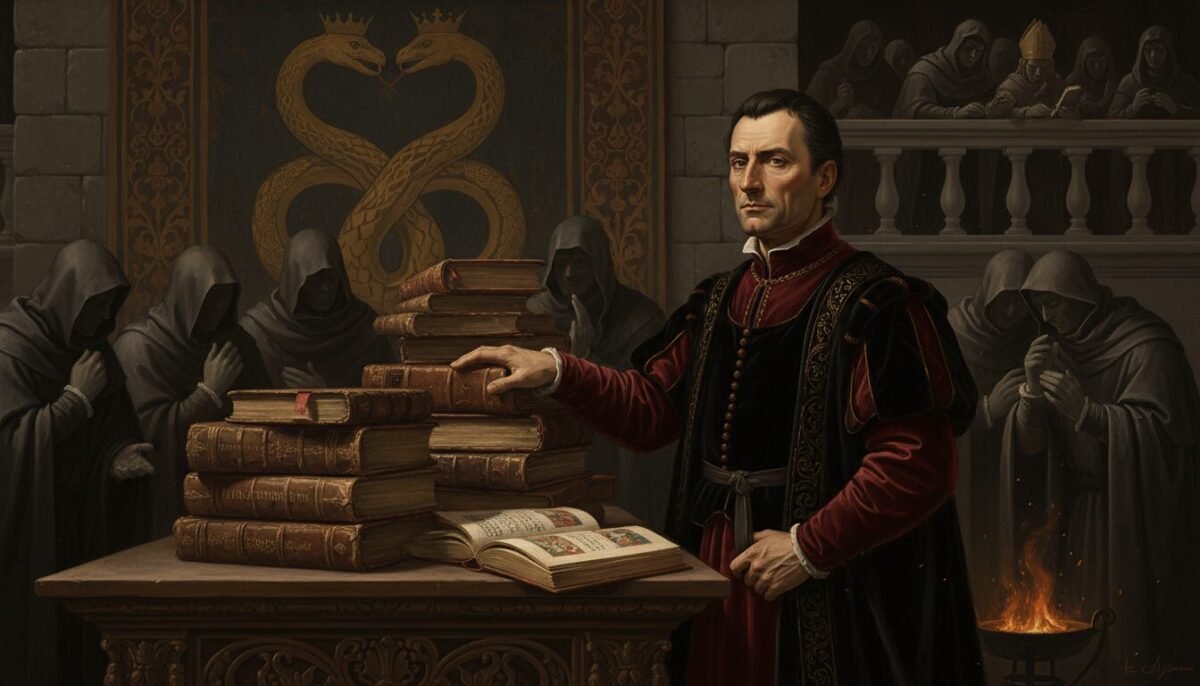
The vilification of Machiavelli went far beyond official bans. He became a convenient bogeyman for both Catholics and Protestants. In England, Elizabethan dramatists turned “Machiavel” into a stock stage villain—a character who would walk onto the stage and boast about his own deceit and lack of conscience. Christopher Marlowe’s The Jew of Malta even features a prologue spoken by a character named “Machevill.” This cultural caricature was so pervasive that many historians believe the English nickname for the Devil, “Old Nick,” is actually a reference to Niccolò Machiavelli.
This religious propaganda served a dual purpose. First, it discredited Machiavelli’s republican ideas, which were a threat to absolute monarchies. Second, it allowed leaders to continue practicing Machiavellian tactics in secret while publicly condemning them. By turning the man into a demon, the powers that be could use his techniques while maintaining a facade of Christian piety. The “Old Nick” legend was less about Machiavelli’s actual writing and more about the collective discomfort of a society forced to confront the hypocrisy of its own leaders.
4. Misunderstood Maxims: Did He Say ‘The End Justifies the Means’?
Perhaps the most famous phrase attributed to Machiavelli is “the end justifies the means.” Interestingly, he never actually wrote those exact words. The closest he came was in Chapter XVIII of The Prince, where he wrote: “Si guarda al fine” (One looks to the result). While the sentiment is similar, the nuance is vital. Machiavelli was not advocating for “senseless cruelty” or a “do whatever you want” attitude. He was making a distinction between “well-used cruelty” and “abused cruelty.”
To Machiavelli, cruelty is “well-used” when it is done once, out of necessity for safety, and then converted into the greatest possible benefit for the subjects. Cruelty is “abused” when it increases over time rather than diminishing. He famously used the example of Cesare Borgia, who used a henchman to brutally pacify a lawless region and then had that same henchman executed in the town square to appease the people and show that he, the prince, did not condone the violence. To Machiavelli, this was a masterful use of power: it achieved peace and then shifted the blame for the necessary violence away from the ruler.
The lack of nuance in popular translations has contributed heavily to his reputation for advocating pure evil. He didn’t believe that any “end” justified any “means.” The “end” had to be the stability and glory of the state, not the personal enrichment or sadistic whims of the ruler. If a leader is cruel for no reason, or for personal gain, Machiavelli calls them a tyrant and predicts their swift downfall. His philosophy was a calculus of consequences, not a license for psychopathy.
5. The Evolution of ‘Machiavellianism’ into a Psychological Trait
As the centuries passed, the term “Machiavellian” migrated from the halls of government into the clinics of psychologists. In the 1970s, social psychologists Richard Christie and Florence Geis developed the “Mach IV” scale to measure a personality trait characterized by a cynical disregard for morality and a focus on self-interest and personal gain. This eventually led to the identification of the “Dark Triad” in modern psychology: Narcissism, Psychopathy, and Machiavellianism.
In this context, Machiavellianism is defined by three pillars: interpersonal manipulation, a cynical worldview, and a pragmatic morality. Unlike the psychopath, who may act impulsively, the “Machiavellian” personality is strategic and patient. They are the corporate climbers who play office politics like a grandmaster, the individuals who view relationships as transactions, and the leaders who use gaslighting as a tool of control. This psychological profile has largely eclipsed the historical Machiavelli in the public consciousness.
However, there is a profound irony in this evolution. Machiavelli himself was a man of deep convictions—a republican who suffered for his beliefs and died in relative poverty. The psychological trait named after him describes someone who has no convictions other than self-advancement. We have taken a man who analyzed the necessity of manipulation for the sake of the common good and used his name to describe people who use manipulation for the sake of their own egos. The transition from political strategy to personality disorder is perhaps the ultimate historical misunderstanding.
6. Machiavelli in 2026: Pioneer of Political Science and Realpolitik
In the year 2026, we are seeing a significant re-evaluation of Machiavelli. In an era of deep-fakes, shifting global alliances, and the erosion of traditional institutional trust, his work feels more relevant than ever. Modern scholars no longer see him as a teacher of evil, but as the first true political scientist. He was the first to look at politics not as a branch of theology or ethics, but as a field of study governed by its own internal logic and laws.
Today, we recognize his influence on the founders of Realpolitik—from Metternich and Bismarck to the international relations theorists of the 20th and 21st centuries. He understood that in a world of sovereign states with competing interests, “morality” is often a luxury that leaders cannot afford if they wish to protect their people. Furthermore, many modern thinkers, such as Quentin Skinner, highlight Machiavelli’s “Republican” side, arguing that his other major work, The Discourses on Livy, shows he was actually a champion of liberty and a critic of those who would enslave the people.
In 2026, Machiavelli serves as a necessary antidote to political naivety. He reminds us that power is not a dirty word, but a tool that must be understood if it is to be managed. Whether we are looking at the competition for AI supremacy or the navigation of climate-driven resource conflicts, Machiavelli’s core insight remains: a leader’s primary responsibility is to deal with the world as it is, not as they wish it to be. By being honest about the brutal nature of power, he provided us with the tools to potentially constrain it.
Machiavelli’s controversy stems from his honesty. He was the man who dared to say the quiet part out loud, exposing the gears and pulleys behind the curtain of “divine” leadership. While his name remains a pejorative, his contributions to secularism and political science are foundational to the modern world. He didn’t invent the dark side of politics; he simply refused to look away from it.
Frequently Asked Questions
- Was Machiavelli actually evil? No, he was a political realist and a patriot. His goal was the stability of the state and the protection of the people, though he believed that achieving these goals sometimes required “un-Christian” actions.
- Did he write ‘The Prince’ as a satire? Some scholars argue that he wrote it to expose the methods of tyrants to the people, but most historians believe it was a sincere attempt to provide a manual for a leader who could unify Italy.
- What is the difference between a Machiavellian and a Psychopath? In psychology, a psychopath is often impulsive and lacks empathy, while a Machiavellian is highly strategic, calculating, and focused on long-term goals.
- Why is he called ‘Old Nick’? During the Elizabethan era, religious propaganda and stage plays turned Machiavelli into a demon-like figure, eventually linking his name to the traditional English nickname for the Devil.
Curious about how these ancient strategies manifest in the modern era? Explore our further guides on Machiavelli & Political Philosophy and Power & Human Nature to see how these ideas continue to shape our world today.
Discover more at DeepPsyche:
- Machiavellianism: The Psychology of Strategy
- Influence & Leadership: Beyond the Prince
- Comparative Philosophy: East vs. West on Power