



Think about the last time you stopped at a red light on a deserted road at three in the morning. There were no cameras, no police cruisers lurking in the shadows, and not a single other car in sight. Yet, you pressed the brake and waited. Why? If power were merely about the threat of physical force, you would have sailed through that intersection without a second thought. But you didn’t. You obeyed an invisible script, a silent agreement between yourself and a system that wasn’t even there to watch you.
We often equate power with the “big stick”—the soldier, the prison, the riot shield. We imagine that leaders stay in charge because they have the biggest guns. But history shows us that regimes built solely on bayonets are brittle; they shatter the moment the soldier tires of holding the rifle. The most enduring structures of authority in human history are those that have managed to move the “policeman” from the street corner into the citizen’s own mind. This is the art of maintaining order without violence, a sophisticated blend of psychology, culture, and institutional design that manufactures consent so effectively that we often forget we are being governed at all.
1. The Foundation of Legitimacy and the Social Contract
At the heart of any stable society lies the concept of political legitimacy. Legitimacy is the mysterious “X-factor” that transforms raw power into recognized authority. It is the difference between a mugger demanding your wallet and a government agent demanding your taxes. In the first instance, you comply out of fear; in the second, you comply—however grudgingly—out of a sense of obligation. You recognize the state’s “right” to rule.

This recognition is often explained through the lens of the Social Contract. Thinkers like Thomas Hobbes, John Locke, and Jean-Jacques Rousseau argued that, at some fundamental level, we all agree to trade a portion of our absolute freedom for security and stability. We accept the state’s monopoly on the use of force because the alternative—a “state of nature” where life is “solitary, poor, nasty, brutish, and short”—is far worse. This contract isn’t a physical document you sign at birth, but a psychological framework that underpins every interaction we have with the law.
When a government possesses legitimacy, it creates a massive “buffer” against social rebellion. If the public believes the system is fair, or at least “the best of a bad bunch,” they will tolerate significant hardships—inflation, high taxes, or unpopular policies—without reaching for the pitchforks. Authority, in this sense, is the recognized right to command. Coercion, by contrast, is a failure of authority. When a leader has to use the police to clear a street, they are admitting that their legitimacy has failed; they are no longer being followed because they are “right,” but because they are “strong.” The most successful leaders understand that it is much cheaper and more efficient to be seen as legitimate than to be feared as a tyrant.
2. Cultural Hegemony and the Manufacturing of Consent
If legitimacy is the foundation, then cultural hegemony is the architecture built upon it. This concept, pioneered by the Italian philosopher Antonio Gramsci while he was languishing in a fascist prison, asks a haunting question: Why do the oppressed often support the systems that oppress them? Gramsci’s answer was that the ruling class does not just rule through politics or economics; it rules through the “common sense” of the culture.

Cultural hegemony occurs when the values, beliefs, and worldviews of the elite are woven so deeply into the fabric of daily life that they become invisible. Through education, media, religion, and even the arts, certain ideas are presented as “natural” or “inevitable.” For example, the idea that “hard work always leads to success” or that “the current economic system is the only one that works” isn’t just a political stance; it becomes the very air we breathe. When a population adopts the worldview of the ruling class, they begin to police themselves. They don’t need a dictator to tell them what to think because their own internal logic aligns with the interests of those in power.
This leads to what is often called the “manufacturing of consent.” In a modern democracy, power isn’t maintained by banning books or silencing critics; it’s maintained by drowning them out with a flood of information that reinforces the status quo. Media outlets, often owned by large conglomerates with a vested interest in the existing order, filter reality. They decide which stories are “newsworthy” and which are “fringe.” By framing the debate within a very narrow window of acceptable opinion, they ensure that even when people disagree, they are disagreeing about the details, never the fundamental structure of the system. The existing power structure is made to seem like the only rational choice, making the idea of radical change seem not just dangerous, but literally unthinkable.
3. Soft Power: The Art of Attraction and Persuasion
While hegemony works internally within a nation, “Soft Power” is how authority is maintained on the global stage without firing a single shot. Coined by Joseph Nye, soft power is the ability to get others to want what you want. If “Hard Power” is the stick (military force) and the carrot (economic bribes), Soft Power is the “magnet.” It is the power of attraction.
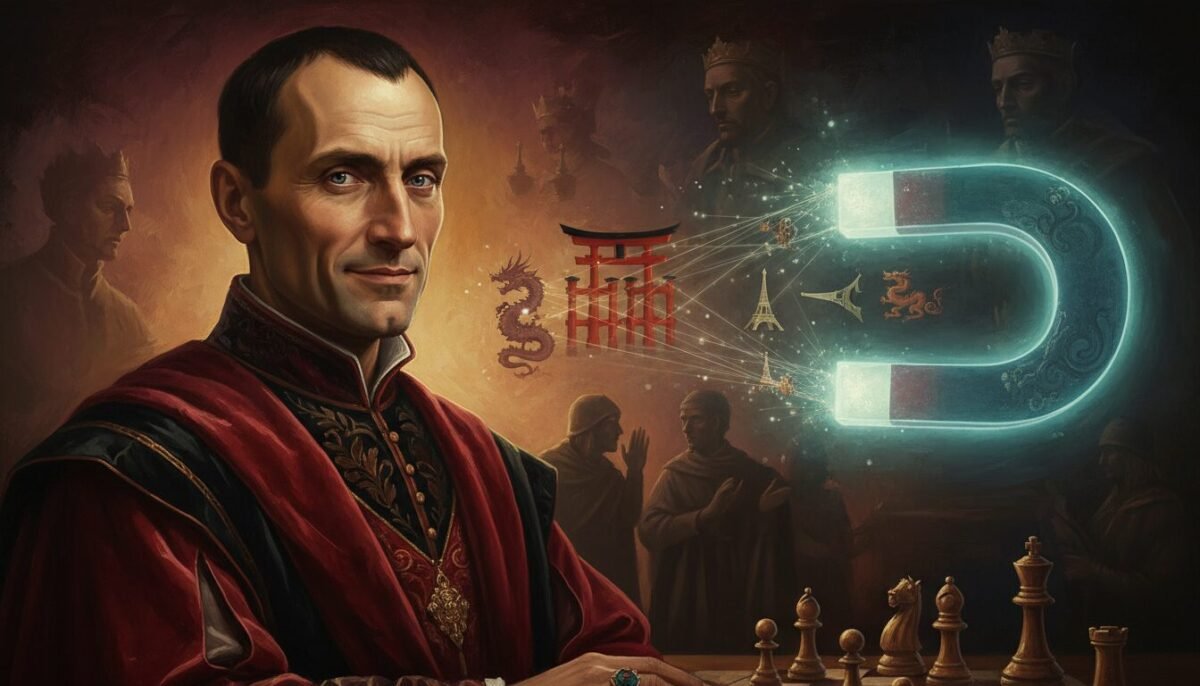
Consider the global influence of the United States in the late 20th century. It wasn’t just the size of the U.S. Navy that kept allies in line; it was Hollywood, Coca-Cola, the promise of the “American Dream,” and the prestige of American universities. When a nation’s culture, political values, and foreign policies are seen as attractive and legitimate by others, those other nations are much more likely to follow its lead. They aren’t being coerced; they are being seduced. They want to be part of the “club.”
This “branding” of a nation or an institution reduces the need for hard power significantly. Diplomacy, international aid, and cultural exchange programs are not just “nice” things to do; they are strategic tools. By building a network of shared values and mutual admiration, a powerful entity can create a world where its interests are naturally protected. When people in a foreign country grow up watching your movies and listening to your music, they are less likely to view you as an enemy. Soft power turns “the other” into “a friend,” making the use of force unnecessary and, often, counterproductive.
4. Institutionalization: The Power of Bureaucracy and Law
One of the most effective ways to maintain power without violence is to make it impersonal. In ancient times, power was tied to a person—the King, the Chieftain, the Warlord. If you hated the King, you killed him. But in the modern world, power is institutionalized. It is embedded in the law, the bureaucracy, and the “system.”
Max Weber, the famous sociologist, spoke of the “Iron Cage” of bureaucracy. In a bureaucratic system, power is exercised through rules, procedures, and hierarchies. When you are denied a loan, or your building permit is rejected, you aren’t fighting a person; you are fighting a “process.” There is no one to punch, no one to overthrow. The impersonality of the system makes resistance feel futile. You are told, “I’m just following the rules,” and because those rules are applied (theoretically) to everyone, they gain a veneer of fairness and predictability.
The legal system plays a crucial role here. By acting as the ultimate arbiter of conflict, the judiciary reinforces the state’s monopoly on “right.” When two parties have a dispute, they go to court rather than fighting in the street. By accepting the court’s decision, they are reaffirming the state’s authority. Furthermore, the sheer weight of standardization—from social security numbers to land deeds and tax records—acts as a tool for social management. The state “sees” you through its data. This level of organization allows for a degree of control that no ancient tyrant could have dreamed of, all without a single soldier ever entering your home.
5. Economic Dependencies and Material Incentives
There is an old saying: “A hungry man is an angry man.” Conversely, a man with a mortgage, a steady paycheck, and a retirement fund is a man who is very unlikely to start a revolution. Economic stability is perhaps the most potent “soft” tool for maintaining social order. When a system provides for the material needs of its citizens—or at least enough of them to keep the peace—it buys their compliance.
This is the “carrot” of power. Governments use subsidies, welfare programs, and employment opportunities to create a stake in the system. When people have something to lose, they become inherently conservative (in the sense of wanting to preserve the status quo). The fear of losing financial security is often a much more effective deterrent than the fear of prison. In the modern world, we are all part of a web of economic interdependence. Our ability to eat, house ourselves, and provide for our families is tied to the stability of the global market and the local economy.
On a global scale, debt structures and trade agreements enforce behavior across borders. A developing nation doesn’t need to be invaded to follow the rules of the global elite; it simply needs to be told that its credit rating will be slashed or its trade privileges revoked. The “invisible hand” of the market often carries a very visible weight, guiding the behavior of nations and individuals alike through the simple, non-violent mechanism of material incentive.
6. The Psychology of Compliance: Habituation and Fear of Chaos
Finally, we must look at the human brain itself. We are creatures of habit. Once a system of power has been in place for a generation or two, it becomes the psychological default. This is “habituation.” We obey the law not because we have thought deeply about the Social Contract, but because we did it yesterday, and the day before, and everyone else is doing it too. Obedience becomes a subconscious routine.
Beneath this routine lies a deep-seated human fear: the fear of chaos. Most people would prefer a flawed, even somewhat oppressive order over the terrifying uncertainty of anarchy. Power structures play on this fear constantly. They present themselves as the only thing standing between the citizen and “the abyss.” This is why, during times of crisis, people often willingly give up their rights in exchange for the promise of order. The perceived threat of “the other” or the “breakdown of society” keeps the population loyal to the existing structures.
This is reinforced by social norms and peer pressure. We are social animals, and the “Spiral of Silence” is a powerful force. If we believe that our opinion is in the minority, we are likely to remain silent to avoid social isolation. This creates an illusion of universal consent. Even if 60% of people dislike a certain law, if each of them believes they are the only one who feels that way, they will continue to comply and remain silent. The community, in effect, polices itself, ensuring that non-conformity is punished not by the state, but by the cold shoulder of one’s neighbors.
Power, in its most sophisticated form, is not a hammer; it is a climate. It is the environment in which we live, move, and have our being. By leveraging legitimacy, cultural hegemony, and the deep-seated psychological needs of the human animal, authority maintains itself through the quiet consent of the governed. It is a system that works best when it is invisible, guiding our choices so gently that we believe we are making them all on our own.
Explore more on the dynamics of influence and human nature:
- Machiavelli & Political Philosophy: The Birth of Modern Realism
- Power & Human Nature: Why We Seek to Dominate
- Influence & Leadership: The Psychology of the Follower
Frequently Asked Questions
What is the difference between power and authority?
Power is the ability to influence or control others, often through force or coercion. Authority is the recognized right to exercise that power, usually based on legitimacy and consent.
Can a government survive without any legitimacy?
Technically, yes, but only through extreme violence and constant surveillance. Such regimes are “brittle” and usually collapse quickly once the military or police force loses the will to enforce the leader’s commands.
How does “manufacturing consent” work in a democracy?
It works through the filtering of information. By controlling the narrative in media and education, the ruling institutions ensure that the public “consents” to policies that benefit the elite, often by making those policies seem like the only logical or “common sense” option.
Is soft power more effective than hard power?
In the long run, yes. Soft power is cheaper, more sustainable, and creates less resentment. However, most states use a combination of both—often called “smart power”—to achieve their goals.
To dive deeper into the dynamics of influence and the hidden structures of our world, subscribe to our newsletter for weekly insights into political science and social theory. Join a community of thinkers who look beneath the surface.