Imagine you are walking along a deserted riverbank when you see a stranger struggling in the current. Without a second thought, you dive in, ruin your expensive watch, and risk your life to pull them to safety. Later, as you dry off, a nagging question arises: Did you do it because of a deep-seated moral instinct to preserve life, or did your brain subconsciously calculate the “hero’s reward”—the surge of dopamine, the social prestige, or the relief of avoiding a lifetime of guilt?
For centuries, this question has been the ultimate battlefield for philosophers, biologists, and psychologists. Are we fundamentally egoistic creatures wearing a mask of civility, or is kindness woven into our very DNA? The debate isn’t just academic; it dictates how we design our laws, how we manage our businesses, and how we view our neighbors. This inquiry dives deep into the heart of the human condition, peeling back the layers of psychological egoism, evolutionary biology, and historical philosophy to see if “true” altruism actually exists or if it is the most beautiful lie we’ve ever told ourselves.
1. The Doctrine of Psychological Egoism: Is True Altruism a Myth?
Psychological egoism is the provocative theory that every human action, no matter how seemingly selfless, is ultimately motivated by self-interest. At first glance, this feels cynical. We think of the soldier jumping on a grenade or the mother skipping meals to feed her child. But the egoist argues that even these acts are driven by internal rewards. The soldier may prefer a sudden death to the unbearable shame of cowardice; the mother may find the pain of her own hunger more tolerable than the psychological agony of seeing her child suffer.

A central pillar of this argument is the concept of the “warm glow.” When we help others, the brain’s reward centers light up. We feel good. Therefore, the egoist claims, we aren’t helping the other person; we are chasing that internal “high.” If we didn’t get a psychological payoff from being “good,” would we ever bother? This perspective suggests that altruism is simply a sophisticated form of hedonism—we’ve just learned that being nice is more satisfying than being mean.
However, critics of psychological egoism, such as the 18th-century philosopher Bishop Joseph Butler, argue that this theory confuses the consequence of an action with its purpose. Just because I feel satisfied after helping a friend doesn’t mean I helped them in order to feel satisfied. Think of it like eating. When you are hungry, you want food. You enjoy the meal, but the object of your desire was the food, not the sensation of pleasure. If you only wanted the pleasure, you could take a pill; instead, you seek the nourishment. Similarly, the altruist seeks to alleviate another’s suffering; the resulting “warm glow” is merely a byproduct, not the primary goal.
To understand human nature, we must distinguish between the object of a desire and the satisfaction of achieving it. If my primary desire is your well-being, my act is altruistic, even if I feel great afterward. The egoist’s trap is assuming that because “I” am the one acting, “I” must be the one benefiting. But as we will see, the “I” is far more complex than a simple seeker of pleasure.
2. Hobbes vs. Rousseau: The Great Philosophical Divide
The debate over our “natural” state reached its peak during the Enlightenment, personified by two titans of thought: Thomas Hobbes and Jean-Jacques Rousseau. Their opposing views on the “State of Nature”—the hypothetical condition of humanity before the invention of government and society—still shape our modern world.
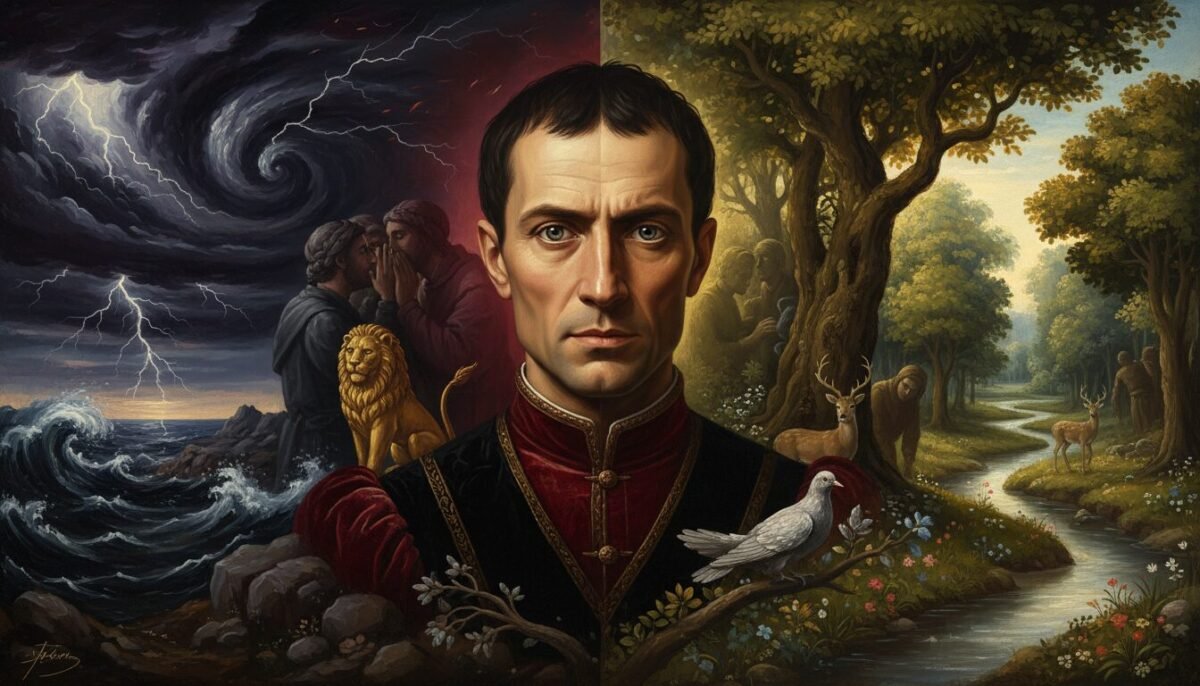
Thomas Hobbes, writing in the shadow of the English Civil War, held a bleak view of human nature. In his masterwork Leviathan, he argued that humans are essentially selfish, power-hungry machines. Without a strong, central authority to keep us in check, we would live in a “state of war of every man against every man.” In this state, there is no industry, no culture, and no security. Hobbes famously described life in this natural state as “solitary, poor, nasty, brutish, and short.” For Hobbes, morality isn’t natural; it’s a survival strategy. we agree to follow rules only because we fear the consequences of a lawless world. We aren’t “good”; we are just smart enough to be afraid.
Enter Jean-Jacques Rousseau, who offered a radical counter-narrative. Rousseau believed in the “Noble Savage.” He argued that in our original state, humans were solitary, peaceful, and motivated by two primary instincts: self-preservation and pitié (compassion). To Rousseau, it was society—with its private property, hierarchies, and competition—that corrupted us. He famously wrote, “Man is born free, and everywhere he is in chains.” Rousseau believed that our natural empathy is stifled by the artificial demands of civilization. In his view, we aren’t naturally selfish; we are naturally empathetic, but we have been “trained” to be greedy by a broken system.
These two views created the foundation for the “Social Contract.” If you believe Hobbes, you favor strong policing, strict laws, and a top-down approach to power to prevent chaos. If you believe Rousseau, you favor social reform, education, and the removal of inequality, believing that if you fix the environment, the “natural” goodness of people will flourish. Every time we debate whether a criminal is a “bad seed” or a “victim of circumstances,” we are replaying the Hobbes vs. Rousseau argument.
3. The Evolutionary Paradox: Why Selfish Genes Produce Altruistic People
If evolution is about the “survival of the fittest,” how did altruism ever survive? On the surface, a selfish individual who takes resources and gives nothing back should out-compete a selfless individual who shares. Yet, look at any human society, and you see cooperation everywhere. This is the evolutionary paradox.

The first key to solving this is Kin Selection. Biologically speaking, you aren’t just an individual; you are a carrier of genes. Because your siblings share 50% of your DNA and your cousins share 12.5%, helping them survive helps your genes survive. As the biologist J.B.S. Haldane once joked, “I would lay down my life for two brothers or eight cousins.” This explains why we are naturally more altruistic toward family. It’s “selfishness” at the genetic level, but it looks like “selflessness” at the human level.
But what about helping strangers? This is where Reciprocal Altruism comes in. In early human tribes, survival was a team sport. If I share my meat with you today when you are hungry, you are likely to share with me tomorrow when I return empty-handed. This “I scratch your back, you scratch mine” strategy is a powerful survival mechanism. Over time, evolution favored those who were good at cooperating and punished those who were “cheaters.” We developed complex emotions like gratitude (to reward cooperators) and moral outrage (to punish cheaters) to manage these social debts.
Finally, there is Group Selection. Imagine two tribes: Tribe A is made up of selfish individuals who won’t risk anything for each other. Tribe B is made up of cooperative individuals who fight for the group. In a conflict or a famine, Tribe B will almost always win. Even if “selfishness” is an advantage within a group, “altruism” is a massive advantage between groups. We are the descendants of the most cooperative tribes in history. Our very existence is proof that being “good” was a winning evolutionary strategy.
4. The Biology of Empathy: Neurological Evidence for Prosociality
Is empathy something we learn, or is it hardwired into our gray matter? Modern neuroscience suggests it’s the latter. One of the most significant discoveries in this field is Mirror Neurons. These are specialized brain cells that fire both when we perform an action and when we observe someone else performing that same action. When you see someone stub their toe, your brain partially recreates that pain. We don’t just “know” someone is suffering; we feel it. This neurological bridge suggests that our brains are physically designed for connection.
Then there is the role of Oxytocin, often called the “bonding hormone” or the “moral molecule.” Released during touch, childbirth, and even shared meals, oxytocin lowers our defenses and increases trust and generosity. It acts as a biological “glue” that makes social interaction rewarding. When oxytocin levels are high, we are more likely to share resources and empathize with others. It’s not a choice; it’s a chemical shift that prepares us for prosocial behavior.
Developmental psychology provides perhaps the most touching evidence. In famous studies of infants as young as 14 to 18 months, researchers found that babies would spontaneously help an adult who was struggling to reach an object or open a door. These toddlers helped without being asked, without being offered a reward, and often before they were even fully toilet-trained. This suggests that the impulse to help is an “innate” default setting, present before parents or society have had the chance to fully “condition” the child. We are born with the hardware for help; society simply determines how we use it.
5. Self-Interest vs. Selfishness: Defining the Moral Boundary
To have a productive conversation about human nature, we must distinguish between self-interest and selfishness. These terms are often used interchangeably, but they are worlds apart. Self-interest is the healthy drive for self-preservation. It’s why you eat, why you sleep, and why you seek a career that fulfills you. Without self-interest, you wouldn’t survive long enough to help anyone else. As the saying goes, “You cannot pour from an empty cup.”
Selfishness, on the other hand, is the pursuit of one’s own advantage at the expense of others. It is a zero-sum game. Ethical Egoism, a philosophy championed by thinkers like Ayn Rand, argues that one ought to act in their own self-interest as a moral duty. Rand argued that “altruism” is often a form of spiritual cannibalism where the productive are sacrificed for the unproductive. While extreme, this perspective highlights a vital truth: total selflessness can be psychologically damaging. People who never say “no” or who ignore their own needs often end up resentful, burnt out, and ultimately unable to contribute to society.
The “sweet spot” of human nature isn’t found in being a martyr, but in “enlightened self-interest.” This is the realization that my well-being is inextricably linked to the well-being of my community. If my neighbors are thriving, my property is safer, my economy is stronger, and my life is richer. In this light, helping others is the most “selfish” thing you can do, because it creates a world that is better for you to live in. The boundary between “me” and “us” is much blurrier than we think.
6. The Power of Nurture: How Culture Shapes Our Instincts
While our biology provides the “hardware,” our culture provides the “software.” Human nature is incredibly plastic. In Individualist cultures, like the United States or Western Europe, the “self” is the primary unit. Success is measured by personal achievement, and competition is seen as a natural driver of progress. In these environments, people may appear more “naturally” selfish because the system rewards that behavior.
In contrast, Collectivist cultures, found in many parts of Asia, Africa, and South America, prioritize the group over the individual. In these societies, “natural” behavior is defined by harmony, duty to family, and social cohesion. A person from a collectivist culture might find Western individualism to be pathologically selfish, while a Westerner might find collectivism to be stifling. This tells us that “human nature” is not a fixed point, but a range of possibilities that are triggered by our environment.
Our economic systems also play a massive role. A system that rewards cutthroat competition will inevitably bring out our Hobbesian instincts. However, thanks to neuroplasticity, we know that the brain can change. Just as we can train our bodies at the gym, we can train our “empathy muscles.” Practices like mindfulness, community service, and even reading fiction (which forces us to inhabit another person’s perspective) have been shown to physically alter the brain’s pathways, making prosocial behavior more of a “default” response. We are not just born; we are made.
Ultimately, human nature is not a binary choice between “selfish” or “selfless.” We are a complex, walking contradiction—a species capable of the most horrific acts of greed and the most breathtaking acts of sacrifice. We are biologically wired to look out for “Number One,” but we are also biologically incapable of being happy in isolation. We are competitive, yes, but we are also the most deeply cooperative species on the planet.
The answer to whether we are naturally selfish is: Yes, and no. We are whatever our environment, our choices, and our biology conspire to make us in any given moment. Perhaps the most “human” thing about us is not our starting point, but our ability to choose which side of our nature to feed.
Frequently Asked Questions
Is there such a thing as a purely selfless act?
Philosophically, it’s debated. If you define “selfless” as having no benefit to the actor, then even a “warm glow” makes it selfish. However, most modern thinkers agree that if the primary intention is to help another, it counts as altruism, regardless of the internal reward.
Are some people born more selfish than others?
There is evidence that genetics play a role in traits like empathy and impulsivity. However, environment and upbringing (nurture) have a massive influence on whether those genetic predispositions manifest as destructive selfishness or healthy self-interest.
Does capitalism make us more selfish?
Capitalism leverages self-interest to drive innovation and production. While it doesn’t necessarily “make” us selfish, it rewards competitive behaviors, which can overshadow our natural cooperative instincts if not balanced by strong social and ethical frameworks.
If you found this exploration of the human psyche intriguing, you might enjoy our deep dives into Machiavelli & Political Philosophy or our analysis of Power & Human Nature. Understanding the mechanics of the mind is the first step toward mastering your own.
What do you think? Is true altruism possible, or are we all just “enlightened egoists”? Share your thoughts in the comments below.