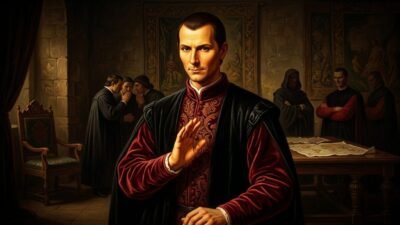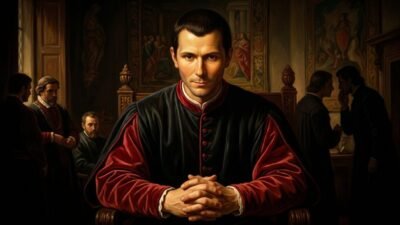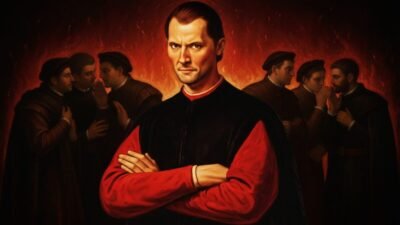

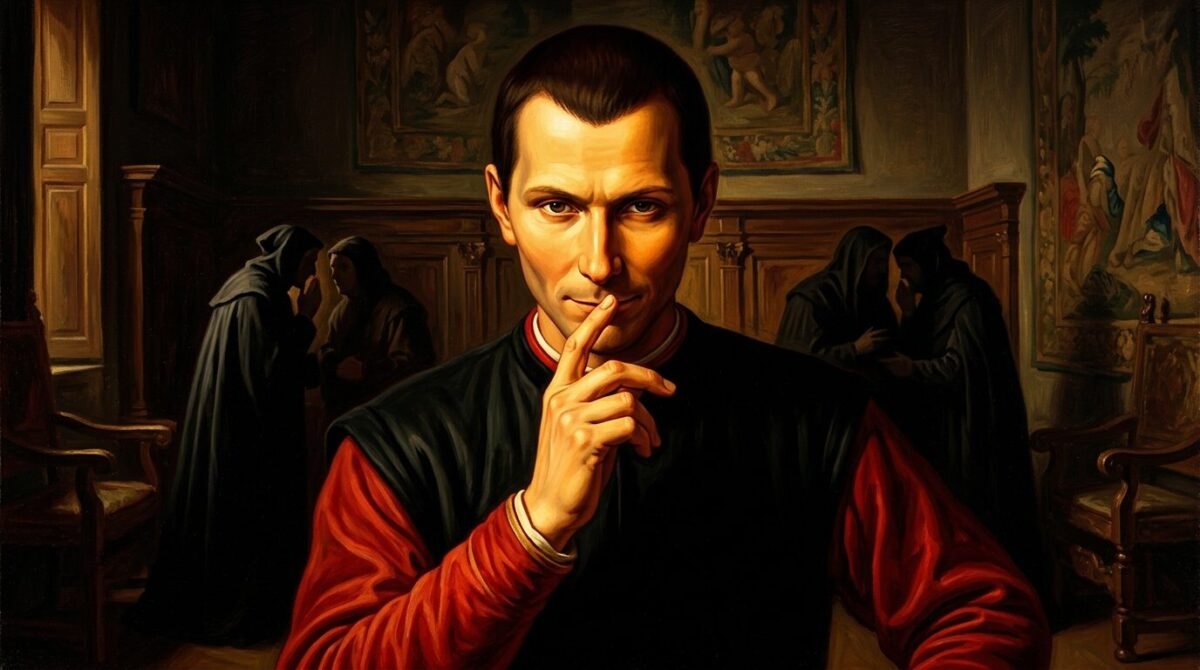
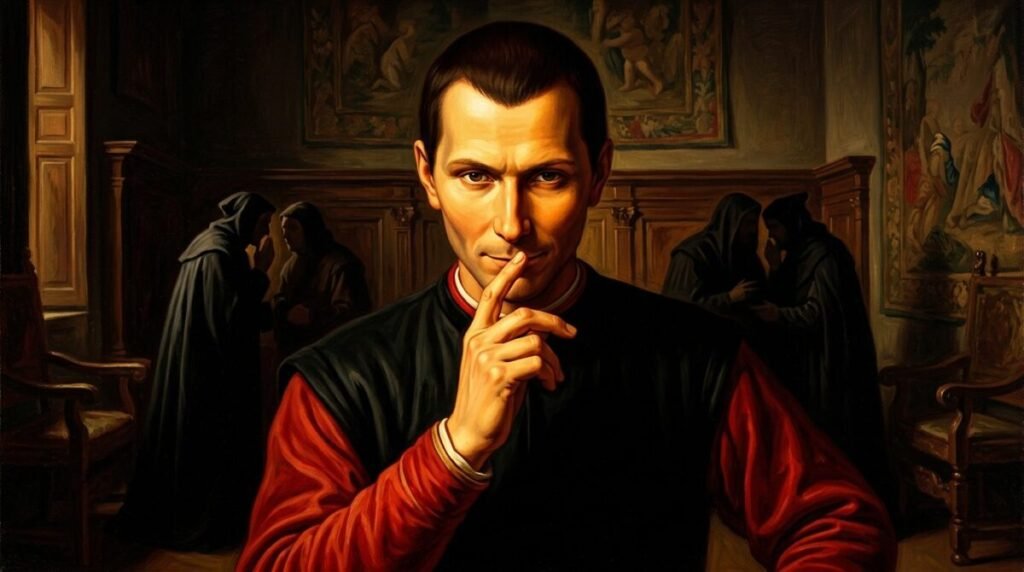
Is it better for a leader to be loved or feared—and more importantly, is it necessary for them to lie? We demand that our leaders be saints, paragons of unwavering moral virtue, yet we simultaneously require them to do the devil’s work to keep us safe. This is the central, uncomfortable paradox of human governance. For centuries, society has misunderstood Machiavellianism as a synonym for pure evil, malice, or psychopathic self-interest. By doing so, we miss the profoundly nuanced philosophical arguments behind political realism, the unforgiving mechanics of statecraft, and the agonizingly heavy burden of leadership.
To understand power is to look into the abyss of human nature without blinking. When we strip away the comforting illusions of idealism, we are left with the raw, mechanical truths of how societies are actually governed. This comprehensive guide explores why Niccolò Machiavelli viewed deception not as a moral failing, but as a crucial, tragic necessity for political stability. By analyzing his key metaphors, historical case studies, and his enduring impact on political thought, we can begin to dismantle our own cognitive biases about leadership and confront the reality of what it truly takes to maintain order in a chaotic world.
1. The Historical Context of Machiavelli’s The Prince
To grasp the profound paradigm shift initiated by Niccolò Machiavelli, one must first step into the blood-soaked, treacherous, and brilliantly vibrant world of Renaissance Italy. In the late 15th and early 16th centuries, the Italian peninsula was not a unified nation but a fractured chessboard of fiercely competitive city-states, papal territories, and foreign proxies. Florence, Milan, Venice, and Naples were locked in perpetual cycles of shifting alliances, brutal betrayals, and devastating mercenary warfare. It was a landscape where a wealthy republic could be overthrown overnight, and where the Pope himself commanded armies and ordered assassinations. In this crucible of instability, Machiavelli served as a senior diplomat and secretary for the Florentine Republic, observing the mechanics of power firsthand.
Before Machiavelli, the prevailing literature on leadership belonged to the “Mirror of Princes” genre, heavily influenced by classical idealism and traditional Christian morality. Philosophers like Thomas Aquinas and Saint Augustine posited that a ruler must embody the highest moral virtues—piety, honesty, clemency, and justice. The assumption was that a good man would naturally make a good king, and that God would favor the righteous state. Machiavelli shattered this illusion. He initiated a fundamental separation of political realism from ethical idealism. He observed that rulers who acted strictly according to Christian virtues were consistently crushed by those who did not. In the brutal reality of geopolitics, turning the other cheek merely invited a fatal blow.
The instability of Florence necessitated a radically new, pragmatic approach to statecraft. After the fall of the Florentine Republic and the return of the autocratic Medici family, Machiavelli was stripped of his position, imprisoned, and subjected to the strappado—a brutal form of torture. Exiled to his small estate outside the city, he wrote The Prince not as an armchair philosopher dealing in utopian hypotheticals, but as a battle-scarred practitioner of statecraft. He recognized that the survival of the state was the highest imperative. If the state falls, the resulting anarchy, foreign occupation, and mass slaughter are infinitely worse than any sin committed by a ruler to prevent it. Therefore, traditional morality had to be subordinated to the practical requirements of power. For those interested in the deeper roots of this ideological split, exploring Machiavelli & Political Philosophy reveals how this single text permanently altered the trajectory of Western thought.
2. The Fox and the Lion: Mastering Force and Cunning
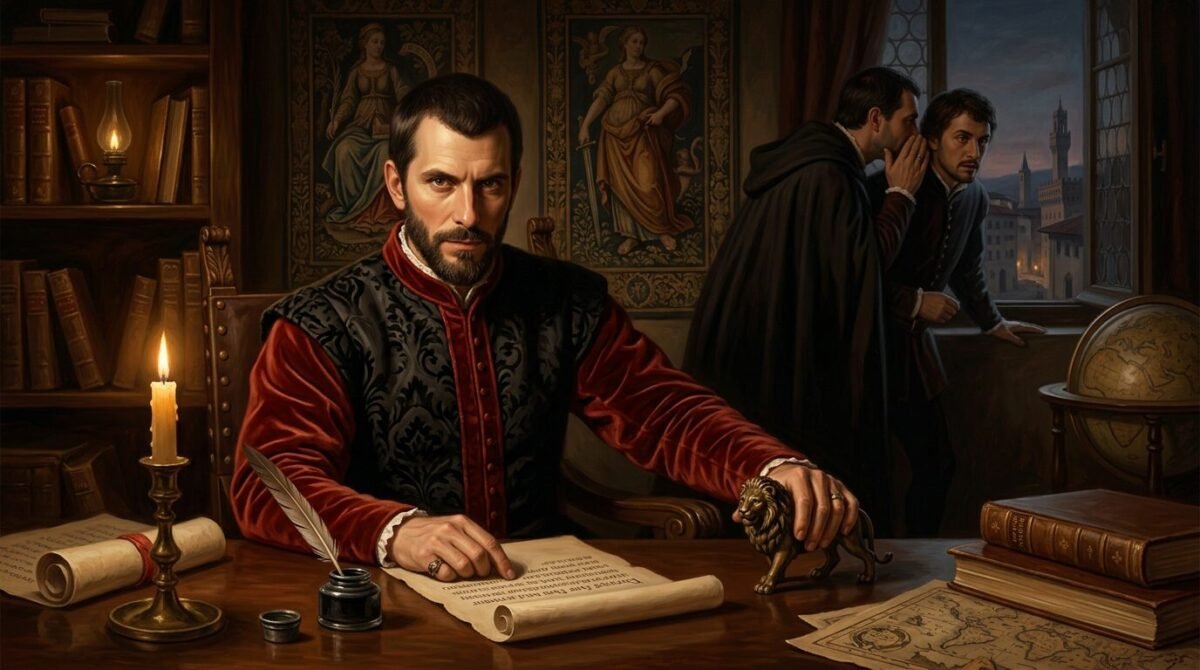
Perhaps the most potent and enduring image in Machiavelli’s political theory is found in Chapter 18 of The Prince, where he introduces the metaphor of the Fox and the Lion. Machiavelli asserts that a ruler must know how to fight not only with laws (the way of men) but also with force and deception (the way of beasts). Because the former is often insufficient in a world populated by wicked men, a prince must master the dual nature of the beast. “A prince, therefore, being compelled knowingly to adopt the beast, ought to choose the fox and the lion; because the lion cannot defend himself against snares and the fox cannot defend himself against wolves.”

The lion represents brute force, martial prowess, and the capacity to inspire terror. A state must possess the military might to crush its enemies and deter wolves—the foreign invaders and domestic usurpers who seek to devour the kingdom. However, Machiavelli astutely notes that brute force is inherently limited. The lion is magnificent and terrifying, but it is also straightforward and easily outmaneuvered. A ruler who relies solely on the roar of the lion is blind to the hidden traps, conspiracies, and subtle machinations that constantly threaten the throne. Force without intelligence is a blunt instrument that exhausts the state’s resources and breeds resentment among the populace.
This is where the cunning of the fox becomes absolutely vital. The fox represents the necessity of political manipulation, the ability to recognize snares, and the agility to navigate the treacherous waters of diplomacy. To play the fox is to understand that promises, treaties, and alliances are not sacred moral bonds, but temporary strategic conveniences. Machiavelli explicitly argues that a prudent ruler cannot, and must not, honor their word when it places them at a disadvantage, or when the reasons for which the promise was made no longer exist. Because “men are wretched creatures who would not keep their word to you, you need not keep your word to them.”
This psychological insight into Power & Human Nature is what makes Machiavelli so deeply unsettling. He forces us to acknowledge that strategic deception is not an aberration of leadership, but a core competency. The fox uses misdirection to divide enemies, feigns weakness to invite overconfidence, and breaks oaths to secure the state’s survival. In the Machiavellian framework, a leader who refuses to employ cunning out of a misplaced sense of personal honor is not a saint; they are a liability to the people they are sworn to protect.
3. Appearance vs. Reality: The Illusion of Morality in Politics
If a leader must act like a deceitful fox and a violent lion, how do they maintain the loyalty and love of their subjects? Machiavelli’s answer lies in the profound psychological disconnect between appearance and reality. He famously observed, “Men judge generally more by the eye than by the hand, for everyone can see and few can feel. Everyone sees what you appear to be, few really know what you are.” This observation forms the bedrock of his argument that rulers must meticulously curate an illusion of morality.
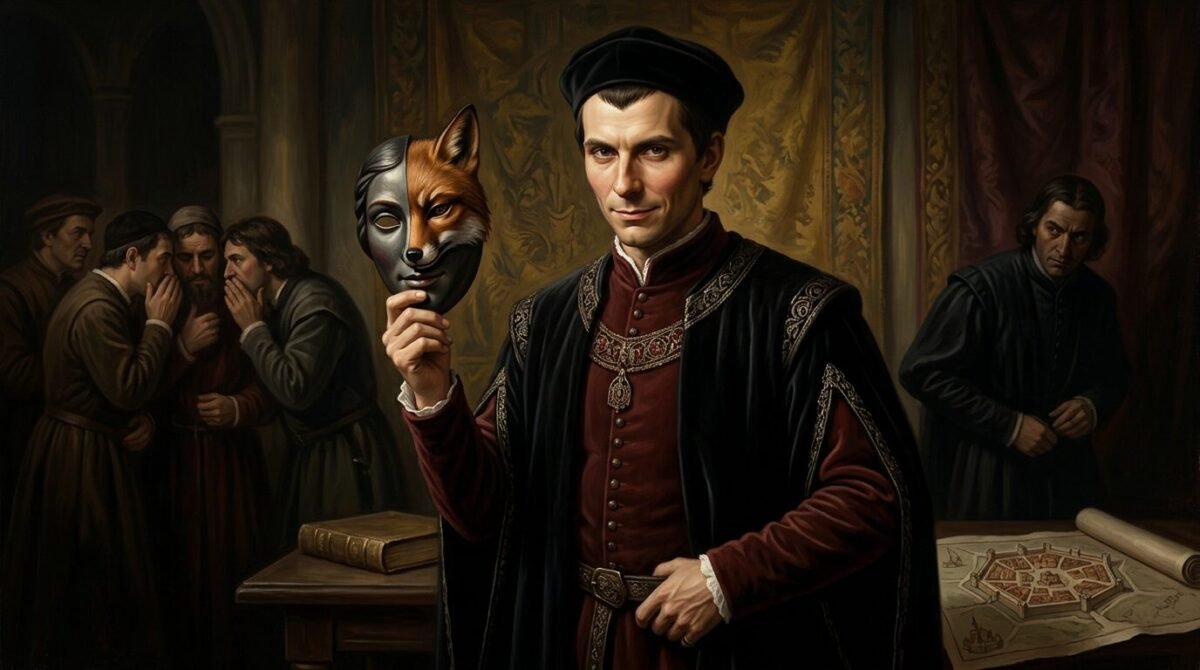
Machiavelli argued that it is not necessary for a prince to actually possess all the traditional virtues—mercy, faith, honesty, humanity, and religion—but it is absolutely essential that they appear to possess them. In fact, he warns that actually possessing and rigidly practicing these virtues is dangerous, while appearing to have them is useful. A leader must have a mind that is flexible enough to pivot toward evil when necessity demands it, but their public persona must remain impeccably virtuous. Religion, in particular, is viewed not as a path to divine salvation, but as an indispensable tool for social cohesion and public control. A leader must appear deeply pious to comfort the masses, even if they are entirely secular in their private strategic calculations.
This dynamic relies heavily on the psychological manipulation of the masses. The general public, Machiavelli noted, is easily taken in by appearances and the outcomes of events. The masses crave the psychological comfort of believing their leader is a good, moral figure. They do not want to know the dark, bloody compromises required to keep the borders secure and the economy stable. By projecting an image of benevolence, the prince satisfies the public’s emotional needs while reserving the operational freedom to act ruthlessly in secret.
Maintaining this facade of traditional morality allows a leader to execute necessary evils without triggering a revolt. When the prince must eliminate a rival, break a treaty, or raise taxes, the public—already convinced of the leader’s inherent goodness—will rationalize the action as a tragic necessity rather than an act of tyranny. The illusion of morality is the shield behind which the machinery of statecraft operates. To understand this is to master the art of Influence & Leadership, recognizing that the public face of power is almost always a carefully constructed theatrical performance designed to manage the collective psyche.
4. Virtù, Fortuna, and the Ends Justifying the Means
To fully comprehend why deception is justified in Machiavelli’s universe, we must dissect his two most critical philosophical concepts: Virtù and Fortuna. It is crucial to understand that Machiavellian Virtù has absolutely nothing to do with the Christian concept of virtue (goodness, chastity, meekness). Instead, it derives from the Latin virtus, meaning manliness, excellence, capability, drive, and ruthless adaptability. Virtù is the sheer force of will and strategic brilliance that a leader uses to impose order on a chaotic world.
Opposing Virtù is Fortuna, which represents luck, fate, and the unpredictable, often destructive circumstances of life. Machiavelli personifies Fortuna as a raging river that, when angry, floods the plains, tears down trees, and destroys everything in its path. However, he argues that while Fortuna controls half of our actions, she leaves the other half to our free will. A leader with high Virtù does not wait for the flood; they build dams and dikes during times of peace so that when the waters rise, the damage is mitigated. Deception, cunning, and violence are simply tools in the arsenal of Virtù, used to master and overcome the chaotic forces of Fortuna.
This brings us to the most famous, yet heavily misunderstood, phrase associated with Machiavelli: “The ends justify the means.” It is a historical irony that Machiavelli never actually wrote this exact phrase. What he wrote in Chapter 18 of The Prince translates closer to: “In the actions of all men, and especially of princes, where there is no court to appeal to, one judges by the result.” (Si guarda al fine). He argued that if a prince succeeds in conquering and holding his state, the means he used will always be judged honorable and praised by the masses.
This is a profound statement on the ethics of outcome versus the ethics of action. Machiavelli is not giving a blank check for sadistic cruelty. He is stating a sociological fact: history forgives the victor. If a leader uses deception, betrayal, and violence (the means) to successfully protect the state from invasion and internal collapse (the end), the people will ultimately revere him. Deception serves as a highly practical tool of Virtù because it allows a leader to navigate the unpredictable shifts of Fortuna without relying on the rigid, often suicidal constraints of traditional honesty. In the brutal calculus of survival, failing to deceive when the state is on the line is the ultimate moral failure.
5. Cesare Borgia and Historical Justifications for Deception
Machiavelli’s theories were not spun from thin air; they were forged in the fires of observation. To illustrate the perfect application of his principles, he frequently relied on historical case studies, focusing most heavily on the political maneuvers of Cesare Borgia, the Duke of Valentinois and the illegitimate son of Pope Alexander VI. For Machiavelli, Borgia was the ultimate embodiment of Virtù—a leader who brilliantly combined the ferocity of the lion with the supreme cunning of the fox.
One of the most chilling and illustrative episodes of Borgia’s career occurred during his pacification of the Romagna region. When Borgia conquered the Romagna, he found it overrun by petty lords who had exploited their subjects, leading to rampant robbery, factional violence, and total lawlessness. To establish order, Borgia knew he needed to use extreme, terrifying force. However, he also knew that if he personally enacted this violence, the people would grow to hate him. His solution was a masterclass in Machiavellian deception and psychological manipulation.
Borgia appointed a cruel, efficient lieutenant named Remirro de Orco and gave him absolute power to pacify the region. Remirro did exactly as instructed, using brutal executions and draconian laws to crush the factions and restore order in a matter of months. Once the region was pacified, Borgia realized that Remirro’s extreme cruelty had generated intense hatred among the populace. To distance himself from the violence he had secretly ordered, Borgia had Remirro arrested. One morning, the people of Cesena awoke to find Remirro’s body cut in half in the public square, with a bloody knife and a block of wood beside him.
Machiavelli notes that the ferocity of this spectacle left the people “at once satisfied and stupefied.” Borgia had successfully used deception and betrayal to achieve his goals. He used a proxy to commit the necessary violence, then sacrificed that proxy to win the love and awe of the people. The ultimate justification for this political deception is stark but logical: ensuring state survival and establishing order. By using a short, concentrated burst of strategic violence and profound deception, Borgia prevented the prolonged, chaotic bloodshed of civil war. He saved thousands of lives by ruthlessly sacrificing one. This is the tragic arithmetic of power that Machiavelli demands leaders understand.
6. Modern Relevance: Machiavellianism in Contemporary Statecraft
More than five centuries after The Prince was written, the ethical critiques of Machiavellian deception remain fierce. Modern philosophers, heavily influenced by Immanuel Kant’s categorical imperative, argue that human beings must never be treated merely as a means to an end, and that lying fundamentally corrodes the trust necessary for a functioning society. Political scientists often debate whether the cynical worldview of Machiavellianism creates a self-fulfilling prophecy, where assuming the worst in international actors guarantees a world of perpetual hostility and zero-sum games.
Yet, despite these ethical critiques, the principles of The Prince remain glaringly applicable to contemporary international relations, diplomacy, and political campaigns in 2026. We live in an era of unprecedented informational warfare, where the battleground has shifted from physical territories to the cognitive landscapes of the masses. The modern leader must still play the fox, though the tools of deception have evolved into sophisticated digital architectures, deepfakes, state-sponsored disinformation campaigns, and algorithmic manipulation.
In the geopolitical arena of 2026, nations routinely engage in proxy wars, cyber espionage, and economic sabotage while their diplomats stand at international podiums preaching human rights, global cooperation, and international law. This is the exact manifestation of Machiavelli’s mandate to appear virtuous while acting ruthlessly. A modern state that disarms itself of intelligence gathering, covert operations, and strategic ambiguity out of a desire to be morally pure would quickly find itself outmaneuvered and subjugated by less scrupulous adversaries. The lion’s roar is now the nuclear deterrent; the fox’s cunning is the intelligence agency.
Similarly, in contemporary political campaigns, the separation of appearance and reality is absolute. Candidates are meticulously packaged by public relations experts to project an image of relatable, flawless morality, while their campaign operatives work in the shadows to suppress opposition turnout, leak damaging narratives, and exploit wedge issues. The enduring legacy of Machiavelli’s realism is that it provides a lens to understand the true nature of political power today, stripped of its ideological camouflage. To study Comparative Philosophy is to realize that while our technology has advanced exponentially, the fundamental psychological drivers of power, fear, and ambition remain exactly as Machiavelli observed them in the Renaissance.
Conclusion
Machiavelli’s advocacy for deception was never rooted in a sadistic love for malice or a desire to see the world burn. It was, rather, a profoundly pragmatic pursuit of state stability and order in a world defined by human frailty and chaotic ambition. By separating political leadership from the unrealistic demands of traditional morality, he established a framework of political realism that continues to shape our understanding of power dynamics today. He forces us to look in the mirror and acknowledge that the peace and security we enjoy are often purchased with the very deceptions we publicly condemn. The burden of the prince is to damn his own soul so that the state might live.
Share this article with fellow political science students, or leave a comment below with your thoughts on whether modern politicians still follow Machiavelli’s playbook. Explore more deep dives into the human mind and the architecture of power here on DeepPsyche.blog.
Frequently Asked Questions
What is the main difference between Machiavellianism and psychopathy?
While both traits are part of the “Dark Triad” in psychology, they differ in their core motivations. Psychopathy is characterized by a lack of empathy, impulsivity, and erratic behavior. Machiavellianism, on the other hand, is highly strategic, calculating, and future-oriented. A Machiavellian leader uses deception and manipulation not for impulsive thrill, but as calculated tools to achieve a specific goal, such as maintaining power or stabilizing a state.
Did Machiavelli actually practice what he preached?
Interestingly, Machiavelli the man was known to be quite loyal, republican in his sympathies, and dedicated to the city of Florence. He served as a diplomat and militia organizer, not a tyrant. The Prince was an observational manual based on what he saw actually worked in the brutal political climate of his time, rather than a reflection of his personal interpersonal morality.
Can a modern democracy survive without Machiavellian deception?
This is the ultimate philosophical debate. Idealists argue that radical transparency is the only way to maintain democratic trust. Realists, channeling Machiavelli, argue that state secrets, covert intelligence, and diplomatic ambiguity are absolutely necessary to protect democratic nations from authoritarian regimes that do not play by moral rules. In practice, every modern democracy employs some level of strategic deception for national security.