
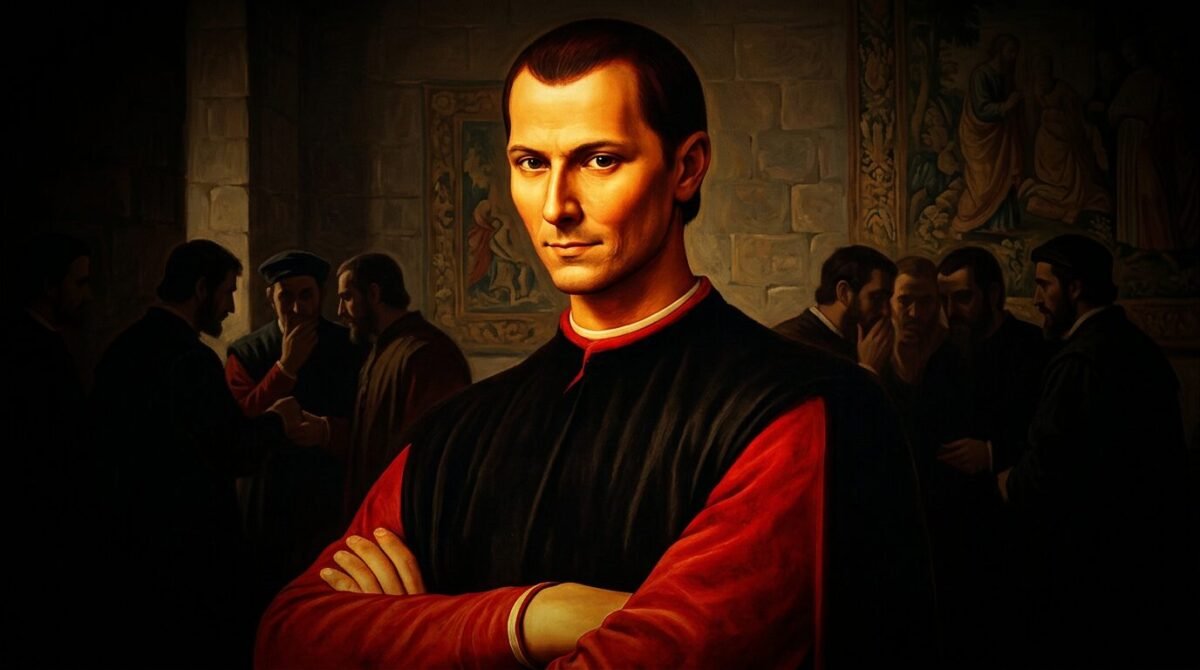
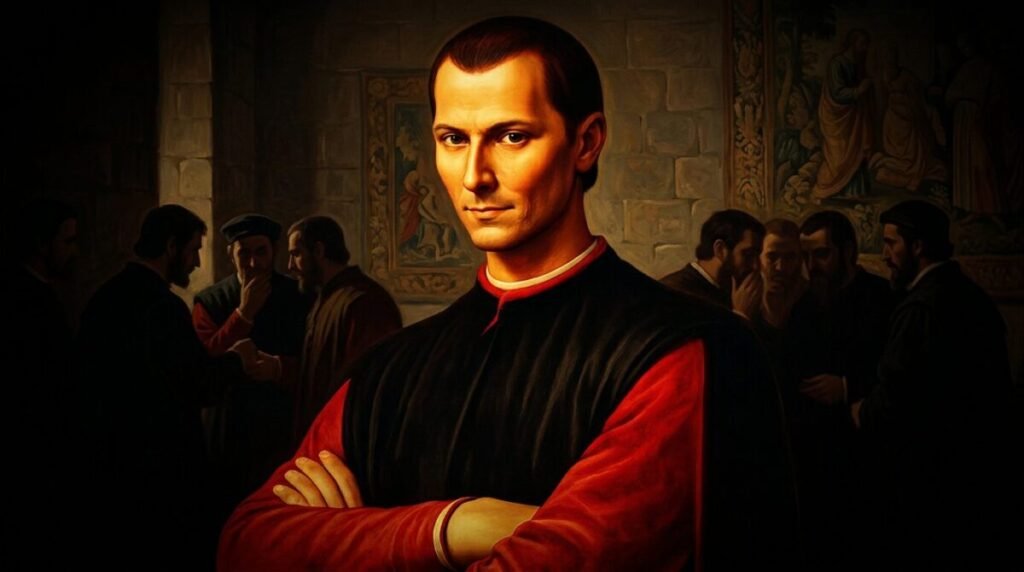
For centuries, the term “Machiavellian” has been hurled across corporate boardrooms and political debates as the ultimate insult. It conjures images of shadowy figures whispering in corridors, psychopathic CEOs orchestrating hostile takeovers, and tyrants clinging to power through deceit and bloodshed. We use the word as a shorthand for ruthless manipulation. But does this dark, cartoonish reputation accurately reflect Niccolò Machiavelli’s actual philosophy on leadership?
The truth is far more unsettling—and infinitely more profound. Many students, political enthusiasts, and even seasoned leaders struggle to separate the myth of the ruthless tyrant from Machiavelli’s highly nuanced theories on statecraft, power dynamics, and what truly constitutes a legitimate ruler. We prefer our philosophers to tell us how the world should be, painting utopian visions of justice and moral harmony. Machiavelli committed the ultimate intellectual heresy: he held up a mirror to human nature and described the world exactly as it is.
This comprehensive guide strips away five hundred years of moralistic smear campaigns and misconceptions. We are going to explore Machiavelli’s true views on authority and legitimacy, unpacking critical concepts like Virtù, Fortuna, and the stark, often misunderstood contrasts between his two masterworks, The Prince and Discourses on Livy. Prepare to step into the mind of history’s most brilliant, brutally honest political psychologist.
1. The Roots of Machiavellian Political Theory
To understand the mind of Niccolò Machiavelli, you must first understand the blood-soaked chessboard of Renaissance Italy. Born in Florence in 1469, Machiavelli did not write from the comfort of a peaceful ivory tower. He lived in a volatile, hyper-competitive ecosystem. Italy was not a unified nation; it was a fractured collection of fiercely independent city-states—Florence, Venice, Milan, Naples, and the Papal States—constantly at each other’s throats. Worse still, these relatively small states were routinely invaded, manipulated, and pillaged by the massive, centralized monarchies of France and Spain.
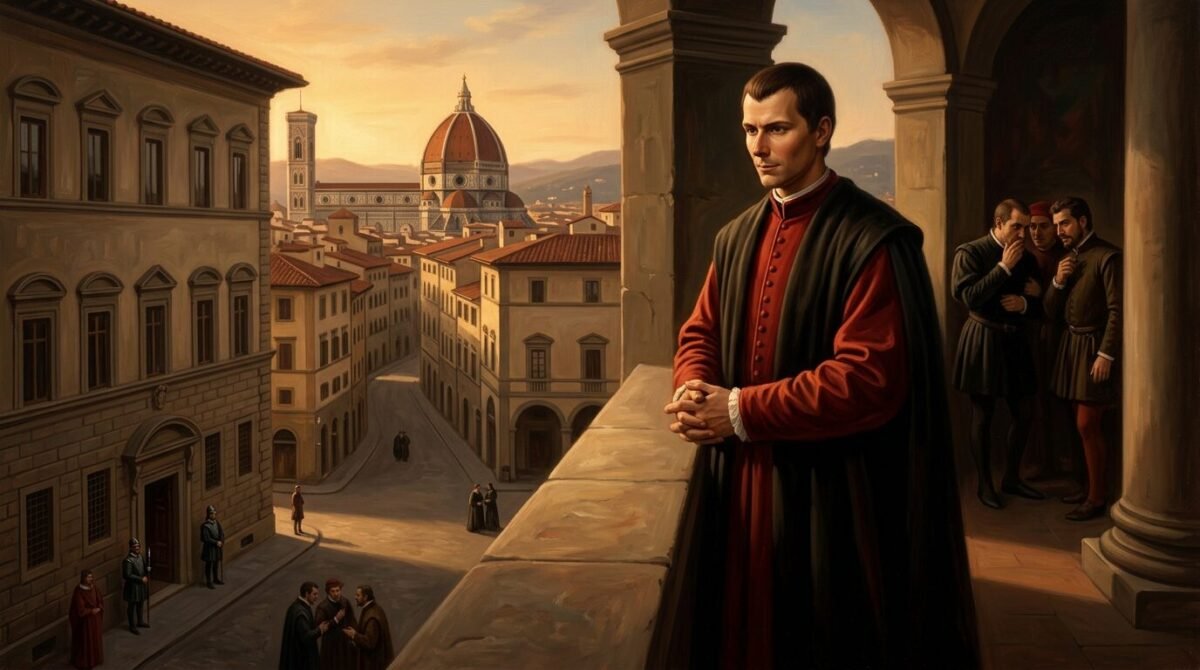
Machiavelli served as a senior diplomat for the Florentine Republic for fourteen years. He rode alongside kings, negotiated with popes, and closely observed the infamous Cesare Borgia—a brilliant, ruthless commander who carved out a state in the Romagna through sheer audacity and violence. Machiavelli saw firsthand how alliances were broken before the ink dried, how mercenaries betrayed their paymasters, and how moral men were routinely slaughtered by pragmatic monsters. When the Medici family violently returned to power in Florence in 1512, Machiavelli was stripped of his position, imprisoned, and subjected to the strappado (a brutal form of torture). Exiled to his small farm, he picked up his quill to make sense of the chaos.
This trauma and firsthand exposure to the mechanics of power triggered a seismic shift in Machiavelli & Political Philosophy. Prior to Machiavelli, the Western tradition of political thought was dominated by classical and Christian moralism. Philosophers like Plato, Aristotle, and St. Thomas Aquinas focused on the ideal state. They argued that a ruler’s primary job was to cultivate moral virtue, pursue divine justice, and lead a “good” life. Politics was essentially a branch of ethics.
Machiavelli shattered this paradigm. He introduced strict realism into political philosophy. In Chapter 15 of The Prince, he famously declares that it is better to go straight to the “effectual truth of the matter” rather than dwell in the imagination of it. He argued that the gap between how men ought to live and how they actually live is so vast that a ruler who insists on acting morally in a world full of immoral people will quickly bring about his own ruin.
Because of the fragmentation and vulnerability of the Italian city-states, Machiavelli became obsessed with one overarching goal: the acquisition and maintenance of state power. To him, the state was a fragile organism constantly threatened by internal decay and external predators. Therefore, the highest duty of a ruler was not to save the souls of his subjects, but to ensure the survival of the state itself. This radical departure from Christian ethics laid the foundation for a completely new way of analyzing human behavior and institutional power.
2. Power vs. Authority: Defining Legitimate Rule
A common misreading of Machiavelli is that he worshipped power for power’s sake. In reality, he drew a razor-sharp distinction between merely acquiring power (through brute force) and establishing legitimate authority (which guarantees consent, longevity, and stability). Anyone with enough weapons and a lack of conscience can seize a throne, but holding it, institutionalizing it, and passing it down requires something far more complex than violence.
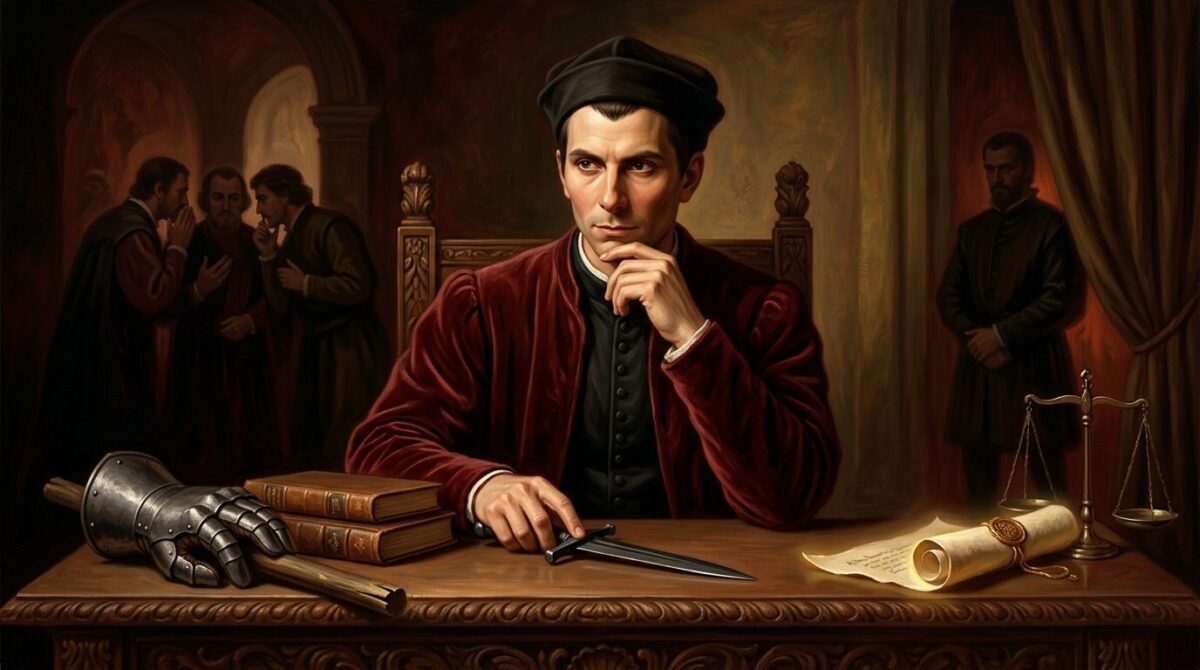
Machiavelli illustrates this fundamental distinction through the historical example of Agathocles the Sicilian. Agathocles rose from the rank of a common potter to become the King of Syracuse by calling a meeting of the city’s senators and wealthiest citizens, and then having his soldiers slaughter them all. He seized power, yes. But Machiavelli explicitly notes that while Agathocles achieved power, he did not achieve glory. His actions were characterized by “savage cruelty and inhumanity,” which allowed him to rule, but prevented him from being celebrated among excellent men. Brute force can conquer a state, but it cannot legitimize it.
So, what is Machiavelli’s definition of legitimate authority? For Machiavelli, legitimacy is not granted by divine right, nor is it inherent in noble bloodlines. Legitimacy is a pragmatic construct. A ruler becomes legitimate when he successfully creates a stable, secure environment where the state thrives and the citizens are protected from foreign invasion and internal chaos. Authority is earned through competence and the successful maintenance of order.
The absolute necessity for this legitimate state rests on a dual foundation, which Machiavelli famously describes as “good laws and good arms.” In his view, you cannot have one without the other. He writes, “There cannot be good laws where there are not good arms, and where there are good arms there must be good laws.” A constitution, no matter how beautifully written, is merely a piece of paper if the state lacks the military strength to defend it. Conversely, a strong military without the structure of good laws is just an armed mob, leading inevitably to tyranny and internal collapse. Legitimate authority sits at the exact intersection of legal structure and the coercive power required to enforce it.
This brings us to the most infamous maxim associated with Machiavellian thought: “The ends justify the means.” Did Machiavelli truly believe this?
The phrase itself is a slight mistranslation and a massive oversimplification. Machiavelli never wrote those exact words. What he actually argued is that in the actions of all men, and especially of princes, one judges by the result. If a ruler succeeds in preserving the state and maintaining order, the means he used will always be judged honorable and be approved by everyone.
He is not giving a blank check for psychopathic behavior. He is stating a psychological reality about human nature and public perception: the masses are always impressed by appearances and the final outcome. If a leader must use deception, break a treaty, or execute a traitor to prevent a civil war, the “evil” means are excused by the “good” end of state survival. However, if a leader uses cruel means simply for personal sadistic pleasure or fails to secure the state, he is not a legitimate ruler; he is a failed tyrant. The ends only excuse the means if the end is the preservation and prosperity of the state, not the mere inflation of the ruler’s ego.
3. Mastering the State: The Roles of Virtù and Fortuna
To understand how a ruler builds and maintains this legitimate authority, we must decode the two most critical concepts in Machiavelli’s philosophical lexicon: Virtù and Fortuna. These are the twin forces that dictate the rise and fall of empires, corporations, and individual lives.
When Machiavelli uses the word Virtù, he is explicitly rejecting the Christian definition of virtue (meekness, humility, charity, and turning the other cheek). Deriving from the Latin root vir (meaning “man”), Machiavelli’s Virtù translates closer to martial prowess, supreme adaptability, sheer willpower, and dynamic leadership ability. It is the drive to impose one’s will upon the world.
A leader with Virtù possesses foresight, courage, and the psychological flexibility to do whatever the situation demands. If the situation calls for mercy, he is merciful. If the situation demands horrific violence to restore order, he is violent without hesitation. Virtù is the ultimate form of strategic pragmatism. It is the recognition that rigid adherence to a single moral code is a fatal weakness in a chaotic world.
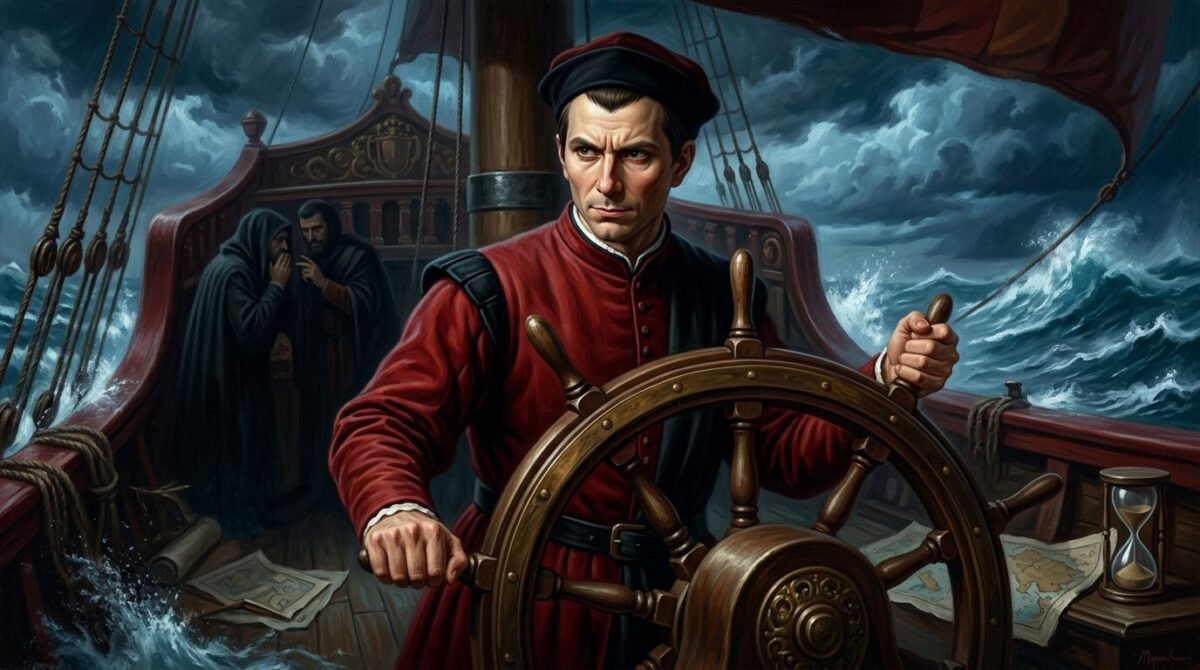
Opposing and interacting with Virtù is Fortuna. In Machiavelli’s worldview, Fortuna is the unpredictable, often destructive force of luck, chance, and historical circumstance. He famously personifies Fortuna as a raging river. When the river floods, it destroys trees, ruins buildings, and washes away the earth. Men flee before it, yielding to its fury, unable to stop it.
Machiavelli concedes that Fortuna controls perhaps half of our actions. However, he insists that the other half is left to our own free will and Virtù. The genius of a legitimate ruler lies in his ability to anticipate the flood. During times of peace and fair weather, a leader with Virtù does not grow lazy; he builds dams, dikes, and canals. When the floodwaters of Fortuna eventually rise—be it an economic collapse, a pandemic, or a sudden invasion—the preparations made by Virtù channel the destructive energy and save the state.
The core of mastering the state is the dynamic interplay between these two forces. Machiavelli argued that human beings naturally have fixed dispositions—some are naturally cautious, while others are naturally impetuous. The tragedy of human nature is that a cautious man will succeed when the times require caution, but when Fortuna shifts and the times require bold, aggressive action, the cautious man cannot change his nature, and he falls.
Therefore, the ultimate manifestation of Virtù is psychological shape-shifting. A ruler must use his Virtù to read the shifting winds of Fortuna and adapt his personality and tactics accordingly. He must be the fox to recognize traps and the lion to frighten off wolves. Legitimacy is maintained not by being consistently “good,” but by being consistently adaptable to the chaotic circumstances that luck throws at the state.
4. The Psychology of Authority: Fear vs. Love
If Virtù and Fortuna dictate the mechanics of statecraft, Machiavelli’s analysis of human emotion dictates the psychology of authority. In Chapter 17 of The Prince, he poses what has become the most famous question in the history of leadership: Is it better to be loved than feared, or feared than loved?
Machiavelli acknowledges that, ideally, a leader should be both. However, because human nature is inherently flawed, selfish, and fickle, it is incredibly difficult to maintain both emotions simultaneously. When forced to choose, Machiavelli delivers a chillingly pragmatic verdict: it is much safer for a ruler to be feared than loved.
To understand why, we must look at his deeply cynical, yet arguably accurate, assessment of Power & Human Nature. Machiavelli writes that men are generally “ungrateful, fickle, false, cowardly, covetous.” As long as you are providing them with benefits, they are entirely yours—they will offer you their blood, their property, their lives, and their children. But the moment the danger approaches and you actually need their help, they will turn against you.
Love is a bond of obligation. Because men are inherently selfish, they will break this bond of love whenever it serves their own advantage. If a leader relies solely on the love of his subjects, he places his authority in their hands. He is dependent on their continued goodwill, which can evaporate overnight due to a bad harvest, a tax increase, or a charismatic rival.
Fear, on the other hand, is maintained by a dread of punishment that never fails. When a leader relies on fear, he keeps the locus of control entirely within his own hands. A subject may want to betray a feared leader, but the psychological paralysis induced by the certainty of severe punishment keeps them in line. Fear is predictable; love is volatile.
However, this is where pop-culture Machiavellianism entirely misses the mark. Machiavelli immediately follows his endorsement of fear with a critical, non-negotiable caveat: A ruler must make himself feared in such a way that, if he does not gain love, he at least avoids hatred.
Being feared and not being hated can coexist perfectly. Fear commands respect and obedience; hatred breeds resentment, conspiracy, and rebellion. The moment a ruler becomes hated, his legitimacy begins to rot from the inside. A hated ruler cannot sleep soundly, for he must fear his own guards as much as foreign armies.
How does a leader avoid hatred while maintaining fear? Machiavelli’s advice is highly specific and deeply rooted in evolutionary psychology: a ruler must keep his hands off the property and the women of his subjects. He notes with dark irony that “men forget the death of their father sooner than the loss of their patrimony.” You can execute a man for treason, and the public will accept it if the justification is clear. But if you arbitrarily steal a man’s land or wealth, you threaten the survival of his lineage, and you will ignite a hatred that burns across generations. Legitimate authority, therefore, is a delicate psychological tightrope: projecting enough calculated menace to deter rebellion, while respecting the basic rights and property of the populace to prevent the boiling over of hatred.
5. Autocracy vs. Republic: The Prince vs. Discourses on Livy
One of the greatest paradoxes in political philosophy is the stark contrast between Machiavelli’s two major works. The Prince is a manual for autocrats, detailing how a single strongman can seize and hold absolute power. Yet, his longer, more comprehensive work, Discourses on Livy, is a passionate defense of republicanism, the rule of law, and the liberty of the people. How could the same man write the ultimate tyrant’s playbook and a foundational text for modern democratic republics?
Scholars have debated this for centuries. Some argued he was a schizophrenic thinker; others suggested The Prince was a satirical trap meant to expose the brutal methods of tyrants to the public. However, the most accurate reading is that the two texts do not contradict each other; they complement each other when viewed through the lens of state-building versus state-maintenance.
The Prince is a book about crisis management. Machiavelli believed that when a state is utterly corrupt, broken, or newly formed, it requires the singular, focused Virtù of an autocratic founder to impose order. A committee cannot build a state from scratch; it requires a visionary with absolute authority to establish the initial “good laws and good arms.” The Prince is the surgical scalpel used to cut out the cancer of anarchy.
However, once the state is established and the crisis has passed, autocracy becomes a liability. A single ruler is mortal, prone to madness, and limited by his own fixed nature. This is where the Discourses on Livy takes over. Machiavelli’s underlying, deeply held belief was that a republic—governed by the rule of law, a mixed constitution, and the consent of the people—is the most stable, legitimate, and enduring form of government.
In the Discourses, Machiavelli argues that while a prince might be better at founding a state, a republic is vastly superior at maintaining it. Why? Because of the problem of Fortuna. Remember that a single man struggles to adapt his nature to changing times. But a republic contains a diverse multitude of citizens. When the times require a cautious leader, a republic can elect a cautious man. When the times require a bold general, the republic can elect a warrior. A republic has a collective Virtù that makes it far more resilient to the shocks of Fortuna than any single monarchy.
Furthermore, Machiavelli recognized the value of social friction. In the Discourses, he praises the historical class conflicts of ancient Rome—the tension between the wealthy patricians and the common plebeians. Rather than seeing this conflict as a weakness, he saw it as the engine of liberty. The struggle between different classes forces the creation of good laws and checks and balances, preventing any one group from achieving tyrannical dominance.
Therefore, Machiavelli’s ultimate vision of legitimate authority is not a dictator ruling by fear forever. It is a republic where the law is supreme, where the people have a voice, and where the state is strong enough to defend its liberty. The Prince is merely the brutal, necessary prologue to the republican ideal outlined in the Discourses.
6. The Enduring Legacy of Machiavelli’s Realism
Niccolò Machiavelli died in 1527, largely out of favor and unaware of the monumental impact his writings would have on the world. By stripping away the theological and moralistic illusions surrounding power, his political realism laid the absolute groundwork for modern political science. He taught us to analyze institutions and leaders not by what they preach, but by what they actually do.
Today, the application of Machiavelli’s theories extends far beyond the borders of Renaissance Italy. In the realm of international relations, the dominant school of “Realism” (championed by modern thinkers and strategists) operates entirely on Machiavellian principles. The international system is viewed as an anarchic arena where states must rely on their own “good arms” for survival, where moral appeals are secondary to national interests, and where the balance of power dictates peace.
In the sphere of corporate governance and Influence & Leadership, Machiavelli’s insights remain startlingly relevant. The distinction between a “wartime CEO” and a “peacetime CEO” perfectly mirrors his theories on adaptability and Fortuna. A corporate turnaround specialist brought in to save a bankrupt company often must act like the ruler in The Prince—centralizing authority, making ruthless cuts, and relying on fear to break complacent cultures. Conversely, a CEO managing a stable, growing tech giant must rely on the decentralized, collaborative principles found in the Discourses to foster innovation and retain top talent.
Machiavelli remains a profoundly misunderstood philosopher because he forces us to confront the uncomfortable truths about ourselves. We want to believe that good things happen to good people, and that moral purity guarantees success. Machiavelli acts as the ultimate psychoanalyst of power, shattering that delusion. He reminds us that the world is unforgiving, that human nature is deeply flawed, and that the preservation of order requires difficult, sometimes dark choices.
To dismiss him as a mere advocate for evil is to miss the profound responsibility he places on the shoulders of leaders. Through Comparative Philosophy, we see that while others taught leaders how to save their souls, Machiavelli taught them how to save their people.
Conclusion
Machiavelli revolutionized political philosophy by violently separating statecraft from traditional morality. He looked at the bloody reality of human history and concluded that legitimate authority is never a divine right, nor is it a default state of nature. It is a fragile, man-made construct. It must be fiercely maintained through a ruler’s dynamic Virtù, the establishment of unshakeable good laws and arms, and the pragmatic, unsentimental balancing of fear and public support. He taught us that to survive the raging river of Fortuna, we must build our dams in the daylight and be prepared to do whatever is necessary in the dark.
Want to dive deeper into the minds that shaped modern governance, psychology, and power dynamics? Bookmark this page for your political science studies, and explore our other deep-dive guides on Renaissance political thought and human nature right here on DeepPsyche.blog!
Frequently Asked Questions (FAQ)
What is the main difference between power and authority for Machiavelli?
For Machiavelli, power is simply the ability to coerce others, often achieved through brute force or violence (like a tyrant seizing control). Authority, however, is legitimate power. It is achieved when a leader establishes stability, creates “good laws and good arms,” and earns the grudging respect or consent of the governed, ensuring the long-term survival of the state rather than just temporary dominance.
Did Machiavelli actually say “the ends justify the means”?
No, he never wrote that exact phrase. The concept is a simplification of his argument in The Prince that in the actions of leaders, people judge by the final outcome. He argued that if a leader successfully preserves the state and protects the people, the harsh or deceptive methods used to achieve that stability will be excused or deemed honorable by the masses. It is not a justification for selfish cruelty, but a pragmatic observation of political survival.
Why did Machiavelli prefer a republic over an autocracy (a principality)?
While Machiavelli believed an autocratic prince was necessary to found a new state or rescue a corrupt one from chaos, he argued in Discourses on Livy that a republic is far superior for maintaining a state long-term. Republics benefit from the diverse talents (Virtù) of many citizens, making them more adaptable to changing circumstances (Fortuna). Furthermore, the rule of law and the checks and balances inherent in a republic prevent the tyranny and instability caused by a single, flawed ruler.