

Imagine for a moment that you are standing in a crowded room—perhaps a corporate gala or a high-stakes political fundraiser. As you look around, do you see a community of collaborators working toward a shared vision of the common good? Or do you see a high-stakes chessboard where every handshake is a move, every smile is a mask, and only the most strategic players will remain standing when the lights go out?
For most of us, the second perspective feels cynical, even chilling. We prefer to believe in the inherent goodness of people and the power of transparency. Yet, for a specific segment of the population, the chessboard isn’t just a metaphor; it is the fundamental reality of human existence. This is the world of Machiavellianism. Often dismissed as mere villainy or a “bad personality,” Machiavellianism is, in fact, a sophisticated psychological framework and a functional worldview used by those who navigate the highest levels of power, strategy, and influence. It is a philosophy of survival in a world perceived as inherently competitive and unforgiving.
1. The Historical Genesis: From Niccolò Machiavelli to Modern Psychology
To understand the Machiavellian mind, we must first travel back to the fractured landscape of 16th-century Italy. Niccolò Machiavelli, a diplomat in the Florentine Republic, wrote The Prince in 1513, not as a work of abstract philosophy, but as a practical guide for a ruler trying to maintain stability in a time of constant warfare and betrayal.

Before Machiavelli, political writing was largely idealistic, focusing on how a leader should behave according to Christian virtues. Machiavelli shattered this tradition. He argued that a leader who tries to be good in a world of people who are not good will inevitably come to ruin. His famous assertion—that it is better to be feared than loved, if one cannot be both—was born from a cold, hard look at the “effective truth” of politics. In the Florentine context, the “ends justify the means” wasn’t a call to cruelty; it was a pragmatic necessity for state survival.
For centuries, “Machiavellian” remained a political slur, synonymous with deceit. However, in the 1970s, social psychologists Richard Christie and Florence Geis transformed this political treatise into a personality construct. They wondered if the strategies Machiavelli described for princes were also utilized by ordinary people in everyday social interactions.
They developed the Mach-IV scale, a series of statements designed to measure a person’s level of Machiavellianism. Participants were asked to agree or disagree with ideas like, “The best way to handle people is to tell them what they want to hear,” and “Anyone who completely trusts anyone else is asking for trouble.” What they discovered was a distinct personality type—the “High Mach”—who viewed the world through the same cold, strategic lens as the 16th-century prince, regardless of whether they were in a boardroom or a classroom.
2. Defining the Machiavellian Worldview: Cynicism and Pragmatism
At the heart of the Machiavellian worldview lies a profound sense of cynicism. A High Mach does not necessarily hate people; they simply have a very low opinion of human nature. They perceive most people as weak, fickle, and easily swayed by their emotions or greed. Because they view the “masses” as gullible, they feel no moral qualms about using manipulation to achieve their goals. To them, if people are easily fooled, it is almost their duty to lead them, even if that leadership requires deception.

This leads to a philosophy of strategic pragmatism. While most people weigh their decisions against a moral compass or an emotional barometer, the Machiavellian asks a single question: Does this work? They prioritize objective outcomes—wealth, status, or power—over subjective feelings. If a lie achieves a better result than the truth with a manageable level of risk, the lie is the logical choice.
Psychologists often refer to this as the “Cool Syndrome.” High Machs possess a remarkable ability to maintain emotional detachment. In moments of crisis where others might be paralyzed by empathy, guilt, or fear, the Machiavellian remains calm and analytical. They treat social relationships as transactional tools. A friend is not just a companion; they are a potential connection. A colleague is not just a teammate; they are an asset to be leveraged or a rival to be neutralized. This detachment allows them to make “rational” decisions that others find heartless, but which the Machiavellian sees as merely efficient.
3. Machiavellianism within the Dark Triad Framework
In modern psychology, Machiavellianism is studied as one of the three pillars of the Dark Triad, alongside Narcissism and Psychopathy. While these three traits often overlap, the Machiavellian is distinct in their methodology and motivation.
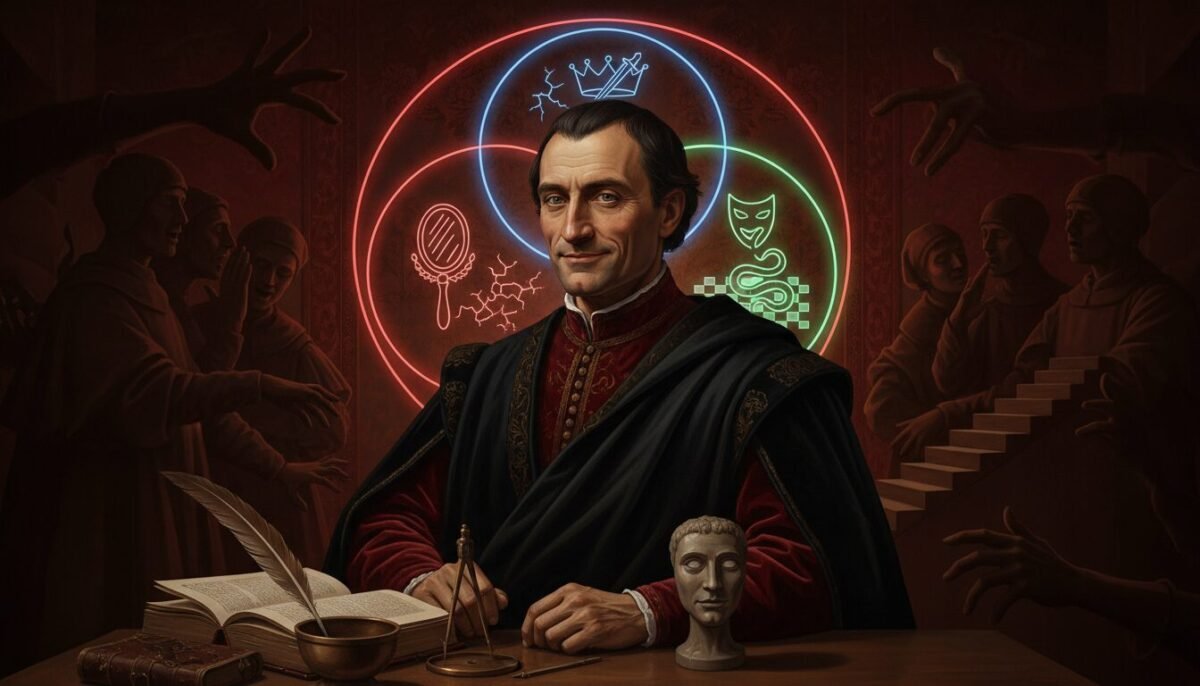
- Narcissism is driven by the ego. The narcissist needs admiration and validation. They want to be the center of attention.
- Psychopathy is characterized by impulsivity and a lack of remorse. The psychopath acts on whim, often seeking immediate gratification without regard for consequences.
- Machiavellianism is the “strategic engine” of the triad. Unlike the narcissist, the Machiavellian doesn’t need your praise—they just need your compliance. Unlike the psychopath, they are rarely impulsive.
The defining feature of the High Mach profile is the gap between cognitive empathy and affective empathy. They are exceptionally good at cognitive empathy—the ability to understand what someone else is thinking or feeling. They can read a room with surgical precision. However, they lack affective empathy—the ability to feel what others feel. They understand your pain, but they aren’t moved by it. This combination is what makes them such effective manipulators; they know exactly which buttons to push to get a reaction, but they aren’t hindered by the emotional fallout of pushing them.
Furthermore, Machiavellianism is defined by long-term planning. While a psychopath might burn a bridge for a momentary thrill, a Machiavellian will spend years carefully maintaining a bridge they might need to cross only once. They are masters of impulse control, willing to delay gratification for decades if it means a larger payoff in the end.
4. Strategic Manipulation vs. Impulsive Behavior
The hallmark of the Machiavellian is the “long game.” In any social or professional hierarchy, you can usually spot the difference between the impulsive actor and the strategic one. The impulsive actor (often leaning toward psychopathy) uses overt aggression; they bully, they shout, and they take what they want by force. This is often effective in the short term but leads to social ostracization and legal trouble.
The Machiavellian, by contrast, understands the value of reputation management. They know that being perceived as “the bad guy” is a strategic disadvantage. Therefore, they often present themselves as the most helpful, reasonable, and charming person in the room. Their manipulation is covert. They use “soft power”—gaslighting, selective sharing of information, and the subtle framing of narratives—to guide others toward a desired conclusion while making those people believe it was their own idea.
Every move is a calculated risk. Before acting, a High Mach performs a mental cost-benefit analysis. “If I betray this person now, what is the likelihood they can retaliate? What will this do to my standing with the board? Is the reward worth the potential damage to my ‘brand’?” If the cost of manipulation is too high, they will be the most loyal, ethical person you’ve ever met—not because they’ve had a change of heart, but because being ethical is currently the most profitable strategy.
5. Machiavellianism in Leadership: Corporate and Political Strategy
Can Machiavellianism ever be a positive trait? This is a question that haunts organizational psychology. In many ways, high-level leadership requires a degree of Machiavellian thinking. We often speak of “Productive Machiavellians”—individuals who use their strategic prowess not for personal gain, but to navigate complex bureaucracies and achieve organizational goals.
In the corporate world, office politics is an inescapable reality. A leader who is too “pure” or naive may find their department’s budget slashed or their best ideas stolen by more aggressive rivals. A Machiavellian leader knows how to build alliances, how to “manage up,” and how to neutralize internal threats before they manifest. In high-stakes negotiations, their moral flexibility allows them to make the hard trades that a more idealistic person might find repugnant but which are necessary for the company’s survival.
However, the line between “strategic leader” and “toxic tyrant” is razor-thin. When a leader’s Machiavellianism is unchecked, it leads to organizational erosion. If employees realize that their leader is transactional and manipulative, trust evaporates. Without trust, collaboration dies, and the organization becomes a collection of individuals all playing their own “long games” against each other. The very traits that help a Machiavellian climb to the top—cynicism and detachment—can eventually cause the structure they lead to crumble from within.
6. Ethical Implications and the Social Consequences of the ‘High Mach’ Life
From a utilitarian perspective, one could argue that if a Machiavellian leader produces the best outcome for the most people, their methods are irrelevant. If a “ruthless” CEO saves 10,000 jobs by making a cold-blooded decision to close one failing factory, is that not a net good? This is the core of the Machiavellian defense.
Yet, there is a significant psychological toll on the individual. Living a life where everyone is a pawn and no one is a confidant is inherently isolating. High Machs often struggle with genuine intimacy because they cannot “turn off” the strategic filter. They are constantly scanning for ulterior motives in others, leading to a life of profound loneliness. When you believe everyone is out for themselves, you can never truly trust anyone, and you can never be truly known.
On a societal level, the rise of Machiavellianism in public life affects social cohesion. When institutional trust is replaced by a “winner-takes-all” mentality, the fabric of society begins to fray. We see this in political polarization, where the goal is no longer to govern but to “win the cycle” at any cost. When Machiavellianism becomes the default worldview of a culture, the concept of the “common good” becomes an obsolete relic of an idealistic past.
The challenge for the modern individual is finding a balance. We live in a competitive world that requires strategic thinking and an understanding of power dynamics. To be completely “Low Mach” is to be vulnerable. However, to be “High Mach” is to lose one’s humanity. The goal, perhaps, is to develop strategic intelligence—the ability to understand the chessboard without forgetting that the people on it are not just pieces, but human beings with inherent value.
Conclusion
Machiavellianism is far more than a personality flaw; it is a calculated, coherent worldview centered on the pursuit of influence through strategic pragmatism. While it offers undeniable advantages in the arenas of corporate and political power, its reliance on cynicism and manipulation presents a fundamental challenge to our ethical frameworks and personal well-being. Understanding this mindset is not about learning how to become a villain; it is about recognizing the forces that shape our world and deciding how we choose to navigate them—whether as players, pawns, or something else entirely.
Frequently Asked Questions
Is Machiavellianism the same as being “evil”?
Not necessarily. In psychology, it is viewed as a personality trait characterized by strategic thinking and emotional detachment. While it can be used for “evil” ends, it is often used by leaders to navigate complex systems and achieve practical results that benefit an organization.
Can a Machiavellian person ever change?
Personality traits are generally stable over time, but individuals can learn to moderate their behavior. A High Mach may realize that building genuine trust is a more effective long-term strategy than constant manipulation, leading them to adopt more prosocial behaviors.
How can I protect myself from a Machiavellian at work?
The best defense is transparency and documentation. Machiavellians thrive in “gray areas” and covert communication. By keeping clear records, communicating openly with your team, and being aware of your own emotional triggers, you reduce their ability to manipulate the narrative.
Are all successful CEOs Machiavellian?
While many successful leaders score higher than average on the Mach-IV scale, it is not a requirement for success. Many leaders achieve great results through “servant leadership” or high-empathy models, though they usually still possess a keen understanding of power dynamics.
If you found this analysis of the human shadow intriguing, explore our further guides on the Dark Triad and personality psychology to better understand the complex dynamics of human behavior in the workplace and beyond.
Deepen your understanding of power and the mind:
- Machiavelli & Political Philosophy: The roots of strategic thought.
- Power & Human Nature: Why we seek to control our environment.
- Influence & Leadership: The ethical path to moving people.
- Comparative Philosophy: How different cultures view the “ends and means” debate.
Explore more at DeepPsyche.blog—where we look beneath the surface of the human experience.