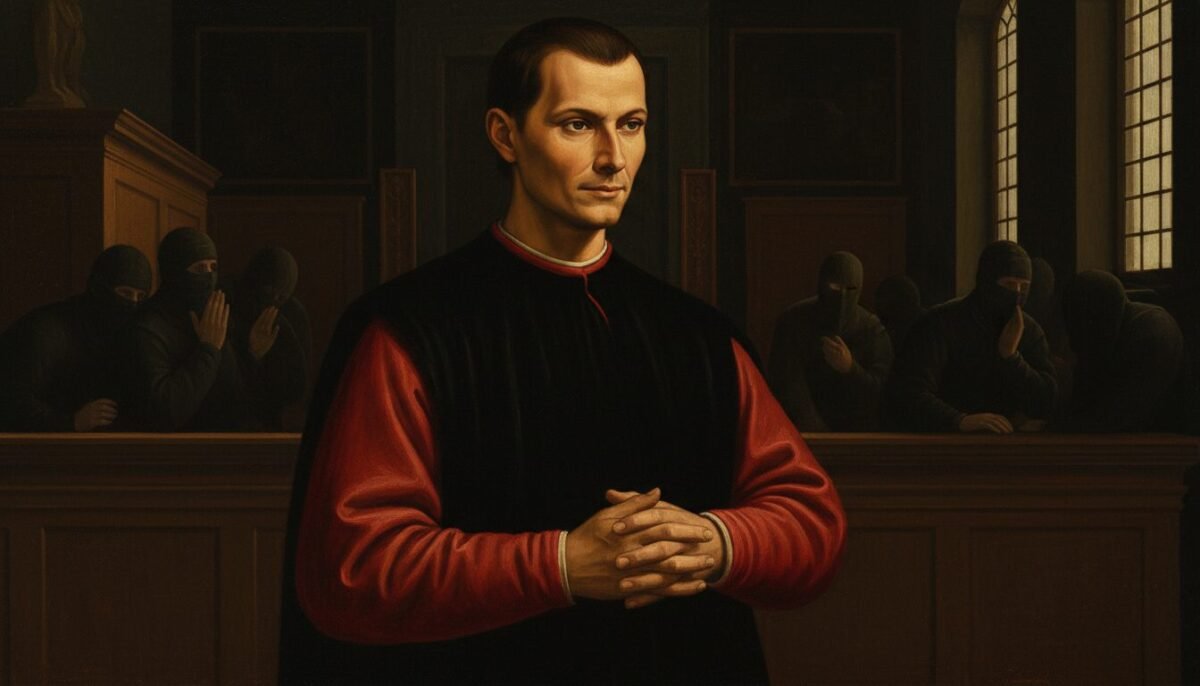
Imagine a man standing in a small, dusty farmhouse outside Florence, wearing his finest silk robes every evening just to read the classics by candlelight. He is a disgraced civil servant, a man who once shook hands with kings and popes, now reduced to trapping thrushes and arguing with local carters over a few cents. When he died in June 1527, he was not a legend; he was a failure. He was poor, he was unemployed, and the city he loved had just rejected his final bid for a job.
How did this man, who slipped away in relative obscurity, become the namesake for political evil? Today, the word “Machiavellian” is hurled as an insult, conjuring images of shadowy manipulators and cold-blooded tyrants. We associate Niccolò Machiavelli almost exclusively with The Prince, a handbook for the ruthless. Yet, the reality of his final years and the true intent behind his writing reveal a far more complex figure: a patriot who sacrificed his reputation to tell the uncomfortable truth about how power actually works. This is the story of Machiavelli’s final struggle, his quiet death, and the 500-year journey from a banned villain to the father of modern political realism.
1. The Final Years in Florence: A Struggle for Political Relevance
Machiavelli’s final decade was defined by a desperate, often heartbreaking attempt to return to the world of high-stakes diplomacy. For fourteen years, he had served the Florentine Republic as a Second Chancellor, traveling on missions to the courts of Louis XII of France and the terrifying Cesare Borgia. But in 1512, the wind changed. The Medici family returned to power, the Republic collapsed, and Machiavelli was not only fired but imprisoned and tortured on the “strappado”—a device that dislocated his shoulders—under suspicion of conspiracy.
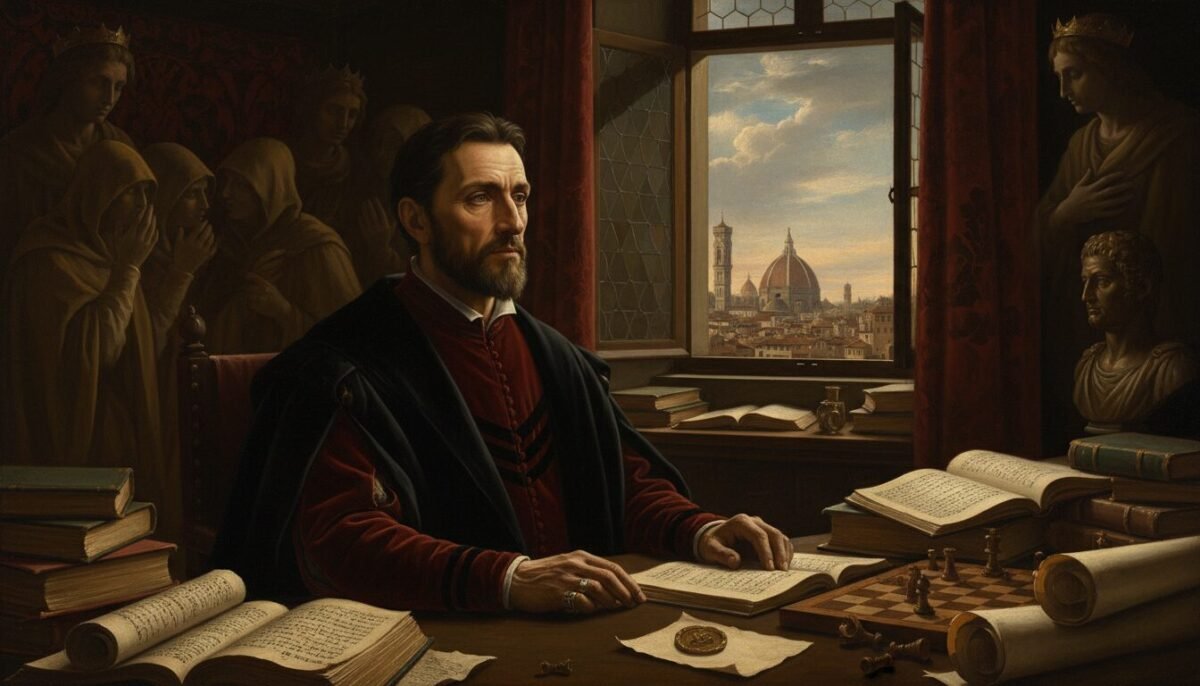
Exiled to his family estate in San Casciano, Machiavelli entered a period of forced “retirement” that he loathed. It was during this frustration that he wrote The Prince. It wasn’t written for the public; it was a desperate job application addressed to Lorenzo de’ Medici, an attempt to prove that he understood the mechanics of power better than anyone else. He was a republican at heart, yet he was willing to serve a prince if it meant saving Florence from foreign invasion.
The irony of these years is thick. While he sought favor from the Medici, he was simultaneously writing his Discourses on Livy, a deep dive into the virtues of a free republic. He became a man of two worlds: a frustrated historian and a playwright. His play The Mandragola became a hit, proving his wit, but it offered little solace to a man who craved the “great things” of statecraft. He spent his days in the local tavern playing cards, but his nights were spent in the company of the ancients, “conversing” with Cicero and Livy.
The final blow came in May 1527. The Sack of Rome by the troops of Holy Roman Emperor Charles V sent shockwaves through Italy. The Medici were once again ousted from Florence, and the Republic was restored. Machiavelli rushed back to the city, certain that his old office would be waiting for him. But the new republican government saw him as a “Medici man.” They didn’t trust him. He was rejected by the very system he had spent his life trying to protect. This final political heartbreak preceded his physical collapse by only a few weeks.
2. The Death of Niccolò Machiavelli: June 1527
Niccolò Machiavelli died on June 21, 1527, at the age of 58. The clinical cause of death was likely a sudden and severe stomach ailment—possibly a perforated ulcer or peritonitis—exacerbated by a “medicine” he frequently took. In an era before modern pharmacology, Machiavelli relied on a concoction of pills he called pillole di ramerino (rosemary pills), which he believed could cure almost any digestive distress. On this occasion, they failed him, or perhaps worsened the inflammation that was already killing him.
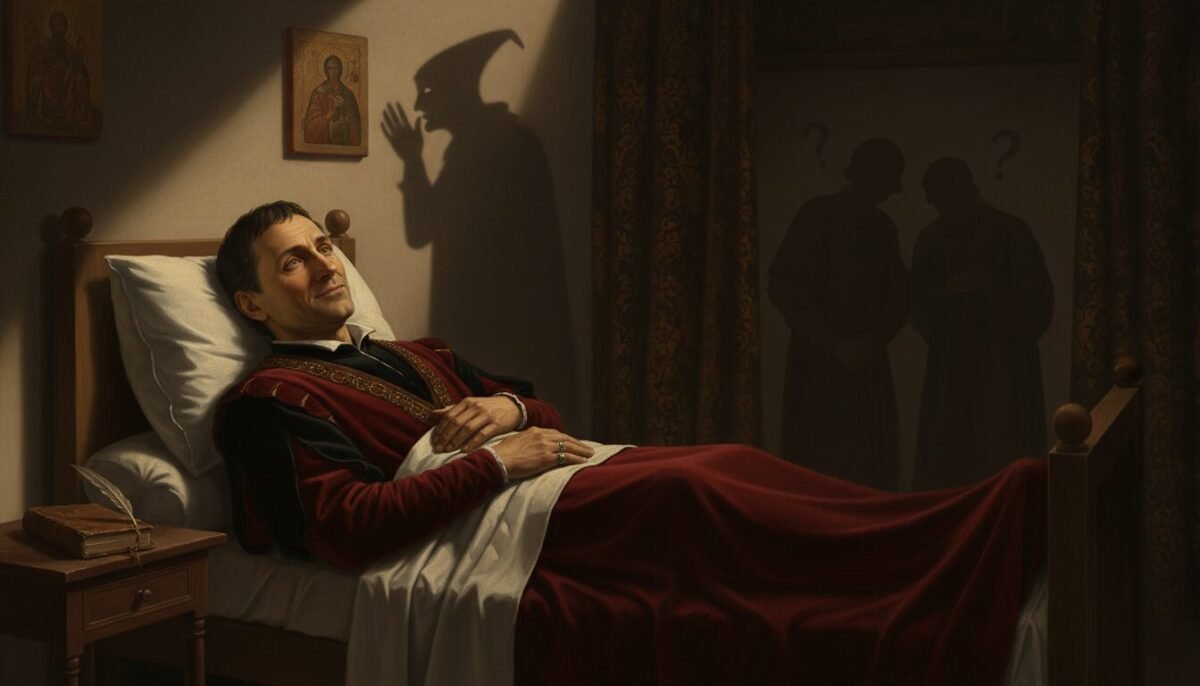
The atmosphere in Florence was one of chaos and transition. The city was reeling from the news of Rome’s destruction and the feverish excitement of its newly regained liberty. Amidst this historical upheaval, Machiavelli lay in his bed on the Via Guicciardini, surrounded by his wife, Marietta Corsini, and their children. His friends, the intellectuals from the Oricellari Gardens where he had discussed philosophy for years, were also present.
A famous legend surrounds his final hours, known as “Machiavelli’s Dream.” It is said that he told his friends he saw two groups of people. The first was a crowd of ragged, saintly-looking paupers on their way to Heaven. The second was a group of noble philosophers and historians—Plato, Plutarch, Tacitus—discussing politics on their way to Hell. Machiavelli allegedly said he would much rather go to Hell to discuss statecraft with the greats than be bored in Heaven with the pious. While historians debate the literal truth of this “deathbed confession,” it perfectly captures the spirit of the man: he was a secularist who valued the “glory of the world” over the quietism of the church.
3. Posthumous Infamy: The Banning of His Works and the Birth of ‘Old Nick’
Machiavelli’s death was the beginning of his transformation into a caricature. While he was alive, The Prince circulated only in manuscript form. It wasn’t until 1532, five years after his death, that it was formally published with papal permission. However, as the Protestant Reformation intensified and the Catholic Church tightened its grip on intellectual life, Machiavelli became an easy scapegoat for the moral decay of the age.
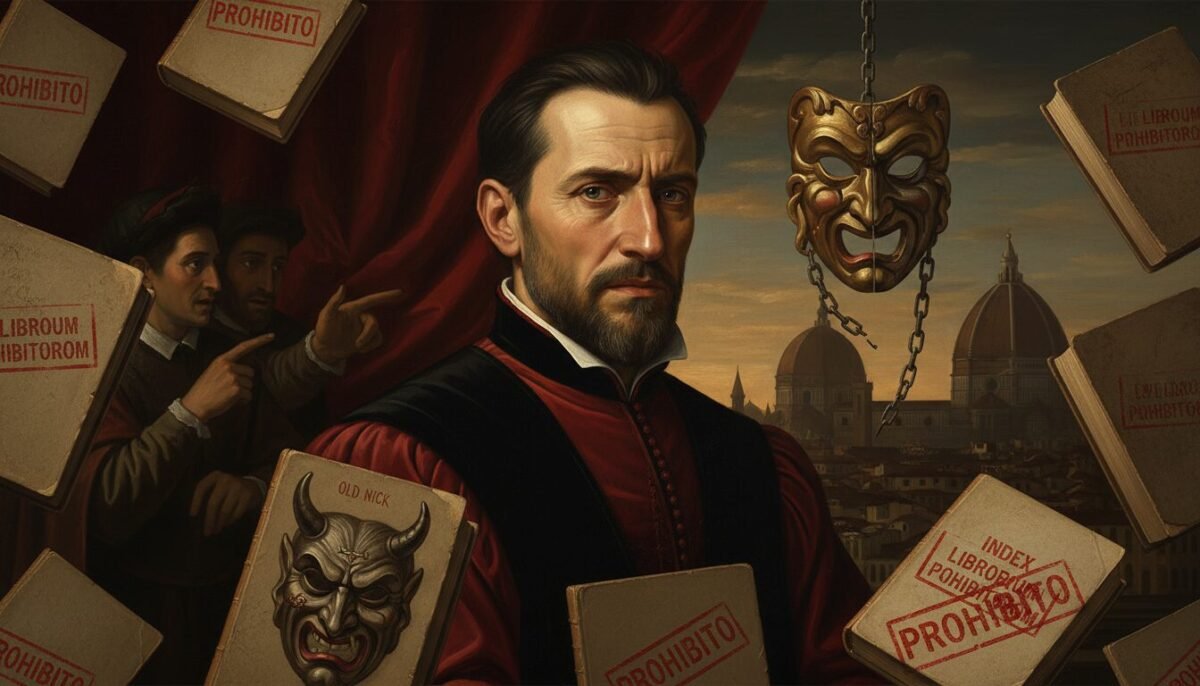
In 1559, the Catholic Church placed his entire body of work on the Index Librorum Prohibitorum (the Index of Prohibited Books). He was branded an atheist and a “teacher of evil.” But the ban only fueled his notoriety. In England, Elizabethan dramatists like Christopher Marlowe and William Shakespeare seized upon the “Machiavel” as a stock villain. In the prologue to Marlowe’s The Jew of Malta, a character representing Machiavelli appears on stage to declare: “I count religion but a childish toy, / And hold there is no sin but ignorance.”
This theatrical distortion birthed the linguistic pejorative “Machiavellian.” In popular English culture, he was even associated with the devil; the nickname “Old Nick” for Satan is often (though perhaps apocryphally) linked to Niccolò. The disconnect between the man and the myth was total. The real Machiavelli was a man who wept for the ruin of Italy; the mythical Machiavelli was a demon who delighted in deceit for its own sake. His name became a shorthand for any political act that lacked a moral compass, regardless of whether it actually followed his logic of necessità (necessity).
4. The Enlightenment Rehabilitation: Machiavelli as a Patriot
The tide began to turn during the Enlightenment. Thinkers who were tired of the “divine right of kings” began to read Machiavelli with fresh eyes. They realized that he wasn’t advocating for tyranny; he was describing it so that people could recognize it. Jean-Jacques Rousseau, in his Social Contract, famously argued that The Prince was “the book of republicans.” He suggested that by appearing to give lessons to kings, Machiavelli was actually exposing the secrets of power to the citizenry.
Baruch Spinoza echoed this sentiment, viewing Machiavelli as a champion of liberty who showed how a free people could protect themselves from being deceived. This rehabilitation reached its peak during the 19th-century Risorgimento—the movement for Italian unification. To figures like Giuseppe Mazzini, Machiavelli was not a villain but a visionary patriot who had called for a “redeemer” to unite Italy and expel foreign invaders three centuries before it became a reality.
Scholars also began to prioritize his Discourses on Livy over The Prince. In the Discourses, Machiavelli argues that the friction between the elite and the common people is what makes a republic strong, and that a state’s longevity depends on the virtue of its citizens. This shift in perception moved him from a “teacher of evil” to the “father of political realism.” He was the first to separate politics from theology, insisting that we must study the world “as it is,” not “as it ought to be.”
5. The Basilica of Santa Croce: A Final Resting Place Among Greats
If you visit the Basilica of Santa Croce in Florence today—the “Temple of the Italian Glories”—you will find Machiavelli’s tomb in prestigious company. He rests alongside Michelangelo, Galileo, and Rossini. But for over 250 years after his death, his grave was unmarked and largely forgotten. It wasn’t until 1787, during the height of his Enlightenment rehabilitation, that a grand monument was finally erected to honor him.
The monument, designed by the sculptor Innocenzo Spinazzi, features a personification of Diplomacy mourning over a sarcophagus. But the most striking element is the Latin inscription: TANTO NOMINI NULLUM PAR ELOGIUM. Translated, it means: “For so great a name, no praise is adequate.”
This inscription is a profound historical irony. The man who was once banned by the Church and mocked on the London stage was now officially recognized as one of the greatest minds in human history. The location of the tomb is symbolic; Santa Croce is the heart of Florentine identity. By placing him there, the city finally apologized for the way it treated him in his final years. The tomb represents the ultimate restoration of his honor, acknowledging that his “evil” was actually a profound, if painful, honesty about the human condition.
6. Modern Legacy: Machiavelli’s Influence on 21st-Century Statecraft
Five centuries later, Machiavelli is more relevant than ever. In the realm of international relations, the “Realist” school—which includes figures like Henry Kissinger and Hans Morgenthau—traces its lineage directly back to him. The core Machiavellian insight remains: in a world where not everyone is “good,” a leader who tries to be perfectly moral in all circumstances will inevitably bring about the ruin of their state.
Beyond politics, Machiavelli has become a staple of leadership studies and business strategy. While some of this is superficial (titles like Machiavelli for Women or The Machiavellian Manager), the underlying attraction is his focus on virtù—not moral virtue, but the skill, energy, and flexibility required to navigate the whims of Fortuna (Fate). He taught us that power is not a static possession but a dynamic relationship that must be constantly managed.
Why does The Prince remain a bestseller? Because it is one of the few books that refuses to lie to the reader. It strips away the comforting illusions of political rhetoric and shows us the gears of the machine. Machiavelli was the first “scientist of power.” He didn’t invent the dark arts of politics; he simply had the courage to write them down. He understood that the greatest threat to a society is not a leader who is “Machiavellian,” but a leader who is delusional about the nature of reality.
Niccolò Machiavelli’s death in 1527 was a quiet end to a tumultuous life, but it marked the beginning of a legendary historical transformation. From a banned author and synonymous villain to a celebrated patriot and the father of political science, his reputation has mirrored the changing values of Western civilization. He remains our most honest mirror—reflecting not who we wish we were, but who we are when the stakes are highest.
Frequently Asked Questions
Did Machiavelli actually say “The end justifies the means”?
No, he never wrote those exact words. However, he did argue in The Prince that a ruler’s actions are judged by their results, and if a ruler succeeds in preserving the state, the “means will always be considered honorable.”
Was Machiavelli an atheist?
It is unlikely. He was a critic of the Catholic Church’s political corruption and its role in keeping Italy divided, but his writings suggest he believed in a divine order and the social necessity of religion.
Is “Machiavellianism” a psychological disorder?
In modern psychology, “Machiavellianism” is one of the “Dark Triad” personality traits (alongside narcissism and psychopathy). It describes a tendency toward manipulation and a cynical disregard for morality, though this is a clinical interpretation that differs from Machiavelli’s original political philosophy.
Which book is more important: The Prince or the Discourses?
While The Prince is more famous, most scholars believe the Discourses on Livy provides a truer picture of Machiavelli’s personal beliefs, specifically his deep commitment to republicanism and civic liberty.
If you found this exploration of power and history compelling, explore our further readings on Machiavelli & Political Philosophy or dive into the psychological roots of Influence & Leadership to see how these Renaissance ideas still shape our modern world.