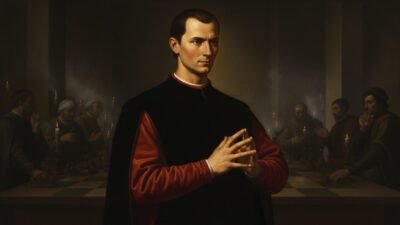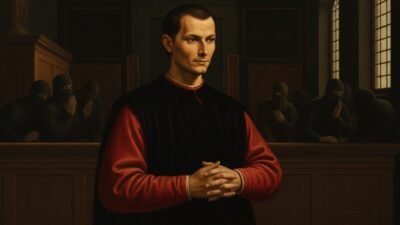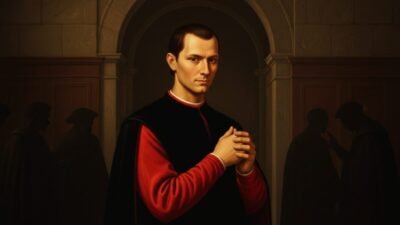

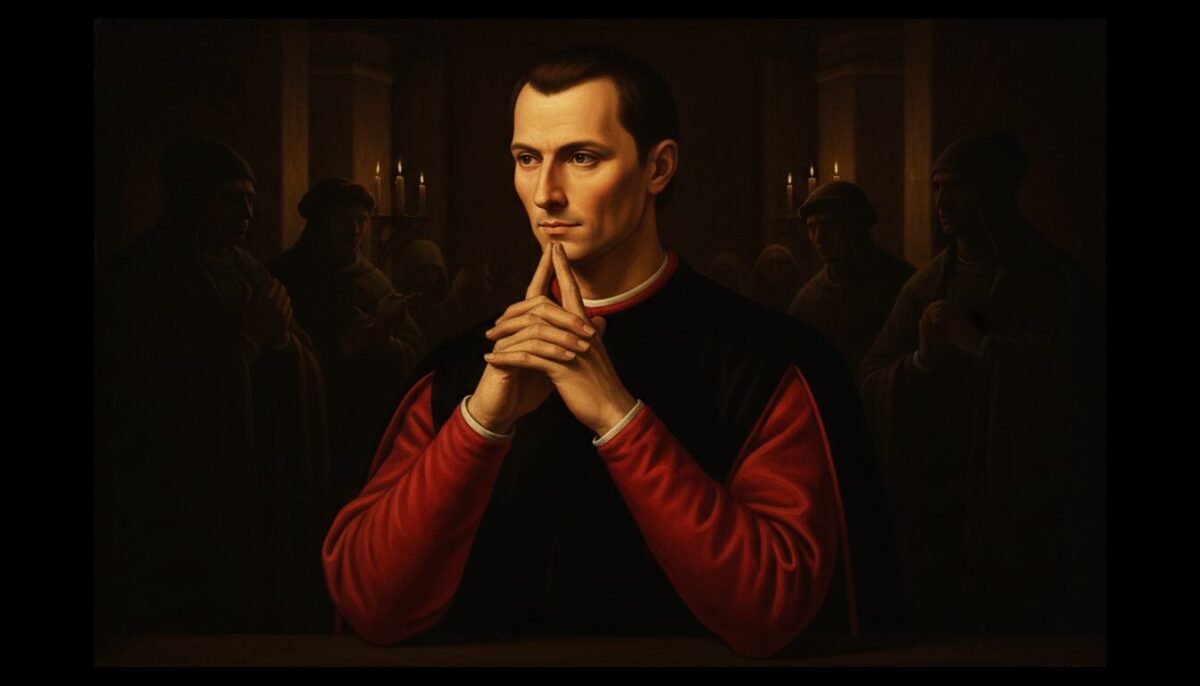
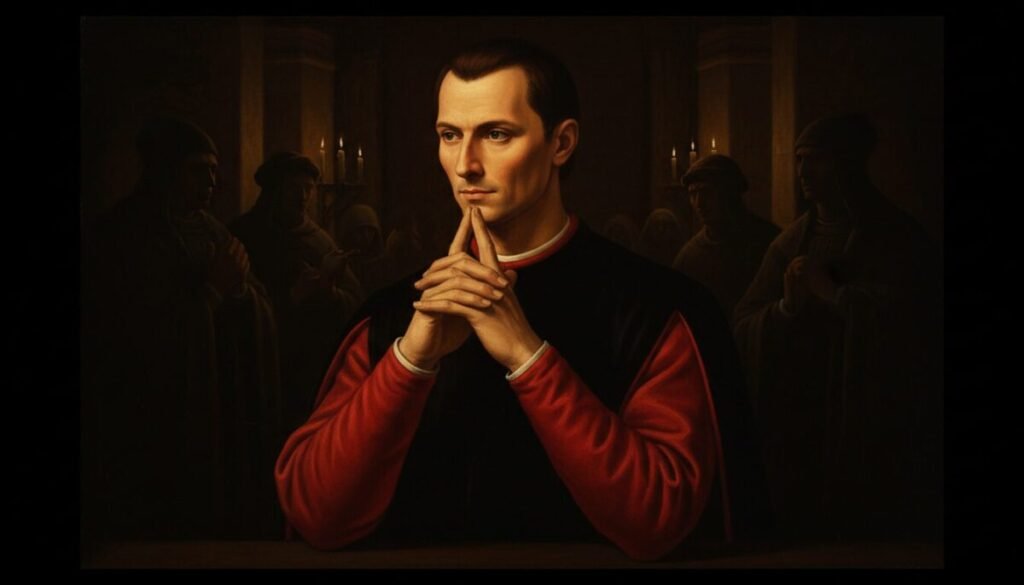
Was Niccolò Machiavelli a teacher of evil, or simply the first political scientist to describe the world as it truly is? For five centuries, his name has been synonymous with deceit, ruthlessness, and the dark arts of manipulation. We call people “Machiavellian” when they are cold and calculating, yet we often forget that the man behind the moniker was a civil servant who loved his country, a playwright with a sharp wit, and a diplomat who spent his life trying to prevent his home from being swallowed by chaos. Modern readers often view his most famous work, The Prince, as a manual for tyranny without understanding the chaotic, violent, and intellectually vibrant world that necessitated his pragmatism.
To understand Machiavelli, one must first understand the smell of woodsmoke and the sound of mercenary boots on cobblestones. He did not write in a vacuum of malice; he wrote from the wreckage of a dream. He lived in a time when the old certainties of the Middle Ages were collapsing, and the new world of the Renaissance was being born in a cradle of blood and brilliance. This was an era where a man could be a patron of the arts one day and a cold-blooded assassin the next. To judge Machiavelli by the standards of a stable, modern democracy is to fundamentally misunderstand the desperate survivalism of 16th-century Italy. This exploration unpacks the cultural climate—from the Medici’s influence to the rise of Humanism—to reveal why Machiavelli abandoned the comfort of idealism for the jagged edges of political realism.
1. The Volatile Landscape of 16th-Century Italian City-States
In the early 1500s, “Italy” was not a country; it was a “geographic expression,” a collection of warring siblings huddled together on a peninsula. While the rest of Europe was coalescing into powerful nation-states like France and Spain, Italy remained a fractured mosaic of competing powers. There was the merchant republic of Venice, the duchy of Milan, the cultural powerhouse of Florence, the Kingdom of Naples, and the Papal States—a territory ruled directly by the Pope, who was often more of a warlord than a spiritual shepherd.
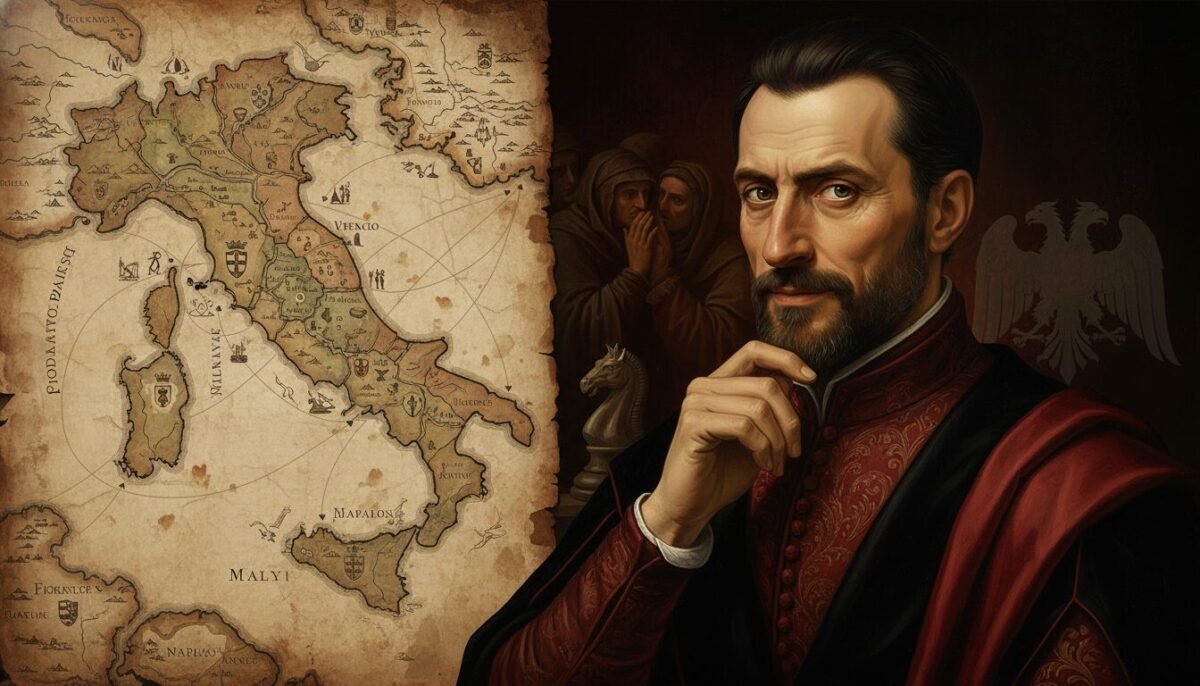
This fragmentation was Italy’s greatest weakness. Because these city-states were constantly bickering, they became the playground for Europe’s “barbarian” superpowers. France and Spain saw the wealthy, divided peninsula as a prize to be carved up. Machiavelli witnessed firsthand how easily a foreign army could march across the Alps and dismantle centuries of Italian progress in a matter of weeks. The instability was not just political; it was visceral. Borders shifted overnight, and a citizen could go to sleep under one flag and wake up under another, or worse, in the middle of a sacked city.
Machiavelli’s realism was born from this exhaustion. He saw that the traditional methods of diplomacy—appeals to shared faith or ancient treaties—were useless against a king with thirty thousand cannons. The constant threat of foreign intervention created a desperate, almost existential need for a strong, unifying leader. He realized that unless Italy could find its own “Prince” to consolidate power and build a standing army, it would remain a victim of history. His focus on power was not a love of cruelty, but a recognition that without a stable state, there is no art, no philosophy, and no safety for the common man. He wasn’t advocating for violence for its own sake; he was advocating for the strength required to end the cycle of perpetual invasion.
2. The Shift from Medieval Morality to Renaissance Humanism
While the political landscape was crumbling, the intellectual landscape was undergoing a revolution. We call it the Renaissance, but for those living through it, it was a profound shift in the very definition of what it meant to be human. For a thousand years, the medieval mind had focused on the “City of God.” Governance was seen through the lens of divine right; a king ruled because God willed it, and his primary duty was to be a virtuous Christian. If the state failed, it was seen as God’s judgment.
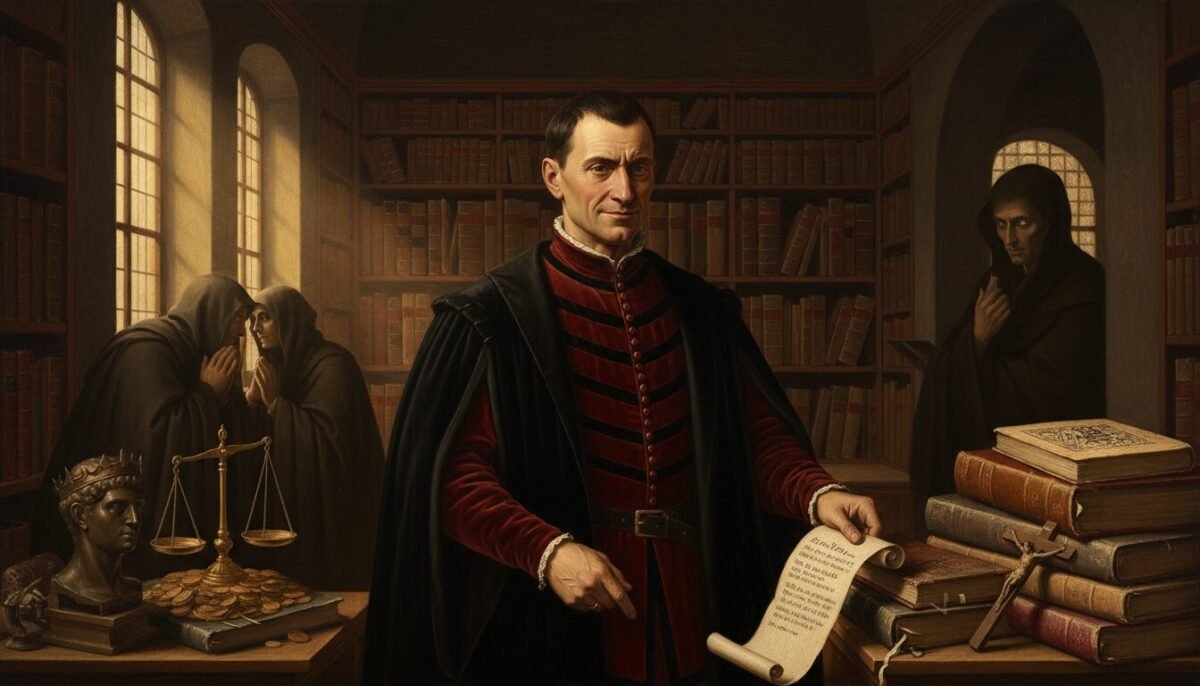
Machiavelli was a child of the new Humanism. This movement turned its eyes away from the heavens and back toward the classical ruins of Rome and Greece. Humanists believed in human agency—the idea that through education, skill, and reason, men could shape their own destinies. They revived the concept of virtù. In the modern sense, “virtue” implies moral goodness, but to Machiavelli and his contemporaries, virtù meant something closer to the original Latin vir (man): it was manly excellence, prowess, cunning, and the ability to adapt to the whims of Fortuna (Fortune).
This intellectual climate encouraged a radical questioning of traditional Christian ethics in the realm of statecraft. If a leader’s primary goal is the survival of the state, can he afford to be “good” in the biblical sense? Machiavelli argued that a ruler who tries to be perfectly virtuous in a world of people who are not virtuous will inevitably bring about his own ruin—and the ruin of his people. By separating politics from theology, Machiavelli wasn’t saying that morality didn’t matter in private life; he was saying that the state operates by a different set of rules. He was the first to suggest that “political necessity” might require a leader to step outside the bounds of conventional morality to protect the greater good.
3. The Rise and Fall of the Florentine Republic
Machiavelli was not a theorist sitting in an ivory tower; he was a man of action. For fourteen years, he served as a high-ranking diplomat and secretary to the Second Chancery of the Florentine Republic. He was the man on the ground, sent to negotiate with kings, emperors, and popes. He saw how the gears of power actually turned, far removed from the sanitized accounts found in history books. This firsthand experience with republican bureaucracy shaped his views on institutional stability more than any ancient text ever could.
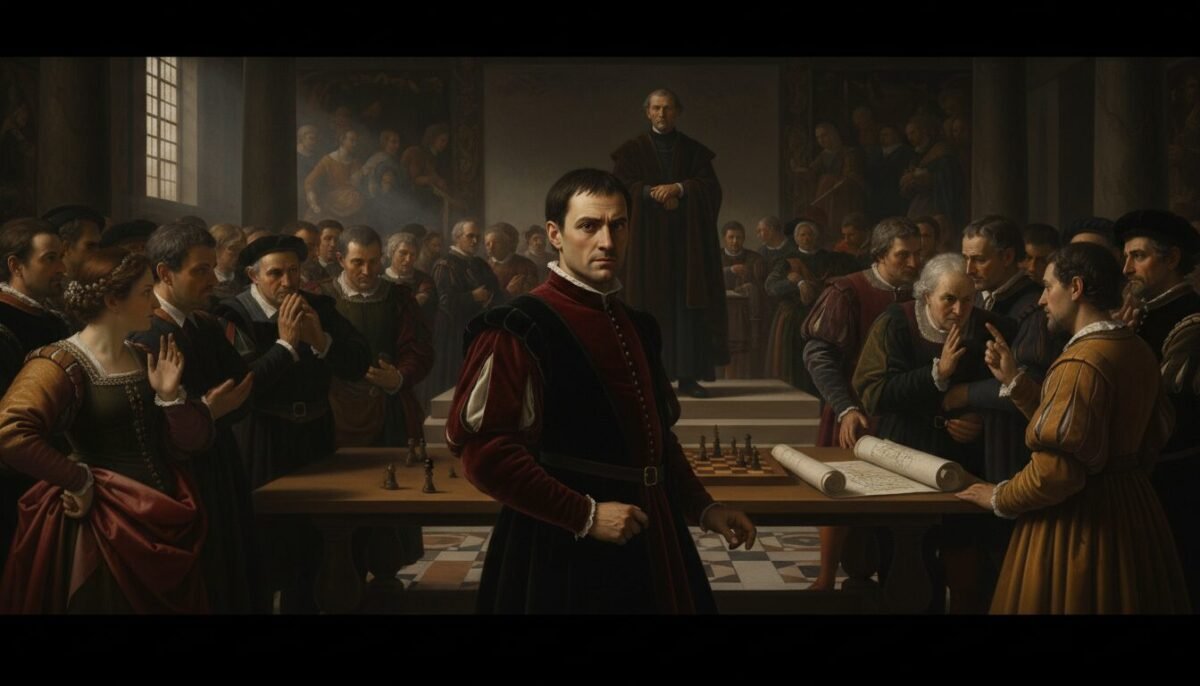
One of the most formative episodes of his life was the rise and fall of Girolamo Savonarola, the fanatical monk who briefly turned Florence into a “Republic of Virtue.” Savonarola preached against the corruption of the Church and the vanity of the Renaissance, leading “Bonfires of the Vanities” where citizens burned their fine clothes and books. Machiavelli watched as Savonarola gained immense power through rhetoric alone, only to be executed when he couldn’t back up his words with force. Machiavelli famously noted that “all armed prophets have conquered, and the unarmed ones have been destroyed.”
This lesson was central to his philosophy. He saw that the Florentine Republic, despite its noble ideals, was fragile because it relied on mercenaries and the shifting winds of public opinion rather than a disciplined national militia. He spent years trying to convince the Florentine leadership to move away from hired soldiers—who were often more interested in looting than fighting—and toward a citizen army. His time in the Republic taught him that a state’s survival depends on the strength of its institutions and its military, not the purity of its intentions.
4. The Medici Family: Patrons, Rulers, and Rivals
In 1512, Machiavelli’s world collapsed. The Medici family, who had ruled Florence for decades before being ousted, returned to power with the help of Spanish troops. The Republic was dissolved, and Machiavelli, as a prominent official of the old regime, was immediately dismissed. But it didn’t stop there. Suspected of involvement in a conspiracy against the Medici, he was imprisoned and subjected to the strappado—a form of torture where the victim’s hands are tied behind their back and they are hoisted up by a rope, often dislocating the shoulders.
He survived the torture, but he was exiled to his small, dusty farm in San Casciano, just outside the city. For a man who lived for the adrenaline of high-stakes diplomacy, this was a living death. In a famous letter to his friend Francesco Vettori, Machiavelli described his days: he spent his mornings trapping thrushes and his afternoons arguing with local woodcutters. But in the evenings, he would return home, strip off his muddy clothes, and put on his “royal and curial robes.” In his mind, he would enter the courts of the ancient greats, conversing with them about the nature of power.
It was in this state of desperate exile that he wrote The Prince. It was, in many ways, a “job application” addressed to Lorenzo de’ Medici. Machiavelli was trying to prove that his years of diplomatic service had given him a unique, “inside” knowledge of how power works. He wanted to show the Medici that he could be an invaluable asset to them. He wasn’t writing to encourage them to be tyrants; he was writing to show them how to be *effective* rulers so that Florence might finally find stability. Ironically, the Medici largely ignored the book, and it wasn’t published until after Machiavelli’s death.
5. Observing Power: Cesare Borgia and the Birth of Realpolitik
If The Prince has a protagonist, it is Cesare Borgia. During his diplomatic missions, Machiavelli spent significant time at the court of Borgia, the Duke of Valentinois and the son of Pope Alexander VI. Borgia was a man of terrifying ambition who was attempting to carve out his own state in central Italy through a combination of brilliant strategy and shocking violence.
Machiavelli was mesmerized by him. He watched as Borgia invited his rivals to a “peace summit” in Senigallia, only to have them all strangled once they were inside. He observed how Borgia used a ruthless henchman, Remirro de Orco, to pacify a rebellious province through brutal methods, and then—to shift the blame and appease the people—had de Orco cut in half and displayed in the town square. To Machiavelli, this wasn’t just mindless cruelty; it was a masterclass in the economy of violence. Borgia had achieved peace and order in a region that had been lawless for generations.
From Borgia, Machiavelli distilled the essence of Realpolitik: the idea that politics is not about how people *should* live, but how they *actually* live. He realized that in a corrupt age, “the ends justify the means” was not a moral failing, but a practical necessity. If a ruler is too kind, he invites disorder; if he is too cruel without purpose, he invites rebellion. The goal is to be “feared rather than loved,” provided that one is not hated. Borgia became the archetype of the “New Prince” because he understood that power is a tool to be used with surgical precision to maintain the integrity of the state.
6. Subverting the ‘Mirror for Princes’ Literary Tradition
To truly appreciate the shock Machiavelli caused, one must understand the genre he was subverting. For centuries, there was a popular literary tradition known as the “Mirror for Princes.” these were instructional books written for young royals, teaching them that the way to be a successful ruler was to be a virtuous, God-fearing man. They were told that if they were just, merciful, and honest, their subjects would love them and their kingdom would prosper.
Machiavelli took this “mirror” and smashed it. He argued that these idealized “imaginary republics” were a fantasy that led to certain destruction. He wrote, “There is such a gap between how one lives and how one ought to live that anyone who abandons what is done for what ought to be done learns his ruin rather than his preservation.” By rejecting the “Mirror for Princes” tradition, he moved political discourse from the realm of ethics to the realm of science.
This was the birth of modern political science. Machiavelli looked at the state as a doctor looks at a body—not judging it for being sick, but trying to understand the mechanics of the disease and how to cure it. He stripped away the religious and moral justifications for power and revealed its raw, secular skeleton. This shift toward realism was a direct response to the perceived weakness of contemporary leadership. He believed that the “pious” rulers of his day were the reason Italy was being trampled by foreign boots. His legacy is the uncomfortable truth that in the arena of global power, the rules of the Sunday school rarely apply.
Conclusion
Niccolò Machiavelli was not a monster; he was a product of a fractured Italy. His philosophy was a desperate response to the corruption, foreign invasions, and political instability of the Renaissance. He lived in a world where the stakes were life and death, not just for individuals, but for entire civilizations. By documenting the world as it was, rather than as we wish it to be, he marked the definitive shift from medieval idealism to modern realism. We may find his conclusions chilling, but his insights into the nature of power and human ambition remain as relevant in the boardrooms and halls of government today as they were in the courts of 16th-century Florence.
Frequently Asked Questions
Did Machiavelli actually say “the ends justify the means”?
While that exact phrase does not appear in his writings, the sentiment is central to his work. He argued that if a ruler succeeds in maintaining the state, the means will always be judged honorable and praised by everyone.
Was Machiavelli an atheist?
It’s complicated. He was highly critical of the Church as a political institution, blaming it for keeping Italy divided. However, he often spoke of the importance of religion as a social glue that keeps a population disciplined and moral.
Why is “Machiavellian” used as an insult today?
The term became a pejorative shortly after his death, largely due to the Church’s condemnation of his work. During the Counter-Reformation, he was painted as an agent of the devil for suggesting that a ruler might need to act immorally.
Did he prefer republics or principalities?
While The Prince focuses on autocracy, Machiavelli’s other major work, The Discourses on Livy, makes it clear that his heart belonged to the Republic. He believed a republic was the most stable and successful form of government, provided the citizens were virtuous and the institutions strong.
If you found this exploration of the Renaissance mind intriguing, consider diving deeper into our other analyses:
- Machiavelli & Political Philosophy: A look at how his ideas shaped modern governance.
- Power & Human Nature: Why the struggle for dominance is hardwired into our psychology.
- Influence & Leadership: Lessons from history’s most effective (and controversial) leaders.
- Comparative Philosophy: How Eastern and Western views on power differ.
Explore more deep dives into the thinkers who shaped our world at DeepPsyche.blog.