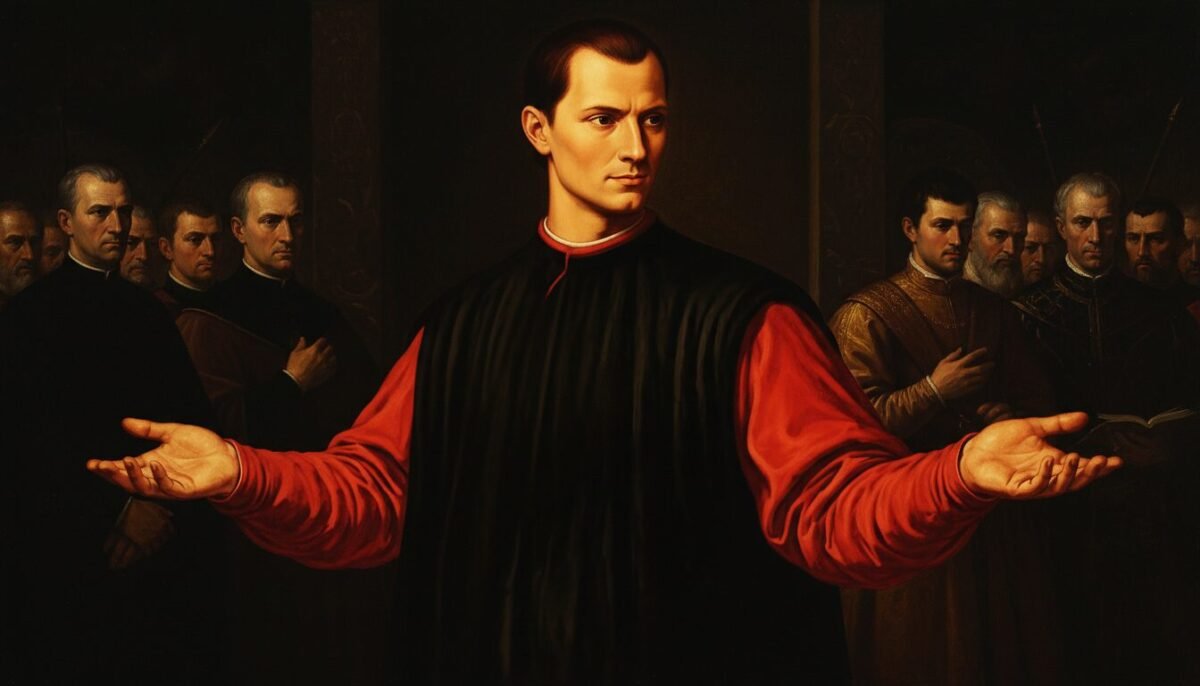
Imagine you are a ruler in 16th-century Italy. Your borders are being squeezed by the French crown, your treasury is dwindling, and your court is a nest of vipers waiting for a single moment of weakness. In your library sit the finest books of the age, written by the most brilliant minds of the Renaissance. They tell you that to be a great leader, you must be the most virtuous man in the room. They promise that if you are just, kind, and pious, God will ensure your prosperity and your people will adore you.
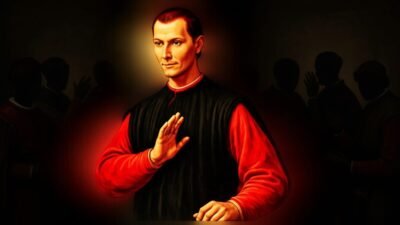
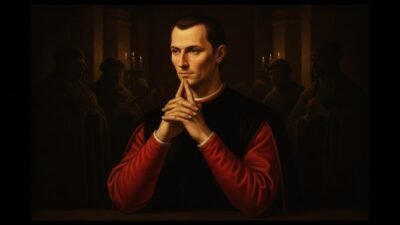
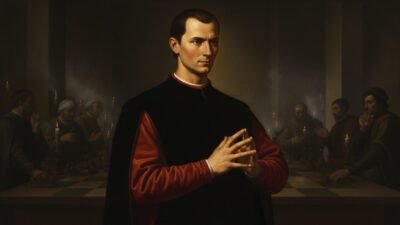
Then, you pick up a slim, scandalous manuscript by a disgraced civil servant named Niccolò Machiavelli. He looks you in the eye through his prose and tells you something that feels like a cold bucket of water: “A man who wishes to make a profession of goodness in everything must necessarily come to grief among so many who are not good.”
Is it better to be loved or feared? This provocative question shattered the moral foundations of Renaissance political thought. While most thinkers of the era were busy sketching blueprints for heaven on earth, Machiavelli was looking at the blood on the floor. To understand the birth of the modern world, we have to look at the collision between Machiavelli’s brutal “realism” and the soaring “idealism” of his contemporaries like Erasmus and Thomas More. It wasn’t just a debate about politics; it was a battle over the very definition of human nature.
1. The Renaissance Intellectual Landscape: Humanism and the Status Quo
To appreciate how radical Machiavelli truly was, we first have to understand the world he was trying to dismantle. The Renaissance was not just an explosion of art; it was a revival of humanism. Led by figures like Petrarch, this movement sought to reclaim the wisdom of ancient Greece and Rome to create a “civic humanism”—a way of life where citizens were educated, eloquent, and morally upright.
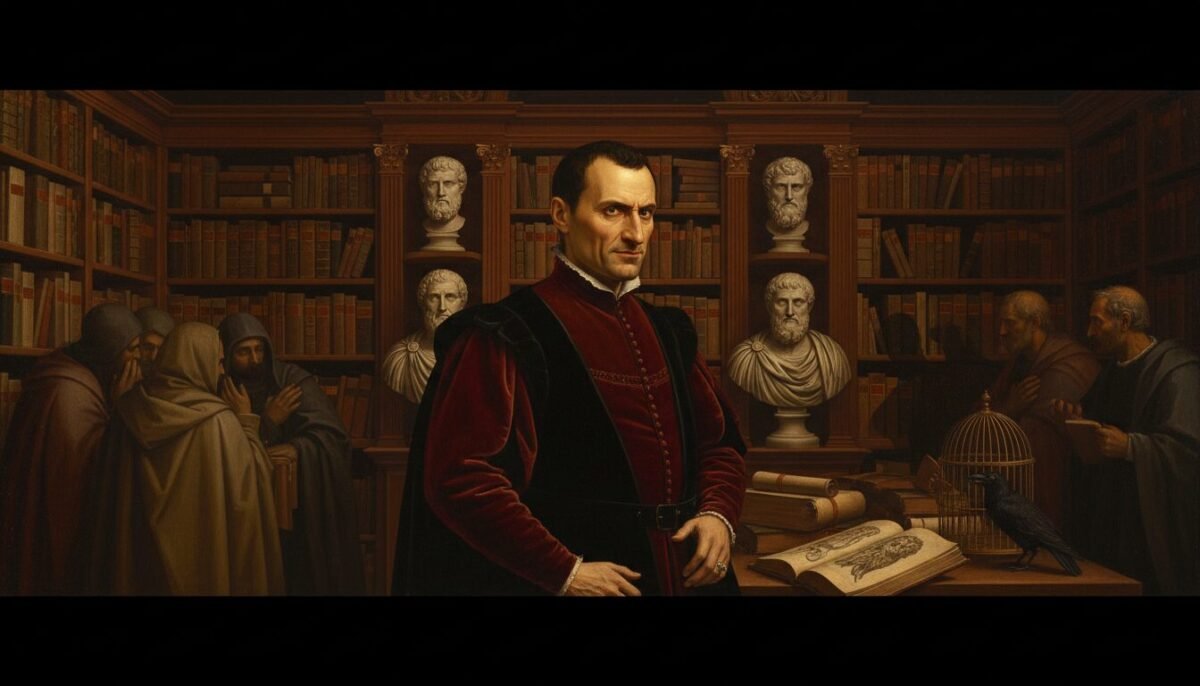
During this time, the dominant literary genre for political advice was the Speculum Principum, or the “Mirror for Princes.” These books were essentially moral handbooks for rulers. They functioned on a simple, comforting logic: a good person makes a good king, and a good king makes a stable state. The “Mirror” tradition taught that a prince should be a paragon of the four cardinal virtues—prudence, justice, temperance, and fortitude—blended seamlessly with Christian piety.
Thinkers of the early Renaissance integrated classical ethics with theology, believing that the laws of the state should reflect the laws of God. They looked back at Cicero and Plato not to find power tactics, but to find the “Good.” In this intellectual landscape, politics was considered a sub-branch of moral philosophy. There was no distinction between a ruler’s private soul and his public duty. If a king was a tyrant, it was seen as a failure of his character, a sin that would eventually be punished by divine providence or a popular uprising. Into this world of “should-be” and “ought-to-be,” Machiavelli dropped a bomb.
2. Realism vs. Idealism: Machiavelli and the ‘Mirror for Princes’ Tradition
Machiavelli’s departure from the “good king” archetype was not a subtle shift; it was a total rejection of the genre. While his contemporaries were writing about how a prince ought to live, Machiavelli famously declared that he would focus on the verità effettuale—the “effectual truth” of the matter. He wasn’t interested in imaginary republics or utopias that had never been seen in reality.
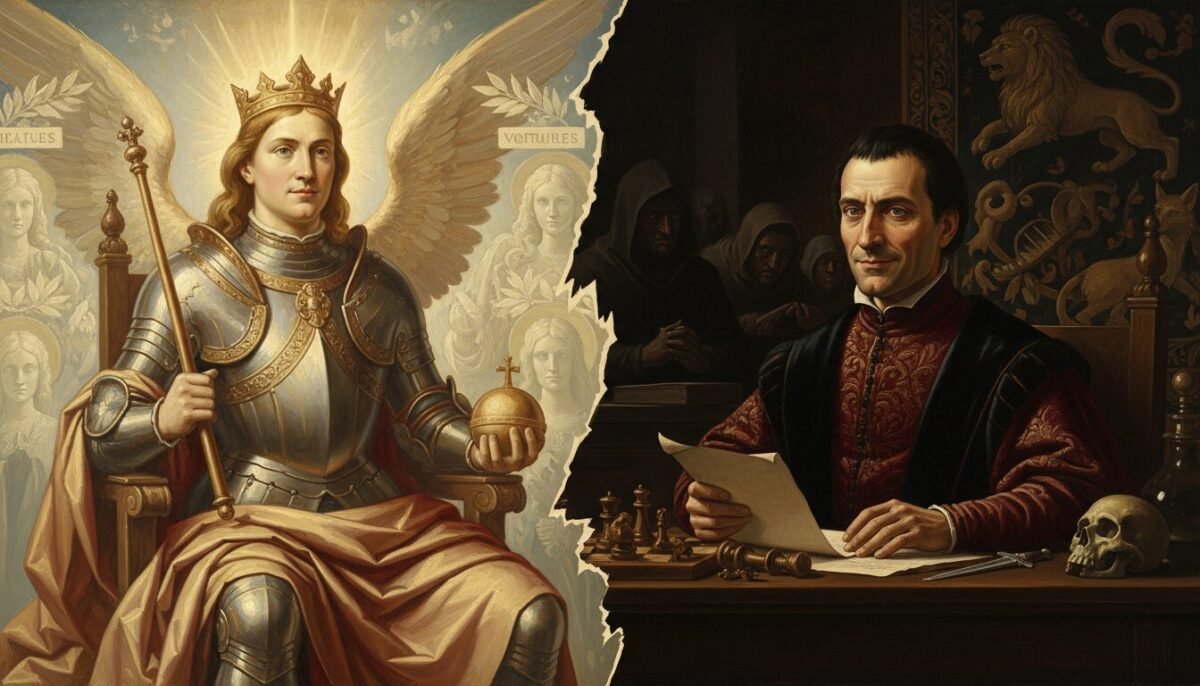
In his view, the traditional “Mirror for Princes” was not just naive; it was dangerous. Machiavelli argued that if a leader tries to be virtuous in a world full of people who are not, he is essentially committing political suicide. He recognized that the survival of the state—the mantenere lo stato—often required actions that were morally reprehensible. To Machiavelli, the highest “good” for a ruler wasn’t the salvation of his own soul, but the security and stability of the commonwealth.
This is the core of political realism. Machiavelli viewed the pursuit of an ideal state as a distraction that left a ruler vulnerable to the “wolves” of the real world. He argued that a prince must learn “how not to be good” and to use that knowledge or not use it according to necessity. By decoupling the ruler’s personal morality from his political efficacy, Machiavelli effectively murdered the medieval political tradition. He moved the goalposts from “How do I become a saint?” to “How do I keep this city from falling apart?”
3. Machiavelli vs. Erasmus: The Morality of the Christian Prince
If Machiavelli represents the dark, pragmatic side of the Renaissance, Desiderius Erasmus represents its bright, hopeful heart. In 1516, just a few years after Machiavelli wrote The Prince, Erasmus published The Education of a Christian Prince. The two books couldn’t be more different if they tried.
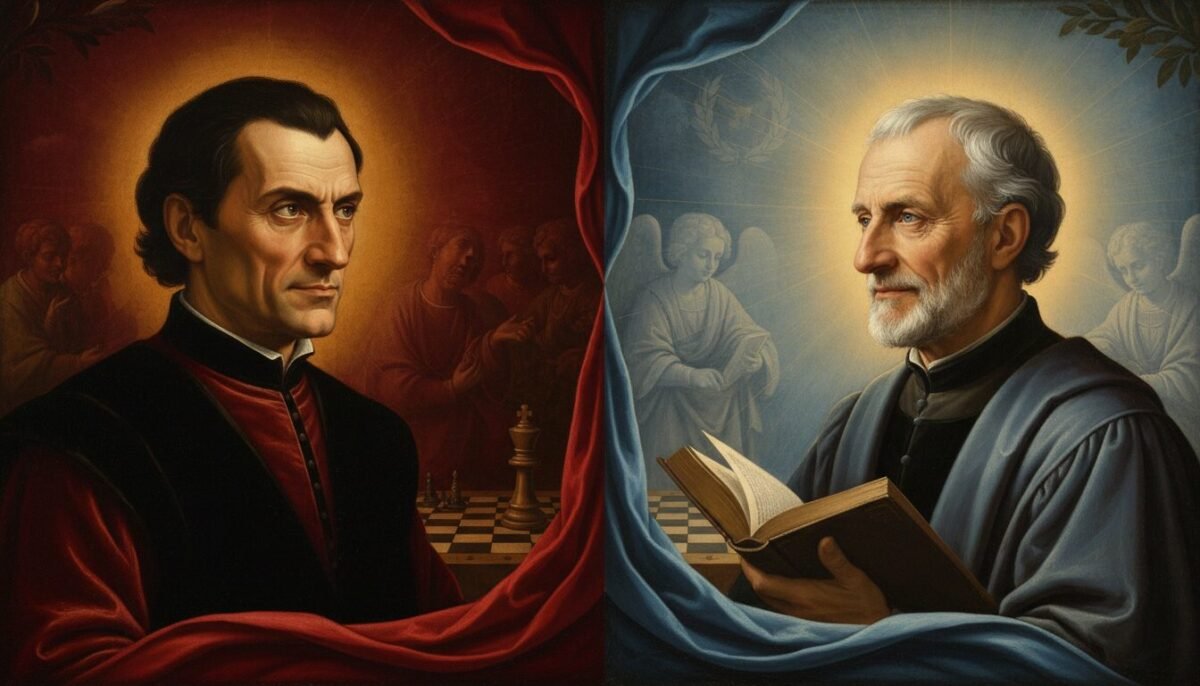
Erasmus was the “Prince of the Humanists,” and his focus was entirely on the prince as a servant of God. To Erasmus, a ruler was a “living likeness of God,” and his primary job was to mimic divine goodness. He argued that a prince should be loved, never feared, and that any ruler who governed through fear was not a king, but a tyrant. Erasmus went so far as to suggest that if a prince could not rule without committing injustice, he should abdicate the throne rather than stain his soul.
Machiavelli’s response to such a notion would have been a cynical laugh. For Machiavelli, the prince is a servant of the state, not a servant of God. He argued that a leader who abdicates because he is “too good” to do what is necessary is actually failing his people by leaving them to the mercy of chaos or foreign invaders. This sparks the eternal debate: Can a ruler remain a “good man” while being an “effective leader”? Erasmus says yes, through education and piety. Machiavelli says no, because the “game” of power has its own rules that have nothing to do with the Ten Commandments.
4. Power vs. Utopia: Comparing Machiavelli and Thomas More
While Machiavelli was analyzing the gritty streets of Florence, Thomas More was dreaming of an island called Utopia. Published in 1516, More’s work presented a fictional society where private property was abolished, everyone worked for the common good, and religious tolerance was the norm. On the surface, More and Machiavelli seem like polar opposites: one a visionary dreamer, the other a cold-blooded strategist.
However, both were reacting to the same thing: the rampant corruption of the 16th-century Catholic Church and the chaotic warfare of European monarchs. Their solutions, however, were worlds apart. More’s Utopia was a structural critique. He believed that the “sickness” of society was rooted in greed and the unequal distribution of wealth. If you change the system, More argued, you change the man.
Machiavelli had no interest in changing the system to make men better; he wanted to master the system because men were inherently “ungrateful, fickle, pretenders, and dissemblers.” While More looked toward the visionary elimination of private property to create peace, Machiavelli looked toward the pragmatic acquisition of power to prevent war. More’s work asks, “What is the perfect society?” Machiavelli’s work asks, “How do I win the next battle?” One sought to transcend the human condition; the other sought to exploit it.
5. Redefining Virtù: Secular Skill vs. Classical Christian Virtue
One of the most profound ways Machiavelli signaled his break from the Renaissance status quo was through his linguistic hijacking of the word virtù. In the classical and Christian tradition, “virtue” (from the Latin virtus) meant moral excellence—justice, charity, and humility. It was the internal quality that made a person “good” in the eyes of God and society.
Machiavelli stripped the word of its religious and moral skin. For him, virtù was not about being a “good person”; it was about prowess, flexibility, and effectiveness. A prince with virtù is someone who has the strength of a lion and the cunning of a fox. It is the ability to adapt to changing circumstances and to command Fortuna (Fortune or Luck). Machiavelli famously described Fortune as a woman who must be beaten and coerced into submission—a stark contrast to the Christian view of accepting one’s fate as God’s will.
Compare this to the cardinal virtues held by humanists like Erasmus. To a humanist, “prudence” meant the wisdom to do what is right. To Machiavelli, “prudence” meant the calculation to do what is necessary. This shift represents a psychological revolution. Machiavelli was suggesting that the skills required to run a successful state are not only different from the skills required to be a good person—they are often in direct opposition. He replaced the “moral man” with the “strategic man.”
6. From Theology to Statecraft: The Shift Toward Secular Governance
The legacy of Machiavelli is the birth of political science as a secular discipline. Before him, politics was a branch of theology; after him, it became a craft, like engineering or medicine. By decoupling political science from moral philosophy, Machiavelli allowed us to study power as it actually functions, rather than how we wish it would function.
This “secular” approach paved the way for the modern concept of the state. We can see the echoes of Machiavelli in the development of Westphalian sovereignty, where the state is seen as an autonomous entity with its own interests (the raison d’état) that supersede the personal morality of its leaders. His thought provided the intellectual foundation for later giants like Thomas Hobbes, who saw life as “nasty, brutish, and short,” and Montesquieu, who sought to balance the inherent dangers of power through institutional checks.
Machiavelli didn’t necessarily want leaders to be “evil.” He simply recognized that the state is a cold monster with its own logic. By stripping away the “veneer of holiness” that had covered European politics for a thousand years, he forced us to look at the mechanics of influence and leadership without blinking. He taught us that power is a tool, and like any tool, its effectiveness is measured by its results, not by the intentions of the person holding it.
Conclusion
Niccolò Machiavelli stood as a radical outlier in the Renaissance. While his contemporaries like More and Erasmus sought to align politics with divine morality and human potential, Machiavelli recognized the autonomy of the state and the messy reality of human nature. He didn’t invent the “dirty” side of politics; he simply had the courage—or the audacity—to write it down. By doing so, he forever changed the trajectory of Western political thought, moving us away from the “Mirror for Princes” and toward the mirror of reality. Whether we like what we see in that mirror is another question entirely.
Are you interested in seeing the world through the eyes of the masters? Explore our database of Renaissance primary sources to compare the original texts of Machiavelli and Erasmus today and decide for yourself: is it better to be a saint or a strategist?
Frequently Asked Questions
- Was Machiavelli actually “evil”? No, most historians view him as a patriot and a realist. He didn’t advocate for cruelty for its own sake, but rather as a tool to prevent greater chaos and suffering.
- Did Thomas More and Machiavelli ever meet? There is no record of them meeting. They lived in different worlds—Machiavelli in the turbulent city-state of Florence and More in the Tudor court of England—yet they were both grappling with the same European crisis.
- Why is ‘The Prince’ still relevant today? Because it deals with the fundamental psychology of power. Whether in corporate boardrooms or international diplomacy, the tension between idealism and the “effectual truth” remains a constant human struggle.
If you enjoyed this deep dive into the psychology of power, you might also like our analysis of Influence & Leadership or our comparative study on Power & Human Nature at DeepPsyche.blog.