If power tends to corrupt and absolute power corrupts absolutely, can any form of governance ever be considered truly moral? We often think of “power” as a dirty word—a force associated with backroom deals, coercion, and the crushing of the individual spirit. Yet, without it, our lives would likely be, as one philosopher famously put it, “nasty, brutish, and short.” We find ourselves caught in a visceral paradox: we need authority to keep the peace, but that very authority often becomes the greatest threat to our freedom.
The inherent tension between the necessity of political authority and the preservation of individual moral autonomy often leads to systemic abuse and ethical decay. When we hand over the “keys to the kingdom” to a leader or an institution, we are essentially making a high-stakes bet that they will use that strength to protect us rather than devour us. This article provides a comprehensive analysis of how major philosophical traditions define, justify, and limit the exercise of power to ensure ethical governance. It is a journey through the minds of history’s greatest thinkers to discover the guardrails that keep civilization from veering into tyranny.
1. The Fundamental Tension: Political Authority vs. Moral Autonomy
At the heart of every political system lies the “Problem of Political Obligation.” Why should you obey a law just because someone else wrote it? If you are a rational, moral being with your own conscience, why should a state have the right to tell you how to live, whom to pay, or what to believe? This is the friction point between collective order and individual soul.
Moral autonomy is the idea that we are the authors of our own moral lives. When the state mandates a law—say, a tax or a draft—it creates a conflict. If your conscience says “no” but the law says “yes,” the state is essentially overriding your moral agency. We grant power to others primarily for the sake of coordination and safety. We realize that if everyone acted solely on their own whims, the result would be chaos. However, the transition from “natural freedom” to “societal constraint” is never a clean break. It is a constant negotiation.
Moral philosophy seeks to justify this transition by arguing that we aren’t losing freedom, but rather trading a chaotic, dangerous freedom for a structured, protected one. The ethical challenge arises when the state stops being a protector and starts being a predator. When the laws of the land violate the fundamental conscience of the individual—think of figures like Socrates or Henry David Thoreau—the moral justification for authority begins to crumble. The goal of ethical governance is to minimize this friction, ensuring that the state’s “might” is always subservient to a higher “right.”
2. Social Contract Theory: The Moral Foundation of Limited Power
To understand why we tolerate power, we must look at the “Social Contract”—the invisible agreement we all sign by living in a society. Three giants of philosophy shaped our understanding of this contract, each offering a different boundary for authority.
Thomas Hobbes, writing during the chaos of the English Civil War, argued in Leviathan that the primary moral justification for power is security. For Hobbes, the “State of Nature” (life without government) is a war of all against all. To avoid a violent death, people must surrender almost all their rights to an absolute sovereign. In Hobbes’ view, the only limit on power is the sovereign’s ability to protect the people. If the leader can no longer keep you safe, the contract is void. It is a grim, pragmatic view: power is a necessary evil to prevent something much worse.
John Locke offered a more optimistic and restrictive perspective. He argued that humans possess “Natural Rights”—life, liberty, and property—that exist before any government is formed. For Locke, the state’s only legitimate job is to protect these pre-existing rights. If a government oversteps and begins to seize property or stifle liberty, it becomes illegitimate. This philosophy provided the moral backbone for the American Revolution; it suggests that power is not a gift from the ruler to the people, but a temporary loan from the people to the ruler, with very strict terms and conditions.
Jean-Jacques Rousseau introduced the concept of the “General Will.” He believed that true power shouldn’t belong to a monarch or a small elite, but to the collective body of citizens. For Rousseau, the check against tyranny is that the law must reflect the common good of everyone, not just the interests of the powerful. While this sounds democratic, it carries a risk: the “tyranny of the majority,” where the collective will might crush the individual dissenter in the name of the “greater good.”
3. Evaluating Power Through Ethical Frameworks: Deontology and Utilitarianism
Beyond the social contract, we use specific ethical “lenses” to judge whether an exercise of power is right or wrong. The two most prominent are Deontology and Utilitarianism, but we must also consider the character of the person holding the gavel.
Deontological Ethics, championed by Immanuel Kant, is built on the “Categorical Imperative.” One of its core tenets is that you must never treat a human being merely as a means to an end, but always as an end in themselves. In the realm of power, this is a massive constraint. It means a government cannot “sacrifice” the rights of a minority to achieve a national goal. For example, even if spying on every citizen would stop all crime, a Kantian would argue it is immoral because it treats citizens as objects to be managed rather than autonomous beings to be respected.
Utilitarianism, led by thinkers like Jeremy Bentham and John Stuart Mill, takes the opposite approach. It assesses power based on the “greatest good for the greatest number.” This is the logic of public policy, infrastructure, and healthcare. However, Mill was deeply concerned about the “tyranny of the majority.” He argued that the only time power can be rightfully exercised over any member of a civilized community, against his will, is to prevent harm to others. This “Harm Principle” serves as a utilitarian limit on power, ensuring that the “greatest good” doesn’t become an excuse for total social engineering.
Finally, Virtue Ethics reminds us that laws are only as good as the people who execute them. This tradition, dating back to Aristotle, suggests that the character of the leader is paramount. A leader who lacks temperance, justice, and wisdom will find ways to bypass even the best-written constitution. Here, the “limit” on power is internal—it is the moral compass of the individual in charge. This is why we still care about the personal integrity of political figures today; we instinctively know that a person without internal limits will eventually break external ones.
4. Machiavellianism vs. Morality: The Ethics of Leadership
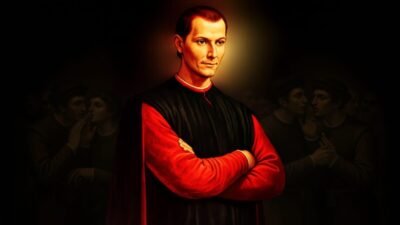
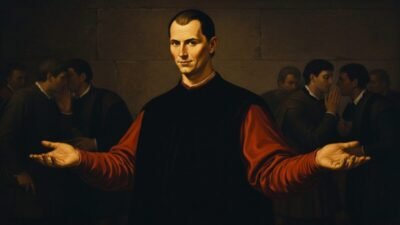
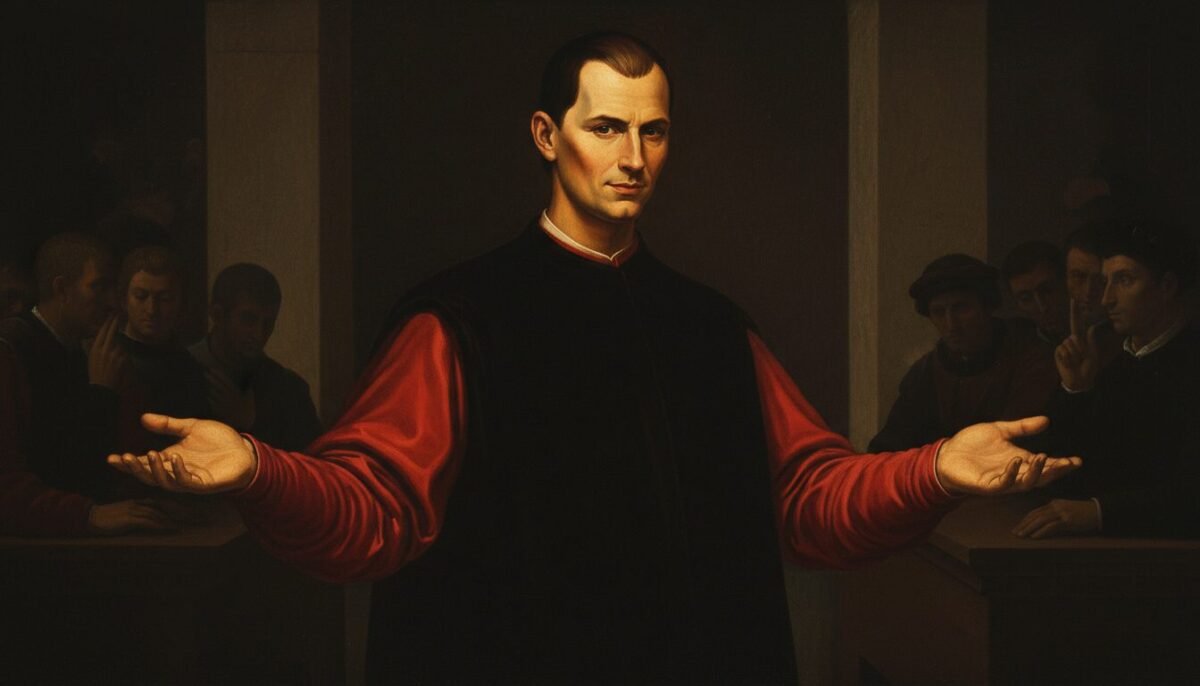
No discussion of power is complete without Niccolò Machiavelli. His name has become shorthand for “the ends justify the means,” but his work The Prince poses a deeper, more uncomfortable question: Can a leader be effective while remaining purely moral?
Machiavelli argued that a prince who tries to be “good” in all circumstances will inevitably be destroyed by those who are not. This is the “Realpolitik” challenge. In a world of competing interests and hidden agendas, a leader might have to lie, break a treaty, or use force to preserve the state. Machiavelli suggested a separation between “private virtue” (being a good person) and “political necessity” (being a good ruler). To him, the highest moral act for a leader is to maintain the stability of the state, even if it requires “dirty hands.”
Modern critiques of Machiavellianism argue that this separation is a slippery slope. When leaders believe they are “above” morality for the sake of the state, they often end up serving their own egos rather than the public. Today, the demand for transparency and accountability is a direct response to Machiavellian secrecy. We have learned that when power operates in the dark, it doesn’t just protect the state; it rots it from within. The ethical leader today must balance the harsh realities of influence with a commitment to the truth, a feat that is as difficult now as it was in the 16th century.
5. Institutional Checks and Balances as Applied Moral Philosophy
If we cannot always trust the “virtue” of a leader, we must build the morality into the system itself. This is where philosophy meets architecture. Baron de Montesquieu, in his seminal work The Spirit of the Laws, argued that “power should be a check to power.”
The “Separation of Powers”—dividing governance into legislative, executive, and judicial branches—is essentially applied moral philosophy. It is a structural admission that human beings are fallible. By creating a system where “ambition counteracts ambition,” we ensure that no single entity can impose its will without oversight. This prevents the moral erosion that occurs when power is concentrated in one hand.
Furthermore, the roles of an independent judiciary and a free press are ethical necessities. The judiciary acts as the arbiter of the social contract, ensuring that the government stays within its Lockean boundaries. The press serves as the “Fourth Estate,” providing the transparency that Machiavelli tried to avoid. Finally, the concept of Universal Human Rights acts as a global moral constraint. These rights are “trump cards” that individuals hold against the state; they are the lines in the sand that no sovereign authority, no matter how powerful, is ethically permitted to cross.
6. Modern Challenges: Corporate Influence and Digital Surveillance
In the 21st century, the nature of power has shifted. It is no longer just about kings and parliaments; it is about algorithms and multinational corporations. This shift presents a massive challenge to our traditional moral frameworks.
Today, multinational corporations often hold more power—and more data—than many nation-states. Yet, they are not bound by the same social contracts. They are driven by profit, not the “general will.” When a tech giant can influence an election or silence a voice, who holds them accountable? The lack of moral oversight in the corporate sphere is one of the great ethical crises of our time. We are seeing a “privatization of power” that bypasses the traditional checks and balances we spent centuries building.
Then there is the Digital Panopticon. Jeremy Bentham once imagined a prison where one guard could watch every prisoner without them knowing if they were being watched. Today, through big data and digital surveillance, we are living in a global version of that prison. The ethical limits of state power are being tested as governments use “security” as a justification for total information awareness. This erodes individual digital autonomy and creates a chilling effect on free thought.
Reimagining the social contract for the modern age means we must extend our moral philosophy into the digital realm. We need a “Digital Bill of Rights” that protects our data as if it were our property and our privacy as if it were our liberty. The limits of power must now be enforced not just in the halls of government, but in the lines of code that govern our lives.
Moral philosophy serves as the essential guardrail for political power, moving from the historical social contract to modern digital ethics. We must realize that true authority is not the absence of restraint, but the adherence to ethical principles that protect human dignity. Power, when left unchecked, is a wildfire; but when contained by the limits of morality, it is the hearth that keeps civilization warm. As we navigate an increasingly complex world, our task is to ensure that the “Leviathans” we create remain our servants, never our masters.
DeepPsyche FAQ:
- Why do we need moral philosophy to limit power? Without ethical constraints, power naturally expands until it infringes on individual rights, leading to tyranny and systemic abuse.
- What is the “Social Contract”? It is the philosophical idea that individuals consent to give up some freedoms to a government in exchange for the protection of their remaining rights and general security.
- Can a leader be both effective and moral? While Machiavelli argued they couldn’t, modern ethics suggests that long-term effectiveness requires transparency, accountability, and the trust of the governed.
- How does digital surveillance change the ethics of power? It creates an imbalance where the state or corporations have total visibility into the individual’s life, threatening the moral autonomy and privacy essential for a free society.
If you found this analysis of power and ethics compelling, you may want to explore our deeper dives into Machiavelli & Political Philosophy or the psychological roots of Power & Human Nature. For those interested in the darker side of influence, check out our guide on Machiavellianism and how it manifests in modern Influence & Leadership. To see how these ideas stack up against Eastern traditions, explore our section on Comparative Philosophy.