Imagine you are walking down a quiet side street late at night. You spot a leather wallet resting near a storm drain. You pick it up and find it stuffed with twenty-dollar bills—perhaps two thousand dollars in total—but there is no driver’s license, no credit card, and no identifying business card. There are no security cameras and no witnesses. Do you pocket the cash, or do you take the wallet to the nearest police station?
Most of us like to believe we are “good people.” We have an internal compass that nudges us toward honesty. But if I asked you why keeping the money is wrong, could you provide a logical defense beyond “it just feels bad”? This is where the casual certainty of our daily lives meets the rigorous, often uncomfortable world of moral philosophy. We navigate our existence using a complex web of “right” and “wrong,” yet we rarely inspect the scaffolding that holds those concepts up. This exploration is not about telling you what to do; it is about providing the intellectual tools to understand why you choose to do it.
1. Defining Ethics and Morality: Key Distinctions and Definitions
In common conversation, we use the terms “ethics” and “morality” interchangeably. However, for the philosopher and the strategic thinker, they represent two distinct layers of human behavior. To understand the difference, we must look at their linguistic ancestors. The word morality stems from the Latin mores, which refers to customs, habits, and the social rules that govern a specific group. Ethics, on the other hand, comes from the Greek ethos, meaning character or “way of living.”

Think of morality as the “data” of our behavior—the specific beliefs, taboos, and rules we inherit from our families, religions, and cultures. It is the “what” of our conduct. Ethics is the “science” of that data. It is the philosophical study and reflection on those behaviors. If morality is the set of rules for a game, ethics is the deep analysis of whether those rules are fair, consistent, and logical.
Consider the distinction between an individual’s moral code and professional ethical standards. A defense attorney might personally find the actions of their client morally repulsive. Their personal morality tells them that the client is a “bad person.” However, their professional ethics—the standards of the legal system—dictate that they must provide the best possible defense to ensure the integrity of the justice system. In this scenario, ethics acts as a universal framework that can sometimes sit in direct tension with personal moral feelings. Understanding this distinction allows us to move from reactive “gut” decisions to proactive, reasoned positions.
2. The Three Branches of Ethics: Meta-ethics, Normative, and Applied
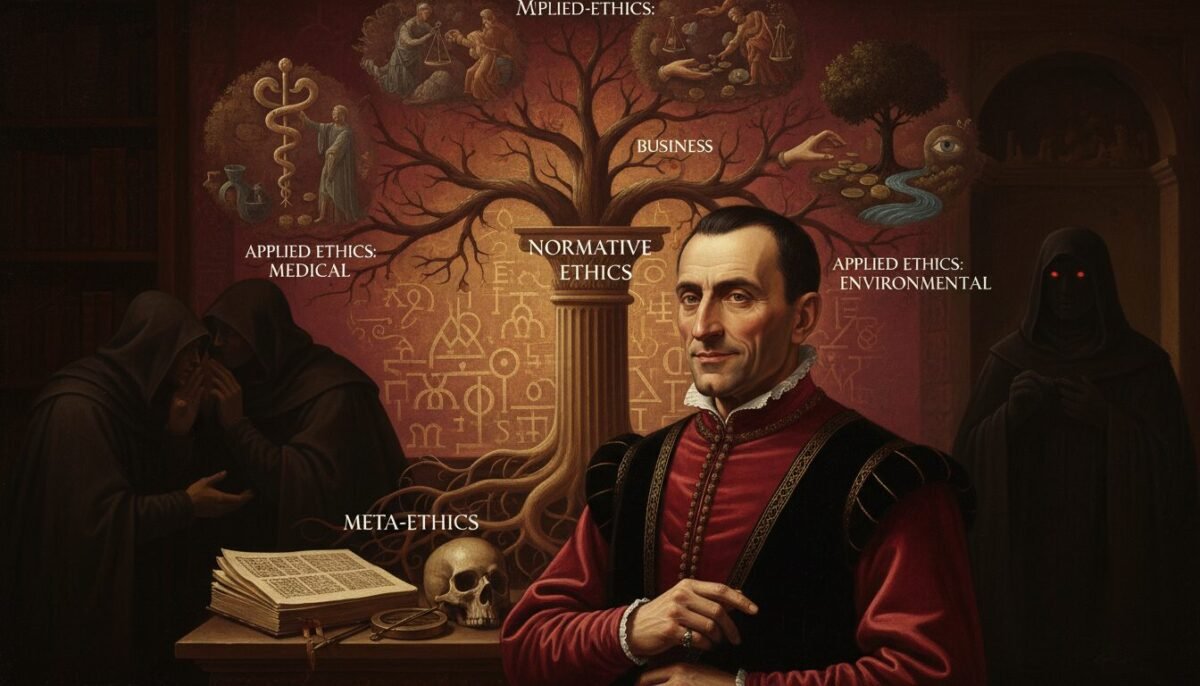
To navigate the vast landscape of moral thought, philosophers generally categorize the field into three distinct branches. Each branch asks a different level of question, moving from the abstract to the concrete.
Meta-ethics: The Foundation
Meta-ethics does not ask “Is stealing wrong?” Instead, it asks, “What does the word ‘wrong’ even mean?” It investigates the origin and meaning of ethical concepts. Is morality an objective truth woven into the fabric of the universe, like gravity? Or is it merely a subjective human invention, a sophisticated tool for social cooperation? Meta-ethics explores whether moral judgments are facts or just expressions of emotion. When we say “Murder is bad,” are we describing a property of the universe, or are we simply saying “Boo to murder”?
Normative Ethics: The Litmus Test
This is the branch most people are familiar with. Normative ethics seeks to establish the standards or “norms” for conduct. It searches for a single, underlying principle or a set of rules that can tell us how we ought to act. If you have ever asked yourself, “What is the right thing to do in this situation?”, you are engaging in normative ethics. It provides the frameworks—such as Utilitarianism or Deontology—that act as a litmus test for behavior.
Applied Ethics: The Battleground
Applied ethics is where theory meets the messy reality of the 21st century. It involves examining specific, often controversial issues through the lens of moral philosophy. This includes bioethics (Should we edit human embryos?), environmental ethics (Do animals have rights?), and business conduct (Is a CEO’s primary duty to shareholders or to the community?). Applied ethics forces us to take our abstract theories and see if they survive the friction of real-world dilemmas.
3. Major Ethical Theories: Deontology, Consequentialism, and Virtue Ethics
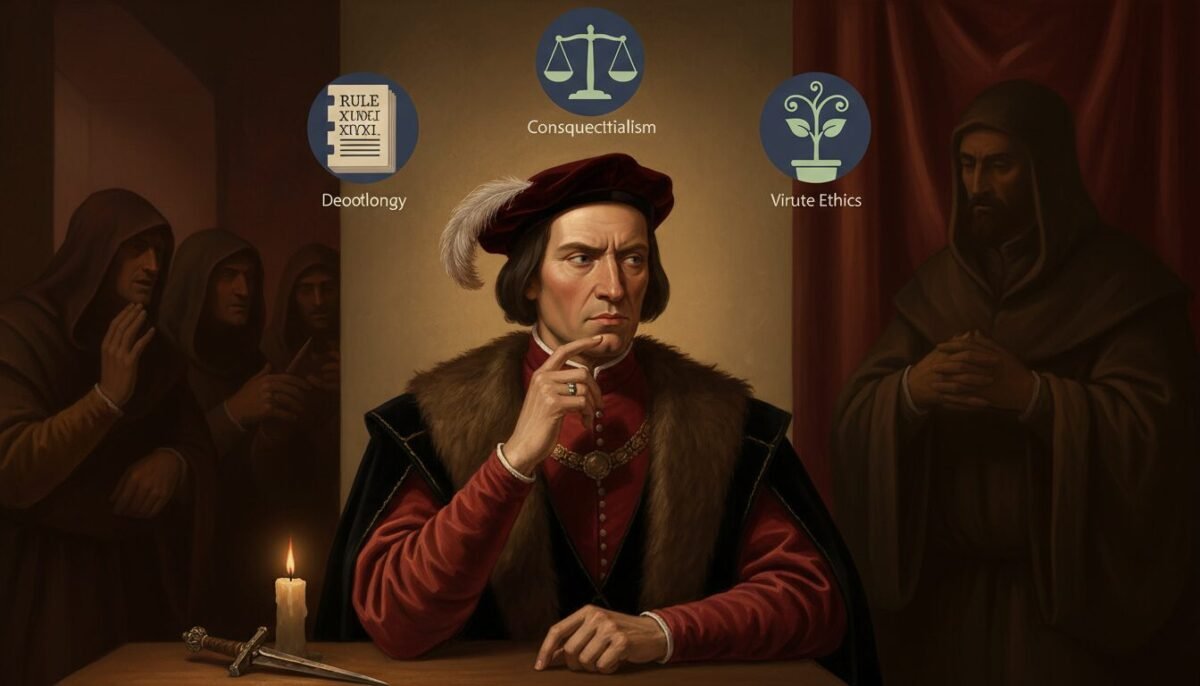
When we face a moral crossroads, we usually lean on one of three major theoretical pillars. Each offers a different “why” for our actions.
Deontology: The Path of Duty
Associated most famously with Immanuel Kant, Deontology argues that the morality of an action is based on whether that action adheres to a set of rules. For a Deontologist, the consequences of an action are secondary; what matters is the intent and the rule. Kant proposed the “Categorical Imperative”: Act only according to that maxim whereby you can, at the same time, will that it should become a universal law.
In simpler terms: Before you act, ask yourself, “Would I want everyone else in the world to do exactly what I am about to do?” If the answer is no, the action is immoral. For Kant, lying is always wrong, even if lying to a murderer could save a life, because you cannot logically wish for a world where lying is a universal law.
Consequentialism and Utilitarianism: The Greatest Good
In direct opposition to Deontology is Consequentialism, specifically Utilitarianism, championed by Jeremy Bentham and John Stuart Mill. This theory posits that the “right” action is the one that produces the “greatest good for the greatest number.” It is a mathematical approach to morality.
If you have to choose between saving one person or five people, the Utilitarian choice is clear: save the five. The moral worth of an action is determined entirely by its outcome. While this sounds logical, it leads to difficult questions. For example, is it ethical to sacrifice one innocent person to harvest their organs and save five others? A pure Utilitarian might struggle to say no, which is why this theory is often critiqued for ignoring individual rights in favor of the collective.
Virtue Ethics: The Character of the Actor
While the first two theories focus on the action or the outcome, Aristotle’s Virtue Ethics focuses on the person. Aristotle argued that morality isn’t about following a checklist of rules; it’s about developing a virtuous character. If you become a virtuous person through habit and practice, you will naturally know the right thing to do.
Aristotle spoke of the “Golden Mean”—the desirable middle ground between two extremes. For instance, Courage is the virtue found between the deficiency of Cowardice and the excess of Recklessness. Virtue ethics asks not “What should I do?” but “What kind of person should I be?”
4. Determining Right and Wrong: The Role of Ethical Reasoning
How do we move beyond “gut feelings” to rigorous ethical reasoning? The human brain is a master of rationalization; we are incredibly good at making excuses for what we already want to do. Ethical reasoning is the process of stripping away those biases to find a logical argument.
One of the most effective tools in this process is the thought experiment. Consider the “Trolley Problem”: A runaway trolley is barreling down the tracks toward five people. You stand next to a lever that can divert the trolley onto another track where only one person is standing. Do you pull the lever?
This scenario isn’t meant to happen in real life; it’s a stress test for your moral consistency. If you pull the lever, you are likely a Utilitarian (minimizing loss of life). If you refuse to pull it because “killing is wrong” regardless of the numbers, you are leaning toward Deontology. These experiments help us identify the “operating system” our brain is running on.
In the modern world, this reasoning is no longer just for philosophy classrooms. Software engineers must program ethical frameworks into self-driving cars. If a crash is inevitable, should the car protect the passenger or the pedestrians? Legislators must decide if the “right to privacy” outweighs the “right to security.” Without a foundation in ethical reasoning, these decisions become arbitrary and dangerous.
5. Challenges to Morality: Cultural Relativism and Moral Skepticism
The study of ethics would be simple if everyone agreed on the rules. However, we are faced with two significant challenges: Relativism and Skepticism.
Cultural Relativism
This is the view that “right” and “wrong” are entirely determined by culture. What is moral in Tokyo might be immoral in Texas, and according to the relativist, neither is “correct.” While this promotes tolerance, it creates a dangerous vacuum. If morality is just a social construct, we lose the ground to criticize horrific practices like slavery or genocide, provided they are “culturally accepted” in a specific place. The challenge for modern thinkers is to respect cultural diversity while upholding universal human rights that transcend borders.
Moral Skepticism
The skeptic asks a more haunting question: Can we ever truly “know” what is right? Unlike physics or chemistry, morality cannot be measured in a lab. If we cannot prove a moral truth, is it even real? This skepticism forces us to be humble, but it shouldn’t lead to nihilism. Even if we cannot “prove” morality like a math equation, we can observe the tangible benefits of cooperation, empathy, and justice for the survival and flourishing of the human species.
6. Secular Ethics: Can Morality Exist Without Religion?
For centuries, morality was inextricably linked to divine command. The “good” was whatever God decreed. However, the Euthyphro Dilemma, posed by Socrates, challenged this: “Is the pious loved by the gods because it is pious, or is it pious because it is loved by the gods?”
If something is good simply because a deity says so, then morality is arbitrary—if God said murder was good tomorrow, it would be. But if God says murder is bad because it is inherently bad, then “badness” exists independently of God. This realization opened the door for Secular Ethics.
Modern Humanism and biological studies suggest that empathy and cooperation are not just religious “rules,” but evolutionary adaptations. We are social animals; we survived because we learned to care for our tribe. Frameworks like Contractarianism (think Thomas Hobbes or John Rawls) suggest that morality is a “social contract” we all sign. We agree not to steal from each other not because of a supernatural threat, but because a society without theft is a better place for everyone to live. We trade a bit of our absolute freedom for the security and benefits of social order.
The Path Forward
Ethics is far more than just “being a good person.” It is a rigorous, demanding discipline that requires us to look into the mirror and ask why we believe what we believe. It is the difference between being a passenger in your own life and being the navigator. Whether you lean toward the duty of Kant, the utility of Mill, or the character-building of Aristotle, the goal remains the same: to live a life that is not just successful, but justifiable.
The next time you face a difficult choice—whether it’s a lost wallet, a workplace conflict, or a political stance—don’t just follow your gut. Pause. Analyze it through the lens of these frameworks. You might find that the “right” answer is more complex, and more rewarding, than you initially thought.
To dive deeper into the mechanics of human behavior and the structures of power that shape our choices, explore our other analyses on Power & Human Nature and Comparative Philosophy.
Frequently Asked Questions
What is the main difference between ethics and morality?
Morality refers to the specific beliefs and social customs regarding right and wrong, while ethics is the philosophical study and systematic reflection on those beliefs.
Which ethical theory is the most “correct”?
There is no single “correct” theory; different frameworks are useful in different contexts. Utilitarianism is often used in public policy, while Deontology is foundational to human rights and law.
Can you be moral without being religious?
Yes. Secular ethics, such as Humanism and Contractarianism, provide logical and biological foundations for morality based on empathy, social cooperation, and reason rather than divine command.
What is the “Trolley Problem” used for?
It is a thought experiment used to highlight the tension between Utilitarianism (saving the most lives) and Deontology (the inherent wrongness of killing), helping individuals identify their moral priorities.