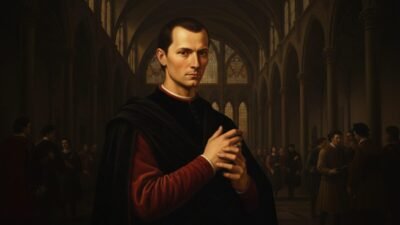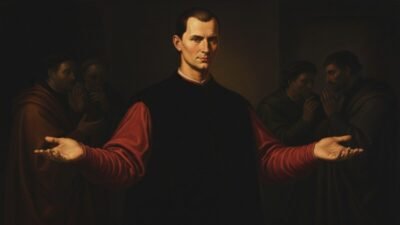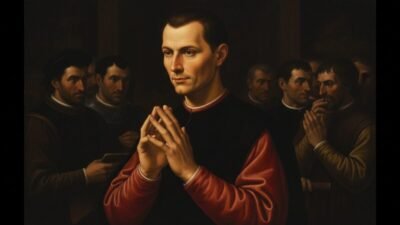

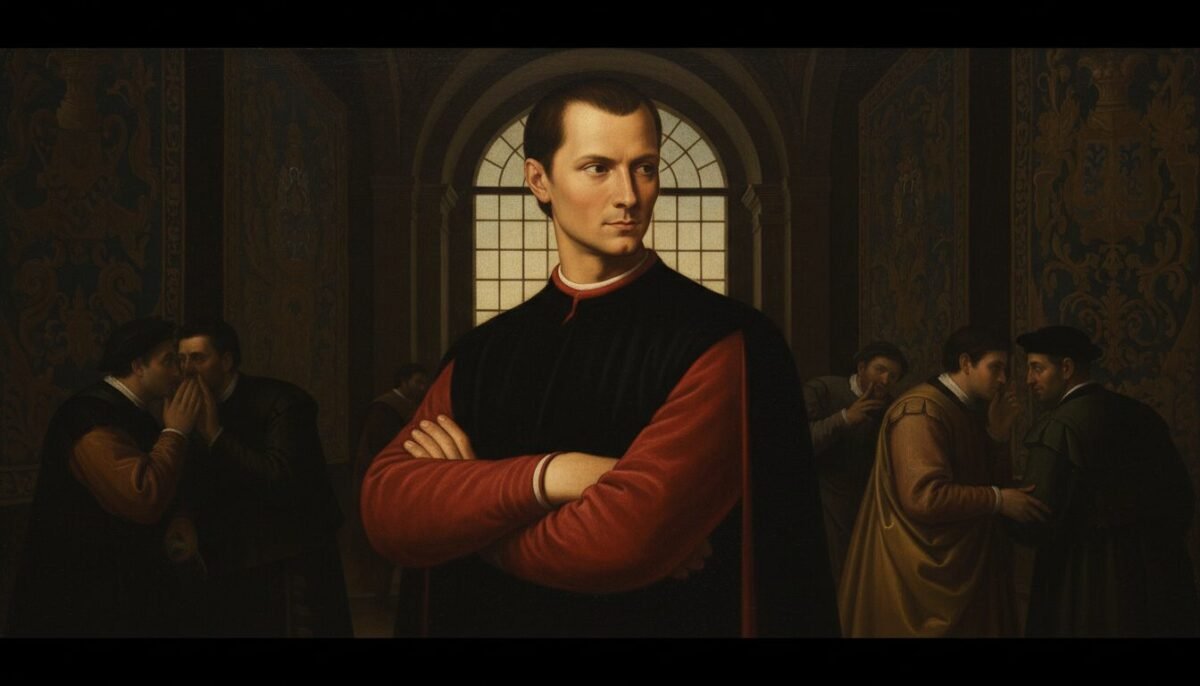
Imagine you are a diplomat in 16th-century Florence. Your city is a jewel of the Renaissance, but it is surrounded by wolves. To the north, the French army is marching; to the south, the Spanish; and internally, powerful families like the Medici are plotting to seize control. In this world, a “good” man—one who is honest, merciful, and pious—often finds himself dead or in exile within a week. This was the reality of Niccolò Machiavelli.
For five hundred years, Machiavelli’s name has been synonymous with the “dark arts” of politics. We use the term Machiavellian to describe the coworker who steals credit or the politician who lies with a smile. But was Machiavelli truly a teacher of evil, or was he the first political scientist who dared to describe the world as it actually is, rather than how we wish it to be? By peeling back the layers of myth, we find a thinker who was less a villain and more a surgeon, cutting through the polite lies of his era to reveal the raw mechanics of power.
1. Historical Context: 16th-Century Italy and the Birth of Realism
To understand Machiavelli, you must first understand the chaos of his home. In the early 1500s, Italy was not a unified nation; it was a fractured collection of city-states—Florence, Venice, Milan, Rome, and Naples—constantly at each other’s throats. It was a playground for foreign superpowers. Machiavelli served as a high-ranking diplomat for the Florentine Republic, traveling to the courts of kings and popes. He saw firsthand how the “virtuous” were crushed by the “ruthless.”
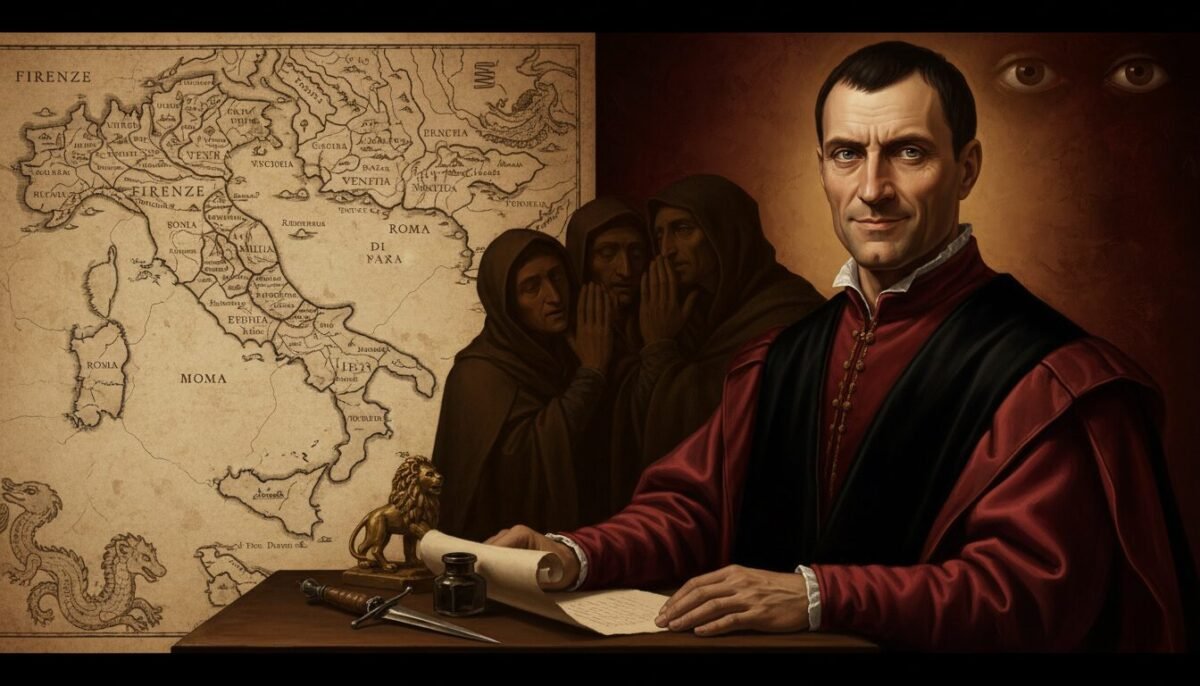
His world collapsed in 1512 when the Medici family, backed by Spanish troops, overthrew the Florentine Republic. Machiavelli was stripped of his office, imprisoned, and tortured on the rack. He was eventually exiled to a small farm outside the city. It was in this state of disgrace and frustration that he wrote The Prince. He wasn’t writing a fantasy; he was writing a survival guide based on the bloody lessons he had learned in the field.
Before Machiavelli, political writing belonged to a genre called “Mirrors for Princes.” these books told rulers that to be successful, they must be the most Christian, the most moral, and the most generous of men. Machiavelli took these books and threw them out the window. He argued that if a leader follows traditional morality in a world full of people who do not, he will inevitably bring about his own ruin and the ruin of his people. This shift from “how things ought to be” to “how things are” marks the birth of political realism.
The instability of the Renaissance demanded a new approach. When a city-state could be sacked and its citizens slaughtered because a leader was too “kind” to execute a traitor, Machiavelli realized that the old rules were not just useless—they were dangerous. He sought to create a science of statecraft based on empirical observation and historical patterns rather than divine command.
2. The Core Pillars: Understanding Virtù and Fortuna
At the heart of Machiavelli’s philosophy are two competing forces: Virtù and Fortuna. These terms do not mean what they seem to mean in modern English, and understanding the tension between them is the key to his entire worldview.
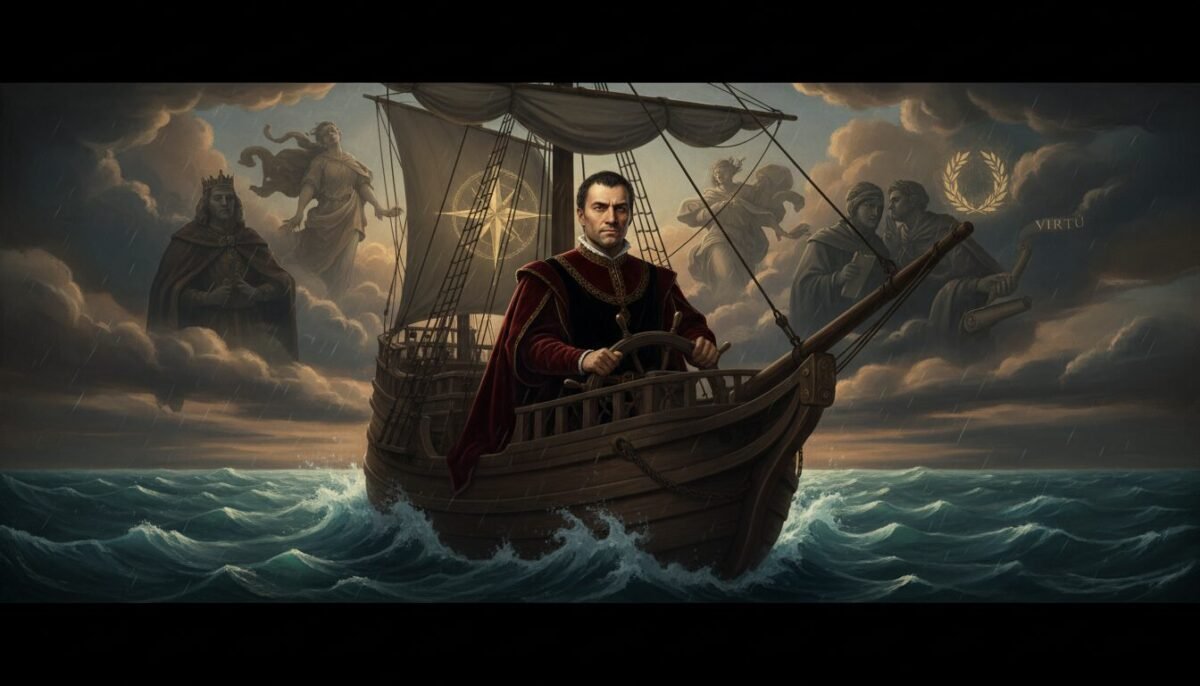
When Machiavelli speaks of Virtù, he is not talking about “virtue” in the sense of being a “good person.” He isn’t interested in your charity or your kindness. Instead, Virtù refers to prowess, skill, energy, and the ability to act decisively. It is the quality of the “manly” leader (from the Latin vir) who has the strength of will to shape his own destiny. A leader with Virtù knows when to be cruel, when to be kind, and how to adapt to any situation. It is the ultimate form of strategic flexibility.
On the other side is Fortuna. Machiavelli famously compares Fortuna to a “capricious river.” When the river floods, it destroys everything in its path, and no human force can stop it. However, a leader with Virtù builds dikes and dams during the dry season so that when the flood comes, the damage is contained. Fortuna is the unpredictability of life—the sudden plague, the unexpected betrayal, the freak storm that sinks a navy.
Machiavelli’s most controversial metaphor for Fortuna is that she is like a woman who must be “beaten and struck” into submission. While jarring to modern ears, the philosophical point is clear: the world is chaotic and indifferent to your plans. You cannot control luck, but you can control your response to it. The successful leader is the one who balances individual agency with the cold reality of fate. If you are too cautious, Fortuna will bypass you. If you are too bold without preparation, she will crush you. Success is the intersection of preparation and opportunity.
3. Ethics in Politics: Does the End Justify the Means?
If you ask a random person what Machiavelli said, they will likely quote: “The end justifies the means.” Here is the irony: Machiavelli never actually wrote that sentence. What he did write was that in the actions of princes, “one looks to the result” (si guarda al fine). This is a subtle but vital distinction.
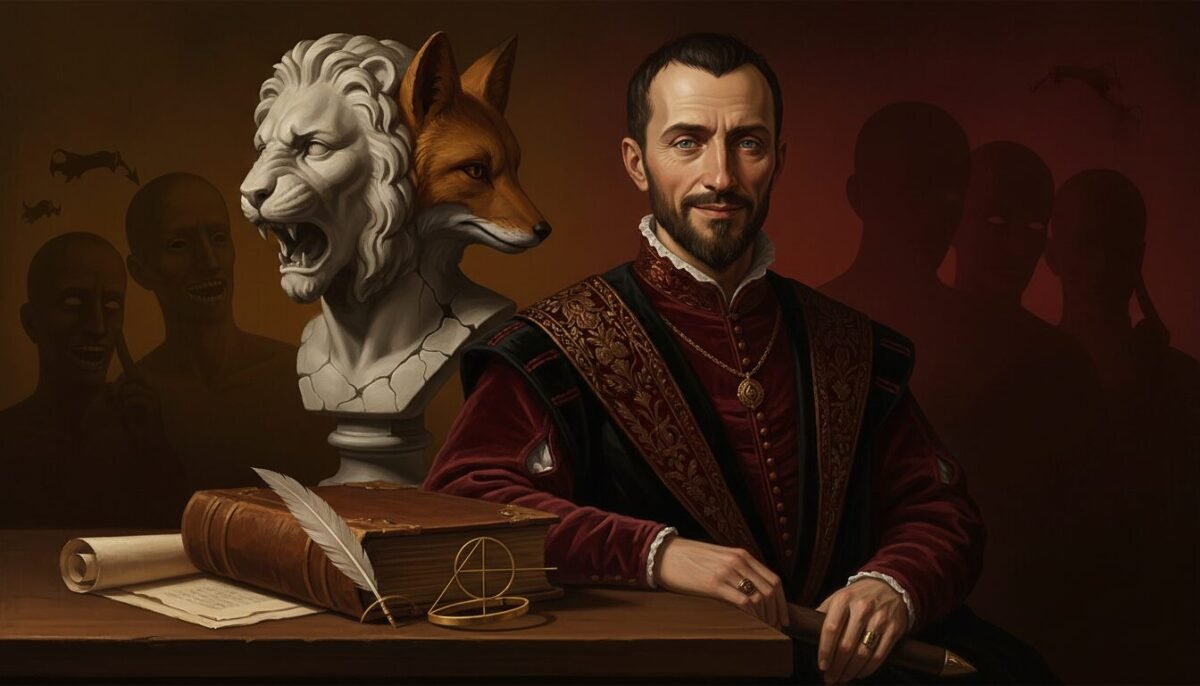
Machiavelli introduced the concept of Raison d’État, or “Reason of State.” He argued that there is a fundamental split between private morality and political necessity. As an individual, you should be honest and kind. But as a leader responsible for the lives of thousands, your primary duty is the survival and stability of the state. If you have to lie to prevent a war, or execute a few conspirators to prevent a civil war that would kill thousands, Machiavelli argues that you are being “virtuous” in a political sense, even if you are being “evil” in a religious sense.
To survive in a corrupt world, a leader must be both a lion and a fox. The lion is strong and can scare away wolves, but he is trapped by snares. The fox is cunning and can see the traps, but he is defenseless against wolves. A leader who is only a lion (pure force) will be outsmarted; a leader who is only a fox (pure diplomacy) will be overpowered. You must be able to switch skins depending on the threat.
This leads to the concept of “criminal virtue.” Machiavelli cites the example of Cesare Borgia, who used a cruel henchman to bring order to a lawless province and then had that same henchman executed in the town square to satisfy the people’s anger. It was a bloody, deceptive act, but it resulted in peace and order. In Machiavelli’s eyes, the “cruelty” of a single execution that prevents a decade of anarchy is actually a form of “mercy.” This is the tragic necessity of power: sometimes, you must do evil so that good may come of it.
4. The Great Paradox: ‘The Prince’ vs. ‘Discourses on Livy’
There is a massive contradiction in Machiavelli’s work that has puzzled scholars for centuries. The Prince is a handbook for autocrats, advising them on how to seize and hold power through force and fraud. Yet, in his much longer and more personal work, Discourses on Livy, Machiavelli reveals himself to be a passionate supporter of Republicanism—a system where the people have a voice and the law is supreme.
How can the same man write a guide for tyrants and a manifesto for freedom? The answer lies in the distinction between founding a state and maintaining one. Machiavelli believed that in times of extreme crisis or corruption—like the Italy of his day—a “Prince” is needed to clear the rubble and establish order. You cannot have a republic if the citizens are corrupt and the institutions are broken. You need a strongman to reset the clock.
However, once the state is established, Machiavelli argues that a Republic is far superior to a Monarchy. Why? Because a single prince is prone to madness, ego, and poor judgment. The “multitude,” he argues, is often wiser and more constant than a single ruler. In a republic, the friction between the elite and the common people creates a system of checks and balances that keeps the state healthy. Conflict, in Machiavelli’s view, isn’t a sign of failure; it’s the engine of liberty. He believed that a free citizenry, armed and invested in their country, would always be more powerful than a population of subjects ruled by fear.
5. Secularism and the Separation of Church and Statecraft
Machiavelli was perhaps the first truly secular political thinker. While he lived in a deeply religious age, he viewed the Catholic Church not as a divine institution, but as a political player—and a destructive one at that. He famously blamed the Church for keeping Italy divided, noting that the Pope was strong enough to prevent anyone else from unifying the peninsula, but not strong enough to unify it himself.
More radically, Machiavelli argued that Christian ethics were actually detrimental to the strength of a state. Christianity, he suggested, praises humility, suffering, and a focus on the afterlife. While these might be good for the soul, they make for a very weak citizenry. He looked back to the pagan religions of Ancient Rome, which praised strength, glory, and service to the fatherland.
By removing God from the equation of power, Machiavelli paved the way for modern political thinkers like Thomas Hobbes and Montesquieu. He treated politics as a laboratory. If you do X, the result is usually Y. This was a revolutionary departure from the “Divine Right of Kings,” which claimed that rulers were placed on the throne by God. Machiavelli countered that rulers are placed on the throne by luck, force, or the support of the people—and they can be removed by the same means. This tension between traditional religious ethics and the survival of the commonwealth remains one of the most debated aspects of his legacy.
6. Legacy and Relevance: Machiavelli in the Modern World
Today, the term “Machiavellian” has migrated from the halls of government to the boardrooms of corporations and the pages of psychology textbooks. In psychology, it is part of the “Dark Triad” (alongside narcissism and psychopathy), describing a personality type characterized by manipulation and a cold disregard for others. But this is a simplification that Machiavelli himself might have found amusing.
In the world of international relations, Machiavelli’s shadow looms large over the school of Realpolitik. Figures like Henry Kissinger have long operated on the Machiavellian principle that a nation’s interests must come before abstract moral crusades. In a world of nuclear weapons and global instability, the idea that a leader must sometimes make “the least bad choice” is as relevant as ever.
For the modern leader, Machiavelli offers a masterclass in strategic planning and reputation management. He famously asked whether it is better to be loved or feared. His answer: it is best to be both, but since that is difficult, it is much safer to be feared than loved—provided you are not hated. In a modern context, this translates to the importance of respect and boundaries. A leader who tries too hard to be everyone’s friend (to be loved) often loses the ability to make hard decisions. A leader who is respected (feared in the sense of consequences) can maintain order and drive results.
Ultimately, Machiavelli remains essential reading because he forces us to confront the “uncomfortable truths” about human nature. He reminds us that power is not a gift; it is a tool that must be wielded with precision. Whether we like it or not, the mechanics of power he described in 1513 are still the gears that turn the world today.
Conclusion
Niccolò Machiavelli was not an advocate for cruelty for cruelty’s sake. He was a patriot who saw his country bleeding and realized that “good intentions” were not enough to save it. He was a realist who recognized that the preservation of the state—the very thing that allows us to live in peace and pursue our own “private morality”—sometimes requires difficult, even tragic, compromises. By distinguishing between the ethics of the individual and the duties of the ruler, he founded the field of modern political science. He didn’t invent the dark side of politics; he simply had the courage to turn on the lights.
If you found this deep dive into the mechanics of power insightful, consider exploring our other analyses of the minds that shaped the world. Subscribe to the DeepPsyche newsletter to receive weekly explorations of philosophy, psychology, and the hidden forces behind human behavior.
Frequently Asked Questions
Did Machiavelli actually believe in the advice he gave in ‘The Prince’?
Scholars are divided. Some believe it was a sincere guide for a “new prince” to save Italy, while others argue it was a satirical warning to the people about how tyrants operate. Given his republican leanings in other writings, it was likely a pragmatic response to the extreme crisis of his time.
Is ‘Machiavellianism’ always a bad thing?
In a clinical sense, it refers to manipulative behavior. However, in a strategic sense, “Machiavellian” thinking—being realistic, calculating, and aware of power dynamics—is often necessary for effective leadership and the survival of organizations in competitive environments.
What is the difference between being ‘feared’ and being ‘hated’ according to Machiavelli?
Fear comes from a leader being firm, consistent, and capable of punishment, which creates stability. Hatred, however, comes from being unpredictable, stealing property, or taking the women of the subjects. Machiavelli warned that once a leader is hated, their downfall is inevitable because the people will eventually revolt regardless of the cost.
How did Machiavelli influence modern democracy?
Through his Discourses on Livy, he championed the idea of checks and balances, the importance of a constitution, and the role of a vibrant, active citizenry. These ideas heavily influenced Enlightenment thinkers and the Founding Fathers of the United States.
Explore More on DeepPsyche: