

Why do we feel a sudden, electric surge of satisfaction when we land a promotion or win a heated debate? Conversely, why does a sharp, bitter sting of resentment ripple through us when a colleague takes the lead on a project we felt was ours? These aren’t just “ego trips” or petty emotions; they are the modern echoes of a biological program written into our DNA over millions of years. We are the descendants of those who climbed the social ladder, and that drive to ascend remains one of the most powerful—and most misunderstood—forces in human psychology.
While the drive for dominance is a fundamental part of human nature, it is frequently dismissed as simple aggression or toxic behavior. This misunderstanding creates a vacuum where power is either sought through brute force or feared as inherently evil. In reality, the quest for status is a complex tapestry of survival instincts, hormonal feedback loops, and social strategies. By exploring the evolutionary, biological, and psychological foundations of dominance, we can learn how to channel this primal drive into effective, ethical leadership rather than letting it devolve into personal conflict and organizational rot.
1. The Evolutionary Roots of Dominance as a Survival Mechanism
To understand why we care about our “place” in the office or the social circle, we must look back at the harsh landscapes of our ancestors. In the early days of human social structures, the concept of “survival of the fittest” was not just a theoretical framework; it was a daily reality. However, “fitness” didn’t always mean being the strongest individual in isolation. It meant being the individual who could best navigate the social hierarchy of the tribe.

Evolutionary psychologists argue that dominance hierarchies actually served as a vital peace-keeping mechanism. Imagine a group of early humans finding a fresh kill. If there were no established hierarchy, every meal would result in a bloody, energy-depleting brawl. By establishing a clear order of resource access, groups reduced internal conflict. Once everyone knew their “rank,” the group could stop fighting each other and start focusing on external threats, like predators or rival tribes. Dominance, in this sense, was a tool for stability.
Furthermore, social status was inextricably linked to reproductive success. In ancestral environments, high-status individuals—those perceived as strong, capable, or influential—had better access to high-quality food, safer sleeping sites, and more desirable mates. This created a powerful selection pressure: those who possessed the drive to seek status were more likely to pass on their genes. We are, quite literally, the children of the ambitious.
Dominance also functioned as a protective shield for the collective. The “alpha” or the leader wasn’t just someone who took the most; they were the individual expected to take the most risk. They were the first to face a predator and the primary strategist in tribal warfare. The drive for dominance was thus balanced by the heavy burden of responsibility. When we seek power today, we are tapping into an ancient instinct that associates high status with the ability to protect and provide for the “tribe,” even if that tribe is now a marketing team or a tech startup.
2. The Biology of Power: Hormones and the Brain
The pursuit of power isn’t just a mental game; it is a full-body chemical experience. Our brains are wired to reward us for climbing the hierarchy and punish us for falling. At the center of this biological storm is testosterone. While often associated solely with physical aggression, testosterone is more accurately described as the “status-seeking hormone.” It rises in anticipation of competition and surges after a victory, making us more confident, more willing to take risks, and more persistent in the face of challenges.
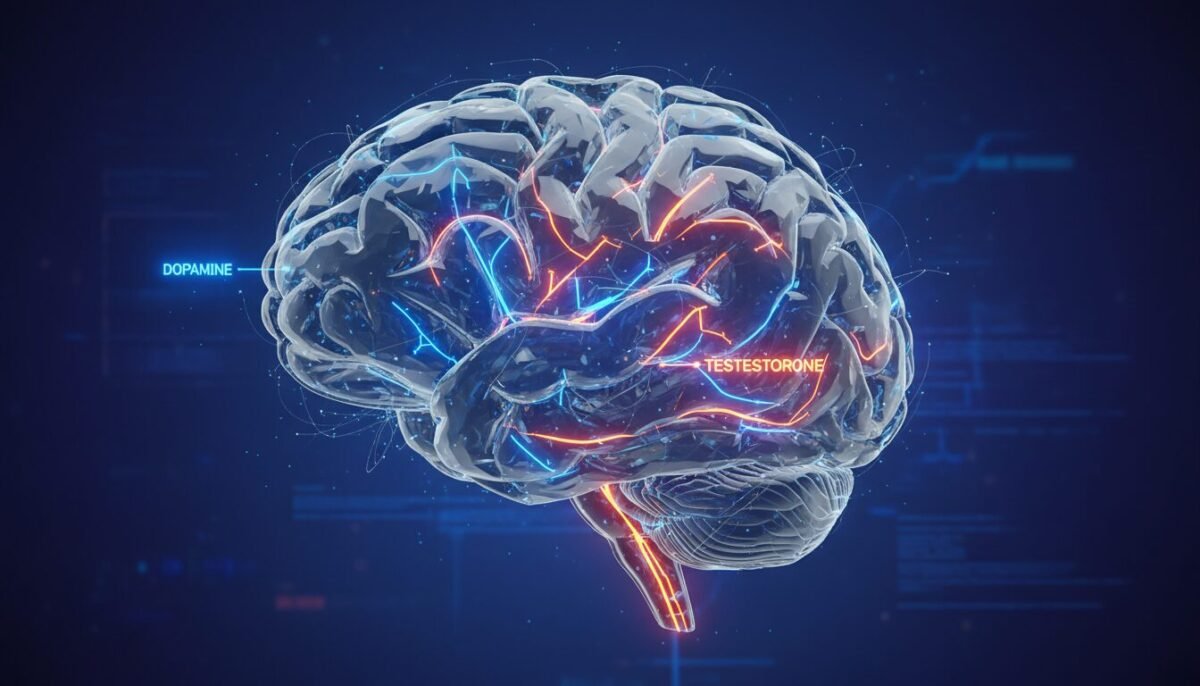
Then there is dopamine, the brain’s primary reward chemical. Every time we achieve a “win”—whether it’s a successful presentation or a surge in social media followers—our brain releases a hit of dopamine. This creates a feedback loop that can make winning feel addictive. This is why people who have achieved immense power often find it impossible to “retire” or step back; their brains are habituated to the high-octane chemical rewards of being at the top.
On the flip side, the biology of low social standing is characterized by cortisol, the stress hormone. Studies in both primates and humans show that individuals at the bottom of a hierarchy often have chronically elevated cortisol levels. This “status stress” suppresses the immune system, clouds judgment, and leads to long-term health issues. The “sting” of being passed over for a promotion isn’t just emotional; it’s a physiological reaction to the perceived threat of losing resource access and social protection.
Perhaps the most fascinating biological phenomenon is the “Winner Effect.” Biologists have observed that an animal that wins a fight against a weak opponent is significantly more likely to win its next fight, even against a stronger foe. This is because the act of winning physically changes the brain. It increases the number of androgen receptors in the areas of the brain responsible for motivation and reward. In human terms, small victories prime the brain for future dominance. This is why successful leaders often start their day with “small wins”—it chemically prepares them for the larger battles ahead.
3. Dominance vs. Prestige: Two Paths to Social Status
While we often use the word “dominance” to describe anyone in charge, psychologists make a crucial distinction between two very different paths to the top: Dominance and Prestige.

- Dominance is status gained through force, intimidation, and coercion. It is the “boss” who rules through fear, the bully on the playground, or the leader who withholds information to maintain control. It is an ancient, primate-based strategy that relies on the ability to inflict costs on others.
- Prestige is status earned through skill, knowledge, and altruism. It is the expert who everyone turns to for advice, the mentor who shares their wisdom, and the leader who is followed because they are genuinely respected. Prestige is a uniquely human strategy; we grant status to these individuals voluntarily because their presence benefits the group.
The psychological toll of these two paths is vastly different. Maintaining a hierarchy based on pure dominance is exhausting. The “dominant” leader must constantly watch their back, suppress rivals, and project an image of invincibility. It is a fragile state because as soon as the leader shows weakness, the hierarchy collapses. In contrast, prestige-based status is remarkably stable. Because the followers *want* the leader to stay in power, they will often support them even during times of failure or personal struggle.
Understanding this distinction is the key to modern influence. In the contemporary world, where physical force is rarely an option, those who rely on “dominance” tactics—interrupting others, taking credit for work, or using “fear-based” management—often find themselves isolated. Those who build “prestige” by becoming indispensable experts or empathetic mentors find that power flows to them naturally and stays with them longer.
4. Modern Manifestations: From the Workplace to Social Media
We no longer fight over mammoth meat, but the digital and corporate arenas of the 21st century are just as much of a “savanna” as the plains of Africa. In the workplace, dominance hierarchies manifest in office politics, the seating arrangements in boardrooms, and the subtle “pecking order” of who gets to speak first in a meeting. The “Alpha” myth—the idea that the best leader is the loudest, most aggressive person in the room—persists in pop-psychology, despite evidence that the most effective modern leaders are often those with high levels of humility and collaborative spirit.
Social media has introduced a radical new dimension to status-seeking: the digital arena for “clout.” Likes, shares, and follower counts are quantifiable metrics of social standing. For the human brain, a “viral” post triggers the same dopamine hit that an ancestral hunter might have felt after a successful hunt. However, this digital status is often hollow. It mimics the rewards of prestige without requiring the actual skill or community contribution that prestige traditionally demands, leading to a widespread sense of anxiety and “status insecurity.”
The impact of these modern hierarchies on mental health cannot be overstated. In high-pressure environments—whether it’s a top-tier law firm or a competitive social circle—the constant pressure to “rank up” can lead to burnout. When our self-worth is tied entirely to our position in a hierarchy, we become vulnerable to the “hedonic treadmill”: no matter how high we climb, we are always looking at the person one step above us, feeling the cortisol-soaked sting of being “lesser than.”
We must recognize that while the drive for status is natural, the *arenas* we choose to compete in are often artificial. Learning to step back from the “clout chase” and focus on internal mastery is often the only way to find psychological peace in a world designed to keep us constantly competing for rank.
5. Channeling the Drive: Turning Dominance into Positive Leadership
The desire for power is not a character flaw; it is an engine. Like any engine, it can propel a vehicle forward or, if mismanaged, cause an explosion. The goal of personal development isn’t to suppress the drive for dominance, but to transform it from aggressive dominance into assertive, goal-oriented leadership.
This transformation requires Emotional Intelligence (EQ). A leader with high EQ understands their own biological urges. They recognize when they are feeling threatened or when they are acting out of a need for “dominance” rather than for the good of the team. They use their influence not to suppress others, but for “collective resource acquisition”—securing the funding, the tools, and the recognition that the entire group needs to thrive.
Consider the difference between a manager who micromanages every detail (dominance-based control) and a leader who sets a clear vision and empowers their team to reach it (prestige-based influence). The latter satisfies their need for status through the success of the group. Their “win” is the team’s “win.”
For individuals, the healthiest way to satisfy the primal need for status is through skill mastery. When you become truly excellent at a craft—whether it’s coding, surgery, or carpentry—you earn a form of prestige that cannot be taken away by a corporate restructuring or a social media algorithm. Mastery provides a sense of “internal status” that buffers you against the fluctuations of external hierarchies. You don’t need to dominate others when you have dominated the complexities of your own field.
6. The Ethical Implications and Downsides of Unchecked Power
There is a dark side to the pursuit of power that we must confront: the “Power Paradox.” Research, most notably by psychologist Dacher Keltner, suggests that the very traits we use to gain power—empathy, collaboration, and openness—are often the first things we lose once we actually *have* power. As people rise in a hierarchy, they often become less adept at reading the emotions of others and more likely to act impulsively or unethically. Power, quite literally, can decrease the brain’s “mirror neuron” activity, making it harder to empathize with those “below.”
This becomes particularly dangerous when combined with the “Dark Triad” of personality traits: Narcissism, Machiavellianism, and Psychopathy. Hierarchies, especially those that reward “dominance” over “prestige,” act as magnets for individuals with these traits. These individuals are experts at navigating the “biology of power,” using manipulation and cold calculation to ascend, often leaving a trail of organizational destruction in their wake.
On a societal level, extreme inequality driven by unchecked dominance leads to instability. When the gap between the “top” and the “bottom” becomes too wide, the social contract breaks down. The “prestige” that holds a society together is replaced by “dominance” (police state tactics, economic coercion), which is inherently unstable and prone to violent correction.
The solution lies in the necessity of checks and balances. Whether in a government, a corporation, or a family, power must be distributed and held accountable. We must create environments that reward prestige—the sharing of value—and penalize dominance—the hoarding of power. Finding a balance between our innate drive to ascend and our ethical responsibility to the collective is the great challenge of the human experience.
The desire for dominance is an innate biological drive rooted in our evolutionary past, but modern success relies more on prestige and collaborative leadership than raw force. We cannot delete the drive, but we can choose how we feed it. By shifting our focus from “ruling over” to “contributing to,” we transform a primal instinct into a force for progress.
Reflect on your own motivations: In your professional and personal life, are you seeking status through dominance or prestige? Are you building your influence on the fear of others or on the value you provide?
To dive deeper into the complexities of human nature and the hidden forces that drive our behavior, subscribe to the DeepPsyche newsletter. We explore the intersection of psychology, philosophy, and strategy to help you navigate the modern world with clarity.
Frequently Asked Questions
Is the “Alpha” male/female concept scientifically accurate?
In the wild, “alpha” individuals are rarely just the most aggressive. In wolf packs and primate groups, the leaders are often the most socially intelligent and protective of the group. The pop-psychology version of the “aggressive alpha” is largely a myth that ignores the importance of social bonding and prestige.
Can you have high status without being “dominant”?
Absolutely. This is the essence of prestige. Many of the most influential people in history—scientists, philosophers, and humanitarian leaders—held immense social status not because they forced others to follow them, but because their knowledge and contributions made people *want* to follow them.
Why does losing feel so physically painful?
Loss of status triggers a drop in dopamine and an increase in cortisol. Because our ancestors’ survival depended on their social standing, our brains process a loss of status as a threat to our physical survival, activating the same neural pathways as physical pain.
How can I deal with a “dominant” boss?
The most effective strategy is often to build your own “prestige” within the organization. By becoming an indispensable expert and building strong alliances with peers, you create a level of social capital that makes it much harder for a dominant individual to target or marginalize you.
Explore more on DeepPsyche: