
Imagine you are sitting in a high-stakes board meeting. The company is facing a hostile takeover, and the atmosphere is thick with panic. While most of your colleagues are paralyzed by ethical dilemmas or emotional distress, one person remains eerily calm. This individual isn’t just surviving the chaos; they are navigating it, quietly forming alliances, withholding key information, and positioning themselves to emerge on top regardless of who loses their job. They aren’t acting out of malice, but out of a cold, calculated pragmatism. Is this person a visionary leader or a psychological threat?
Is it better to be feared than loved? This chilling question, posed by Niccolò Machiavelli centuries ago, continues to define modern power dynamics in both politics and psychology. While many use the term “Machiavellian” to describe manipulative or “snake-like” behavior, there is significant confusion regarding whether it is a legitimate political philosophy or a psychological red flag. To understand the “High Mach” individual, we must first bridge the gap between 16th-century political realism and modern social psychology. By doing so, we can begin to see how a strategy once intended to save a nation has evolved into a personality trait that defines some of the most successful—and dangerous—people in our lives.
1. The Historical Roots: Niccolò Machiavelli and the Birth of Political Realism
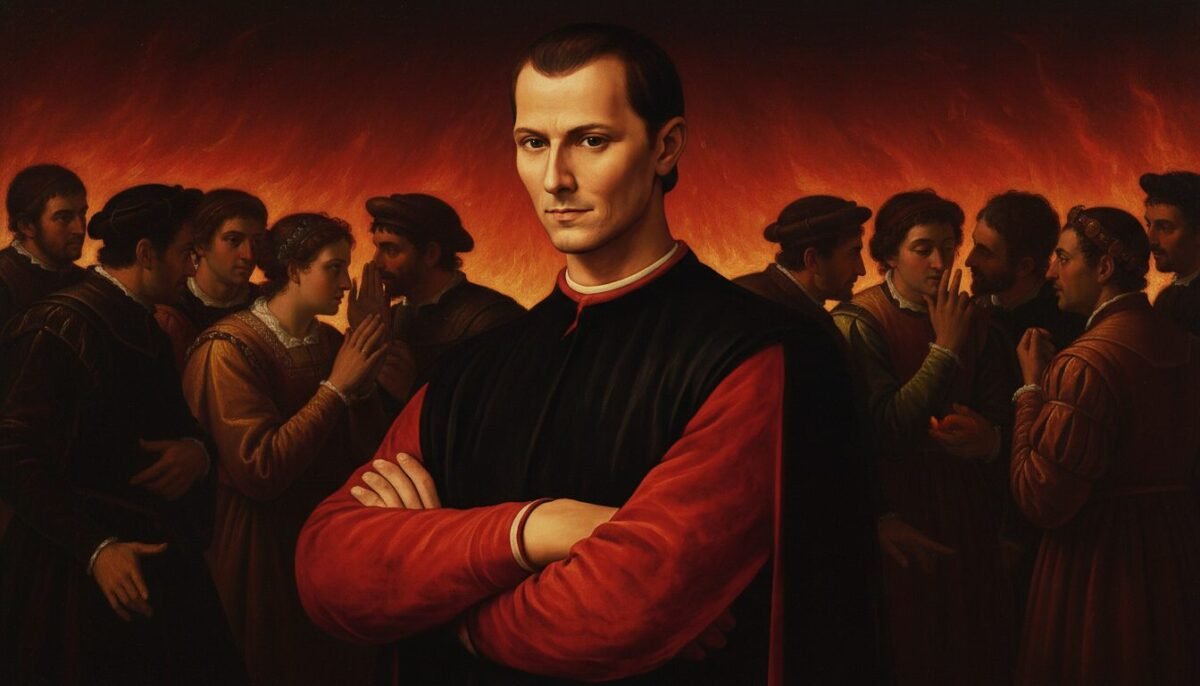
To understand the term, we must travel back to the fractured landscape of Renaissance Italy. Niccolò Machiavelli was not a “villain” in the cartoonish sense; he was a diplomat, a historian, and a civil servant who watched his beloved Florence fall victim to foreign invasions and internal corruption. His most famous work, The Prince, was written as a practical guide for a ruler—specifically a member of the Medici family—to achieve and maintain state stability.

At its core, Machiavellianism as a political philosophy is defined by political realism. Before Machiavelli, political writing was largely idealistic, focusing on how a ruler should behave according to Christian virtues. Machiavelli flipped the script, arguing that a leader who tries to be good in all circumstances will inevitably be ruined by the many who are not good. He advocated for pragmatism over morality, suggesting that the “ends justify the means”—though he never used that exact phrase—provided the “end” was the security and prosperity of the state.
In the context of 16th-century Italy, this meant that a ruler might need to be cruel, deceptive, or break promises if it prevented a civil war or a foreign occupation. However, over the centuries, the nuance of his work was stripped away. Machiavelli’s name became synonymous with cold-blooded calculation and the pursuit of power for power’s sake. The term “Machiavellian” drifted from a specific strategy for statecraft into a broader social label for anyone perceived as being “too clever for their own good.”
2. From Politics to Psychology: The Evolution of the Machiavellian Trait
For nearly 450 years, Machiavellianism remained a term of political science and literature. That changed in the 1970s when social psychologists Richard Christie and Florence Geis became fascinated by the idea that some people naturally possessed a “Machiavellian” outlook on life, regardless of whether they held political office. They wanted to know: Is there a measurable personality trait that mirrors Machiavelli’s philosophy?
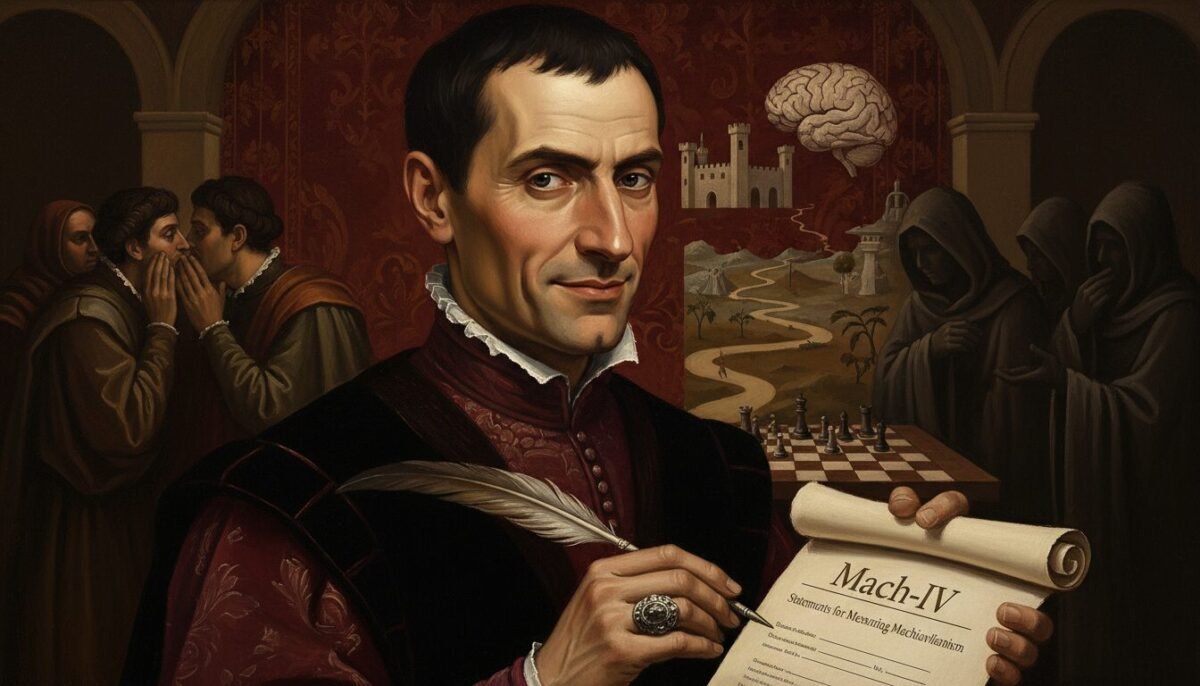
Their breakthrough came with the development of the Mach-IV scale. This was a series of statements designed to measure a person’s level of cynicism and their willingness to manipulate others. Participants were asked to rate their agreement with statements like, “The best way to handle people is to tell them what they want to hear,” and “Anyone who completely trusts anyone else is asking for trouble.”
Christie and Geis discovered that people who scored high on this scale—whom they dubbed “High Machs”—shared a distinct set of behaviors. They were socially adept, emotionally detached, and highly effective at manipulating others in laboratory games. By quantifying these tendencies, psychology transitioned the concept from a strategy for rulers into an individual personality construct. It was no longer just about how to run a country; it was about how an individual moves through the world, viewing other people as pawns on a chessboard rather than fellow human beings.
3. The Dark Triad: Where Machiavellianism Fits in Modern Psychology
In the modern psychological landscape, Machiavellianism does not exist in a vacuum. It is recognized as one of the three pillars of the Dark Triad, alongside Narcissism and Psychopathy. While these three traits often overlap, understanding the specific flavor of Machiavellianism is crucial for identifying it in the real world.
- Narcissism is driven by ego and a need for admiration.
- Psychopathy is characterized by impulsivity, a lack of remorse, and a thrill-seeking nature.
- Machiavellianism is the “cool” trait. It is defined by strategic thinking, emotional detachment, and a deeply cynical worldview.
A “High Mach” is not necessarily a loud, boastful narcissist or a violent psychopath. In fact, they are often the most subtle of the three. Their core characteristic is strategic manipulation. While a psychopath might lash out impulsively and get caught, a High Mach is willing to wait months or even years to execute a plan. They are experts at “impression management,” presenting a charming or professional facade while quietly working toward their own hidden agenda.
The High Mach worldview is fundamentally cynical. They believe that people are inherently weak, fickle, and easily led. Because they view the world as a “dog-eat-dog” environment, they feel that their manipulation is not only justified but necessary for survival. This emotional detachment allows them to remain calm under pressure, making them formidable opponents in any competitive environment.
4. Philosophy vs. Personality: Key Differences in Intent and Application
One of the most common mistakes is conflating Machiavelli’s actual philosophy with the personality trait that bears his name. The difference lies primarily in intent and application.

Machiavelli’s philosophical pursuit was the collective stability of the state. He believed that a ruler’s private morality was secondary to their public duty. If a leader had to lie to prevent a war that would kill thousands, Machiavelli argued that lying was the “moral” choice in the context of leadership. The goal was the greater good, even if the methods were unpalatable.
In contrast, the psychological trait of Machiavellianism is almost entirely focused on the pursuit of self-interest. A High Mach individual uses Machiavelli’s principles—such as selective honesty or strategic cruelty—not to save a nation, but to get a promotion, win an argument, or control a romantic partner. This is where pragmatism becomes exploitation. While the philosopher saw manipulation as a tool for governance, the personality trait uses it as a tool for personal gain.
Both the philosophy and the personality share a foundation of moral flexibility. They both reject the idea of absolute “good” or “evil” in favor of “what works.” However, the High Mach personality lacks the civic-mindedness that Machiavelli championed. They have adopted the tactics of the Prince without the responsibility of the office.
5. Machiavellianism in the Workplace: Leadership, Power, and Culture
The modern corporate world is perhaps the most common “natural habitat” for High Machs. In environments where power, status, and resources are up for grabs, Machiavellian traits can actually be rewarded. This creates a complex dilemma for organizations: Can Machiavellianism ever be a positive trait?
In some leadership contexts, a degree of “strategic pragmatism” is valuable. A leader who can remain emotionally detached during a crisis, make difficult headcount decisions without being paralyzed by guilt, or navigate complex political alliances can be an asset to a company’s survival. This is the “productive Machiavellian”—someone who uses their political skill to drive the organization forward.
However, the dark side is far more common. High Mach employees often create toxic cultures characterized by:
- Information Hoarding: Using knowledge as power rather than sharing it for the team’s benefit.
- Gaslighting: Manipulating colleagues’ perception of reality to maintain control.
- Backstabbing: Forming temporary alliances only to break them when a better opportunity arises.
For HR and management, identifying these individuals is difficult because they are often high performers who appear very “pro-social” on the surface. Managing them requires high levels of transparency and accountability. When processes are opaque, High Machs thrive; when every decision is documented and results are tied to team success rather than individual maneuvering, their “edge” is neutralized.
6. Clinical Perspectives: Is Machiavellianism a Mental Disorder?
A frequent question arises when discussing the Dark Triad: Is being a High Mach a mental illness? According to the Diagnostic and Statistical Manual of Mental Disorders (DSM-5), the answer is no. Machiavellianism is not a clinical diagnosis; it is considered a “subclinical” personality trait.
While it shares features with Antisocial Personality Disorder (ASPD)—such as a lack of empathy and a tendency toward deceit—Machiavellians typically function quite well in society. Unlike those with ASPD, who often struggle with impulse control and have frequent run-ins with the law, High Machs are usually highly controlled and law-abiding. They don’t want to break the system; they want to master it.
Research suggests that Machiavellianism is a remarkably stable trait across a person’s lifespan. While people may learn to “mask” their tendencies as they age to better fit into social norms, their underlying worldview—the belief that others are tools to be used—rarely changes. It is a fundamental part of their personality architecture, a lens through which they view every human interaction.
Understanding this distinction is vital. We shouldn’t look for a “cure” for Machiavellianism, as it isn’t a disease. Instead, we must learn to recognize it as a personality style. By understanding the High Mach profile, we can better protect ourselves from manipulation and navigate the complex power dynamics of our personal and professional lives.
Frequently Asked Questions
Is Machiavellianism the same as being a “sociopath”?
Not exactly. While both involve low empathy, sociopathy (often associated with ASPD) is characterized by impulsivity and social irresponsibility. Machiavellianism is characterized by long-term planning, social charm, and calculated manipulation.
Can a Machiavellian person be a good friend or partner?
It is difficult. High Machs tend to view relationships transactionally. While they can be loyal if it serves their long-term interests, they often struggle with genuine emotional intimacy and may prioritize their own goals over the needs of their partner.
How can I tell if my boss is a High Mach?
Look for “impression management.” Does your boss act completely differently depending on who is in the room? Do they use “divide and conquer” tactics among the team? High Machs are often excellent at managing “up” while being subtly exploitative of those “below” them.
Is there any benefit to being a “Low Mach”?
Absolutely. Low Machs tend to have higher levels of trust, stronger social bonds, and lower levels of stress. While they may be more vulnerable to manipulation, they often lead more fulfilling lives based on genuine connection rather than constant strategic calculation.
The world of human personality is deep and often hidden. If you found this analysis of the “High Mach” profile enlightening, consider exploring our other deep dives into the mechanics of the human mind.
Explore more on DeepPsyche: