
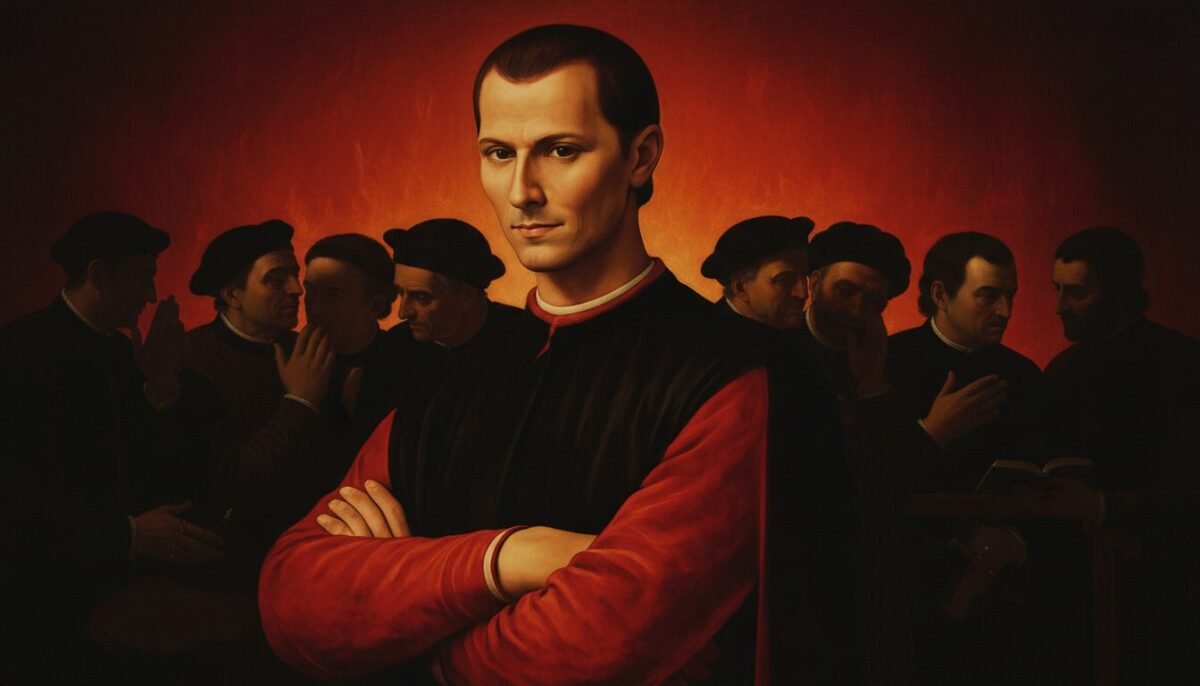

Is it better to be feared than loved? This chilling question has defined political and psychological strategy for over five centuries. Imagine a leader who, while appearing virtuous in public, is making cold, calculated decisions behind closed doors—decisions that might sacrifice a few for the stability of the many. We often use the term “Machiavellian” as a quick-fire slur for someone “evil” or “manipulative,” but this surface-level definition ignores the complex philosophy and psychological depth behind the name. To call someone Machiavellian is to invoke the ghost of a man who watched his beloved city-state crumble and decided that survival was more important than a clean conscience.
Niccolò Machiavelli was not a cartoon villain. He was a diplomat, a historian, and a realist who lived in a world of constant betrayal. Today, his name lives on not just in history books, but in psychological laboratories and corporate boardrooms. By deconstructing the historical origins of his work, its evolution into a psychological personality trait, and how it functions in modern leadership, we can begin to understand why his ideas remain so stubbornly relevant in the 21st century.
1. The Historical Origins: Niccolò Machiavelli and ‘The Prince’
To understand the man, you must understand the chaos of Renaissance Florence. In the early 16th century, Italy was not a unified nation but a collection of warring city-states, constantly under threat from foreign powers like France and Spain. Niccolò Machiavelli served as a high-ranking diplomat and civil servant for the Florentine Republic. He spent years observing the great power players of his day—men like Cesare Borgia, who was known for his ruthless efficiency and strategic use of violence.

When the Medici family returned to power in 1512, Machiavelli was ousted, tortured, and exiled. It was during this period of forced retirement that he wrote Il Principe (The Prince). This was not a book of abstract ethics; it was a job application. Machiavelli wanted to show the new rulers that he understood the “real” mechanics of power. He moved away from the idealized medieval kingship—where a ruler was expected to be a pious, God-fearing servant of the people—and toward a cold, hard Realpolitik.
In The Prince, Machiavelli argues that a ruler’s primary duty is the stability and survival of the state. If achieving that stability requires deceit, cruelty, or the breaking of promises, then so be it. He famously noted that while it is ideal to be both loved and feared, if one must choose, it is much safer to be feared. Love is a fickle emotion, easily discarded when it no longer serves the subject, but fear is maintained by a dread of punishment which never fails.
The reaction to the book was explosive. The Catholic Church eventually placed it on the Index Librorum Prohibitorum (the list of prohibited books), and critics labeled it as being “written by the finger of Satan.” To the religious and moral authorities of the time, Machiavelli had committed the ultimate sin: he had divorced politics from morality, suggesting that the “good” of the state was a higher priority than the “good” of the soul.
2. Defining Machiavellianism: Core Characteristics and Mindset
In modern terms, Machiavellianism describes a specific worldview that prioritizes utility over morality. At its heart is the fundamental belief that “the ends justify the means.” However, this isn’t just a license for chaos. For a true Machiavellian, the “end” must be something substantial—such as the preservation of an organization or the achievement of a long-term strategic goal—not just petty personal gain.
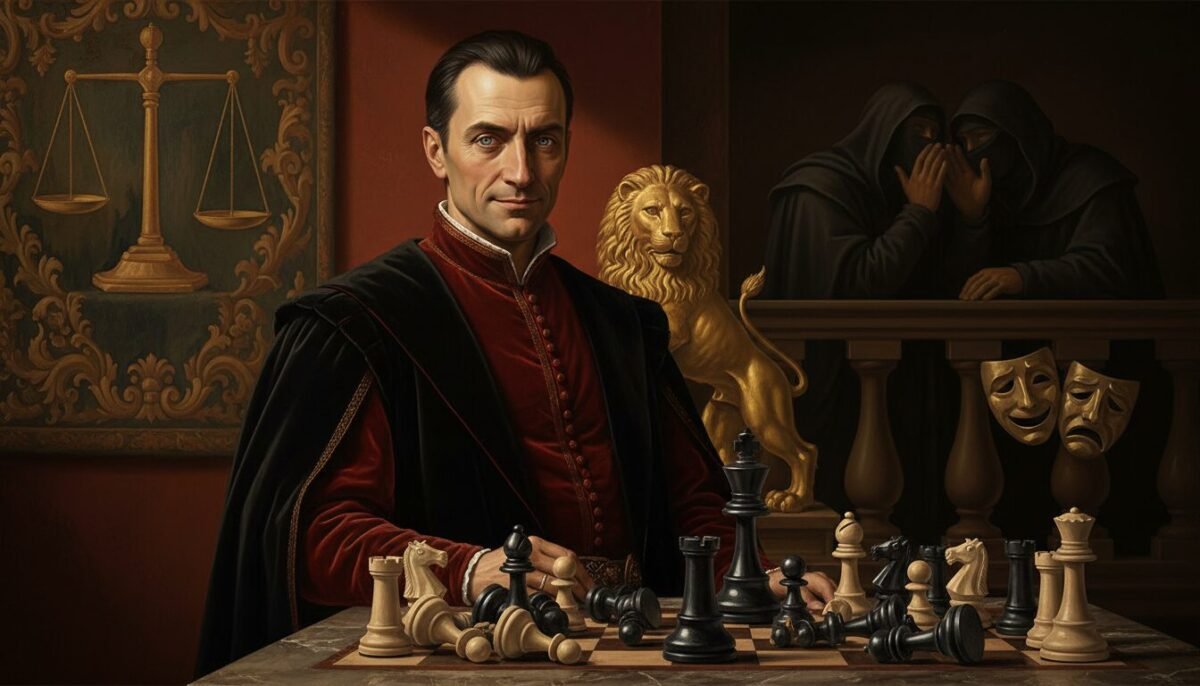
One of the defining characteristics of this mindset is emotional detachment. While others might be swayed by empathy, guilt, or social pressure, a Machiavellian prioritizes logic and strategy. They view the world as a giant chessboard. People are not just individuals with feelings; they are pieces with specific values and functions. This detachment allows them to make “tough calls” that others would find emotionally paralyzing.
This leads to a profound cynicism regarding human nature. Machiavelli himself wrote that men are “ungrateful, fickle, simulators and deceivers, avoiders of danger, and greedy for gain.” If you start with the assumption that everyone is inherently selfish and untrustworthy, then manipulation isn’t “evil”—it’s a necessary defensive measure. To a Machiavellian, being honest in a world of liars isn’t virtuous; it’s suicidal.
Crucially, Machiavellianism is characterized by strategic long-term planning. This is what separates a Machiavellian from a common bully or an impulsive criminal. A Machiavellian is patient. They are willing to play the “long game,” building alliances and waiting for the perfect moment to strike. They understand that reputation is a tool; they will often appear kind, humble, and cooperative for years, only revealing their true intentions when the goal is within reach.
3. Machiavellianism in Psychology: The Dark Triad Connection
In the mid-20th century, psychologists began to notice that Machiavelli’s political philosophy mirrored a specific type of personality. This led to the inclusion of Machiavellianism in the “Dark Triad”—a trio of socially aversive traits that also includes Narcissism and Psychopathy. While these three traits often overlap, they are distinct.

- Narcissism is driven by a need for ego-reinforcement and admiration.
- Psychopathy is characterized by impulsivity, thrill-seeking, and a complete lack of remorse.
- Machiavellianism is the “cold” trait. It is defined by calculated manipulation, a cynical worldview, and a focus on self-interest.
In the 1970s, psychologists Richard Christie and Florence Geis developed the Mach-IV scale, a personality survey designed to measure a person’s level of Machiavellianism. They found that individuals who scored high on this scale—”High Machs”—were significantly more likely to manipulate others in laboratory experiments. High Machs don’t necessarily want to hurt people (unlike some psychopaths); they simply don’t care if people get hurt in the process of achieving a goal.
The “High Mach” profile is one of social maneuvering. These individuals are often charming and persuasive because they are constantly monitoring social cues to see how they can best influence a situation. They lack conventional morality not because they are “insane,” but because they view morality as a social construct used by the weak to restrain the strong. In psychological terms, they have high “cognitive empathy” (they understand what you are thinking) but low “affective empathy” (they don’t feel what you are feeling).
4. Common Misconceptions: Did Machiavelli Advocate for Evil?
The legacy of Machiavelli is often distorted by 16th-century religious propaganda. For centuries, he was depicted as a teacher of tyrants, but modern scholarship offers a more nuanced view. One prominent theory, supported by thinkers like Jean-Jacques Rousseau and Baruch Spinoza, is the “Satire Theory.” They argued that The Prince was actually a warning to the people. By exposing the dirty tricks of rulers, Machiavelli was showing the public how they were being manipulated, effectively acting as a champion of republicanism in disguise.
Another vital distinction is Pragmatism vs. Malice. Machiavelli never advocated for cruelty for the sake of cruelty. In fact, he explicitly stated that “senseless violence” was counterproductive because it made the people hate the ruler, and a hated ruler is an insecure ruler. He advocated for “well-used cruelty”—actions that are swift, effective, and necessary for the survival of the state, followed by a period of peace and benefit to the subjects. To Machiavelli, a leader who is “too kind” and allows a civil war to break out is actually more immoral than a leader who executes a few conspirators to maintain order.
Finally, we must consider Machiavelli’s personal values. In his other major work, The Discourses on Livy, he expresses a clear preference for a republic (a government by the people) over an autocracy. This suggests that his advice in The Prince was a desperate response to the specific crises of his time, rather than a universal endorsement of tyranny. He was a realist who believed that you cannot build a perfect society using the tools of a perfect world; you must work with the flawed tools of the world you actually inhabit.
5. Modern Applications: Machiavellianism in Leadership and Business
The ghost of Machiavelli is alive and well in corporate boardrooms. High-stakes business environments often reward the traits of “High Machs.” In a world of hostile takeovers, complex negotiations, and cutthroat competition, the ability to remain emotionally detached and strategically focused is a massive advantage. High Machs are often the ones who can navigate the “art of the deal,” building strategic alliances that last exactly as long as they are useful.
However, Machiavellian leadership carries significant risks. While a High Mach might achieve short-term results through manipulation, they often leave a trail of destruction behind them. Toxic culture and trust erosion are the hallmarks of Machiavellian management. When employees realize that their leader views them as mere pawns, loyalty vanishes. This leads to high turnover and a “look over your shoulder” atmosphere that stifles genuine innovation and collaboration.
Is there such a thing as “Positive Machiavellianism”? Some argue that in certain high-pressure roles—such as crisis management, international diplomacy, or high-level intelligence—a degree of Machiavellian thinking is essential. A leader who refuses to “get their hands dirty” might fail to prevent a much larger catastrophe. In this context, strategic manipulation is seen as a tool for the greater good. The ethical question then becomes: can you use the methods of a villain to achieve the goals of a hero without losing your soul in the process?
6. The Ethical Dilemma: Navigating Power in the 21st Century
In the 21st century, the game of power has changed. We live in an era of digital transparency and social media, where a leaked email or a recorded conversation can destroy a reputation in seconds. The traditional Machiavellian tactics of “Hard Power”—secrecy, coercion, and overt manipulation—are becoming increasingly dangerous to use. Today, power is often found in “Soft Power”: influence, storytelling, and the ability to shape the narrative.
This creates a fascinating tension between personal integrity and professional effectiveness. We want our leaders to be honest and empathetic, yet we also want them to be effective and protective. We are often drawn to the “authentic” leader, but authenticity can be a liability in a negotiation with a ruthless opponent. The modern Machiavellian must be even more sophisticated than their Renaissance counterpart, often using the appearance of total transparency as a mask for deeper strategies.
Ultimately, Machiavellianism forces us to confront the necessity of realism in an idealistic world. It challenges us to look at the world not as we wish it to be, but as it actually is. Understanding these traits doesn’t mean we have to adopt them, but it does mean we can recognize them—in our leaders, in our competitors, and perhaps even in the darker corners of our own ambition.
Interested in more personality psychology? Explore our deep dive into the Dark Triad traits here.
Frequently Asked Questions
What is the main idea of Machiavellianism?
The core idea is that in the pursuit of power and the maintenance of stability, the “ends justify the means.” It emphasizes pragmatism, strategic manipulation, and emotional detachment over traditional moral or religious constraints.
Is being Machiavellian a mental disorder?
No, Machiavellianism is considered a personality trait, not a clinical mental disorder. While it is part of the “Dark Triad” of socially aversive traits, many people with high Machiavellian tendencies function successfully in high-level careers.
How can you tell if someone is Machiavellian?
Common signs include a cynical view of others, a tendency to be charming yet emotionally distant, a focus on long-term personal or professional gain at the expense of others, and a high level of skill in social maneuvering and persuasion.
Can Machiavellianism be a good thing?
In certain contexts, such as high-stakes diplomacy or organizational survival, the ability to make cold, calculated decisions can be beneficial. However, it often comes at the cost of trust, long-term relationships, and ethical integrity.