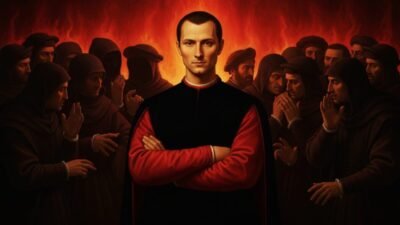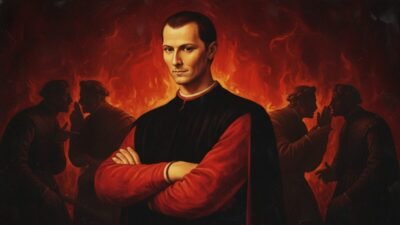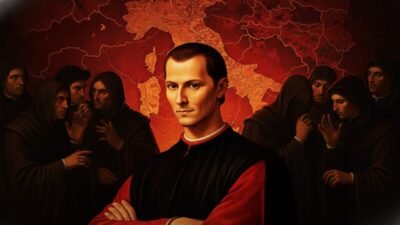

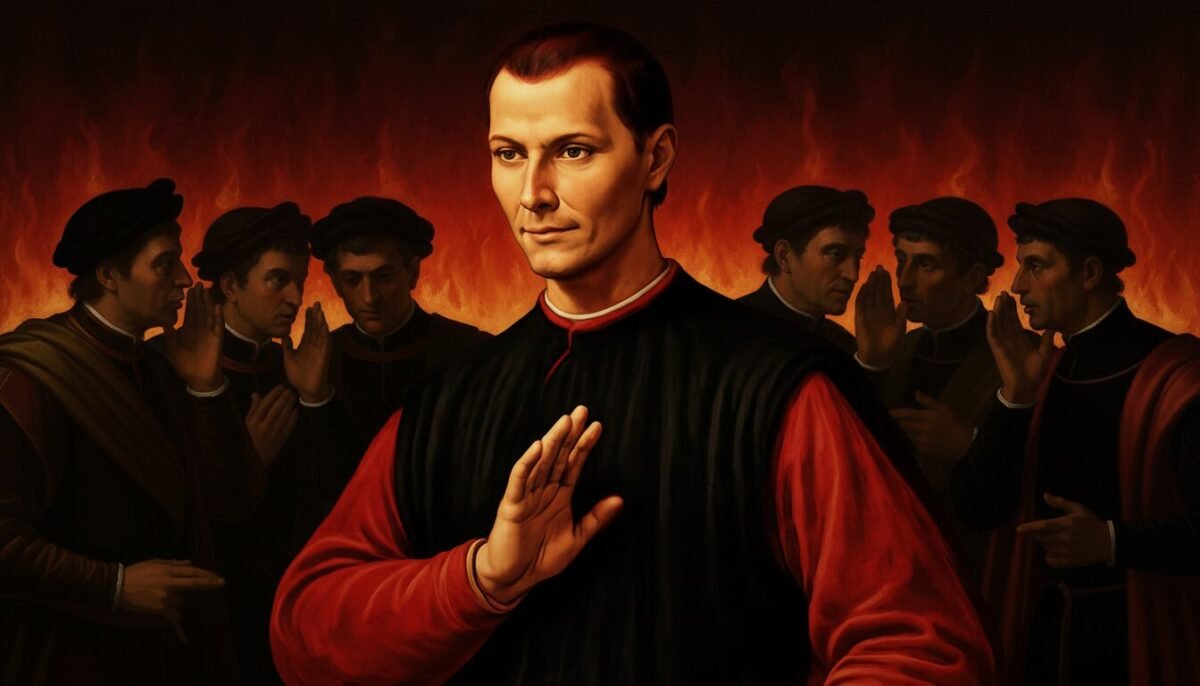
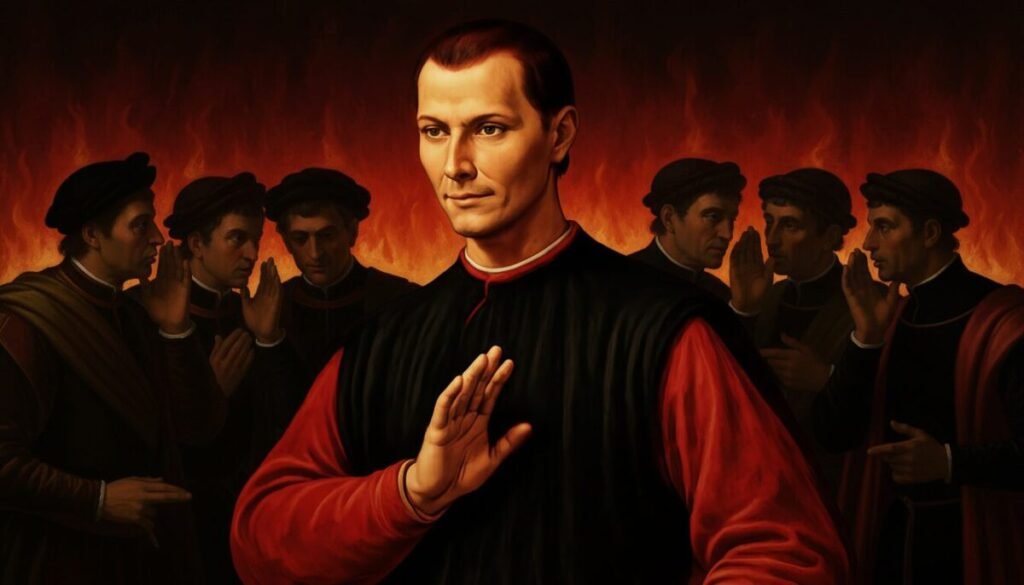
Imagine a city where the air smells of both expensive incense and drying blood. A place where the same hand that commissioned a Botticelli masterpiece might, hours later, sign a death warrant for a political rival. This was Florence in the late 15th century—a paradox of sublime beauty and bone-chilling brutality. To read Niccolò Machiavelli’s The Prince without understanding the volatile, blood-soaked soil from which it grew is like trying to understand a trauma victim without knowing their history. He didn’t invent political ruthlessness; he simply had the courage to describe the world as he actually saw it, rather than how the Church said it should be.
Machiavelli’s worldview was forged in a furnace of constant instability. Between foreign invasions, religious fanatacism, and the rise and fall of dynasties, he learned a hard truth: in a world of wolves, the sheep are always eaten. This exploration into the political landscape of Renaissance Florence reveals how a man of the Republic became the most infamous political strategist in history.
1. The Golden Age and the Fall of Lorenzo the Magnificent
For decades, Florence existed under a carefully maintained illusion of liberty. The Medici family, led by Lorenzo “il Magnifico,” didn’t hold a royal title; they were technically just private citizens, wealthy bankers who “suggested” how the city should be run. Lorenzo was a master of the “soft power” we discuss today. He kept the peace among the warring Italian states through a delicate balance of power, earning him the reputation as the “needle of the Italian compass.”
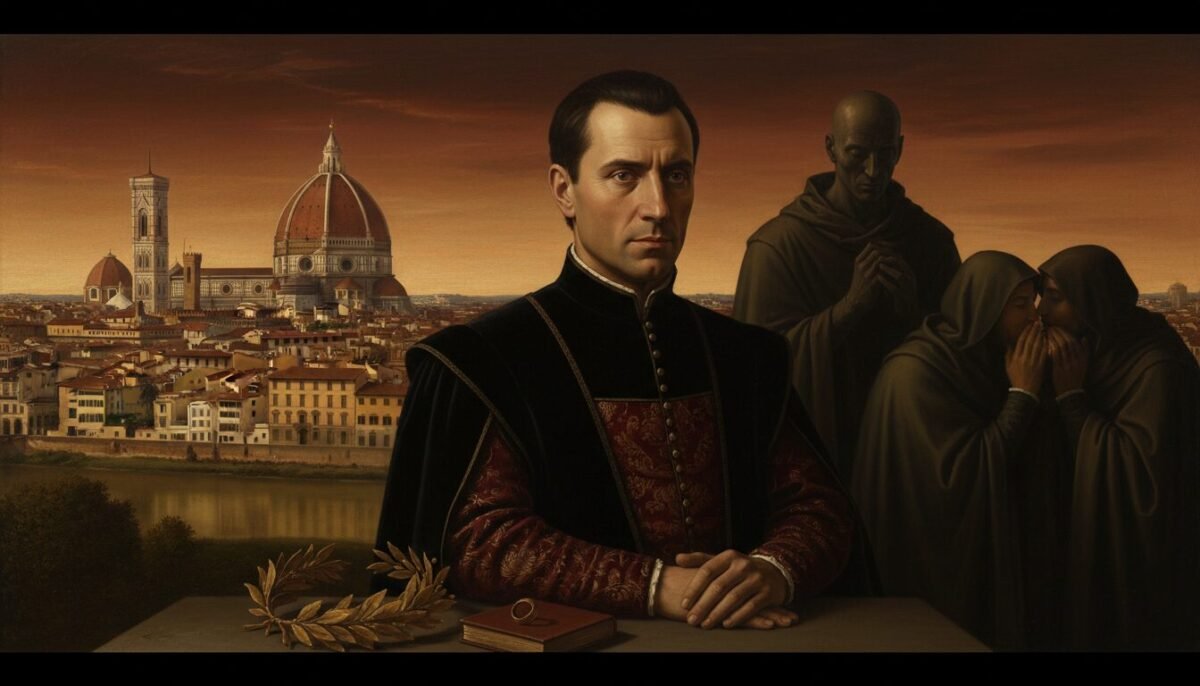
However, this stability was fragile. In 1478, the Pazzi Conspiracy shattered the facade. During High Mass at the Duomo, assassins—backed by the Pope and rival families—attacked Lorenzo and his brother, Giuliano. Giuliano was stabbed 19 times and bled out on the cathedral floor. Lorenzo escaped, but the retaliation was swift and visceral. The conspirators, including an Archbishop, were hung from the windows of the Palazzo Vecchio. This event taught a young Machiavelli a permanent lesson: internal security is a blood sport, and half-measures lead to ruin.
When Lorenzo died in 1492, the “Golden Age” died with him. His successor, Piero the Unfortunate, lacked his father’s psychological depth and diplomatic finesse. When the French King Charles VIII marched into Italy in 1494 with a massive army and modern bronze cannons, Piero buckled. He surrendered key Florentine fortresses without a fight, outraging the citizenry. The Medici were chased out of the city, their palace looted, and their century-long dominance evaporated in a matter of days. This power vacuum didn’t lead to a peaceful utopia; it opened the door for one of the strangest chapters in political history.
2. The Theocratic Republic: The Rise and Fall of Girolamo Savonarola
With the Medici gone, Florence didn’t turn to a seasoned statesman. Instead, it fell under the spell of a radical Dominican friar, Girolamo Savonarola. He was a fire-and-brimstone preacher who claimed to have direct visions from God. He convinced the Florentines that their love of art, luxury, and classical philosophy was a sin that had invited the French invasion as divine punishment.
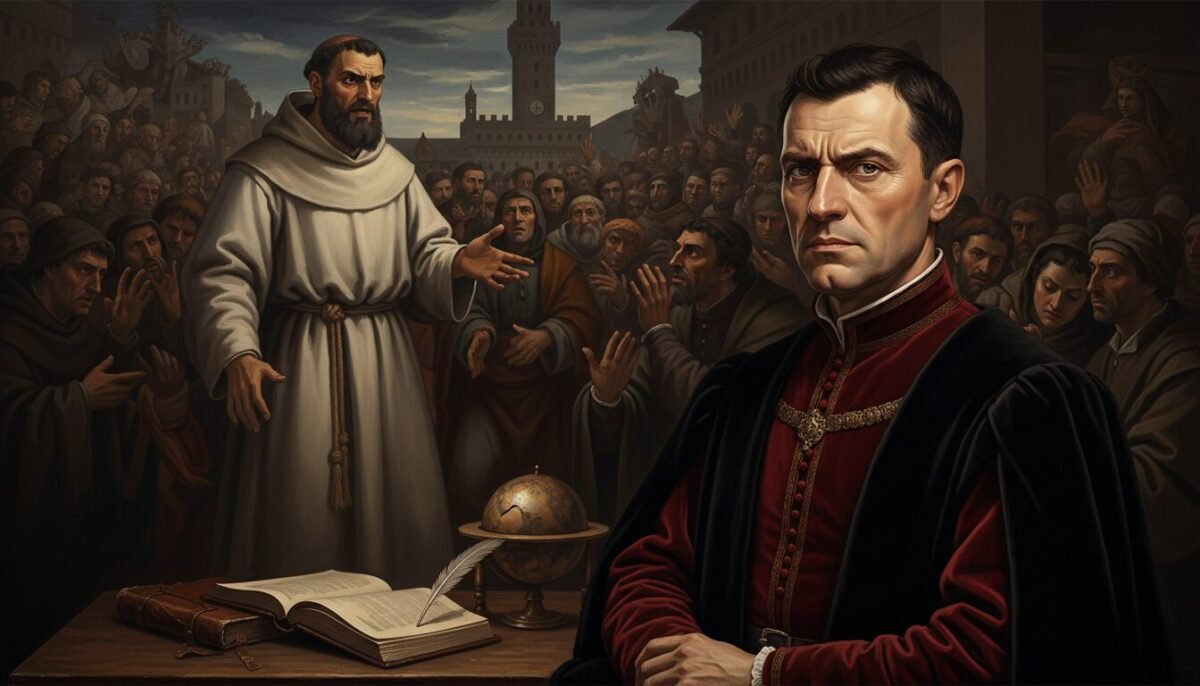
Under Savonarola, Florence became a “Christian and Religious Republic.” He organized the infamous Bonfire of the Vanities, where citizens were pressured to throw their paintings, fine clothes, musical instruments, and books into a massive pyre in the Piazza della Signoria. Machiavelli, watching from the sidelines, observed the friar with a mixture of fascination and contempt. He saw how Savonarola used fear and spiritual manipulation to control the masses, but he also noticed a fatal flaw: Savonarola had no military power.
Machiavelli famously labeled Savonarola an “unarmed prophet.” In his view, prophets who lack the means to enforce their visions are destined to be destroyed once the crowd’s fervor cools. The end came quickly when Savonarola defied Pope Alexander VI (the notorious Rodrigo Borgia). Excommunicated and losing support as the city faced famine and plague, the friar was arrested. In 1498, the same crowd that had burned their “vanities” at his command watched as Savonarola was hanged and burned in the same square. For Machiavelli, this was the ultimate proof that political power cannot rest on religious ecstasy alone; it requires the cold steel of institutional authority.
3. Machiavelli in the Second Chancery: Diplomat of the Republic
Following Savonarola’s execution, Florence restructured itself as a more traditional Republic. At age 29, Machiavelli was appointed as the Secretary to the Second Chancery. This wasn’t a high-ranking aristocratic post, but it was a vital one. He was essentially a high-level civil servant, a diplomat, and a military strategist rolled into one. He spent the next fourteen years on the road, representing Florence in the courts of the world’s most powerful leaders.
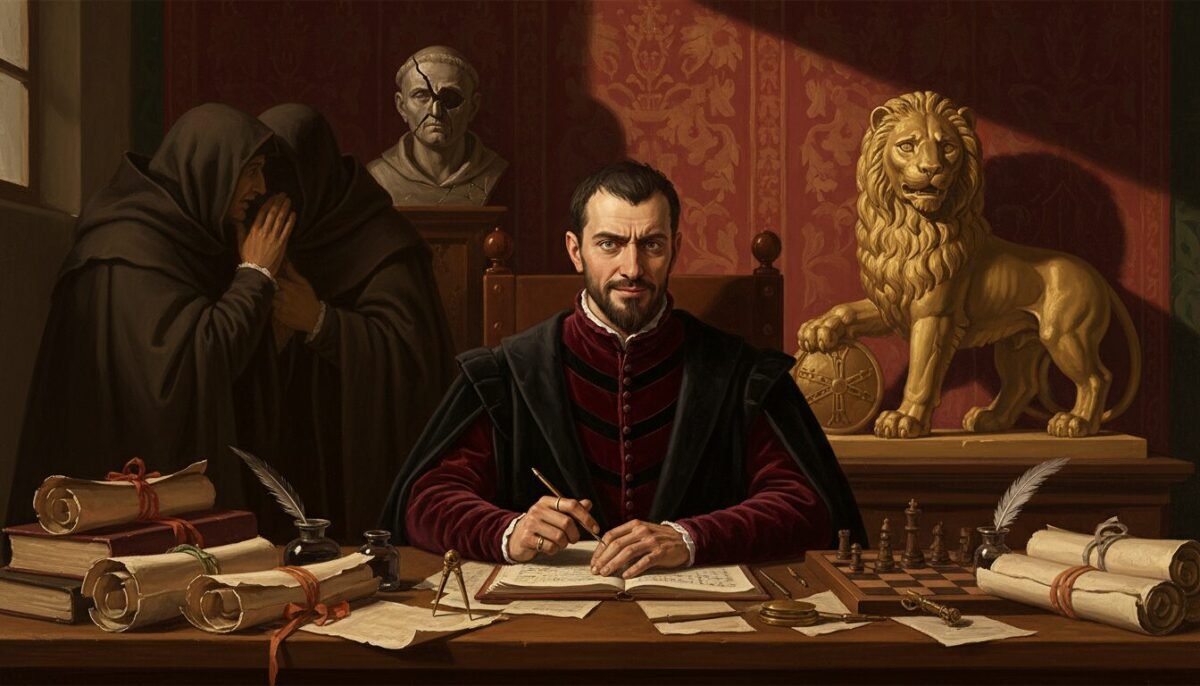
His missions to King Louis XII of France and Emperor Maximilian I exposed him to the emerging “nation-states” of Europe. He realized that while the Italian city-states were squabbling over tiny patches of land, the great powers of France and Spain were building massive, centralized war machines. But the most transformative encounter of his life was with Cesare Borgia, the son of the Pope.
In Cesare Borgia, Machiavelli saw the “ideal” prince in action. Borgia was ruthless, efficient, and utterly unburdened by conventional morality. Machiavelli watched as Borgia invited his rebellious generals to a “peace summit” at Senigallia, only to have them all strangled once they were inside. While the act was horrific, Machiavelli noted that it brought immediate peace and order to a chaotic region. This birthed the central thesis of his later work: that a leader must sometimes do evil so that a greater good—stability and the survival of the state—can be achieved.
During this time, Machiavelli also became obsessed with the idea of a citizen militia. He hated the mercenary armies (condottieri) that Italy relied on. These soldiers of fortune were expensive, disloyal, and often fled at the first sign of real danger. Machiavelli successfully lobbied for a Florentine army made up of its own citizens—men who would fight for their homes, not just for a paycheck. It was his proudest achievement, but it would soon be put to a devastating test.
4. The Italian Wars and Foreign Intervention
The tragedy of Machiavelli’s Florence was that it was a small player in a very large, very violent game. The 1494 French invasion had turned the Italian peninsula into a playground for the “Great Powers.” This period, known as the Italian Wars, saw France, Spain, the Holy Roman Empire, and the Papacy constantly shifting alliances to prevent any one power from dominating.
Florence was often used as a pawn. Because the Republic had historically allied with France, it found itself in the crosshairs of Pope Julius II, the “Warrior Pope.” Julius II was a man who wore armor over his vestments and personally led troops into battle. He formed the Holy League with the goal of “driving the barbarians (the French) out of Italy.”
As the French influence waned, Florence was left exposed. The Republic’s diplomatic tap-dancing could no longer save it. In 1512, the Spanish troops of the Holy League marched toward Florence. They stopped at the nearby town of Prato and committed a massacre so brutal that it sent shockwaves through the region. The Florentine government, realizing they were next, collapsed in terror. The experiment of the Republic was over, and the old masters were waiting in the wings to reclaim their prize.
5. The Medici Restoration and Machiavelli’s Political Downfall
The Medici returned to Florence in 1512, backed by Spanish pikes and the Pope’s blessing. They didn’t return as “first among equals” this time; they returned as lords. For Machiavelli, the collapse of the Republic was a personal and professional catastrophe. He was immediately dismissed from his post, forbidden from entering the Palazzo Vecchio, and eventually accused of being part of a conspiracy to overthrow the new Medici government.
What followed was the darkest period of his life. He was imprisoned and subjected to the strappado—a form of torture where the victim’s hands are tied behind their back and they are hoisted up by a rope, then dropped, causing the shoulders to dislocate. Machiavelli endured six “drops” and refused to confess. Lacking evidence, the Medici eventually released him, but he was exiled to his small, dusty estate in San Casciano, far from the halls of power.
This transition from active politician to powerless observer was agonizing. In a famous letter to a friend, he described his days: spending the morning in the woods with loggers, the afternoon at a local tavern playing cards with a butcher and a miller, arguing over pennies. But at night, he would return home, strip off his muddy clothes, and put on his “regal and courtly garments.” In his study, he “conversed” with the great thinkers of antiquity. This psychological shift—from the heat of the moment to the coldness of reflection—is what gave The Prince its sharp, clinical edge. He wrote not out of academic interest, but out of a desperate, burning need to understand why he had lost everything.
6. The Historical Context of ‘The Prince’ and ‘The Discourses’
In the quiet of his exile, Machiavelli produced two works that would change the world, though they seem to contradict each other. The Prince was a short, punchy handbook on how an autocrat can grab and hold power. He dedicated it to Lorenzo de’ Medici (the grandson of the Magnificent), not because he loved the Medici, but as a desperate job application. He wanted to show them that his years of diplomatic experience were too valuable to waste in a farmhouse.
However, his longer work, The Discourses on Livy, reveals his true heart: he was a die-hard Republican. In The Discourses, he argues that a government of the people is more stable and virtuous than a monarchy. How do we reconcile the two? The answer lies in the chaos of the Italian Wars. Machiavelli believed that in “normal” times, a Republic is best. But in “extraordinary” times—when a country is being torn apart by foreign invaders and internal rot—a “New Prince” is required to perform the “cruelty well-used” necessary to reset the system.
Machiavelli’s realism was a rejection of the “mirror for princes” genre of his time, which told leaders to be pious and kind. He looked at the corpses of Savonarola and the exiled Medici and concluded that the ends justify the means (though he never used that exact phrase). If a leader is too “good” in a world that is not, he will bring about the destruction of his people. For Machiavelli, the ultimate sin wasn’t being cruel; it was being incompetent and losing the state.
Conclusion
Niccolò Machiavelli was not the “Machiavellian” villain that popular culture portrays. He was a man who loved his city more than his own soul, watching it be humiliated by foreign powers and internal incompetence. His writings were a scream of frustration against a world that refused to be orderly. He lived through the peak of the Renaissance and the depths of the Italian Wars, and he realized that the beauty of a Raphael fresco couldn’t survive without the strength of a well-organized army. His life reminds us that political philosophy isn’t born in a vacuum; it is written in the ink of experience and the blood of history.
If you want to understand the darker side of human nature and the mechanics of influence, explore our deep dives into the psychological profiles of history’s most complex figures.
Frequently Asked Questions
Was Machiavelli actually a “Machiavellian” person?
Surprisingly, no. In his personal life, Machiavelli was known for being witty, a loyal friend, and a dedicated civil servant. His “Machiavellian” reputation comes from his willingness to describe the harsh realities of power without the usual religious sugar-coating.
Why did he write ‘The Prince’ if he preferred a Republic?
Machiavelli believed that Italy was in such a state of crisis that only a strong, singular leader could unite the country and drive out foreign invaders. He saw The Prince as a temporary “emergency manual” for a leader to restore order so that a Republic could eventually function again.
What was his most significant contribution to politics?
He is often called the father of modern political science because he separated ethics from politics. He argued that the “virtue” of a ruler is different from the “virtue” of an individual; a ruler’s primary moral duty is the survival and safety of the state.
Deepen Your Understanding:
- Explore the intersection of Machiavelli & Political Philosophy to see how his ideas shaped the modern state.
- Analyze the link between Power & Human Nature to understand why leaders often choose fear over love.
- Read our breakdown of Machiavellianism in modern psychology to see how these traits manifest in today’s world.
- Compare different leadership styles in our guide to Influence & Leadership.
Curious about the figures who lived Machiavelli’s theories? Explore our further reading on the Borgia family and their influence on Renaissance power dynamics to see more of this world in action.