
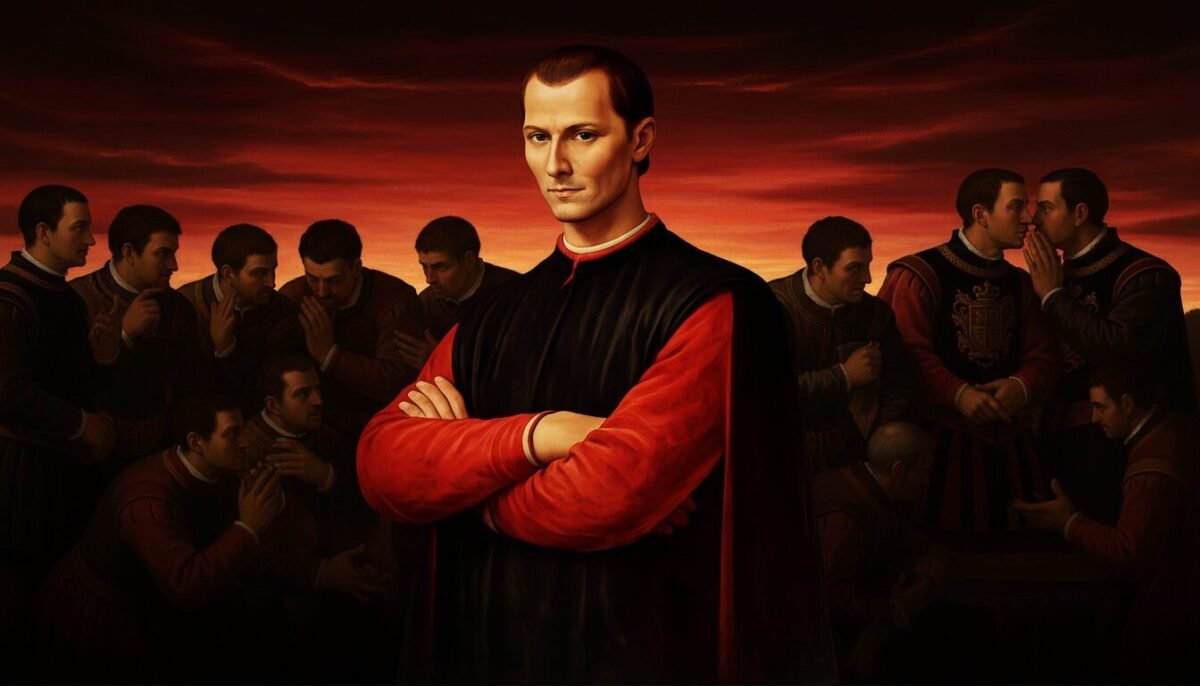
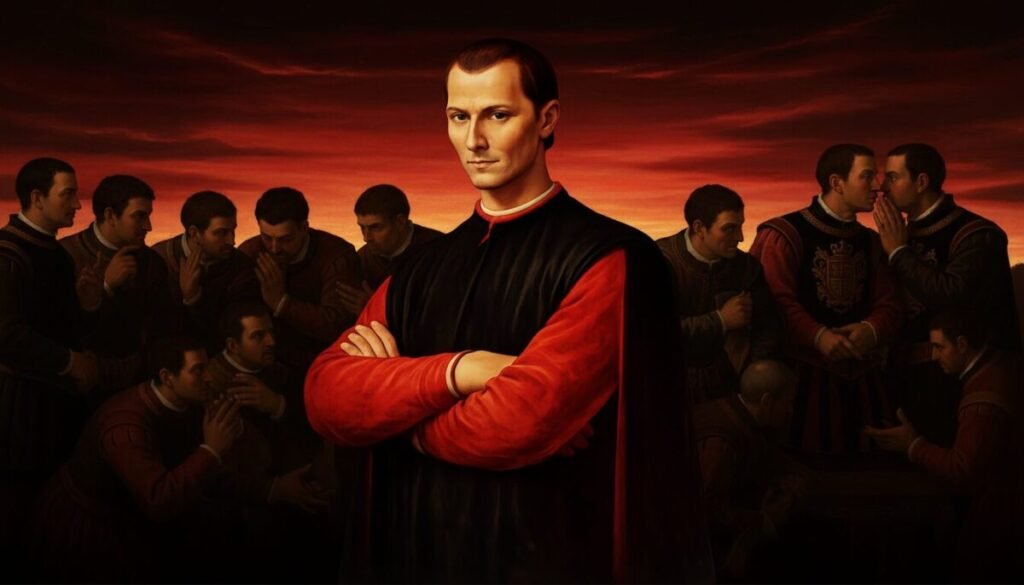
Is it truly better to be feared than loved? This provocative question has defined the legacy of Niccolò Machiavelli for over five centuries, echoing through the halls of modern corporate boardrooms and the corridors of global power. Most people today view Machiavelli through the lens of “Machiavellianism”—a term that has become a convenient synonym for deceit, manipulation, and cold-blooded ruthlessness. We use it to describe the colleague who takes credit for our work or the politician who pivots on a promise. However, to judge Machiavelli solely by the modern definition of his name is to look at a masterwork through a keyhole.
To understand the man, we must understand the fire. Machiavelli’s pragmatism wasn’t born out of a desire for villainy; it was a desperate response to a chaotic, violent world that was tearing his home apart. He lived in an era where “morality” was often a luxury that led straight to the gallows. This exploration dives deep into the historical context of the Italian Renaissance to reveal how Machiavelli’s work was not a manual for evil, but a survival guide for a fragmented nation, ultimately founding the very discipline of modern political science.
1. The Fragmented Reality of Renaissance Italy
To grasp why Machiavelli wrote with such clinical coldness, one must first visualize the map of 15th-century Italy. It was not the unified, boot-shaped nation we know today. Instead, it was a volatile patchwork of competing city-states: the Republic of Florence, the Duchy of Milan, the Republic of Venice, the Papal States, and the Kingdom of Naples. These entities were locked in a perpetual dance of shifting alliances, backstabbing, and border skirmishes.
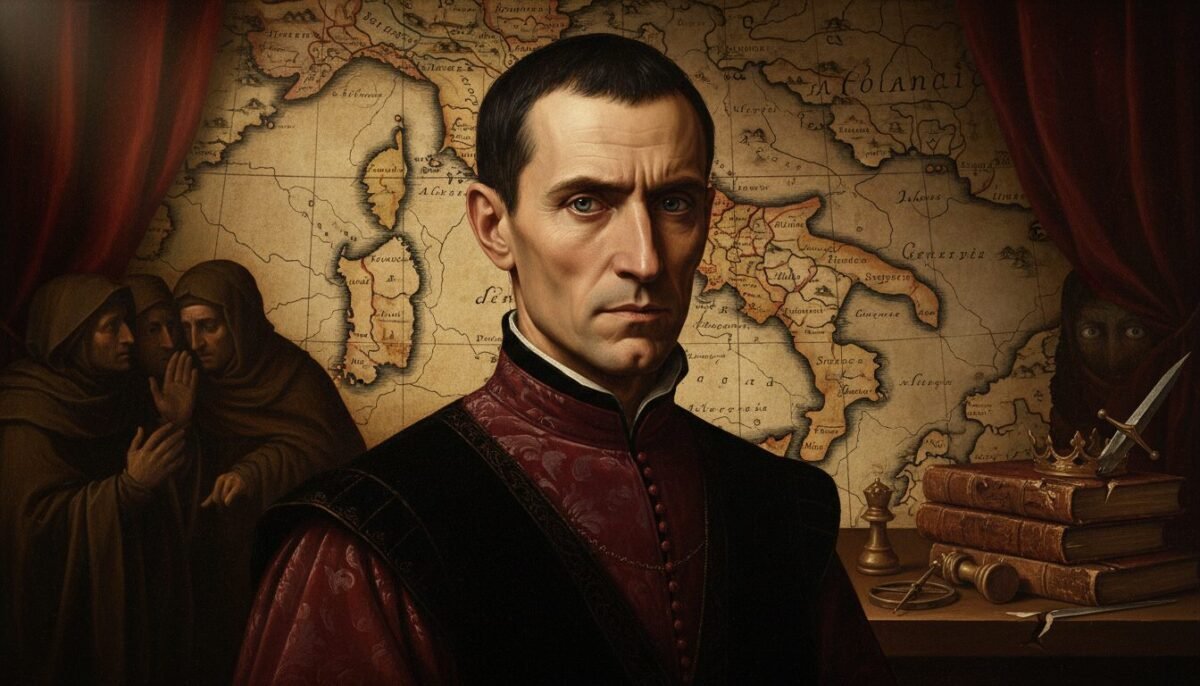
While the rest of Europe was beginning to coalesce into powerful nation-states like France and Spain, Italy remained a “geographic expression.” This fragmentation made the peninsula a playground for foreign giants. Starting in 1494, with the invasion of Charles VIII of France, Italy became the primary battlefield for the “Italian Wars.” French, Spanish, and Holy Roman Empire troops marched across the landscape, looting cities and toppling governments. For an Italian patriot like Machiavelli, watching his culture—the pinnacle of art and learning—be trampled by “barbarian” foreign armies was a source of profound humiliation and urgency.
Simultaneously, the social fabric was shifting. The old medieval feudalism, where power was tied to land and inherited titles, was giving way to a new, merchant-driven urban reality. Florence was the heart of this transformation. It was a city of bankers, wool merchants, and artisans. Power was no longer just about bloodlines; it was about capital, influence, and the ability to navigate the complex bureaucracy of a republic. In this environment, the traditional virtues taught by the Church—humility, turning the other cheek, and honesty—often seemed at odds with the brutal requirements of maintaining a city’s independence. Machiavelli saw that a leader who acted like a saint in a world of wolves would inevitably be devoured.
The Rise of the Mercenary
One of the most destabilizing factors of this period was the reliance on condottieri, or mercenary captains. These were professional soldiers of fortune who sold their services to the highest bidder. Because their primary motivation was profit rather than loyalty, they were notoriously unreliable. They would often drag out wars to keep the paychecks coming or switch sides in the heat of battle if offered a better deal. Machiavelli’s obsession with a “citizen militia” stemmed from his firsthand observation of how these mercenaries drained the coffers of Italian cities while providing no real security. He realized that a state without its own teeth was merely waiting to be eaten.
2. Machiavelli’s Career in the Florentine Republic
Machiavelli was not an armchair philosopher. He was a man of action, a high-ranking civil servant who spent fourteen years at the heart of Florentine politics. In 1498, following the execution of the radical monk Savonarola, Machiavelli was appointed as the Second Chancellor of the Republic of Florence. His role was essentially that of a diplomat and a military strategist. He was the man sent into the field to negotiate with kings, popes, and warlords.
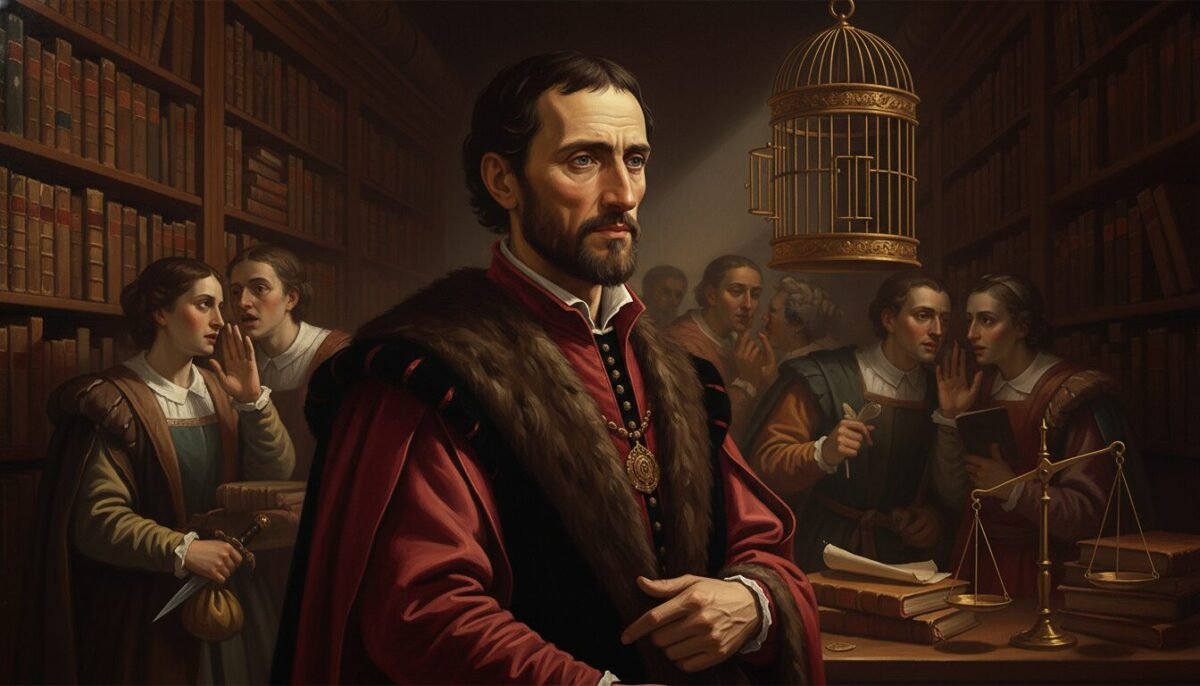
During his diplomatic missions, Machiavelli became a keen observer of power in its rawest form. He traveled to the court of Louis XII in France, where he realized that the French looked down on the Italians because they lacked a unified military. He spent time with Pope Julius II, the “Warrior Pope,” whose impetuousness often achieved what cautious diplomacy could not. But no figure left a deeper impression on him than Cesare Borgia, the Duke of Valentano and the son of Pope Alexander VI.
The Lesson of Cesare Borgia
In Cesare Borgia, Machiavelli saw a new kind of leader. Borgia was ruthless, efficient, and utterly unsentimental. Machiavelli famously recounts an incident in the Romagna region, which Borgia had recently conquered. To bring order to the lawless province, Borgia appointed a cruel governor, Remirro de Orco, to do the “dirty work” of pacification. Once the region was subdued, Borgia realized the people hated the governor for his cruelty. To distance himself from the violence while still reaping the benefits of order, Borgia had Remirro executed and his body left in the town square, cut in two. The spectacle left the people “at once stunned and satisfied.”
To a modern reader, this is horrific. To Machiavelli, it was a masterpiece of political stagecraft. He observed that Borgia used force precisely and economically to achieve a stable outcome. These missions shaped Machiavelli’s cynical yet realistic view of human nature. He concluded that men are generally “ungrateful, fickle, pretenders, and dissemblers.” If people are inherently unreliable, then a leader cannot rely on their “love,” which is a bond of obligation they will break whenever it suits them. Fear, however, is maintained by a dread of punishment which never fails.
3. The Medici Family and the Genesis of ‘The Prince’
Machiavelli’s world came crashing down in 1512. The Florentine Republic, which he had served so faithfully, collapsed when the Spanish-backed Medici family returned to power. The Medici were the titans of Florence, a banking dynasty that had ruled the city for generations before being exiled. Their return signaled the end of Machiavelli’s political career. He was dismissed from his post, accused of conspiracy against the new regime, and thrown into a dungeon.
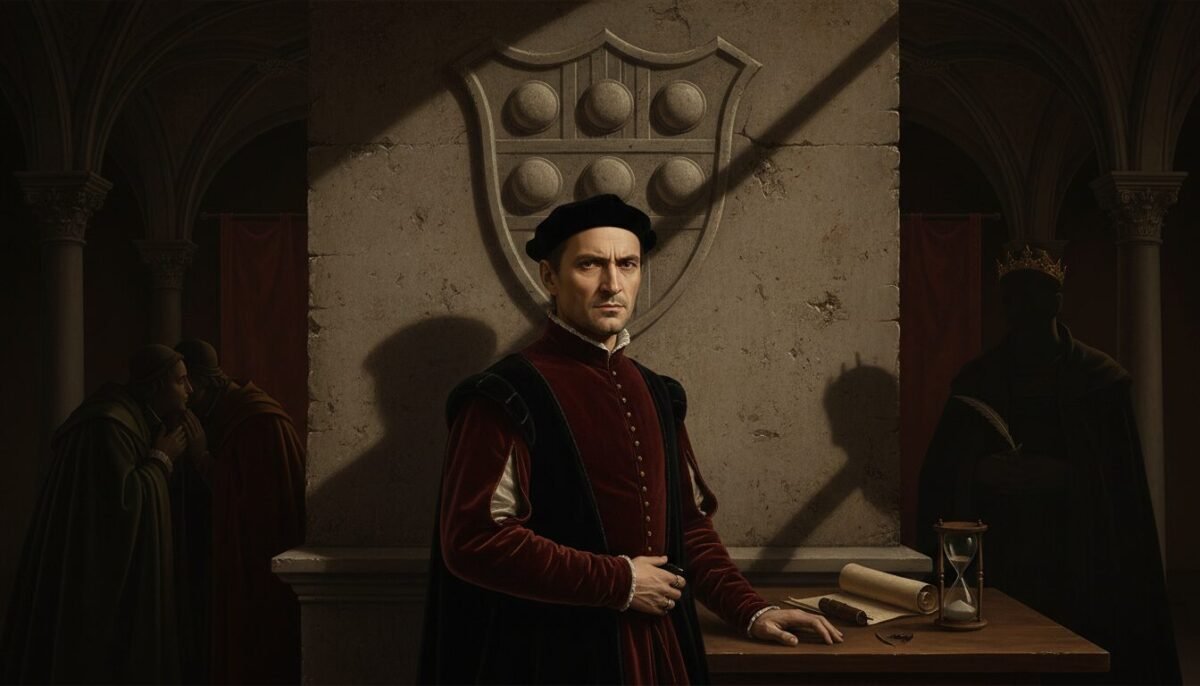
While in prison, Machiavelli was subjected to the strappado—a form of torture where the prisoner’s hands are tied behind their back and they are hoisted up by a rope, causing the shoulders to dislocate. He survived the ordeal without confessing to crimes he didn’t commit, but he was eventually exiled to his small, dusty farm in San Casciano, just outside the city. For a man who thrived on the adrenaline of high-stakes diplomacy, exile was a living death. He spent his days trapping thrushes and arguing with local woodcutters in the village tavern.
A Letter to the Future
It was in this state of desperation and boredom that The Prince was born. In a famous letter to his friend Francesco Vettori, Machiavelli described his evening routine: he would strip off his muddy farm clothes and put on the “curial robes” he wore when he was an ambassador. Thus “honorably dressed,” he would enter his study to “converse” with the great thinkers of antiquity. The Prince was not intended as a book for the general public. It was, in essence, a high-stakes job application.
Machiavelli dedicated the work to Lorenzo de’ Medici, the grandson of Lorenzo the Magnificent, in a blatant attempt to regain political favor. He wanted to show the Medici that his years of diplomatic experience were a valuable asset they could use to stabilize their rule and, eventually, liberate Italy from foreign invaders. He was saying, “I know how the world actually works. Let me show you how to keep your power so that we can save our country.” Ironically, the Medici largely ignored the gift. The manual that would change the world sat on a shelf, unread by the very man it was meant to advise.
4. Core Philosophy: Virtù, Fortuna, and Secular Realism
The true radicalism of Machiavelli lies in his separation of politics from private morality. Before Machiavelli, political treatises (often called “Mirrors for Princes”) argued that a leader should be a paragon of Christian virtue—just, merciful, and pious. Machiavelli shattered this tradition. He argued that the “effectual truth” of a matter is more important than the “imagination” of it. If a leader tries to be “good” in all circumstances, he will bring about the ruin of the state, which is the greatest “evil” of all because it leads to anarchy and suffering for everyone.
Redefining Virtù
One of Machiavelli’s most misunderstood concepts is Virtù. In the Italian of his time, this didn’t mean “virtue” in the sense of moral goodness. Instead, it derived from the Latin vir (man) and referred to prowess, energy, courage, and, most importantly, adaptability. A leader with virtù is like a chameleon; he knows when to be the “Lion” (to scare the wolves) and when to be the “Fox” (to recognize the traps). Virtù is the ability to do whatever the situation requires—even if that action is “evil”—to achieve a stable and prosperous state.
Wrestling with Fortuna
Machiavelli balanced virtù against Fortuna (luck or fate). He famously compared Fortuna to a torrential river that, when angry, floods the plains and destroys everything in its path. However, he argued that when the weather is calm, a leader with virtù can build dikes and dams to direct the water. In one of his most controversial passages, he wrote that “fortune is a woman, and if you wish to keep her under it is necessary to beat and ill-use her.” While shocking to modern ears, the metaphor was meant to convey that a leader must be bold and proactive rather than passive. You cannot control luck, but you can prepare for it and command it through sheer force of will.
This secular realism marked the birth of a new way of thinking. Machiavelli wasn’t interested in how people ought to live, but in how they do live. By removing the “divine right of kings” and the constraints of religious dogma from the equation, he turned politics into a technical craft—a science of the possible. He argued that the survival of the state (the ragione di stato) justifies the means used to achieve it. This wasn’t an “anything goes” philosophy; it was a “whatever is necessary for the common good” philosophy.
5. Beyond ‘The Prince’: The Republicanism of ‘Discourses on Livy’
If you only read The Prince, you might conclude that Machiavelli was a fan of tyranny. However, his much longer and more complex work, Discourses on Livy, reveals a very different side of his thought. While The Prince was a handbook for a “new prince” in a time of crisis, the Discourses is a deep dive into how a stable Republic should be governed, using the history of ancient Rome as a guide.
In the Discourses, Machiavelli expresses a clear preference for a republic over a principality. He argues that the populace, as a whole, is “wiser and more constant” than a single prince. He believed that the collective wisdom of the citizens and their desire for liberty were the best safeguards against corruption. However, he was also a realist about human nature within a republic. He didn’t believe in a peaceful utopia; instead, he argued that the “clashes” between the nobility and the common people (the plebs) were actually what made Rome strong. These tensions led to the creation of laws that protected liberty.
The Importance of Checks and Balances
Machiavelli was an early advocate for what we now call checks and balances. He believed that a healthy state needs a “mixed” constitution that combines elements of monarchy, aristocracy, and democracy. By giving each group a share of power, they would keep each other in check, preventing any one faction from becoming tyrannical. He also emphasized the role of “civic religion”—not necessarily a belief in the supernatural, but a shared set of values and myths that bind a people together and inspire them to sacrifice for the common good. For Machiavelli, the ultimate goal was not the power of the ruler, but the liberty and longevity of the state.
6. The Father of Modern Political Science and International Relations
Machiavelli’s influence on the modern world is difficult to overstate. By separating ethics from politics, he paved the way for the study of “Realpolitik”—a system of politics based on practical rather than moral or ideological considerations. This approach became the foundation for modern diplomacy and international relations. When a modern diplomat negotiates a treaty based on “national interest” rather than shared moral values, they are speaking Machiavelli’s language.
His impact on later philosophers was seismic. Thomas Hobbes’s view of the “state of nature” as a “war of all against all” owes a great debt to Machiavelli’s cynical view of human behavior. John Locke and the American Founding Fathers, while more optimistic, were deeply influenced by his ideas on republicanism, the danger of standing armies, and the necessity of checks and balances. James Madison’s Federalist Papers echo Machiavelli’s belief that “ambition must be made to counteract ambition.”
In the realm of science, Machiavelli is often credited with applying the empirical method to human affairs. Just as Galileo was observing the stars to understand the laws of physics, Machiavelli was observing the behavior of men in power to understand the laws of politics. He didn’t care for “imagined republics and principalities that have never been seen or known to exist.” He wanted the data. He wanted to know what worked and why.
A Scientist of the Possible
Ultimately, Machiavelli was not a “teacher of evil.” He was a scientist of the possible. He looked at the wreckage of Renaissance Italy and tried to find a way to build something that could endure. He understood that power is not a dirty word, but a tool. Like a scalpel, it can be used to kill or to perform life-saving surgery. His “crime” was simply describing the world as it is, rather than as we wish it to be.
Frequently Asked Questions
Did Machiavelli actually say “the end justifies the means”?
Interestingly, that exact phrase never appears in his writings. The closest he comes is in The Prince, where he suggests that in the actions of all men, and especially of princes, “one judges by the result.” He argued that if a prince succeeds in maintaining the state, the means will always be judged honorable by the public.
Was Machiavelli an atheist?
Machiavelli was highly critical of the Catholic Church of his time, primarily because he felt its emphasis on humility made Italians “weak” and easy prey for invaders. He also blamed the Papacy for keeping Italy fragmented. However, whether he was a personal atheist is debated; he seemed to value religion more for its social utility in maintaining order and morale than for its spiritual truth.
Why is ‘The Prince’ so much more famous than his other works?
The Prince is short, punchy, and intentionally provocative. Its “shock value” and clear, clinical advice on power made it a scandalous bestseller for centuries. The Discourses, while perhaps more representative of his personal beliefs, is a much longer, academic study of history that requires more patience to digest.
If you found this analysis of power dynamics intriguing, you might also enjoy exploring our deep dives into Machiavellianism in the modern workplace, the psychological intersection of Influence & Leadership, or our comparative study on Power & Human Nature across different cultures.
Explore more at DeepPsyche.blog to uncover the hidden mechanics of the human mind and the structures of power that shape our world.