
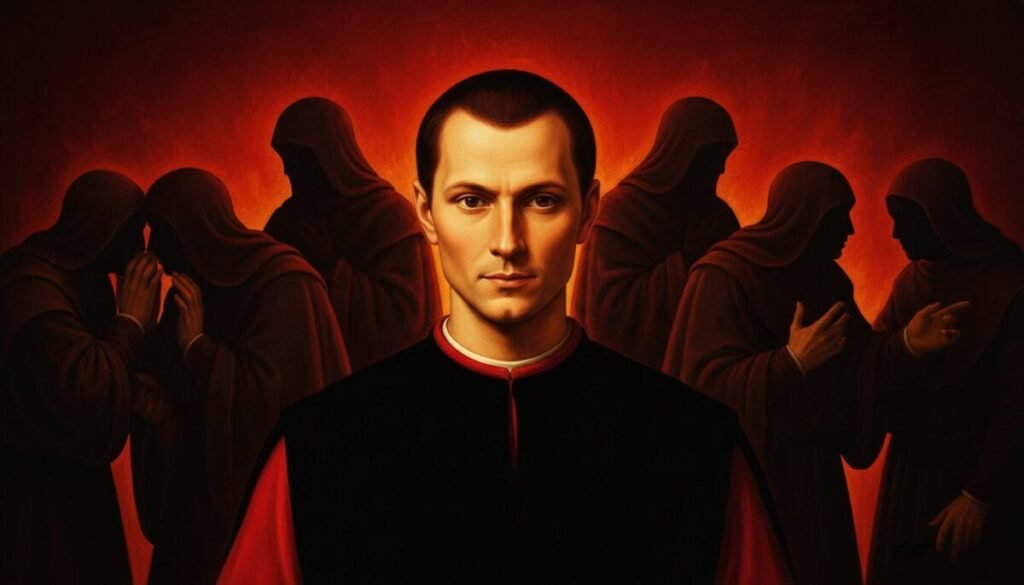
Is it truly better to be feared than loved, or is this the ultimate political misconception? For five centuries, the name Niccolò Machiavelli has been used as a shorthand for cold-blooded manipulation and the dark arts of power. We call people “Machiavellian” when they are ruthless, deceptive, and devoid of moral fiber. Yet, if we pull back the curtain on the man who wrote The Prince, we find something far more complex than a “teacher of evil.” We find a man who was deeply concerned with the survival of society in a world that refuses to play by the rules of Sunday school.
Imagine living in a world where your city could be sacked, your family exiled, and your government overthrown by a neighboring prince’s whim or a mercenary’s greed. This was the reality of 16th-century Italy. Machiavelli didn’t invent cruelty; he simply had the courage to describe it as it actually functioned. He wasn’t interested in how people ought to live, but in how they actually live. By stripping away the veneer of medieval idealism, he offered a pragmatic guide for those who carry the heavy burden of leadership. This analysis explores the mechanics of power, the necessity of “virtù,” and why Machiavelli’s observations remain the bedrock of modern statecraft.
1. Historical Context: Renaissance Italy and the Birth of Realpolitik
To understand Machiavelli, you must first understand the chaos of his environment. Renaissance Italy was not just a period of breathtaking art and architecture; it was a fragmented collection of city-states—Florence, Milan, Venice, the Papal States, and Naples—constantly at each other’s throats. Foreign powers like France and Spain used the Italian peninsula as their personal playground for war. In this atmosphere, political stability was a rare luxury, and survival was a daily struggle.
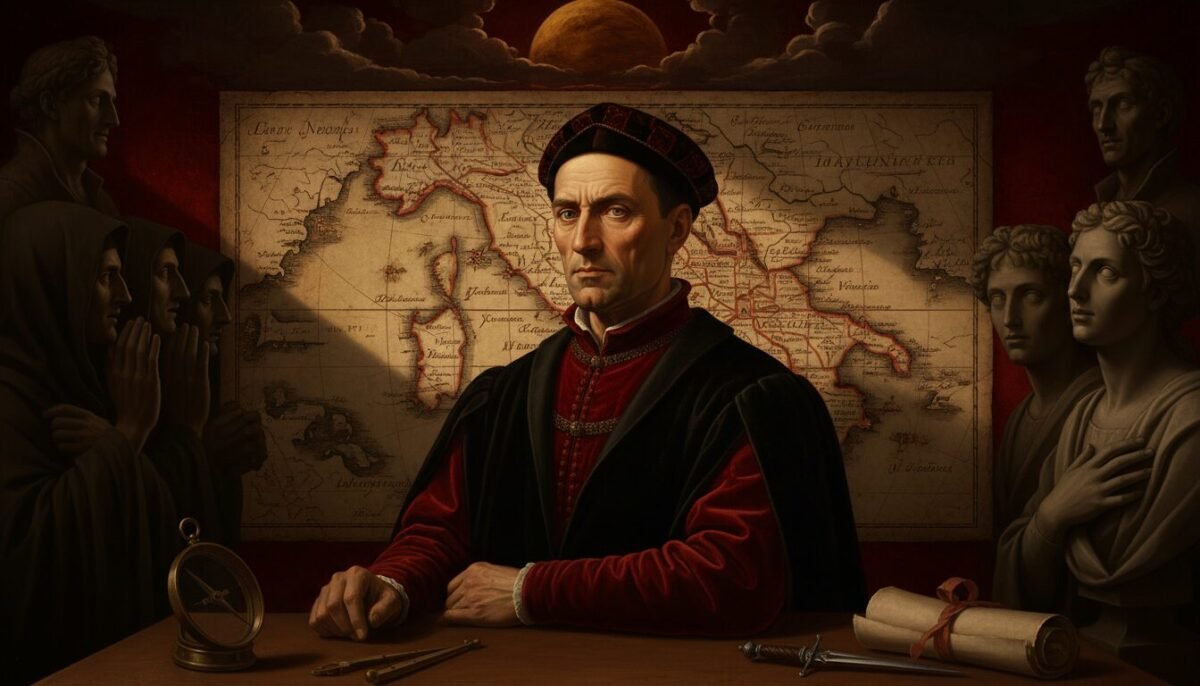
Machiavelli served as a diplomat for the Florentine Republic for fourteen years. He witnessed firsthand the brutal efficiency of Cesare Borgia, the son of Pope Alexander VI. Borgia was a man who could invite his enemies to a “peace dinner” and have them strangled before the dessert was served. While others recoiled in horror, Machiavelli watched with a clinical eye. He saw that Borgia’s ruthlessness, however bloody, had brought order to the lawless region of Romagna. To Machiavelli, a short burst of calculated violence that resulted in long-term peace was infinitely more “moral” than a weak leader whose kindness allowed a civil war to break out.
The turning point in Machiavelli’s life came in 1512 when the Medici family, backed by Spanish troops, dissolved the Florentine Republic. Machiavelli was ousted from his post, imprisoned, and tortured on the rack. When he was finally released to his farm in the countryside, he didn’t write a book about the beauty of democracy or the power of prayer. He wrote The Prince. It was a job application of sorts, but more importantly, it was a transition from medieval idealism—which believed a king must be a mirror of Christ—to the pragmatic observation of human nature. He realized that the state is a fragile construct, and the rules that govern a private individual’s soul are often the very things that lead to a nation’s ruin.
2. The Autonomy of Politics: Separating Morality from Statecraft
One of Machiavelli’s most radical contributions to human thought was the idea that politics has its own internal logic, entirely separate from Christian ethics. Before Machiavelli, political writers argued that a good ruler must be a good person. They believed that justice, mercy, and honesty were the only paths to a successful reign. Machiavelli looked at the graveyard of history and disagreed. He observed that “the man who neglects what is done for what ought to be done, sooner effects his ruin than his preservation.”
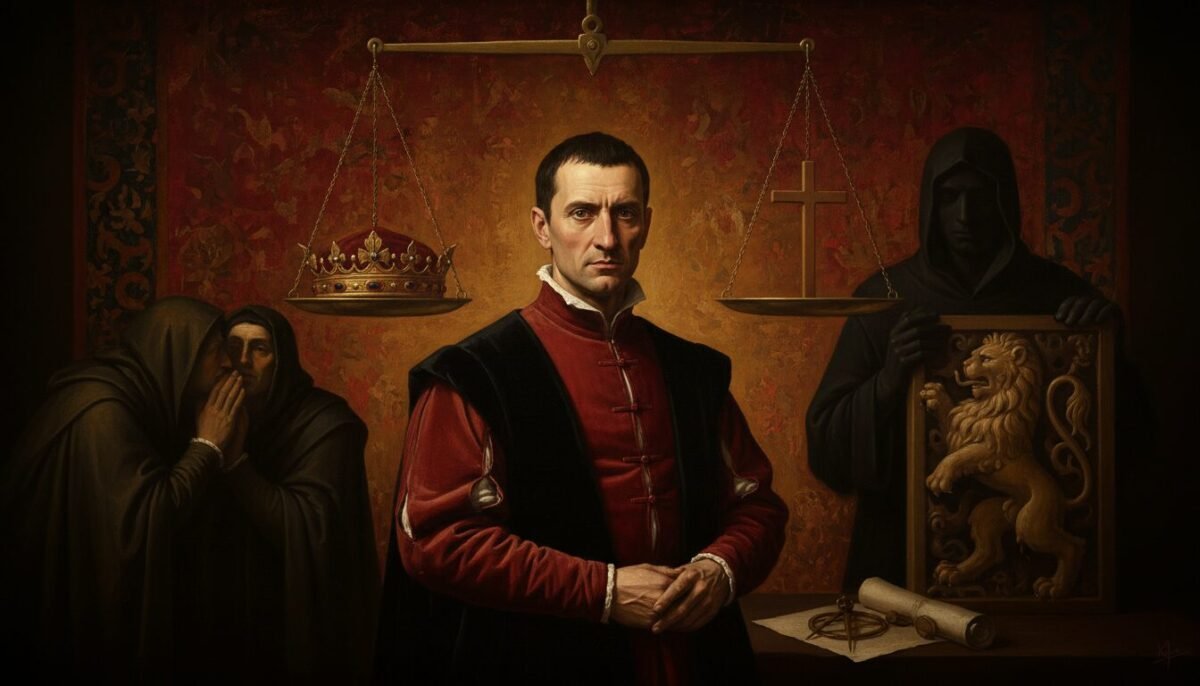
This is the core of what we now call Raison d’État or “Reason of State.” Machiavelli argued that the primary duty of a ruler is the security and survival of the state. If achieving that security requires deception, breaking a treaty, or even execution, then the ruler is “morally” obligated to do those things for the greater good of the people. This is often summarized as “the end justifies the means.” While Machiavelli never used that exact phrase, the sentiment is accurate: the “end” (a stable, prosperous state) justifies the “means” (actions that would be considered sinful in private life).
Think of it as a surgeon performing an amputation. In any other context, cutting off a person’s leg is an act of horrific violence. But in the context of saving a patient from gangrene, it is an act of necessity. Machiavelli viewed the state as a body and the ruler as the surgeon. Private Christian morality—turning the other cheek, being humble, telling the truth at all costs—is wonderful for the soul, but Machiavelli warned that it is a recipe for disaster in the arena of power. A leader who refuses to “enter into evil” when necessary is not being holy; they are being irresponsible. They are handing their citizens over to the wolves.
3. Virtù and Fortuna: The Two Pillars of Machiavellian Success
In the Machiavellian universe, success is determined by the interplay between two forces: Virtù and Fortuna. It is essential to understand that when Machiavelli speaks of virtù, he is not talking about “virtue” in the sense of moral goodness. Instead, he is using the Latin root vir (man), referring to manliness, prowess, skill, and the bold energy required to seize the moment. Virtù is the ability of a leader to adapt to any circumstance, to be flexible, and to act decisively.
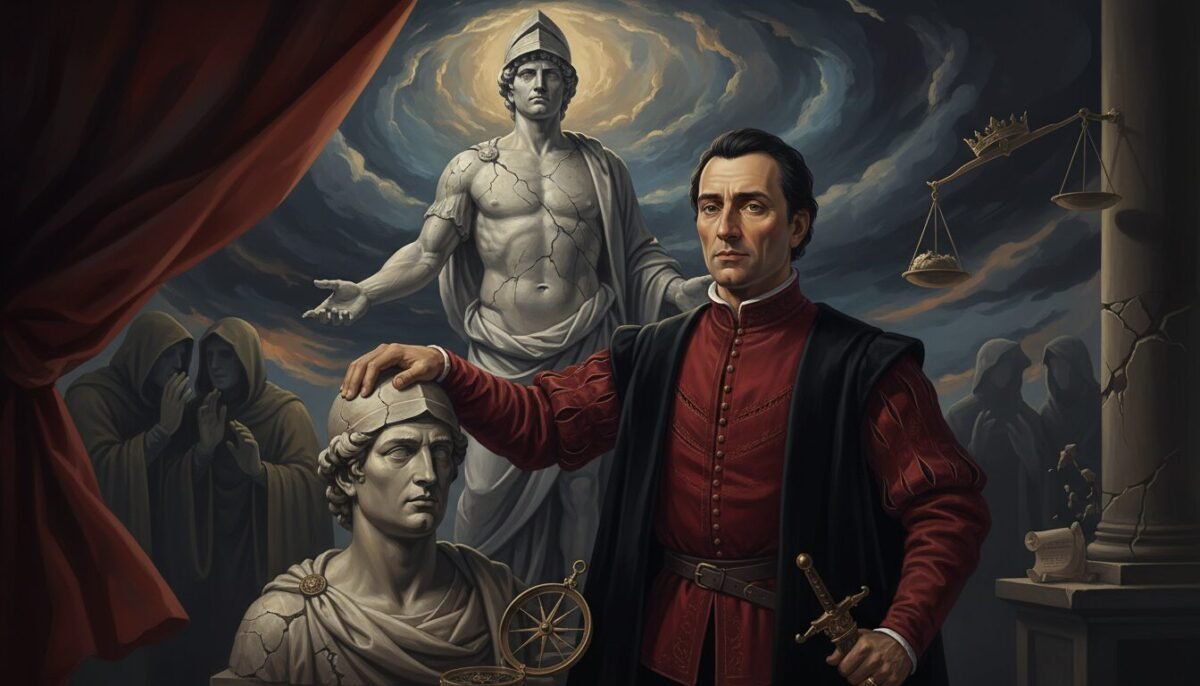
On the other side of the coin is Fortuna—luck, chance, or the unpredictable nature of the world. Machiavelli famously compared Fortuna to a raging river. When it floods, it destroys everything in its path, and no one can stop it. However, a man of virtù does not simply wait for the flood. During the dry season, he builds dikes and dams so that when the river rises, its force is channeled or contained. In other words, you cannot control luck, but you can prepare for it. A leader who relies entirely on good fortune will fall the moment the wind changes. A leader with virtù creates their own luck through preparation and audacity.
Machiavelli’s most controversial metaphor regarding Fortuna is that she is like a woman who must be “beaten and coerced” to be kept under control. While this language is jarring to modern ears, the psychological point remains: the world favors the bold. History is not made by those who wait for the perfect moment; it is made by those who have the skill to recognize an opportunity and the ruthlessness to seize it before it vanishes. The successful ruler is the one who can match their virtù to the specific demands of the times.
4. The Lion and the Fox: Leadership Strategies for Power Dynamics
How should a leader actually behave in the face of opposition? Machiavelli suggests that a ruler must learn to imitate the nature of two animals: the Lion and the Fox. The Lion is strong and can drive away wolves, but he is trapped by snares. The Fox is cunning and can recognize traps, but he is defenseless against wolves. Therefore, a ruler must be a Fox to recognize the traps and a Lion to frighten the wolves.
This brings us to the famous question: Is it better to be feared or loved? Machiavelli’s answer is a masterpiece of psychological realism. He argues that it would be best to be both, but since that is rarely possible, it is much safer to be feared than loved. Why? Because love is a bond of obligation that men, being a “sorry lot,” break whenever it serves their interest. But fear is maintained by a dread of punishment which never fails. However, there is a crucial caveat: a ruler must be feared, but never hated. Hatred is the ultimate political poison. Once the people hate their leader, they will conspire against him regardless of the consequences. To avoid hatred, a ruler must respect the property and the women of his subjects. As Machiavelli dryly noted, “men sooner forget the death of their father than the loss of their patrimony.”
Furthermore, Machiavelli argues that a ruler must be a “great pretender and dissembler.” He doesn’t need to actually possess all the good qualities—mercy, faith, integrity, humanity, and religion—but he must appear to possess them. In fact, actually having these qualities and always practicing them can be harmful, while appearing to have them is useful. The public judges by what they see, and as long as the state is stable and the ruler successful, the “means” will always be judged honorable by the masses.
5. The Prince and the State: A Blueprint for Political Stability
While The Prince is often read as a handbook for tyrants, it was actually written as a manual for “new princes”—leaders who have just taken over a territory and must establish order in a volatile environment. Machiavelli was obsessed with stability. He had seen the horrors of anarchy, and he believed that a strong, even harsh, central authority was the only thing standing between civilization and chaos.
One of his most practical pieces of advice concerned the military. During the Renaissance, most Italian states relied on mercenaries—soldiers for hire. Machiavelli despised them. He argued that mercenaries are “disunited, ambitious, without discipline, unfaithful.” They are brave when there is no war, but when the fighting starts, they either run away or switch sides to the highest bidder. Machiavelli insisted that a stable state must have its own national citizen-militia. When men fight for their own homes and families, they fight with a tenacity that money cannot buy. This was a revolutionary idea that foreshadowed the modern nation-state and the concept of the “citizen-soldier.”
The ultimate goal of the Prince is not personal wealth or the indulgence of whims. The goal is the glory and longevity of the state. A successful leader leaves behind a legacy of order and strength. For Machiavelli, the greatest sin a leader could commit was not a moral sin like lying or killing, but the political sin of weakness. A weak leader allows the state to crumble, leading to far more suffering for the common people than a “cruel” but effective leader ever would.
6. Legacy and Impact: Machiavellian Thought in Modern Politics
Machiavelli’s influence is so pervasive that we often don’t even realize we are breathing his air. He is the founding father of modern political science and the school of Realpolitik. His ideas paved the way for thinkers like Thomas Hobbes, who argued that without a strong “Leviathan,” life would be “nasty, brutish, and short.” In international relations, the “Realist” school—which views the world as a competition for power between self-interested states—is purely Machiavellian.
In the modern world, we see Machiavelli’s ghost in every election cycle and corporate boardroom. When a political candidate shifts their platform to match the “mood of the times,” they are practicing virtù. When a CEO makes the “hard decision” to lay off thousands of workers to save the company from bankruptcy, they are invoking the “Reason of State.” Even the way modern governments use “spin” and public relations is a high-tech version of Machiavelli’s advice to be a “great pretender and dissembler.”
However, the transition from Machiavellianism to modern democracy added a layer he didn’t emphasize: the rule of law. While Machiavelli focused on the individual Prince, modern political science has moved toward creating systems where power is checked and balanced. Yet, even in a democracy, the fundamental questions remain: How much “evil” are we willing to tolerate from our leaders to ensure our safety? Can a truly moral person ever survive in the highest levels of power? Machiavelli’s genius was that he stopped asking what we should do and started showing us what we actually do.
Conclusion
Machiavelli’s view on power was not a celebration of cruelty, but a realistic assessment of the state’s survival. He was a man who looked into the abyss of human nature and didn’t blink. By balancing virtù and fortuna, and understanding the necessity of political realism, he laid the groundwork for how we understand leadership today. He reminds us that power is not a prize to be won, but a tool to be managed with extreme care and constant vigilance. Whether we like it or not, we live in a Machiavellian world; understanding his rules is the first step toward navigating it without being destroyed by it.
Explore our further readings on Renaissance political thought and leadership strategy to master the art of influence at DeepPsyche.blog.
Frequently Asked Questions
1. Did Machiavelli actually believe the “end justifies the means”?
While he never used that specific phrase, he argued that a ruler’s primary duty is the survival of the state. If “immoral” actions are necessary to achieve that stability, they are politically justified.
2. Why is Machiavelli considered the father of modern political science?
He was the first to analyze politics as a secular, objective field of study, focusing on how power actually functions rather than how it should function according to religious or moral ideals.
3. What is the difference between “Virtù” and modern virtue?
Modern virtue implies moral goodness. Machiavellian virtù refers to a leader’s skill, prowess, and ability to act decisively and adapt to changing circumstances, regardless of morality.
4. Is Machiavellianism relevant in business today?
Yes. Many concepts of strategic competition, crisis management, and “appearing” to hold certain values while making pragmatic decisions are rooted in Machiavellian realism.
Internal Link Suggestions:
- Learn more about the intersection of Machiavelli & Political Philosophy.
- Dive deeper into the dark side of Power & Human Nature.
- Is your boss a “Prince”? Read our guide on Machiavellianism in the workplace.
- Master the psychological tactics of Influence & Leadership.
- How does Western realism compare to Eastern thought? See Comparative Philosophy.