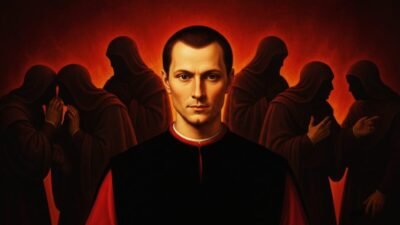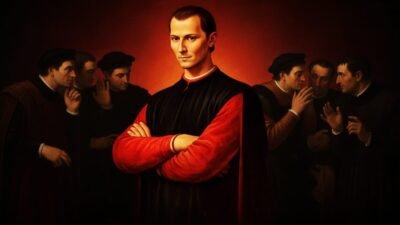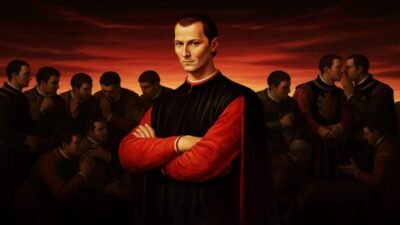
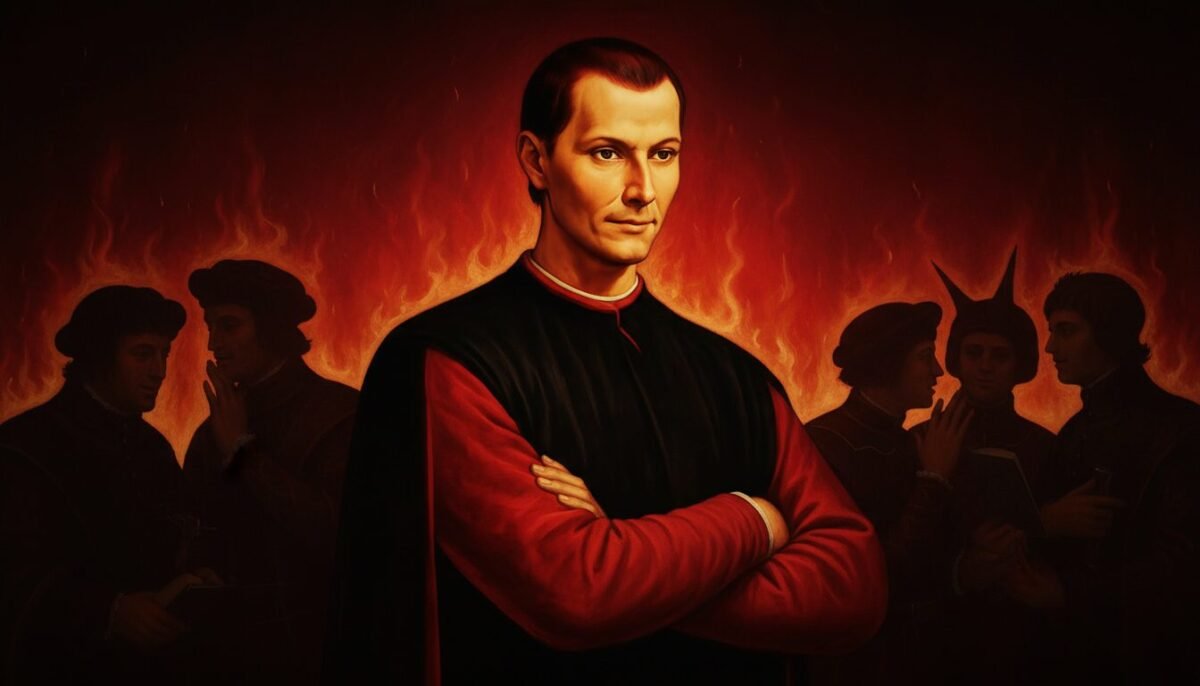
Imagine you are the leader of a city-state under siege. Your treasury is dwindling, your allies are whispering behind your back, and your citizens are restless. You have two choices: you can act with the utmost Christian charity, hoping your goodness inspires loyalty, or you can take a calculated, perhaps even ruthless, action to secure your borders and silence dissent. If you choose the former and your city falls, history will remember you as a “good man” who presided over a catastrophe. If you choose the latter and succeed, you are a “villain” who saved a civilization.
This is the fundamental tension at the heart of Niccolò Machiavelli’s worldview. For centuries, his name has been used as a slur—a synonym for deceit, manipulation, and cold-blooded ambition. Yet, to dismiss Machiavelli as a mere teacher of evil is to miss one of the most profound structural insights into the human condition ever recorded. He didn’t invent the dark side of politics; he simply had the courage to describe it as it actually functions, rather than how we wish it did. By peeling back the veneer of “divine right” and moral posturing, he laid the groundwork for what we now call political science.
1. The Historical Context of Renaissance Florence
To understand Machiavelli, one must first understand the chaos of 15th-century Italy. This wasn’t the Italy of postcards and quiet vineyards; it was a fractured landscape of warring city-states—Florence, Milan, Venice, the Papal States, and Naples—all being trampled by the “barbarian” superpowers of France and Spain. Florence, the jewel of the Renaissance, was a laboratory of political instability. One year it was a republic, the next it was under the thumb of the Medici family, and the year after that, it was a religious theocracy under the fanatical monk Savonarola.
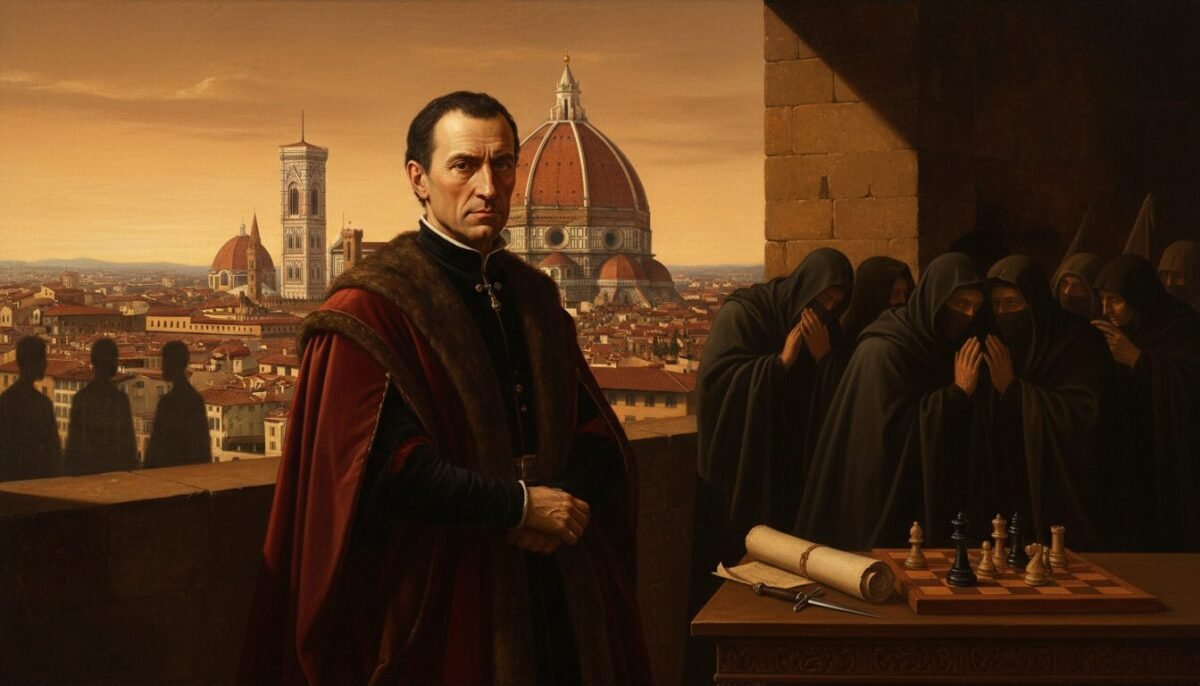
Machiavelli was not an armchair philosopher. He was a high-ranking diplomat and civil servant for the Florentine Republic. He spent fourteen years riding across Europe, meeting with kings, popes, and warlords. He watched firsthand as the ruthless Cesare Borgia consolidated power through a mix of brilliance and brutality. When the Medici returned to power in 1512, Machiavelli was ousted, imprisoned, and tortured on the “strappado”—a device that dislocated the shoulders. It was during his forced exile to a small farm outside the city that he wrote The Prince.
This transition from the medieval world to the Renaissance is crucial. The medieval “scholastic” tradition viewed politics as a branch of theology; a ruler was supposed to be a servant of God, and his success was tied to his piety. Machiavelli broke this mold entirely. Influenced by the humanistic revival of Greek and Roman texts, he looked at history not as a series of divine miracles, but as a cycle of human cause and effect. His pragmatism was born from the trauma of seeing his beloved Florence humiliated by more organized, more realistic powers.
2. From Idealism to Realpolitik: The Birth of Political Realism
Before Machiavelli, there was a popular genre of literature known as “mirrors for princes.” These were handbooks that told rulers they should be virtuous, kind, and generous, promising that if they were good men, God would ensure their kingdoms prospered. Machiavelli took these “mirrors” and smashed them. He famously wrote that there is such a gap between how one lives and how one should live that he who neglects what is being done for what should be done will learn his destruction rather than his preservation.
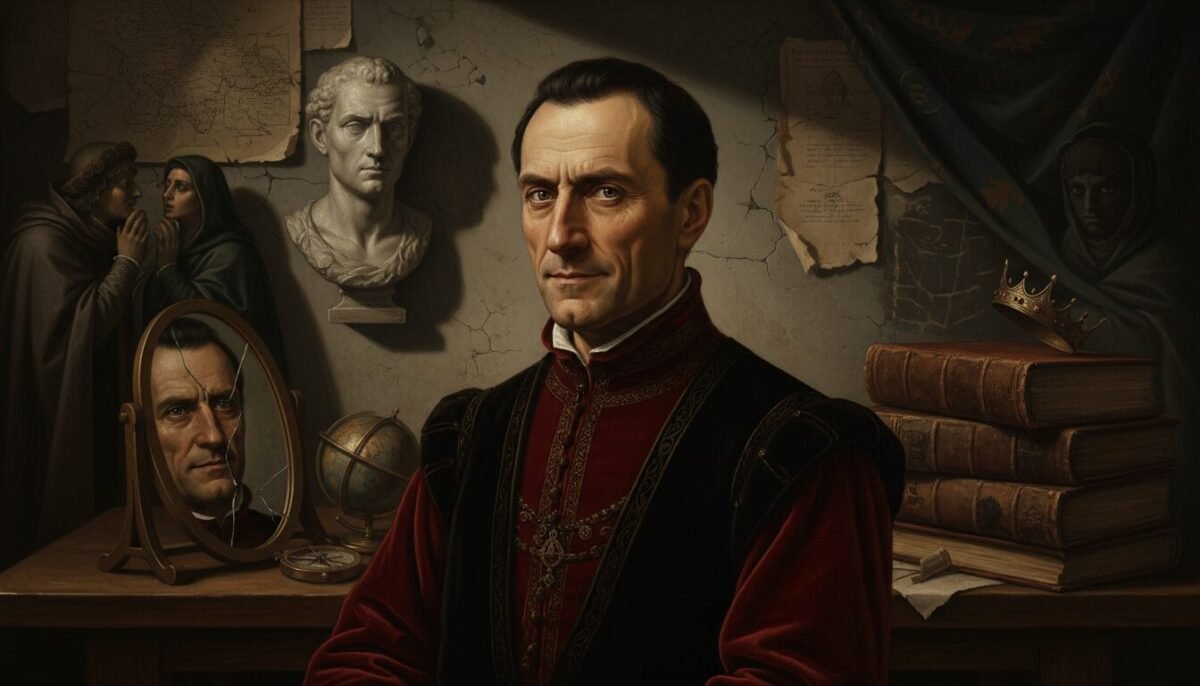
This is the birth of verità effettuale—the “effective truth.” Machiavelli argued that if you want to understand power, you must look at the world as it is, not as it appears in the dreams of poets or the sermons of priests. He mocked the “imaginary republics and principalities” described by previous thinkers, likely a jab at Plato’s Republic or Thomas More’s Utopia. For Machiavelli, an ideal state that cannot survive a single invasion is not a “good” state; it is a failure.
The core of political realism is the recognition that human beings are, by nature, “ungrateful, fickle, simulators and deceivers, avoiders of danger, greedy for gain.” If a leader bases his security on the hope that people will be better than they are, he is building his house on sand. A successful ruler must assume that men are “bad” (in a political sense) and create structures that account for this selfishness. This wasn’t a cynical hatred of humanity, but a clinical observation. By accepting the “effective truth,” a leader can actually protect his people, whereas an idealist often leads them to the slaughter.
3. Power vs. Morality: Does the End Justify the Means?
Perhaps no phrase is more associated with Machiavelli than “the end justifies the means.” Interestingly, he never actually wrote those exact words, but the sentiment permeates his work. He argued that in the “actions of all men, and especially of princes, where there is no court to appeal to, one looks to the end.” If a prince succeeds in maintaining the state, the means will always be judged honorable and praised by everyone.
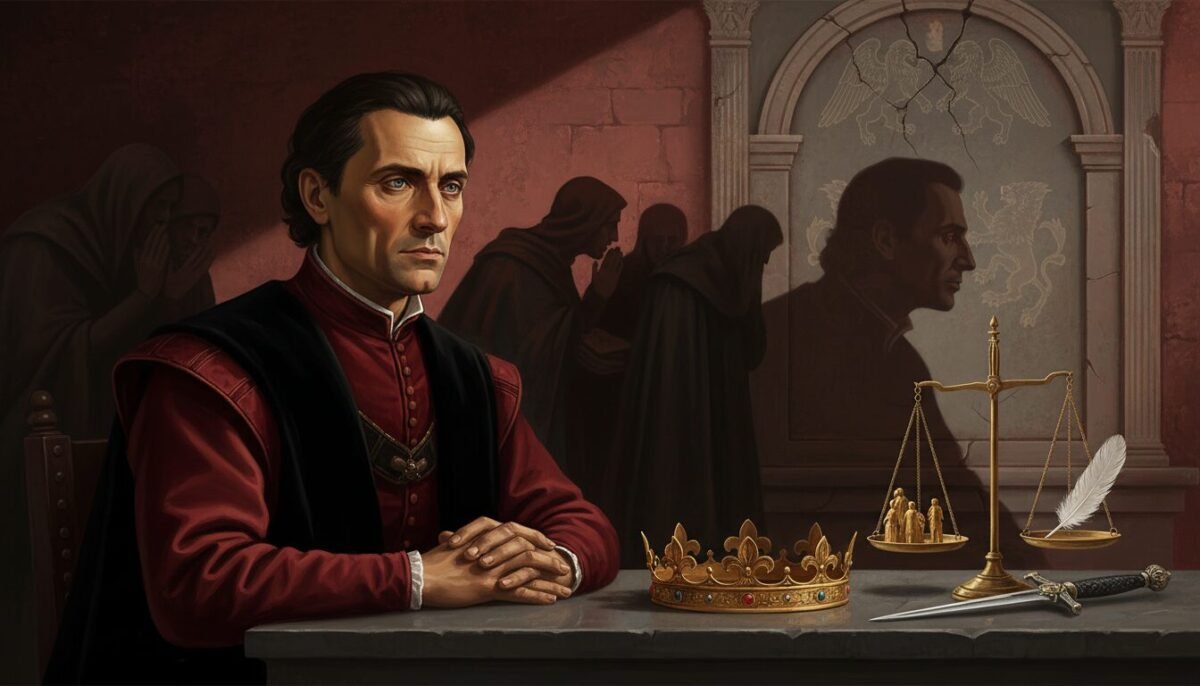
This marks the radical separation of private ethics from “reason of state.” Machiavelli wasn’t saying that murder or lying is “good” in a moral sense. He was saying that the moral code of an individual—the Christian ethics of turning the other cheek—is often incompatible with the survival of a political community. A private citizen who kills is a murderer; a general who kills to prevent a civil war is a savior. This is the “dirty hands” problem: to do a great good (stability), one must sometimes be willing to do a necessary evil.
He introduced the chilling concept of “well-used cruelty.” He cited the example of Cesare Borgia, who used a brutal henchman, Remirro de Orco, to pacify the chaotic region of Romagna. Once the job was done, Borgia had de Orco executed and his body left in the town square. This act of violence served two purposes: it removed a now-hated subordinate and it left the people “satisfied and stupefied.” To Machiavelli, this was “well-used” because it was swift, effective, and ended the long-term chaos of the region. “Badly-used” cruelty, by contrast, is violence that increases over time and serves only the ruler’s ego, leading to the state’s eventual collapse.
4. The Interplay of Virtù and Fortuna
In the Machiavellian lexicon, two words carry more weight than any others: Virtù and Fortuna. To understand these is to understand his entire philosophy of action.
Virtù is not “virtue” in the sense of moral goodness. Instead, it is closer to the Roman concept of virtus—manliness, prowess, skill, and strategic flexibility. A leader with virtù is like a master chess player who can read the board and adapt his strategy in an instant. It is the ability to be a “fox” to recognize traps and a “lion” to frighten the wolves. Virtù is the human agency that allows a leader to impose his will on the world.
Fortuna, on the other hand, is the unpredictable, often violent force of circumstance. Machiavelli famously compared Fortuna to a “raging river” that, when it overflows, destroys everything in its path. No one can stop the river once it has flooded. However, a man of virtù builds dikes and dams during the dry season so that when the river rises, its energy is diverted or contained.
The successful leader is the one who can match his “mode of proceeding” to the times. If the times require caution, he is cautious; if they require audacity, he is bold. The tragedy of most leaders, Machiavelli noted, is that they cannot change their nature. A man who has succeeded by being bold will continue to be bold even when the situation calls for restraint, and thus he falls. Mastery of power requires the almost superhuman ability to transcend one’s own personality to meet the demands of Fortuna.
5. Statecraft in ‘The Prince’: Maintaining Stability and Order
The ultimate goal for any ruler, according to Machiavelli, is mantenere lo stato—to maintain the state. This might sound like a simple preservation of power, but for Machiavelli, “the state” represented the only thing standing between civilization and the “war of all against all.” Without a stable state, there is no commerce, no art, no safety, and no justice. Therefore, the stability of the state is the highest moral good in politics.
To achieve this, Machiavelli focused heavily on the foundations of power: “good laws and good arms.” He was a fierce critic of the mercenary system prevalent in his day. Mercenaries, he argued, are “useless and dangerous” because they have no motive to fight other than a small wage. They are cowardly in the face of real danger and greedy in times of peace. He advocated for a “citizen-militia”—soldiers who have “skin in the game” because they are defending their own homes, families, and way of life.
Furthermore, he advised the prince on how to manage the people. While it is better to be feared than loved (if one must choose), a prince must avoid being hated. Hatred is what triggers conspiracies and revolutions. To avoid hatred, a prince should leave the citizens’ property and women alone. People will sooner forget the death of their father than the loss of their patrimony. By maintaining a predictable, stable environment where people can go about their business, the prince secures his own position while providing the public with the order they crave.
6. Machiavelli’s Legacy as the Father of Modern Political Science
Machiavelli’s influence is so pervasive that we often breathe his ideas without realizing it. By stripping away the religious justifications for power, he paved the way for Thomas Hobbes’s Leviathan, which argued that power comes from a social contract rather than divine right. He influenced John Locke’s ideas on the necessity of property rights and Max Weber’s definition of the state as the entity that holds a “monopoly on the legitimate use of physical force.”
In the realm of modern international relations, Machiavelli is the patron saint of the “Realist” school. When modern diplomats talk about “national interest” or “balance of power,” they are speaking Machiavelli’s language. He taught us that in a world of competing interests, morality is a luxury that can only be enjoyed if you have the power to defend it. His work remains essential for anyone in a leadership position today—not as a manual for being a tyrant, but as a reminder that leadership requires a clear-eyed assessment of reality, a willingness to make difficult trade-offs, and the courage to act when others are paralyzed by indecision.
Ultimately, Machiavelli was a patriot who wanted to see Italy strong enough to protect itself. He understood that the “goodness” of a leader is measured not by his personal piety, but by the safety and prosperity of the people he serves. In a world that is often as chaotic and unpredictable as the Renaissance, his clinical analysis of power remains as relevant as ever.
Frequently Asked Questions
Was Machiavelli actually an evil person?
No. Historically, Machiavelli was a dedicated civil servant and a man of high personal integrity. His writings were a “clinical” analysis of how power works, much like a doctor describing a disease. He didn’t advocate for cruelty for its own sake, but only as a tool for achieving the greater good of social stability.
What is the difference between “Machiavellian” and Machiavelli’s actual philosophy?
The term “Machiavellian” usually refers to someone who is sneaky and manipulative for personal gain. Machiavelli’s actual philosophy was focused on the “reason of state”—using strategic power to preserve a political community and prevent the chaos of war and invasion.
Why did he say it is better to be feared than loved?
He argued that love is a bond of obligation which men, being selfish, break whenever it serves their interest. Fear, however, is maintained by a “dread of punishment” which never fails. However, he emphasized that a leader should avoid being hated, as hatred leads to the downfall of the state.
If you found this exploration of power dynamics intriguing, you might want to deepen your understanding of political theory by exploring our companion guide on Thomas Hobbes and the Social Contract, or dive into the psychological roots of influence in our analysis of Power & Human Nature.
Explore more deep dives on DeepPsyche.blog to sharpen your strategic thinking and master the complexities of the human mind.