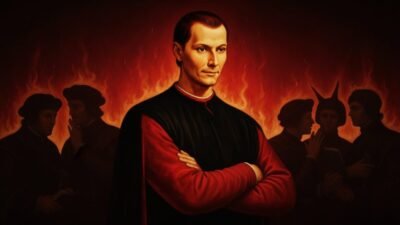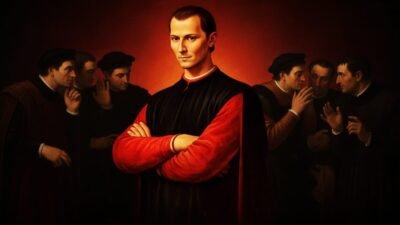
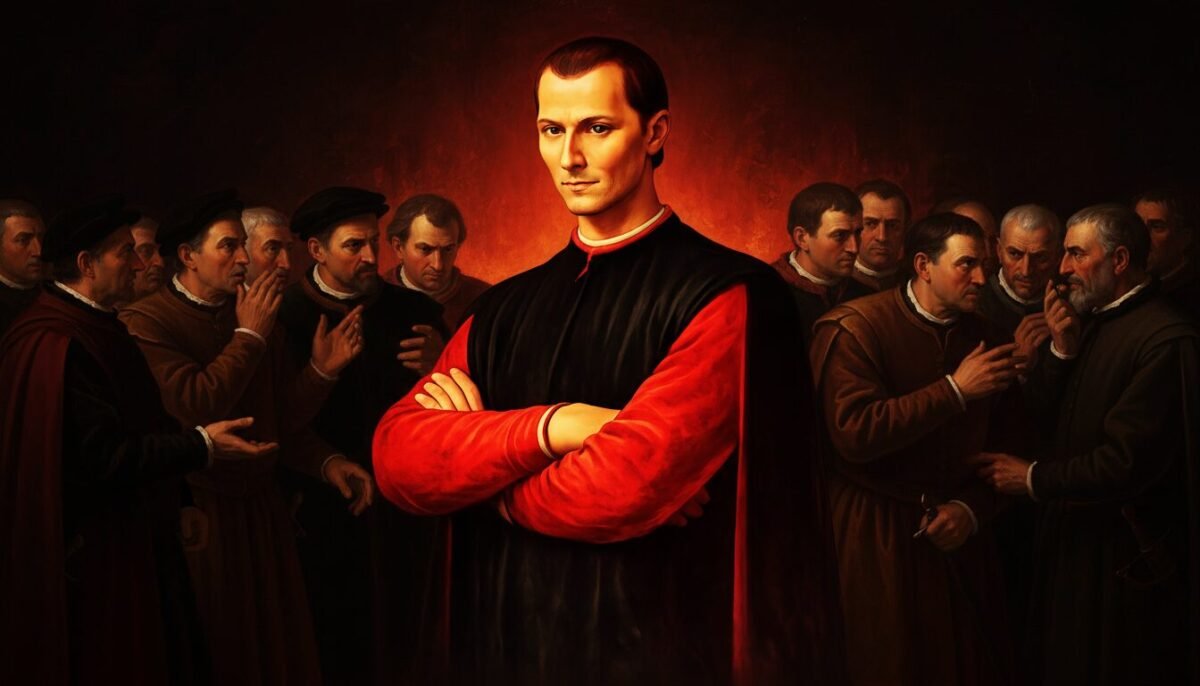
Imagine you are the CEO of a struggling company or the leader of a nation under threat. You have spent your life being told that kindness, honesty, and transparency are the ultimate virtues. But as you sit in the boardroom or the war room, you realize your competitors are playing by a different set of rules. They lie, they manipulate, and they strike when you are at your weakest. If you remain “good” in the traditional sense, your organization will collapse, and thousands of people who depend on you will suffer. Is it truly better for a leader to be loved than feared, or is the reality of power far more cold and calculated?
For centuries, political thought was shackled to religious dogma and moral idealism. Philosophers spent their time dreaming of “Utopias” and “City-States of God,” leaving actual leaders ill-equipped for the brutal, bloody realities of governance. Then came a man who refused to look at the world through a stained-glass window. Niccolò Machiavelli broke these chains, establishing the empirical foundations of modern political science and realism. He didn’t invent the dark side of politics; he simply had the courage to describe it as it actually was.
1. The Historical Context: Renaissance Florence and Machiavelli’s Career
To understand Machiavelli, you must understand the chaos of 15th-century Italy. This wasn’t the peaceful, postcard-perfect Italy we see today. It was a fragmented collection of city-states—Florence, Venice, Milan, the Papal States, and Naples—constantly at each other’s throats. Foreign powers like France and Spain used the Italian peninsula as their personal playground, invading at will and shifting the balance of power overnight.
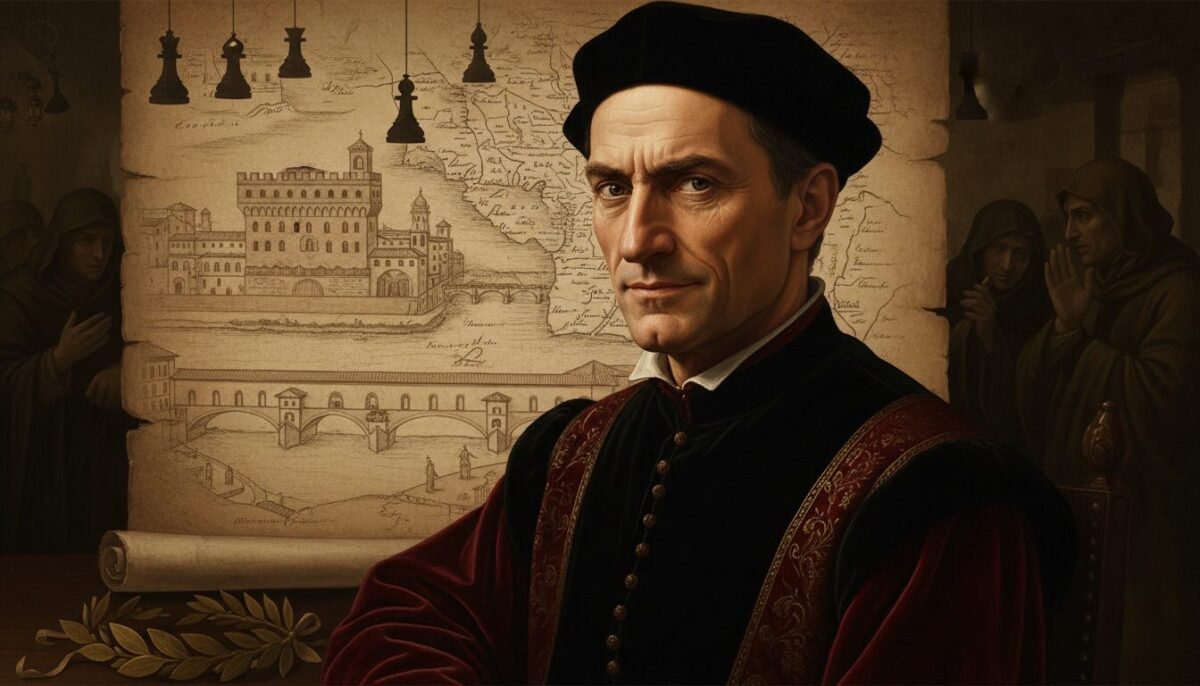
Machiavelli was born into this volatility in Florence in 1469. His career took off after the powerful Medici family was expelled from the city and a republic was established. As a high-ranking diplomat and civil servant, Machiavelli spent fourteen years traveling across Europe. He met with kings, popes, and ruthless warlords like Cesare Borgia. He didn’t learn about power from books; he learned it from the smell of gunpowder and the hushed whispers of backroom deals.
The influence of the Medici family looms large over his story. When they returned to power in 1512 with the help of Spanish troops, the Florentine Republic collapsed. Machiavelli was stripped of his office, imprisoned, and tortured on suspicion of conspiracy. It was during his forced retirement in the countryside—brooding over his lost career and the instability of his beloved Florence—that he wrote his most famous works. His pragmatic view of the state was forged in the fire of personal failure and national humiliation. He saw that Florence’s reliance on mercenaries and its moral hesitation made it weak. He realized that in a world of wolves, a leader who acts like a sheep will inevitably be devoured.
2. Breaking with Tradition: From Medieval Idealism to Political Realism
Before Machiavelli, political writing belonged to a genre called “mirrors for princes.” These were essentially instruction manuals for rulers that emphasized Christian virtues. They argued that a good king was a godly king, and that if a ruler practiced justice, mercy, and faith, his kingdom would prosper. This was the legacy of thinkers like Plato and Cicero, who focused on “imaginary republics”—idealized versions of society that had never actually existed.
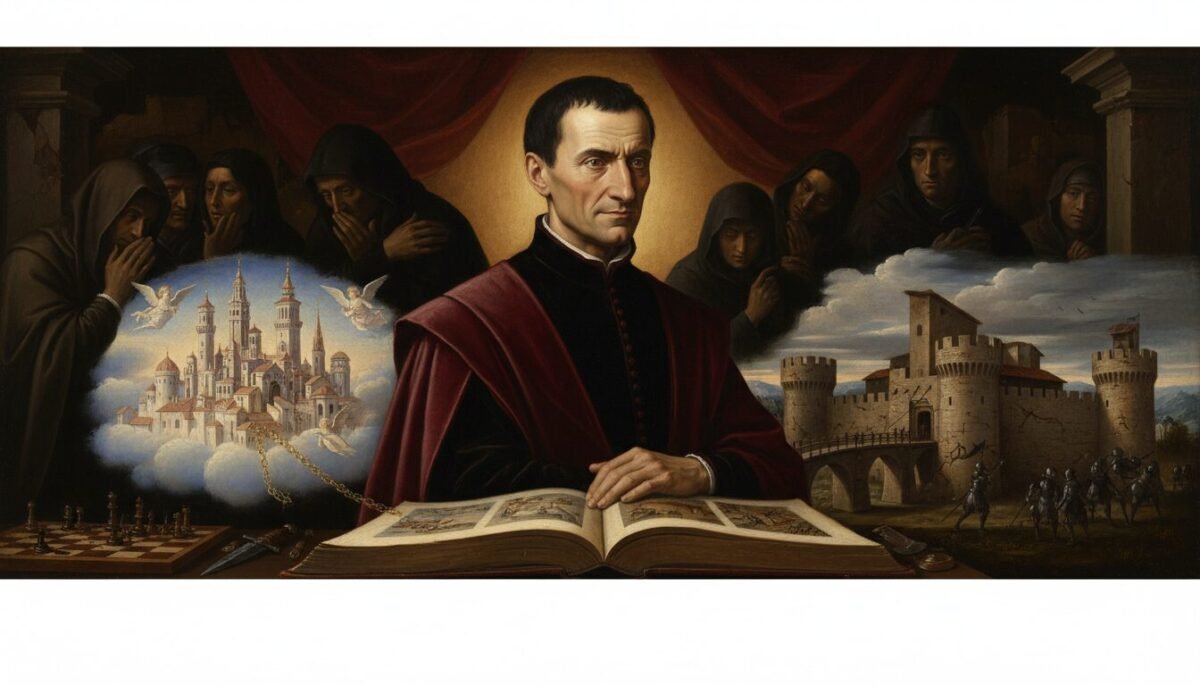
Machiavelli found this tradition not only useless but dangerous. In one of the most famous passages of The Prince, he writes that he intends to go straight to the “effectual truth” (verità effettuale) of the matter rather than the imagination of it. He argued that there is such a gap between how one lives and how one ought to live that anyone who abandons what is done for what ought to be done will achieve his ruin rather than his preservation.
This was the birth of political realism. Machiavelli shifted the focus from metaphysics to physics, from “why” to “how.” He stopped asking what the perfect state looks like and started asking: How do you actually keep a state from falling apart? By basing his analysis on empirical observation—watching what leaders actually did to survive—he turned politics into a science. He treated the state as a biological organism that needed to be kept alive, regardless of the moral cost. This shift was revolutionary. It removed the “divine right” and replaced it with the “practical necessity.”
3. The Secularization of Power: Separating Politics from Morality
Perhaps Machiavelli’s most controversial contribution was the decoupling of political success from traditional Christian ethics. In the medieval mind, the laws of man were supposed to be a reflection of the laws of God. A ruler who committed a “sin” was seen as a failure. Machiavelli flipped this on its head. He argued that the “good” of the state might actually require “evil” actions.
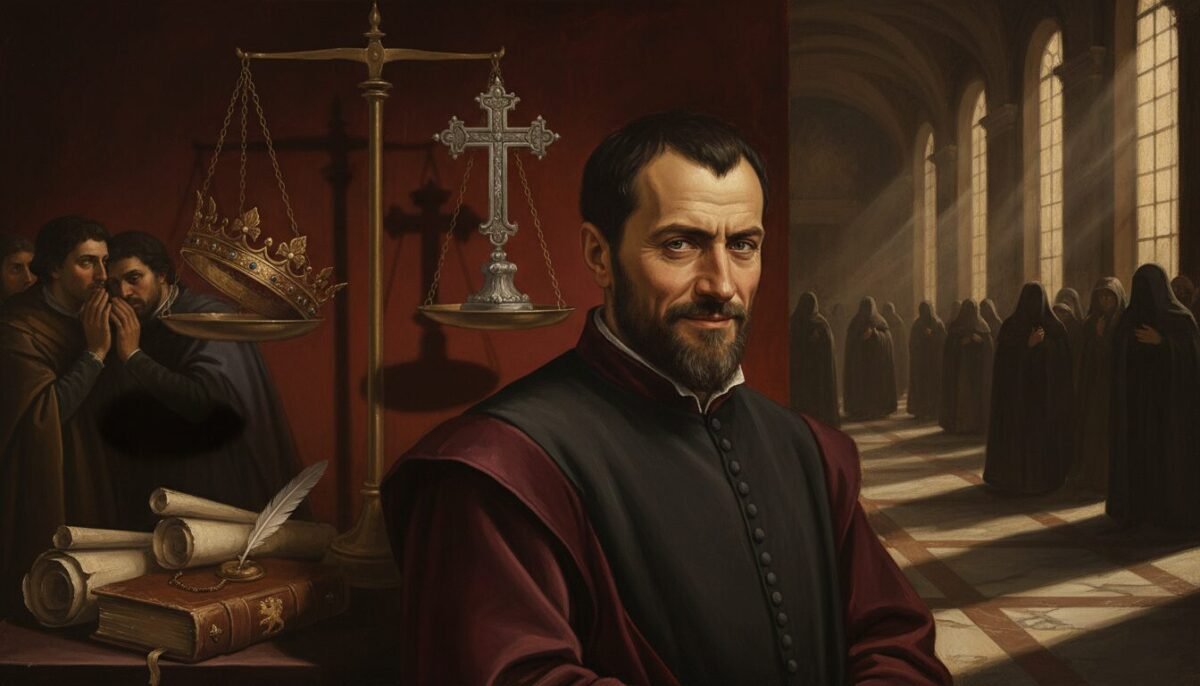
This is the concept of the secularization of power. Machiavelli didn’t necessarily hate morality; he just believed it belonged in the private sphere. A private citizen should be honest, kind, and forgiving. However, a ruler—the person responsible for the safety of thousands—does not have the luxury of a clean conscience. If a leader’s honesty leads to an invasion, or if his mercy leads to a civil war, then that “virtue” has become a vice. Conversely, if a leader’s cruelty brings peace and stability, then that “vice” has become a virtue.
Consider the distinction between private morality and public necessity. If a leader must lie to a foreign diplomat to prevent a massacre at home, Machiavelli would argue that lying is the only moral choice. This isn’t “evil” for the sake of being evil; it is the recognition that the state operates in a different moral universe than the individual. By separating the two, Machiavelli allowed for a cold, objective analysis of power that was no longer clouded by religious guilt. He paved the way for the modern idea that the state is a secular entity with its own logic and requirements.
4. The Mechanics of Power: Understanding Virtù and Fortuna
To navigate this brutal world, Machiavelli introduced two core concepts: Virtù and Fortuna. These are often misunderstood by modern readers. When Machiavelli speaks of Virtù, he isn’t talking about “virtue” in the sense of being a nice person. He is talking about “prowess”—a combination of strategic intelligence, courage, flexibility, and the sheer will to dominate. It is the ability of a leader to adapt to any situation, no matter how chaotic.
On the other side is Fortuna, or luck. Machiavelli famously compared Fortuna to a violent river that, when it overflows, destroys everything in its path. You cannot control the river, but you can build dams and dikes when the weather is calm so that when the flood comes, you are prepared. A leader with Virtù is someone who prepares for the unpredictability of Fortuna. They don’t just hope for the best; they plan for the worst.
This brings us to his famous metaphor of the lion and the fox. Machiavelli argued that a leader must embody both. The lion is strong and can scare away wolves, but it is easily trapped. The fox is cunning and can recognize traps, but it cannot defend itself against wolves. A successful prince must be a fox to discover the snares and a lion to terrify the wolves. If you are only a lion, you are too blunt; if you are only a fox, you are too weak. Power is the art of knowing which mask to wear and when to switch them. It is about strategic flexibility—the refusal to be pinned down by a single way of acting.
5. The Reason of State: Core Arguments in ‘The Prince’
At the heart of Machiavelli’s work is the concept of lo stato—the state. He was one of the first thinkers to treat the state as an independent entity that must be maintained above all other considerations. This is the foundation of what would later be called “Reason of State” (Raison d’État). The survival of the state is the ultimate law. If the state falls, there is no law, no order, and no safety for anyone. Therefore, the ends—the preservation of the state—often justify the means.
Machiavelli’s advice in The Prince is startlingly practical. For example, he was obsessed with military self-reliance. He had seen Florence rely on mercenaries—soldiers of fortune who fought only for money. Machiavelli argued that mercenaries were useless and dangerous because they had no “skin in the game.” They would rob you in peacetime and desert you in wartime. He advocated for a citizen-militia, where people fought for their own homes and families. This was a radical idea that prefigured the national armies of the modern era.
He also famously addressed the question of whether it is better to be loved or feared. His answer is nuanced: it is best to be both, but since that is difficult to achieve, it is much safer to be feared than loved. Why? Because love is a bond of obligation that men break whenever it serves their advantage, but fear is strengthened by a dread of punishment which never abandons you. However, he cautioned that a leader must avoid being hated. Fear is a tool; hatred is a liability that leads to conspiracies and coups. To avoid hatred, a prince should leave his citizens’ property and women alone. Even in his most “ruthless” advice, Machiavelli is always calculating the long-term stability of the state.
6. The Machiavellian Legacy: Influence on Modern Governance
The term “Machiavellian” has become a pejorative, synonymous with being a “dark triad” personality—manipulative, cynical, and cruel. But in the world of political science, his legacy is far more profound. Machiavelli is the grandfather of International Relations (IR) theory, specifically the school of Realism. When modern diplomats talk about “national interests” or “balance of power,” they are speaking Machiavelli’s language. They are acknowledging that in a world without a global police force, states must look out for themselves.
His influence can be traced through the greatest minds in political history. Thomas Hobbes took Machiavelli’s realism and used it to describe the “state of nature” as a war of all against all. Montesquieu and the American Founding Fathers studied him to understand how to balance power so that no single “prince” could become a tyrant. Even modern political strategists and corporate leaders use his insights to navigate the competitive landscapes of the 21st century.
Machiavelli didn’t teach us how to be evil; he taught us how to see. He pulled back the curtain on the theater of power and showed us the gears and levers moving behind the scenes. By focusing on how men actually live rather than how they ought to live, he provided the blueprint for the modern state. He taught us that leadership is not about personal purity, but about the heavy, often dirty responsibility of keeping the “river” of chaos at bay.
Machiavelli’s departure from moral philosophy to empirical realism transformed politics into a science. He reminds us that while we may dream of a perfect world, we must live in this one. And in this world, the most dangerous thing a leader can be is naive.
Frequently Asked Questions
Was Machiavelli actually an “evil” person?
No. Machiavelli was a patriot who deeply loved Florence. His writings were born out of a desire to see Italy unified and strong enough to resist foreign invaders. He didn’t advocate for cruelty for its own sake, but rather as a surgical tool to prevent greater chaos and suffering.
What is the difference between “Machiavellian” and “Machiavellianism”?
“Machiavellian” usually refers to the political philosophy of realism and the preservation of the state. “Machiavellianism” is a psychological term used to describe a personality trait characterized by manipulation, a cynical disregard for morality, and a focus on self-interest and personal gain.
Did Machiavelli really say “the ends justify the means”?
While he never wrote that exact phrase in Italian, the sentiment is present throughout his work. He argued that if a prince is successful in maintaining the state, the means he used will always be judged honorable and praised by everyone, because the general public is always taken by appearances and results.
How does Machiavelli relate to modern leadership?
Modern leaders often face “Machiavellian moments” where they must choose between a popular decision and a necessary one. His concepts of Virtù (prowess) and Fortuna (luck/risk) are still taught in business schools and military academies as essential frameworks for strategic thinking.
If you found this deep dive into the mechanics of power intriguing, you might also enjoy our explorations of Power & Human Nature or the evolution of Influence & Leadership. Dive deeper into the history of political thought—subscribe to our newsletter for more insights into the philosophers who shaped our world.