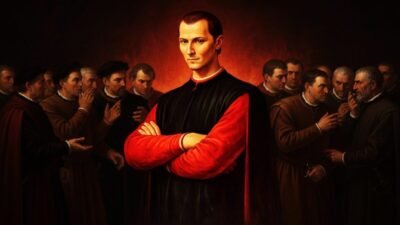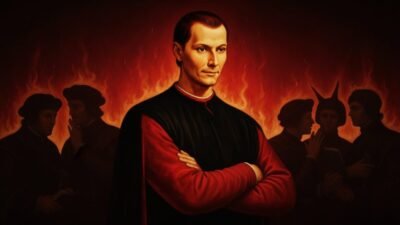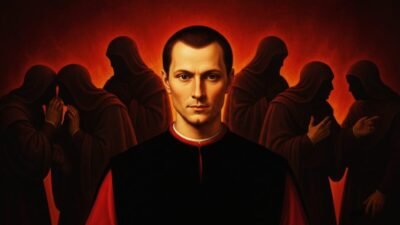
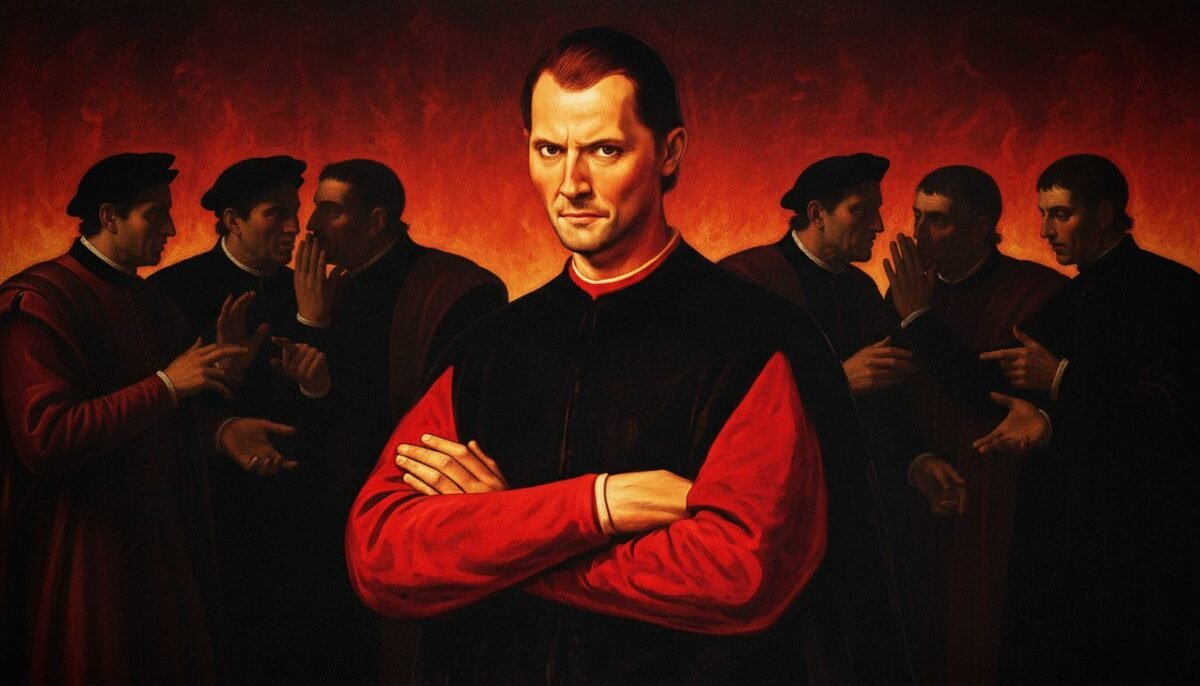
Is it better to be feared than loved? Five centuries later, this provocative question from a Florentine diplomat still echoes through the halls of modern power, from the boardrooms of Silicon Valley to the war rooms of global superpowers. We often use the word “Machiavellian” as a slur, a synonym for a person who is cold, calculating, and devoid of a moral compass. Many dismiss Niccolò Machiavelli as a “teacher of evil,” a man who whispered dark secrets into the ears of tyrants. Yet, to ignore his insights is to remain willfully blind to the harsh, often uncomfortable realities of how power actually functions in the real world.
The truth is that Machiavelli did not invent the ruthlessness of politics; he simply had the courage to describe it without the comforting veil of religious or moral idealism. He was the first political scientist to perform an autopsy on the body politic, showing us the organs and the rot exactly as they were. In an era of “post-truth” politics and shifting global alliances, his philosophy is not a relic of the Renaissance—it is a survival manual. By deconstructing his core principles, we can begin to see how contemporary statecraft operates under the same gravity that Machiavelli mapped out in 1513.
1. The Renaissance Roots: Why Machiavelli Wrote ‘The Prince’
To understand the man, we must understand the chaos of his environment. Sixteenth-century Italy was not the romanticized landscape of art and poetry we often imagine; it was a fractured collection of city-states—Florence, Venice, Milan, the Papal States—constantly at each other’s throats and serving as a playground for the invading armies of France and Spain. In this volatile theater, stability was a luxury, and survival was a daily struggle.
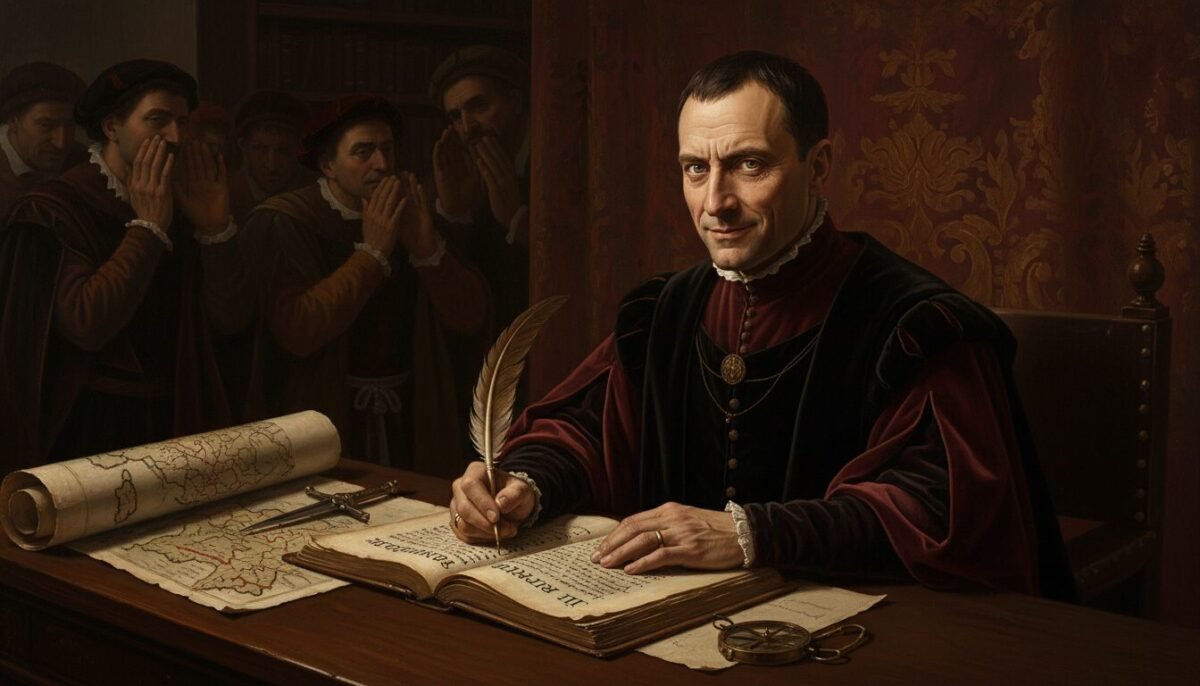
Machiavelli was not an armchair philosopher. He was a high-ranking civil servant and diplomat for the Florentine Republic, a man who spent fourteen years traveling to the courts of kings and popes, observing firsthand the mechanics of deception and the fragility of treaties. When the Medici family returned to power in 1512, the Republic fell. Machiavelli was stripped of his office, imprisoned, tortured on the rack, and eventually exiled to his farm in the countryside. It was from this place of personal ruin and political observation that The Prince was born.
Before Machiavelli, political writing belonged to a genre called “Mirrors for Princes.” These books were essentially moral instruction manuals, advising rulers to be virtuous, pious, and kind, under the assumption that a “good” man would naturally be a “good” king. Machiavelli shattered this tradition. He realized that the idealistic “Mirror” literature was useless—and even dangerous—because it described a world that didn’t exist. He chose instead to follow the “effectual truth” of the matter rather than the imagination of it. His transition from an active diplomat to an exiled theorist marked the birth of political realism: the objective study of power as a force of nature, independent of how we wish it would behave.
2. Core Principles: The Separation of Private Morality and Political Necessity
The most scandalous aspect of Machiavelli’s thought is his insistence that the rules of private morality do not apply to the leadership of a state. This is the foundation of what would later be called Raison d’État, or “Reason of State.” For Machiavelli, the primary duty of a leader is the preservation and stability of the commonwealth. If the state falls, the result is anarchy, slaughter, and the loss of all civil liberties. Therefore, the leader must be willing to “enter into evil” if the survival of the state depends on it.
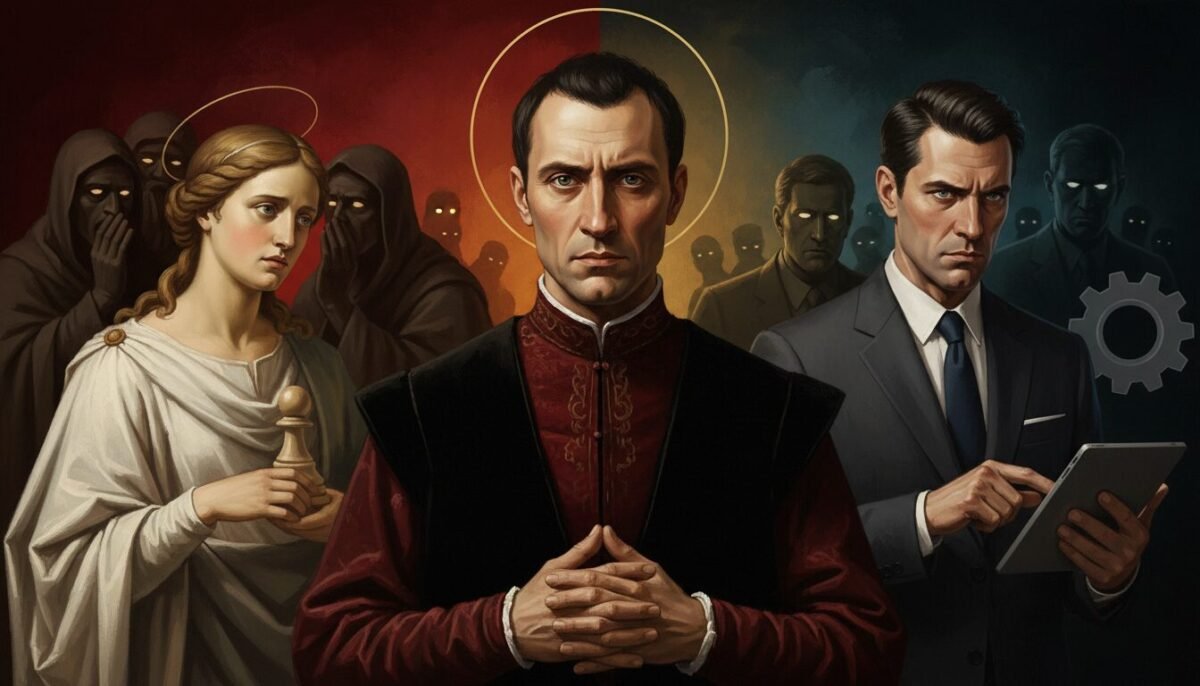
Machiavelli famously argued that a leader must learn how not to be good. In a world populated by “wolves”—people who are ungrateful, fickle, and greedy—a leader who insists on playing the “lamb” will inevitably be devoured. This isn’t an endorsement of cruelty for its own sake; rather, it is an acknowledgment of political necessity. He makes a startling distinction between “cruelty well-used” and “cruelty abused.” Cruelty is well-used when it is applied once, out of necessity for safety, and then converted into the greatest possible benefit for the subjects. Cruelty is abused when it increases over time rather than diminishing.
Consider the modern corporate turnaround or a national security crisis. A leader may have to make a decision that is personally agonizing and morally questionable—such as a massive layoff to save a company from bankruptcy or a pre-emptive strike to prevent a larger war. In Machiavelli’s view, the leader who refuses to make these “dirty” choices out of a desire to keep their own conscience clean is actually the one who is immoral, because they have sacrificed the well-being of the collective for the sake of their own personal vanity. He teaches us that the ethics of responsibility are often at odds with the ethics of ultimate ends.
3. Virtù and Fortuna: Navigating Chaos in the 21st Century
Two of the most important concepts in Machiavelli’s lexicon are Virtù and Fortuna. In modern English, “virtue” implies moral goodness, but for Machiavelli, Virtù meant something closer to the Roman virtus: prowess, skill, energy, and the flexibility to adapt to changing circumstances. A leader with Virtù is like a master sailor who knows how to read the winds. Fortuna, on the other hand, is the unpredictable, often violent nature of luck and global events.
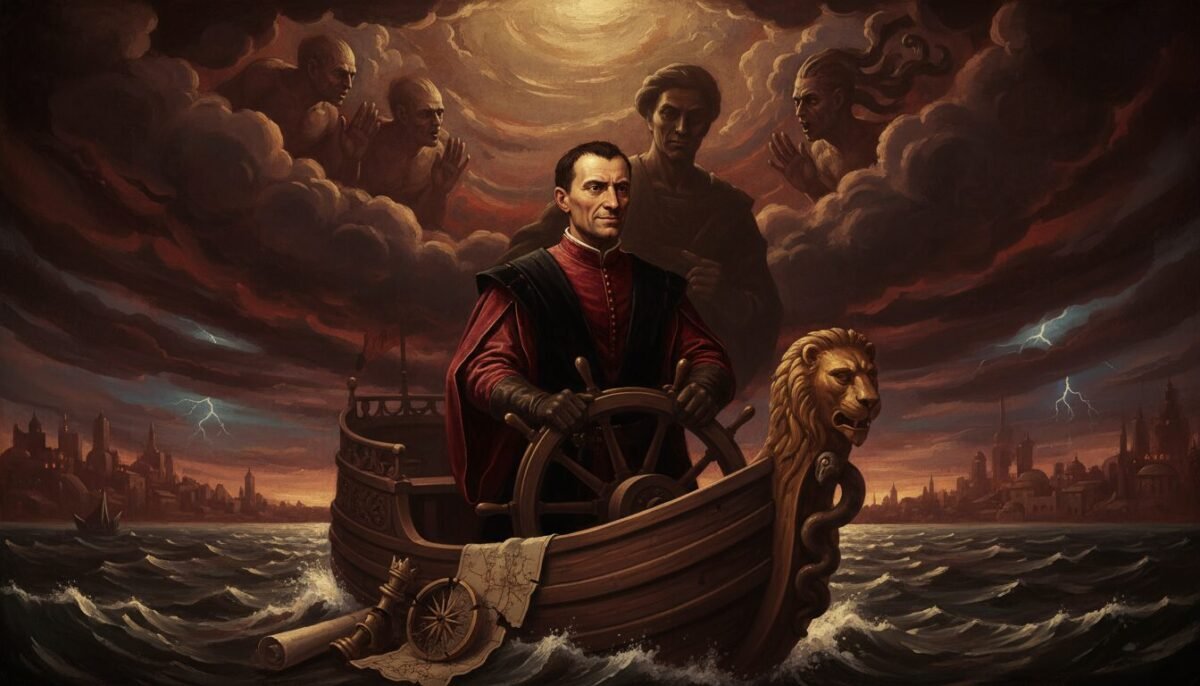
Machiavelli famously compared Fortuna to a raging river that, when it overflows, destroys everything in its path. However, he noted that when the weather is calm, men can “build dikes and dams” so that when the floods come, the water is diverted into a canal or its force is less devastating. This is the essence of strategic foresight. In the 21st century, Fortuna takes the form of global pandemics, sudden economic collapses, or disruptive technological shifts like Artificial Intelligence.
The modern Machiavellian leader doesn’t just react to crises; they use their Virtù to anticipate them. They build “dikes” in the form of diversified supply chains, robust cybersecurity, and agile organizational structures. Machiavelli’s insight is that while we can never control Fortuna entirely—she is, after all, the arbiter of half our actions—the other half is left for us to govern through preparation and bold action. He famously concluded that it is better to be impetuous than cautious, for Fortuna favors the young and the bold who command her with audacity.
4. Machiavellianism vs. Realpolitik: The Foundation of International Relations
While Machiavelli wrote for the princes of the Renaissance, his DNA is visible in the modern school of Realism in international relations. Thinkers like Henry Kissinger, Hans Morgenthau, and John Mearsheimer are the intellectual descendants of the Florentine diplomat. This school of thought, often called Realpolitik, argues that international politics is an anarchic realm where states act primarily out of national interest rather than ideological purity or international law.
Machiavelli’s advice on alliances remains a masterclass in diplomacy. He warned that a prince should never make a common cause with one more powerful than himself to defeat others, for if you win, you remain the powerful ally’s prisoner. This mirrors the “balance of power” theory that dominated the Cold War and continues to dictate modern geopolitics. When nations form alliances today, they are rarely doing so out of a shared love for “values”; they are doing so because their interests happen to align at that specific moment in history.
In Realpolitik, the “morality” of a foreign policy is judged by its success in maintaining peace and protecting the citizenry, not by its adherence to abstract ideals. For example, when a democratic nation maintains a strategic partnership with an autocratic regime for the sake of regional stability or energy security, it is practicing Machiavellian pragmatism. It is an admission that in a world of limited choices, the “least bad” outcome is often the most “moral” one available.
5. Machiavelli in Practice: Case Studies of Modern Political Strategy
If we look at modern election campaigns, we see Machiavelli’s fingerprints everywhere. One of his most famous observations was that “everyone sees what you appear to be, few experience what you really are.” In the age of social media and 24-hour news cycles, the management of perception has become more important than the reality of governance. A candidate does not need to possess all the “good” qualities—being merciful, faithful, humane, upright, and religious—but they must absolutely appear to possess them.
Consider the “calculated perception” used by successful 20th-century leaders. Lyndon B. Johnson was a master of the “Johnson Treatment,” a mixture of intimidation, flattery, and strategic deception to pass landmark legislation. He knew when to play the populist and when to play the ruthless power broker. Similarly, the “Iron Chancellor” Otto von Bismarck unified Germany not through speeches and majority votes, but through “blood and iron”—a direct application of Machiavellian pragmatism to achieve a long-term goal of national stability.
In the 21st century, we see this in how leaders use “strategic ambiguity.” By keeping their true intentions hidden and their public persona carefully curated, they maintain the maximum amount of leverage over both their allies and their enemies. Machiavelli would have recognized the modern political consultant as the contemporary version of the court advisor, someone whose job is to ensure the “prince” maintains the love of the people (or at least avoids their hatred) while doing what is necessary behind the scenes to hold onto power.
6. Beyond the Villain: Re-evaluating Machiavelli’s Enduring Reputation
It is a common misconception that Machiavelli coined the phrase “the ends justify the means.” He never actually wrote those words. A more accurate translation of his sentiment is that “in the actions of all men, and especially of princes… the outcome justifies the action.” This is a subtle but vital distinction. It isn’t a blank check for any behavior; it is a focus on the results. If a leader’s actions result in a safe, prosperous, and stable society, the people will generally forgive the methods used to get there.
We must also remember that Machiavelli was not just the author of The Prince. In his longer, more complex work, The Discourses on Livy, he reveals himself to be a staunch republican. He argued that a republic—a government of the people—is more stable and more virtuous than a principality. He believed that the collective wisdom of the many is superior to the whims of the few. Why the contradiction? Because Machiavelli was a “scientist” of politics. The Prince was a diagnostic tool for a state in crisis, while The Discourses was a blueprint for a healthy, long-lasting society.
Ultimately, Machiavelli matters today because he forces us to take off our “moral tinted glasses” and look at the world as it is, not as we wish it to be. He challenges us to confront the paradoxes of leadership: that sometimes you must be cruel to be kind, and that the road to hell is often paved with good, but naive, intentions. He wasn’t teaching us how to be evil; he was teaching us how to survive in a world where evil exists.
Frequently Asked Questions
- Was Machiavelli actually an evil person? No, Machiavelli was a patriot and a civil servant who was deeply concerned with the survival of his home, Florence. His writings were an objective analysis of power, not a personal manifesto of his own moral character.
- Is ‘The Prince’ still relevant in a democracy? Absolutely. While the “Prince” today might be a President, a CEO, or a community leader, the psychology of power, the necessity of perception, and the challenge of Fortuna remain identical.
- What is the difference between Machiavellianism and being a sociopath? A sociopath lacks empathy and acts for personal whim. A Machiavellian leader, in the original sense, uses calculated strategy specifically to achieve a political or organizational goal, often for the perceived “greater good” of the state.
To deepen your understanding of these complex power dynamics, explore our related analyses on Machiavelli & Political Philosophy, the intersection of Power & Human Nature, or our deep dive into the Evolution of Realpolitik in the Digital Age. Understanding the mechanics of influence is the first step toward navigating the modern world with clarity and purpose.
Curious about how these ancient strategies apply to your own life and career? Explore more thought-provoking insights at DeepPsyche.blog and join the conversation on the hidden forces that shape our world.